 The Itinerary
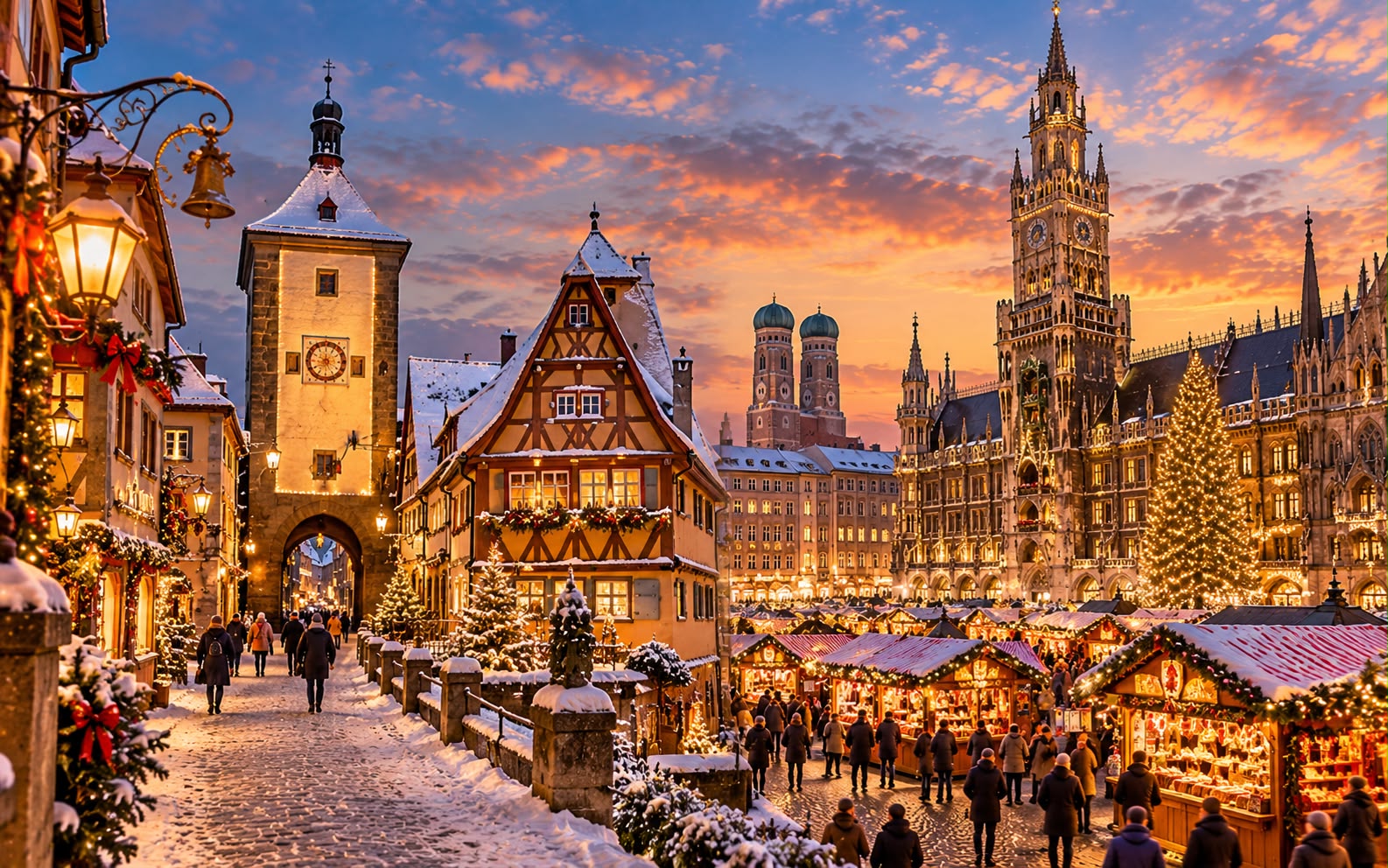
Germany's Christmas markets: Nuremberg, Rothenburg and Munich in 7 days
Three weeks a year, Germany turns into the world's most organised fairy tale: the Christkind opening Nuremberg's 400-year-old market, a walled medieval town glowing under lanterns, Munich running five markets at once — with the glühwein-mug economics, the halal-and-veg stall strategy, and the one date mistake (arriving December 26) this guide exists to prevent.
- Western Europe
- 7 days
- ≈ AED 5,550 / person
- Winter magic
Before you go
For eleven months Germany is an efficient country with good trains. Then Advent arrives, every town square sprouts wooden stalls and strings of lights, the air fills with cinnamon, roasted almonds and hot spiced wine — and the country that invented the Christmas market (and the Christmas tree, and half your ornaments) runs the greatest winter show on earth for exactly four weeks.
This guide joins our winter-specials shelf (alongside Siberia and Hokkaido) and runs the classic Bavarian-Franconian trio: Nuremberg, the most famous market of them all; Rothenburg ob der Tauber, the walled medieval town that looks like the inside of a snow globe; and Munich, which doesn’t have a Christmas market so much as a Christmas district. One airport, three trains, seven days.
The window is strict: roughly 20 November – 24 December. Markets open the week before the first Advent Sunday and — the mistake this paragraph prevents — nearly everything closes on December 23–24. There is no Christmas market on the 26th. Plan inside the window; early December (weekdays) is the crowd-to-magic sweet spot. All costs are in euros (EUR).
Before you go: the admin and the mug economics
Visa
- Visa: everything from our Schengen visa guide applies — VFS Global, €90, the usual Schengen file — with one December-specific warning: appointment demand spikes for the market season, so apply by late September/October.
The mug economics
- The markets themselves are free. You pay for what you hold: and what you hold works on the Pfand system — a glühwein (~€4.50–5.50) comes with a €3–5 mug deposit; return the mug for your coins, or keep it as the year-stamped souvenir (everyone keeps the first one; each market and year has its own design — a collecting habit begins).
- Cash rules the stalls (Germany’s cash habit doubles at a wooden hut): €50–100/day in notes and coins keeps the queue moving. Bigger stalls now tap cards; don’t rely on it.
Cold, and the crowd calendar
- The cold is the price of the glow: late-afternoon temperatures run 0–5°C, evenings dip below freezing. This trip is spent standing outdoors at night — thermal base layers, real gloves (mug-holding doubles as hand-warming), wool hat and thick-soled boots for cobbles. Kids need one layer more than you think.
- Crowd calendar: weekday mornings = dreamy; Friday and Saturday evenings = shoulder-to-shoulder (and pickpocket prime — zips forward in the crush). Every market closes by 20:00–21:00 — this trip runs on afternoons and early evenings, then dinner.
Day by day
Day 1 — Land in Munich, train to Nuremberg, first mug
- Morning — Land MUC (non-stop from most of Europe, the Gulf and North America); ICE to Nuremberg (~1 h, from ~€18–35 booked ahead).
- 14:00 — Check in inside the old town walls; orient via the Kaiserburg ramparts — red roofs, church spires, market stripes below.
- 16:30 — Descend into the Christkindlesmarkt (27 November – 24 December 2026; 10:00–21:00): 180 red-and-white stalls around the Frauenkirche — “the little town of wood and cloth” running since the 1600s. First glühwein, first gasp.
- 19:00 — Dinner the Nuremberg way: Drei im Weggla — three finger-sized Nuremberg bratwursts in a bun (~€4.50–5.50) from the market grills, or the 1419-vintage Bratwursthäusle for the sit-down version (~€15–20).
Where to stay in Nuremberg (two nights)
- Old-town classic: Hotel Drei Raben — storytelling boutique rooms five minutes from the market. ~€180–240.
- Mid-range: Sorat Hotel Saxx — directly on the Hauptmarkt; market-view rooms exist and go early. ~€150–200.
- Value: Motel One Nürnberg-Hauptbahnhof — the reliable German budget-design chain at the station. ~€100–140.
Day 2 — Nuremberg: the Christkind’s own market
- 09:30 — Choose your morning:
- The Kaiserburg (~€9) — the imperial castle above the town, Holy Roman Empire HQ; or
- The Documentation Centre at the Nazi Party Rally Grounds (~€7.50) — Nuremberg owns its whole history, and this is the sobering, excellently-done other half (12+ advisable; the market feels different, and better-earned, afterwards).
- 12:30 — Market lunch crawl: 3 im Weggla round two, feuerzangenbowle (glühwein’s dramatic cousin — a rum-soaked sugarloaf set on fire over the mug, ~€6–8), and the city’s UNESCO-listed Elisenlebkuchen — proper gingerbread, ~25% nuts, from Wicklein or Schmidt (tins from ~€8–15; the ones in decorative chests are the gifts that survive the flight).
- 15:00 — Kinderweihnacht on Hans-Sachs-Platz — the children’s market: nostalgic carousel, little Ferris wheel, steam train, craft tents where kids dip candles and bake lebkuchen. Then the Handwerkerhof craft courtyard by the Königstor.
- 17:00 — Souvenir with a story: the Zwetschgenmännle — Nuremberg’s prune-and-walnut people, made here for 200 years (~€8–15).
- 18:30 — The market at full glow from the Frauenkirche steps — if your dates catch the opening Friday, the Christkind herself delivers the prologue from this balcony at 17:30 (beautiful chaos; arrive an hour early or watch from a side street).
- 20:00 — Dinner in a vaulted Altstadt cellar (schäufele, dumplings, ~€18–28).
Day 3 — Rothenburg: the snow-globe town
- 10:00 — Regional trains to Rothenburg ob der Tauber (~1h15–1h30 via Ansbach + the little Steinach shuttle — a Bayern-Ticket (~€40–45 for two) covers the whole day). Drop bags at the hotel inside the walls — staying overnight is the entire trick: the town empties of coaches by 17:00 and becomes yours.
- 12:00 — The greatest-hits walk while light lasts: the Plönlein corner (the most photographed half-timber junction in Germany), a stretch of the covered medieval wall walk (free), Burggarten views over the Tauber valley.
- 14:00 — Käthe Wohlfahrt’s Christmas Village — the flagship of the world’s most famous ornament company: 1,500 m² of year-round Christmas, plus the German Christmas Museum upstairs (€4 adult / €7 family) explaining how this country invented the whole aesthetic. Wallets: brace.
- 15:30 — Schneeball verdict, delivered honestly: Rothenburg’s baseball-sized pastry snowballs (~€3.50–5) are 500 years old, photogenic, and taste like sweet shortcrust rubble. Buy one, share it, no regrets either way.
- 16:30 — The Reiterlesmarkt (20 November – 23 December 2026; to 19:00/20:00) as the lanterns win: a compact, 500-year-old market where the mulled wine is white as often as red (a Franconian wine-country quirk — try it).
- 20:00 — The Night Watchman’s Tour (English, nightly at 8 from the Marktplatz, ~€9–10): an hour of deadpan medieval storytelling that every traveller rates among their favourite hours in Germany. Then empty lamplit lanes back to the hotel — the moment the whole trip is built around.
Where to stay in Rothenburg (one night, inside the walls — non-negotiable)
- Historic splurge: Hotel Eisenhut — the grand old patrician-house hotel on Herrngasse. ~€180–250.
- Half-timbered charm: Hotel Reichsküchenmeister — by St Jakob’s, hearty Franconian restaurant attached. ~€140–190.
- Value: Gasthof Goldener Greifen — a 700-year-old guesthouse two doors from the Plönlein. ~€100–140.
Day 4 — Morning-empty Rothenburg, then Munich’s main square
- 08:30 — The photographs everyone else can’t get: Plönlein, Markusturm and the walls before the day-trip coaches arrive (~10:30). Breakfast at a bakery window-seat.
- 11:30 — Trains south to Munich (~3 h regional on the same Bayern-Ticket logic, or backtrack via the Nuremberg ICE to save an hour). Check in near Marienplatz.
- 16:00 — The Münchner Christkindlmarkt on Marienplatz (typically ~23/24 November – 24 December — confirm exact 2026 opening): the giant tree and stalls under the neo-Gothic Rathaus, the Glockenspiel doing its 17:00 turn, daily live Advent music from the town-hall balcony at 17:30.
- 18:00 — First Munich mug, then two minutes away the Kripperlmarkt — Germany’s largest nativity-figure market, a craft unto itself.
- 19:30 — Dinner warm and Bavarian: Haxnbauer’s crackling pork knuckle or Ratskeller vaults (~€20–35); the sausage-averse pivot to käsespätzle without regret.
Where to stay in Munich (three nights) — the verified picks from our Germany guide apply: Platzl Hotel (4.5/5, ~€280+ in season, two minutes from the market), Hotel Torbräu (4.6/5, ~€230–300), Hotel Mirabell (4.4/5, ~€150–200) — and December is Munich’s second-highest season: book by October.
Day 5 — The Munich market crawl (five in one day)
Munich’s genius is variety — each market a different flavour, all walkable or one U-Bahn apart:
- 11:00 — Residenz Weihnachtsdorf: the “Christmas village” in the palace’s Kaiserhof courtyard — arguably the prettiest setting in the city.
- 12:30 — Wittelsbacherplatz Medieval Market (Mittelaltermarkt): staff in tunics, fire-pits, meat roasting on swords, and Feuerzangenbowle served in clay mugs — the market your kids (and you) will call the best.
- 14:30 — U-Bahn to the Chinese Tower market in the snow-dusted Englischer Garten — the locals’ market, carousel included; or swap in Schwabing’s artsy Münchner Freiheit market.
- 17:00 — Ice-skating hour at Karlsplatz (Stachus) (~€8–12 + skate hire) under the lights.
- 19:00 — Tollwood Winter Festival on the Theresienwiese (free entry): the alternative wonderland — world-food halls (this is where halal, vegan and everything-else eating is easiest), craft tents, live music until late. Munich’s answer to “aren’t all these markets the same?”
Day 6 — Day trip: Salzburg’s silent night (or the snow castle)
Two great endings — the Bayern-Ticket covers both:
- The recommended: Salzburg (~1h50 by regional train — yes, Austria; your Schengen visa doesn’t blink): the Christkindlmarkt on Domplatz beneath the fortress (opens ~19 November), chestnut smoke in baroque squares, Mozart’s birthplace in fairy lights — and this is Silent Night country: the carol was first sung in 1818 in Oberndorf, 20 minutes away, and the city sings it accordingly. Funicular up Hohensalzburg (~€14) for the white-Alps panorama.
- The alternative: Neuschwanstein in winter — the castle dusted white above a frozen valley (tours as per our Germany guide; the Marienbrücke bridge closes in ice conditions — check before committing).
- 20:30 — Back in Munich: last mug at Marienplatz (final mug-keep decision), pretzels the size of steering wheels, pack around the lebkuchen tins.
Day 7 — Home from MUC
- Morning — S-Bahn to the airport (~45 min). Suitcase status: two mugs, three ornament boxes, one Zwetschgenmännle, 2 kg of lebkuchen, zero regrets. Fly home from MUC.
Costs and practicalities
Best time to visit
The window is strict: roughly 20 November to 23 or 24 December, and outside it there is simply nothing to see.
- Late November — the markets open, usually in the week before Advent. The first days are the quietest and the stalls are at their freshest.
- Early December — the best balance of atmosphere and crowds. Weekdays are far calmer than weekends.
- Mid-December — peak. Nuremberg, Dresden and Cologne are shoulder to shoulder, especially on Saturdays.
- 23–24 December — most markets close on the 23rd and almost all by midday on the 24th. Do not plan a market trip for Christmas week itself.
A few markets run slightly longer — some Berlin ones into early January — but the classic Bavarian and Saxon ones do not. Check each market’s published dates; they shift by a few days each year.
Travel tips
- Weekday mornings and early afternoons are a different experience from Saturday evening. If you can only go at a weekend, start when the stalls open.
- Glühwein comes with a deposit on the mug — the Pfandbecher. Return it for your money back or keep it as the souvenir it is designed to be.
- Carry cash. Many stalls are cash-only and the queue for the one card machine is long.
- Dress for standing still in the cold, not for walking. Thermal layers, proper boots and gloves; an hour outdoors at minus 5°C is different from an hour walking.
- Trains between market cities are the right way to do this — Nuremberg, Dresden, Cologne and Munich are all connected and parking is impossible.
- Book accommodation months ahead. Market cities fill from September for December weekends.
- Pickpockets work dense market crowds. Bag in front, wallet in an inside pocket.
What this trip actually costs
Two people, 6 nights (2+1+3), mid-range comfort, international flights excluded:
| Item | Cost |
|---|---|
| Hotels, 6 nights (December-peak rates) | EUR 1,100 (≈ AED 4,504) |
| Trains: airport ICE, Bayern-Ticket days, city transport | EUR 300 (≈ AED 1,228) |
| The glühwein & feuerzangenbowle fund (mugs kept included) | EUR 200 (≈ AED 819) |
| Entries: Kaiserburg, Christmas Museum, night watchman, fortress funicular, ice rink | EUR 90 (≈ AED 369) |
| Food, 7 days (market grazing + warm dinners) | EUR 650 (≈ AED 2,661) |
| eSIM, extras | EUR 40 (≈ AED 164) |
| Buffer: the ornament box you didn’t plan to buy, lebkuchen tins, skate hire | EUR 320 (≈ AED 1,310) |
| Total for two | EUR 2,700 (≈ AED 11,055) |
- Roughly EUR 1,350 (≈ AED 5,528) per person — the cheapest European guide on this site, because the headline attraction is free and dinner is often a €5 sausage eaten grinning under fairy lights. December beds are the one premium: book hotels by October, especially Rothenburg’s few inside-the-walls rooms. Shopping is the true variable — Käthe Wohlfahrt has ended stronger budgets than glühwein has.
- Book in this order: Schengen visa (by September/October — December demand is real) → flights (MUC round trip) → Rothenburg and Munich hotels immediately → Nuremberg hotel → ICE seats when booking opens → nothing else needs booking: the markets, the watchman and the wonder all walk up.
- Hotel and restaurant picks here are unsponsored — no affiliate links in this article. Chosen on location and current ratings; always check prices and recent reviews before booking.
What to pack
- Thermal base layers (the trip is spent standing still outdoors at night), wool hat, scarf, real gloves.
- Boots with grippy soles — wet cobbles + occasional ice; thin sneakers end trips.
- Layers over one warm coat; markets alternate with overheated trains and cellars.
- A tote bag for mug-and-ornament accumulation; bubble wrap earns its space on the return.
- Cash wallet with coins (Pfand economy) and hand cream — cold plus glühwein-steam chaps knuckles.
- Kids: one more layer than yours, and a thermos the kinderpunsch stalls will happily refill.
FAQ
If we can only do ONE market? Fame says Nuremberg; this guide’s heart says an overnight in Rothenburg — the market is smaller, but a walled medieval town by lantern-light after the coaches leave is the single most Christmassy experience in Germany. Do both; they’re 90 minutes apart.
What are the exact dates — and the closing trap? 2026: Rothenburg 20 Nov–23 Dec, Nuremberg 27 Nov–24 Dec (Christmas Eve until 14:00 only), Munich Marienplatz ~23/24 Nov–24 Dec, Salzburg from ~19 Nov. After December 24 the lights come down — Christmas week travellers arriving on the 26th find dismantled stalls (Munich’s Tollwood and ice rinks run on; the markets don’t). Early December weekdays are perfection.
Is it good with kids? It might be the best kids’ trip in Europe: carousels, steam trains, candle-dipping, ice rinks, kinderpunsch (alcohol-free punch at every stall), and a nightly 8pm bedtime that the market hours actively support. Cold management is the whole job — see the packing list.
Halal and vegetarian at the markets? Better than the bratwurst image suggests: the default sausage is pork (assume so unless labelled), but every market carries kartoffelpuffer (potato pancakes with apple sauce), käsespätzle, roasted chestnuts and almonds, flammkuchen variants, fish stalls (fischsemmel), crêpes and the whole sweet universe — and kinderpunsch/alcohol-free glühwein stands at every corner make the drinking ritual fully halal. Munich’s Tollwood is the jackpot: world-food halls with labelled halal, vegan and everything between.
Will it snow? Maybe — and the markets don’t need it. Early-December snow odds in Bavaria run roughly one year in three; Salzburg and any Alpine day trip raise them. The lights, steam and lebkuchen air do the atmospheric work either way; treat snowfall as a bonus scene, not the plot.
Extensions? The market corridor is endless: Salzburg is built into Day 6; Vienna (2h40 from Salzburg) and Strasbourg/Colmar (France’s “capital of Christmas” — Schengen visa already covers it) are the famous next-doors; Prague joins from Munich in ~4h. Any of them turns this into a 10-day markets grand tour — say the word and we’ll write it.
Prices and entry rules change, and what you need depends on your passport; last checked 8 October 2026, so confirm with the embassy or your airline before booking.


