 The Itinerary
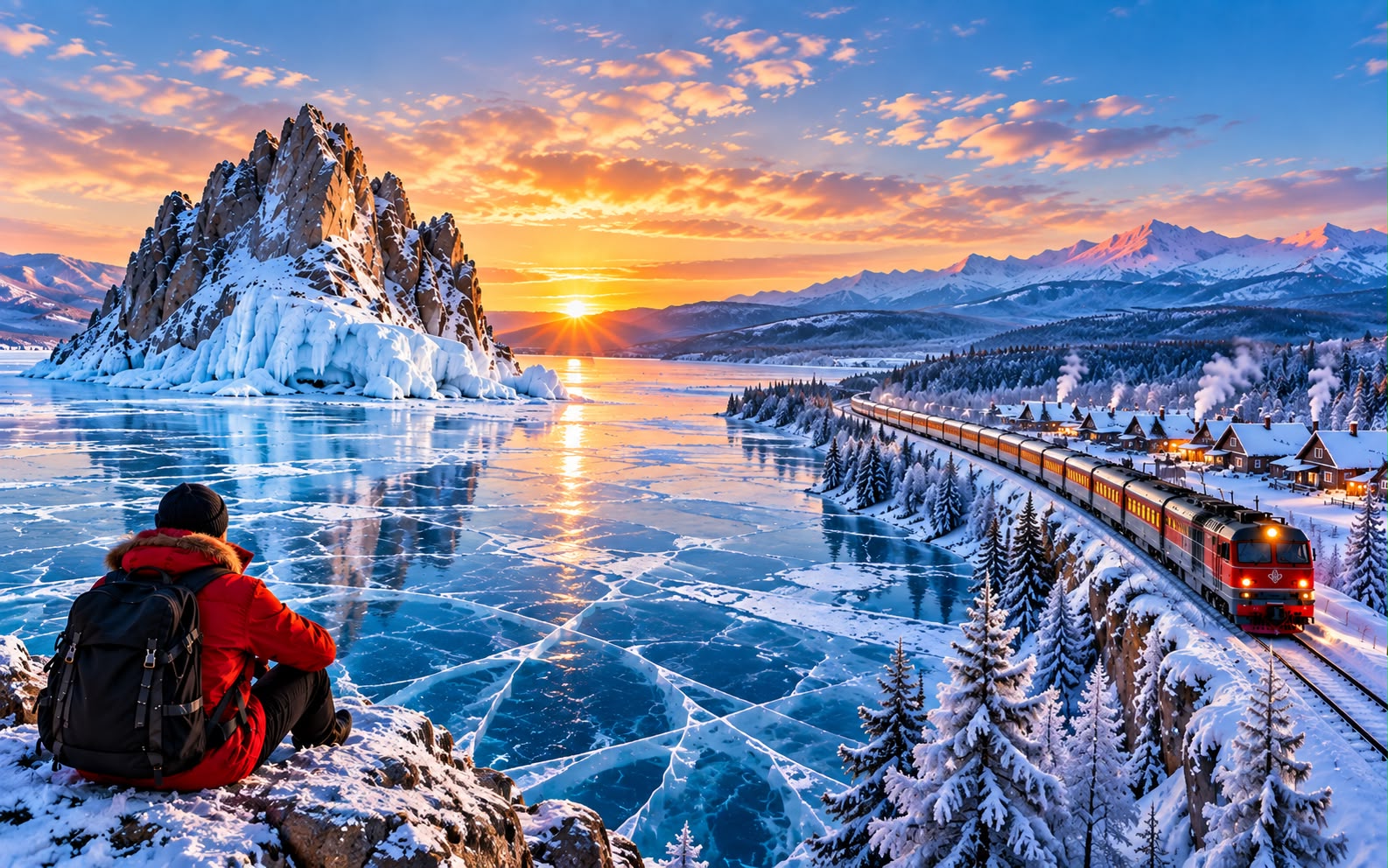
Siberian winter: Baikal ice, the Trans-Siberian and the coldest village on Earth
A February expedition across Russia's deep winter — a night on the Trans-Siberian through the taiga, the blue ice of frozen Lake Baikal, and the road to Oymyakon, the coldest inhabited place on Earth.
- Eastern Europe
- 15 days
- ≈ AED 11,650 / person
- Adventure travellers
Before you go
There is winter, and there is Siberian winter. This trip is built around three things that exist nowhere else: a night aboard the Trans-Siberian as it crosses the frozen taiga, a day driving on the metre-thick blue ice of Lake Baikal, and the Kolyma Highway to Oymyakon — a village of 500 people where −50°C is a normal January morning and the record stands at −71.2°C.
Be clear about what this is: an expedition, not a holiday. It is the most expensive and most physically demanding route on this site, it runs only in deep winter, and the Oymyakon leg is adults-only (operators require 18+). It is also, for the right traveller, the trip of a lifetime — and far more organised and safe than it sounds, because Yakutian operators have been running the Pole of Cold route for decades.
Go in February. It’s the only month where everything aligns: Baikal’s famous transparent blue ice has risen (late January onward), Oymyakon still delivers −45°C and below, and daylight has recovered to workable hours.
All costs are in Russian rubles (RUB), with conversions calculated at today’s exchange rate. Opening hours are approximate — treat anything marked ~ as a guide, not a contract.
Before you go: the admin, plus the cold
The visa, payment and SIM rules are identical to our other Russia guides, where they’re covered in depth. The essentials, then what’s different out here:
- Visas: e-visa for 64 nationalities including India — evisa.kdmid.ru, ~USD 52, 30-day stay, medical insurance mandatory. UAE and several Gulf passports visa-free; US/UK/Canada/Australia/NZ need a consular visa.
- Money: foreign Visa/Mastercard don’t work anywhere in Russia. Crisp USD/EUR/AED cash + a prepaid virtual MIR card set up before you fly. Carry more cash than usual on this route — villages east of Yakutsk are cash country.
- SIM and apps: international travel eSIM (expect the ~24-hour first-connection block), offline Yandex Maps for every city, Yandex Go for taxis, Telegram for messaging (WhatsApp and Instagram are blocked; your Oymyakon guide will be on Telegram).
Install it before you fly; a foreign eSIM can take ~24 hours to clear onto a Russian network. Expect no signal at all for stretches of the Kolyma Highway.
- Insurance: check your policy covers −50°C destinations and overland travel in remote regions, not just city tourism — and check your government’s travel advice affects neither it nor you.
- Book the Oymyakon tour first. Everything else on this route can be arranged weeks out; the Pole of Cold expeditions run on fixed winter departures with small groups (typically 6–12) and fill up around the December–March season. The tour price includes Arctic clothing rental — you do not need to buy a −60°C wardrobe.
The cold, honestly
- −40°C to −55°C is not “very cold”, it’s a different physical regime: exposed skin frostbites in minutes, phone batteries die in your hand (keep the phone inside your inner layers; swap to a warm power bank), glasses fog and freeze, and cotton next to the skin is dangerous because sweat freezes — merino or synthetic base layers only.
- The rules guides drill into you: never run or breathe hard outdoors at −50°C; mittens beat gloves; go inside every 15–20 minutes; tell someone before you wander.
- Tours are vehicle-based with short outdoor bursts — you’re never far from a heated cabin. Thousands of travellers do this route each winter without incident; the cold is managed, not defied.
Travelling with kids?
- Not this one. Oymyakon operators set an 18+ minimum, and −50°C plus two 9-hour driving days is no place for small children.
- The Baikal half (Days 1–7) does work as a family winter trip — the ice day is magical with kids — so a family version of this route is simply: Moscow → Krasnoyarsk → train → Irkutsk → Olkhon → home.
Day by day
Day 1 — Land in Moscow, winter warm-up
- 15:00 — Check in near the centre; one night only.
- 17:00 — Red Square in winter dress: the GUM ice rink on the square (~10:00–23:00 in season, session tickets a few hundred RUB) with St Basil’s floodlit behind you — the best first-evening photo in Russian winter.
- 19:30 — Dinner: Stolovaya 57 in GUM, or Kamergersky Lane’s restaurants. Early night — tomorrow you cross four time zones.
Where to stay in Moscow (one night)
- Mid-range: Cosmos Selection Tverskaya — central and sensible for a one-nighter.
- Budget: Godzillas Hostel — the reliable central cheap bed.
Day 2 — Fly east: Krasnoyarsk
- 9:00 — Fly Moscow → Krasnoyarsk (~4.5 h; you land in the evening local time, four zones ahead). Aeroflot and S7 fly it several times daily.
- 19:00 — Check in, walk the Yenisei embankment after dinner: the river never freezes below the dam, so at −25°C it smokes like a hot spring under the streetlights — your first proper Siberian-winter image.
Where to stay in Krasnoyarsk (one night)
- Upscale: Hilton Garden Inn Krasnoyarsk — still operating under the brand; polished, though not downtown.
- Mid-range: Kupechesky Hotel — well-rated, right in the centre, breakfast included.
Day 3 — Stolby in the snow, then board the Trans-Siberian
- 9:30 — Stolby Nature Park (free; visitor centre ~9:00–18:00) — granite pillars rising out of snow-loaded taiga, 20 minutes from the city. The walkway loops from the eastern entrance are groomed in winter; two–three hours of pine forest and viewpoints.
- 13:30 — Late lunch back in town; supermarket run for train supplies — tea, instant noodles, bread, sausage, something to share.
- 16:00 — Collect bags, head to the station.
- ~18:00–20:00 — Board an eastbound Trans-Siberian sleeper to Irkutsk (~18 h, ~850 km; several departures nightly — some legs are run by the flagship Rossiya itself). Kupe 4-berth class runs roughly 4,000–7,000 RUB per berth booked ahead. Sheets handed out, samovar boiling at the carriage end, taiga going dark outside — this is the scene you came for.
Day 4 — The taiga by daylight, arrive Irkutsk
- Morning — The best hours of the ride: frozen rivers, endless birch and pine, village platforms where babushkas sell pirozhki through the cold. Do nothing. That’s the point of a long train.
- ~14:00–15:00 — Arrive Irkutsk, check in, thaw.
- 17:00 — 130 Kvartal — the restored quarter of carved wooden houses, glowing in the frost; Irkutsk’s lace-windowed wooden architecture is the finest in Siberia.
- 19:30 — Dinner in 130 Kvartal — Baikal fish (omul) makes its first appearance; you’ll be eating it for days.
Where to stay in Irkutsk
- Upscale: International Hotel Sayen — the city’s standout, superbly rated, with an on-site spa you will appreciate twice on this trip.
- Mid-range: History Boutique Hotel & Spa — central, warm, excellent breakfasts.
- Budget: Ushanka Hostel — small, brilliantly reviewed, famously kind hosts.
Day 5 — To Olkhon Island over the ice
- 9:00 — Morning in Irkutsk: the Decembrists Museum house (closed Mon; ~300–400 RUB) tells the story of the exiled aristocrats who built this city’s culture.
- 12:00 — Transfer to Olkhon Island (~5–6 h with the crossing; shared minivans ~1,500–2,000 RUB, or book through your ice-tour operator). The crossing itself is the event: before the official ice road opens (usually February) you skim across on a Khivus hovercraft; after, vehicles simply drive onto the lake.
- 18:00 — Arrive Khuzhir, the island’s village capital. Guesthouses come in “standard” and “comfort” tiers — book through your tour operator and dinner is usually included (home-cooked, omul again, no complaints).
- 20:00 — Step outside before bed: Olkhon’s winter sky, with no city within 250 km, is ferocious with stars.
Day 6 — The blue ice day
The reason February exists. A local UAZ van (the loaf-shaped Soviet 4x4 built for exactly this) takes you out onto the lake for a full day (~10:00–17:00, typically ~10,000–15,000 RUB/person in a small group).
- Ice caves and grottoes on the northern capes — turquoise ceilings, metre-long icicle curtains.
- The transparent ice fields — black glass a metre thick, with frozen methane bubbles stacked beneath your boots like pearls.
- Cape Khoboy, the island’s wild northern tip, where pressure ridges of turquoise ice blocks pile against the cliffs.
- Lunch is cooked on the ice — fish soup from a guide’s camp stove, tea from a thermos, at a table of frozen lake.
- 17:30 — Back in Khuzhir for sunset at Shamanka Rock, the sacred cape above the ice — one of the most photographed places in Siberia, and quietest at dusk.
Day 7 — Back across, night in Irkutsk
- 10:00 — One last walk on the ice below Shamanka, then the midday transfer back to Irkutsk (~5–6 h).
- 17:00 — Check in, then the Central Market for the classic Irkutsk purchase: hot smoked omul, plus pine nuts and taiga honey.
- 19:30 — Proper dinner and an early night — from here the trip turns serious. Repack: one small bag for the expedition, extra batteries charged.
Day 8 — Fly to Yakutsk, the coldest city on Earth
- 10:00 — Fly Irkutsk → Yakutsk (~3 h; S7 daily plus Yakutia Airlines — around nine direct flights a week).
- 14:00 — Land in the world’s coldest major city — 300,000 people living on permafrost, where −40°C is routine and the airport works anyway. The ice fog hanging over the city at midday is like nothing you’ve seen.
- 15:30 — Krestyansky Market — the famous frozen-fish rows: whole fish stood upright in the open air like firewood, frozen milk sold in discs. Photograph fast; fingers allow ~2 minutes bare.
- 17:00 — Warm up in the National Art Museum of Sakha (closed Mon; ~300 RUB) or the hotel.
- 19:30 — Yakut dinner: stroganina — shavings of raw frozen whitefish, the region’s signature — plus venison and strong tea. Tomorrow, the road.
Where to stay in Yakutsk
- Best in town: Polar Star Hotel — the central classic on Lenin Square.
- Alternative: Azimut Hotel Yakutsk — reliable chain standard near the centre.
Day 9 — Onto the Road of Bones
A five-day, ~2,000 km round trip on the Kolyma Highway — the “Road of Bones” built by Gulag prisoners — run as an organised expedition (group rate ~145,000–155,000 RUB/person, 6–12 people, warm-clothing rental and most logistics included; 18+ only).
- 07:00 — Yakutsk → Khandyga (~9 h): across the frozen Lena River on the ice road, then east through white hills.
- 13:00 — Roadhouse cafés, truckers, tea, which is the rhythm of this road.
- 18:00 — Overnight Khandyga.
Day 10 — Over the Verkhoyansk ranges
- 07:00 — Khandyga → Tomtor/Oymyakon (~9 h): the highway climbs through the Verkhoyansk ranges — mountain passes, the Black Prison gorge, GULAG-era memory the guides don’t gloss over.
- 16:00 — Descend into the Oymyakon valley, where cold pools like water — the valley floor traps it and that is why the record is here.
- 19:00 — Overnight in village guesthouses.
Day 11 — Oymyakon in full
- 10:00 — The Pole of Cold monument (−71.2°C, recorded 1933) and your certificate from the keeper of the cold.
- 12:00 — The daily physics show — boiling water thrown into the air turning to instant snow, bananas used as hammers, jeans frozen standing.
- 14:00 — A visit to the village school (it closes only below −52°C).
- 18:00 — An evening of Yakut culture with the locals whose horses live outside all winter.
- Days run −35 to −45°C, nights can reach −60°C. You will never describe cold the same way again.
Day 12 — The Indigirka, then west
- 09:00 — Second Oymyakon morning — Indigirka River by car or snowmobile, last photos.
- 13:00 — Then back west to Khandyga.
- 20:00 — Overnight Khandyga, and the road in this direction is the same nine hours.
Day 13 — Back to Yakutsk
- 07:00 — Khandyga → Yakutsk.
- 18:00 — Arrive evening, hot shower, large dinner, which after five days on that road is the entire plan.
Day 14 — Yakutsk underground, then thaw
- 10:30 — Kingdom of Permafrost (~10:00–18:00, ~500–700 RUB) — a tunnel complex inside a permafrost hill: ice sculptures lit in colour, the underground lab where −10°C now feels warm to you, which is the joke everyone makes and it’s true.
- 12:30 — Mammoth Museum (closed Sun–Mon typically; ~300 RUB) — Yakutia yields most of the world’s mammoth finds; the real tusks and the baby mammoth story are worth an hour.
- 14:00 — Lunch, then souvenirs: Yakutsk is Russia’s diamond capital — certified Sakha diamonds cost far less here than anywhere west; knives and silverwork are the budget alternative.
- 17:00 — End the trip the local way: a Russian banya — the −45°C-to-+90°C swing is the full Siberian experience in one hour.
- 20:00 — Farewell dinner.
Day 15 — The long flight home
- Morning — Fly Yakutsk → Moscow (~6.5–7 h against the time zones, so you land close to when you left) and connect onward. Gulf travellers are home overnight.
Costs and practicalities
Getting there
Fares swing hard by season and by day of the week — moving a trip by a few days is often the biggest single saving on the whole budget.
Best time to visit
February is the answer, and it is unusually specific: the ice on Lake Baikal is thick enough to drive on, clear enough to see through, and the days are long enough to use.
- February–early March — the Baikal ice is at its best: a metre thick, with the transparent blue hummocks and methane bubbles frozen into it. Hovercraft and UAZ vans run on the lake, and the ice caves at Olkhon are accessible.
- December–January — the coldest, down to minus 35°C, with very short days and the ice not yet fully formed or safe.
- Late March — still good ice, warmer, and the Baikal ice marathon crosses the lake.
- April–May — the ice breaks up and the lake is neither frozen nor navigable. The worst time to come.
- June–September — the summer trip entirely: hiking the Great Baikal Trail, and the lake swimmable for the brave in August.
Travel tips
- Dress for minus 30°C properly. Layers, a down outer, a hat that covers the ears, mittens not gloves, and boots rated for cold — this is not a question of comfort but of frostbite.
- Check current advice and the practicalities before planning. Sanctions have changed what is possible for many travellers, and Western cards do not work at all.
- Bring the entire budget in cash.
- The Trans-Siberian from Moscow to Irkutsk takes about three days. Flying is four hours. Decide which is the point of the trip.
- Ice travel is only on routes the local drivers use. Pressure ridges and cracks shift; never walk or drive onto the lake independently.
- Olkhon Island is reached by a hovercraft or ice road in winter and a ferry in summer; in the shoulder weeks it can be cut off entirely.
- Camera batteries die fast in the cold. Keep spares inside your jacket and let the lens warm up slowly indoors to avoid condensation.
What this trip actually costs
Two people, 14 nights (6 hotel + 1 train + 2 Khuzhir + 4 on expedition + 1 Yakutsk), international flights excluded:
| Item | Cost |
|---|---|
| Oymyakon 5-day expedition, group rate, 2 pax | RUB 290,000 (≈ AED 12,999) |
| Baikal leg: transfers, Khuzhir guesthouse, ice day, 2 pax | RUB 60,000 (≈ AED 2,690) |
| Domestic flights (Moscow→Krasnoyarsk, Irkutsk→Yakutsk, Yakutsk→Moscow), 2 pax | RUB 85,000 (≈ AED 3,810) |
| Trans-Siberian sleeper Krasnoyarsk→Irkutsk, kupe, 2 pax | RUB 10,000 (≈ AED 448) |
| Hotels, 6 city nights | RUB 36,000 (≈ AED 1,614) |
| Food and drink outside the expedition | RUB 24,000 (≈ AED 1,076) |
| Museums, taxis, eSIM, banya, extras | RUB 15,000 (≈ AED 672) |
| Total for two | RUB 520,000 (≈ AED 23,309) |
- Roughly RUB 260,000 (≈ AED 11,655) per person — no way around it: this is an expedition, and the Oymyakon leg is more than half the bill. Two honest levers: a bigger group drops the per-person tour rate, and cutting Oymyakon entirely turns this into a ~RUB 100,000 (≈ AED 4,483)-per-person Baikal winter trip — still spectacular, no longer the coldest place on Earth.
- Book in this order: Oymyakon expedition (fixed winter departures, small groups — this date anchors everything) → e-visa → virtual MIR card → domestic flights → Baikal arrangements → trains.
- Hotel and tour picks here are unsponsored — no affiliate links in this article. Chosen on location and current ratings; always check prices and recent reviews before booking.
What to pack
The expedition rents you the Arctic outer layer (expedition parka, overtrousers, felt boots) — pack the system underneath:
- Merino or synthetic base layers, two sets — no cotton against skin; sweat that freezes is the real danger.
- Fleece or wool mid-layers; your own down jacket for city days.
- Liner gloves under mittens (mittens always beat gloves at −40), balaclava, wool socks in triples.
- Insulated boots rated to at least −30°C for the Baikal days — the tour’s felt valenki cover Oymyakon.
- Ice grips for boot soles — Baikal’s ice is polished glass.
- Two power banks, kept warm in inner pockets; your phone lives inside your coat and still needs them.
- Chemical hand and toe warmers — one packet per outdoor day.
- Sunglasses and sunscreen — February sun on lake ice burns.
- Thermos, lip balm, heavy moisturiser; contact-lens wearers bring glasses as backup (and know frames freeze to skin — guides brief you).
- Printed e-visa and insurance, offline maps, cash split across bags.
FAQ
How cold does it actually get, and can a normal person handle it? Days on this route run −20 to −45°C, with Oymyakon nights touching −60°C. Yes — with rented Arctic gear, vehicle-based touring and 15–20 minute outdoor bursts, ordinary travellers in reasonable health do this every winter. The cold is intense but scheduled; you are never improvising in it.
Why February specifically? Baikal’s transparent blue ice only rises from late January and is at its best February to mid-March; Oymyakon is reliably below −40°C through February; and daylight is back to 7–9 usable hours. January is colder but darker; March is brighter but Oymyakon softens.
Is the Road of Bones safe? It’s a maintained federal highway in winter, driven daily by truckers, and tours run it in convoy-ready 4x4s with satellite comms. The name is history, not a warning — and good guides tell that Gulag history properly, which is part of why this trip stays with people.
Can I see the northern lights on this route? Sometimes — Yakutia and the Baikal region sit south of the auroral oval, so displays happen but aren’t the point here. If aurora is your priority, our Murmansk itinerary is built for it; this trip’s sky show is stars and ice fog.
Do I need to speak Russian? For the cities, Yandex Translate covers it. For the expedition, no — Pole of Cold operators run English-speaking departures; confirm when booking. Beyond Yakutsk, English disappears entirely, which is rather the point.
What’s the food like out there? Hearty and singular: stroganina (frozen raw fish shavings), venison, horse meat (a Yakut staple — no one is offended if you pass), fish soup on the Baikal ice, roadhouse pelmeni on the Kolyma. Vegetarians should brief the operator ahead; it’s manageable with notice, dull without.
Prices and entry rules change, and what you need depends on your passport; last checked 29 October 2026, so confirm with the embassy or your airline before booking.


