 The Itinerary
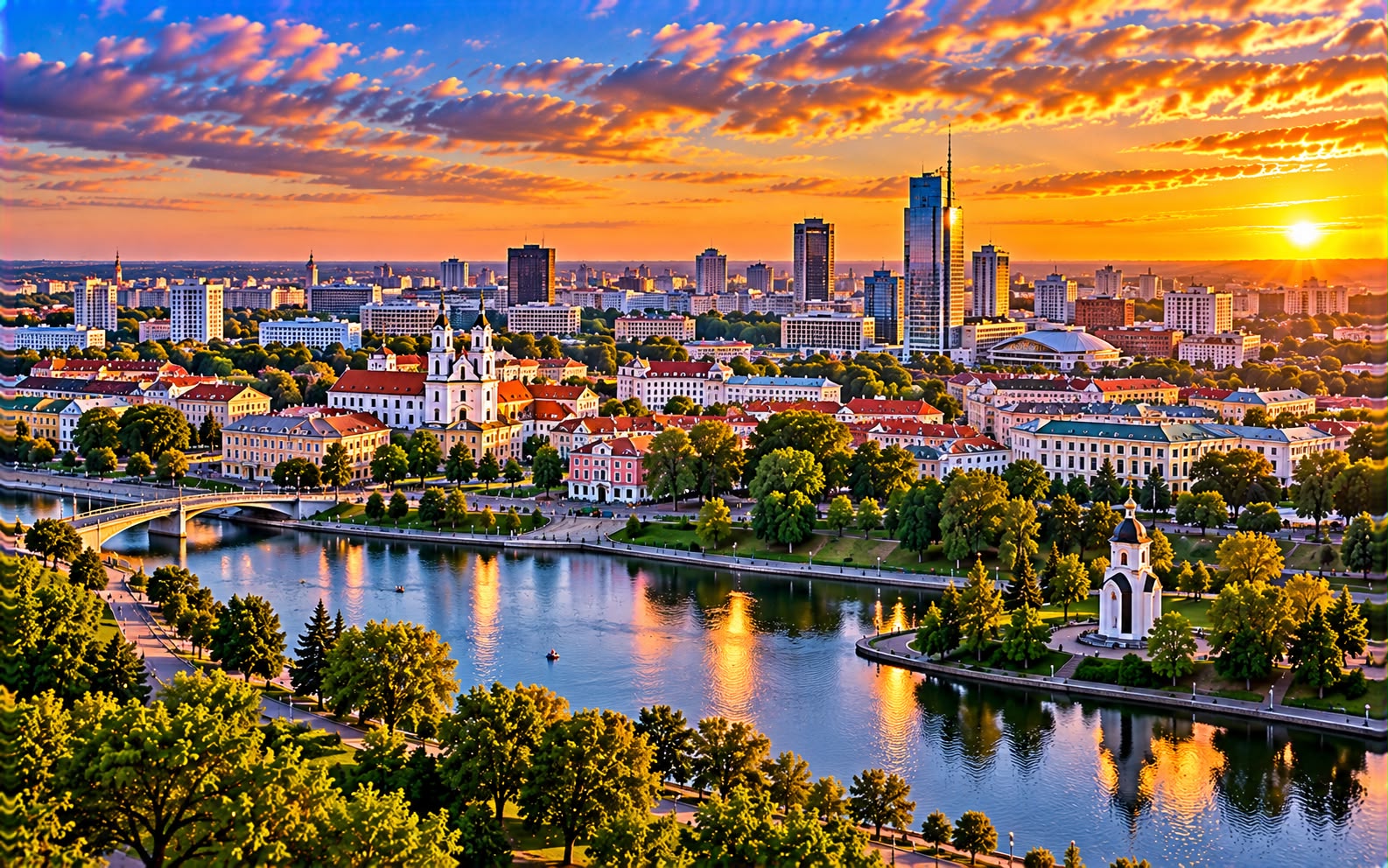
Belarus in 6 days: Mir, Nesvizh and the last primeval forest in Europe
Renaissance castles, a fortress that held out in 1941, and the last fragment of the forest that once covered the European plain — in a country most governments now advise against visiting, for reasons this guide sets out before anything else.
- Eastern Europe
- 6 days
- ≈ AED 1,700 / person
- Two UNESCO castles and a forest of wild bison — behind a serious set of warnings
Before you go
Read this first
Most governments advise against all or all but essential travel to Belarus. The reasons are specific, and they are about the state rather than about crime:
- Arbitrary arrest and detention of foreign nationals, including on charges relating to things said or shared online, sometimes years earlier and outside the country.
- Belarus supported Russia’s 2022 invasion of Ukraine, allowing its territory to be used as a launch point. The border region with Ukraine is a military zone and should not be approached.
- Western diplomatic presence is much reduced. Several countries have withdrawn or cut their embassies, so consular help may be slow or unavailable.
- Dual nationals may not be recognised as foreign citizens at all, which removes consular protection entirely.
- Phones and laptops are searched at the border. Social media, messaging apps and photographs are examined. People have been refused entry, and detained, over content.
- Any perceived political activity is dangerous — including displaying the white-red-white flag, which is the opposition symbol and is treated as extremist.
- Flights from the EU do not operate. EU carriers are banned from Belarusian airspace and vice versa, so arrival means Istanbul, Dubai, Moscow or an overland crossing.
Read your own government’s current advice before anything else.
This guide exists because Belarus holds genuine World Heritage and because people research countries before conditions change. It is not an encouragement to go, and if you do, the risks above are yours to weigh.
What is there is real. Mir Castle and the Nesvizh Radziwiłł complex are both UNESCO World Heritage sites — a sixteenth-century fortified castle in red brick, and the palace of a family who were among the wealthiest in Europe and effectively ran a state within the Polish-Lithuanian Commonwealth.
Belovezhskaya Pushcha is the other, and the more remarkable. It is the last substantial fragment of the primeval forest that once covered the European plain, UNESCO-listed and shared with Poland’s Białowieża, and it holds the largest population of European bison — a species that was extinct in the wild by 1927 and was rebuilt from fifty-four animals in captivity.
Brest Fortress is where the 1941 invasion met its first sustained resistance, and the Soviet memorial built over it is one of the most overwhelming pieces of monumental architecture anywhere.
Minsk was almost entirely destroyed in the war and rebuilt as a Stalinist showpiece — a city of enormous avenues and neoclassical blocks, intact in a way Moscow no longer is.
Six days. Figure BYN 1,400 (≈ AED 1,718) per person excluding flights. Go May–September; winters are long and severe.
Before you go: the 15-minute admin
Visas and entry
- Belarus has extended visa-free entry to citizens of many European countries in recent years, generally for stays up to 30 days by specified routes. The rules have changed repeatedly and are political. Check the official position close to travel.
- Visa-free entry has historically applied only to arrival at Minsk National Airport, not at land borders. Arriving overland may need a visa even where flying would not.
- Compulsory medical insurance from an approved provider is required and is checked.
- Register if staying beyond the permitted period.
At the border
- Expect your devices to be examined. Assume anything on your phone will be read. This is the single most common cause of difficulty for visitors.
- Have an itinerary, bookings and a return ticket to show.
- Do not carry opposition material of any kind.
Money
- The Belarusian rouble (BYN).
- Cards work in Minsk at hotels, restaurants and shops, but Western cards issued by sanctioned-adjacent banks may not, and Visa and Mastercard transactions have been unreliable. Bring cash in euros or dollars and change it locally.
- Do not rely on any single payment method.
Behaviour
- Do not photograph military, police, government buildings, borders or railway infrastructure.
- Avoid any gathering, however small.
- Do not discuss politics with people who could be endangered by the conversation. This matters more than your own comfort.
Getting around
- Trains are good, cheap and punctual, and link Minsk with Brest, Grodno and Vitebsk.
- Minsk’s metro is clean, deep and cheap.
- A driver or an organised tour is the usual way to reach Mir, Nesvizh and the forest, which are not well served by public transport.
Day by day
Day 1 — Minsk
- Independence Avenue, fifteen kilometres of Stalinist neoclassicism built in the decade after 1945, and nominated for UNESCO listing in its own right.
- Victory Square and the obelisk, Oktyabrskaya Square, and the Island of Tears memorial to the Soviet-Afghan war.
- The National Library, a rhombicuboctahedron in glass that lights up at night and has an observation deck.
Where to stay in Minsk (three nights across the trip)
- Mid-range: the centre around Independence Avenue.
Day 2 — Minsk, and Khatyn
- The Great Patriotic War Museum, which is the country’s central institution — Belarus lost something between a quarter and a third of its population between 1941 and 1945, a higher proportion than any other European country.
- Khatyn, an hour north: a village burned with its inhabitants inside in 1943, rebuilt as a memorial where a bell tolls every thirty seconds for each of the 186 villages destroyed and never rebuilt. It is extremely hard going and it is the most important place in the country.
- Trostenets, on the city’s edge, the site of the largest Nazi extermination camp on Belarusian soil.
Day 3 — Mir and Nesvizh
- Mir Castle, UNESCO-listed: a sixteenth-century fortified castle of red brick and white stone with five towers, Gothic underneath and Renaissance on top, reflected in its own lake.
- Nesvizh, 30 kilometres on, also UNESCO-listed: the Radziwiłł family’s palace and park, the family vault in the Corpus Christi Church — the oldest Jesuit church outside Italy — and a landscape park laid out in the nineteenth century.
- Both are restored to within an inch of their lives, which is either reassuring or disappointing depending on your taste.
Day 4 — Brest
- Train west to Brest, about four hours.
- Brest Fortress. The garrison held out for weeks after the invasion of 22 June 1941, long after the front had moved east. The Soviet memorial complex built over the ruins — the Thirst sculpture, the vast Courage head cut from concrete, the eternal flame — is monumental in the fullest sense.
- The Brest Railway Museum and the old town, which is Polish in feel because it was Polish until 1939.
Where to stay in Brest (two nights)
- Mid-range: the centre, which is small and walkable.
Day 5 — Belovezhskaya Pushcha
- An hour north of Brest. The last primeval lowland forest in Europe, UNESCO-listed, continuous with Poland’s Białowieża across the border.
- European bison — the continent’s largest land mammal, extinct in the wild by 1927 and restored from 54 captive animals. Belarus holds the largest population.
- The forest itself is the point: oaks and hornbeams several hundred years old, dead wood left standing, and a structure that almost nowhere else in Europe retains.
- The estate also contains the Viskuli lodge, where the Belavezha Accords dissolving the Soviet Union were signed in December 1991.
Day 6 — Back, and out
- Train to Minsk, and the airport.
- Allow time at the border or the airport. Exit checks can be as thorough as entry.
Costs and practicalities
Best time to visit
May–September. The winter is long and genuinely cold — minus 10°C is an ordinary January day — and the summer is short, green and warm.
- May–June — the best of the year. Białowieża is in full leaf, the days are long, and Minsk’s parks are in use.
- July–August — warm, up to 30°C, and the holiday month.
- September–October — autumn colour in the forests, and the quietest good month.
- November–March — cold, grey and short-dayed, though Minsk under snow has a particular severity that suits its architecture.
Independence Day on 3 July brings a large military parade through Minsk and heavy central closures.
Travel tips
- Register if you stay more than a few days. Hotels do it automatically; private accommodation does not, and the obligation is yours.
- Carry your passport at all times. Police checks are routine and not carrying it is an offence.
- Cards work in Minsk and are unreliable outside it. Western-issued cards may be declined outright — bring cash and assume you cannot draw more.
- Do not photograph government buildings, metro interiors, military or police. This is enforced.
- Political conversation puts the other person at risk, not you. Do not raise it, including online while you are there.
- The Minsk metro is cheap, fast and deep. Tokens at the window, and the stations are worth seeing in their own right.
- Białowieża requires a permit for the strictly protected core, arranged through the park. The Belarusian side is far less visited than the Polish one.
What this trip actually costs
Two people, 5 nights, mid-range comfort, flights excluded:
| Item | Cost |
|---|---|
| Hotels, 5 nights | BYN 1,200 (≈ AED 1,472) |
| Trains, driver for the castles, transfers | BYN 900 (≈ AED 1,104) |
| Castle and museum entries, forest fees | BYN 300 (≈ AED 368) |
| Compulsory medical insurance, two | BYN 100 (≈ AED 123) |
| Food and drink, 6 days | BYN 300 (≈ AED 368) |
| Total for two | BYN 2,800 (≈ AED 3,435) |
- Roughly BYN 1,400 (≈ AED 1,718) per person, which is inexpensive by European standards.
- Bring cash. Card reliability for foreign-issued cards has been poor and should not be assumed.
- The compulsory insurance is a small, separate, unavoidable cost bought on arrival or in advance from an approved insurer.
- A driver for Mir and Nesvizh in one day is the efficient option and is the main transport cost.
- Hotel picks here are chosen on location, not on commission — always check prices and recent reviews before booking.
What to pack
- A clean phone. Assume everything on it will be read at the border.
- Cash in euros or dollars, enough for the trip.
- Printed bookings and itinerary.
- Warm layers outside high summer.
FAQ
Is it safe to visit Belarus? Most governments advise against it, and the risk is arbitrary detention by the state rather than ordinary crime. Device searches at the border are routine and have led to refusals and arrests. Read your own government’s advice and weigh it honestly.
Can I get in without a visa? Belarus has offered visa-free entry to many European nationalities, generally by air into Minsk and for limited stays. The rules change with the politics — check the official position close to travel, and note that land borders are often treated differently.
Can I combine it with Ukraine? No. The border is closed and the region is militarised. Do not attempt it.
Will my cards work? Unreliably. Visa and Mastercard transactions have been intermittent. Bring cash.
Why is the forest significant? Belovezhskaya Pushcha is the last substantial piece of the primeval forest that once covered the European plain, and it holds the largest population of European bison — a species rebuilt from 54 captive animals after it went extinct in the wild.
Prices and entry rules change, and what you need depends on your passport; last checked 8 October 2026, so confirm with the embassy or your airline before booking.


