 The Itinerary
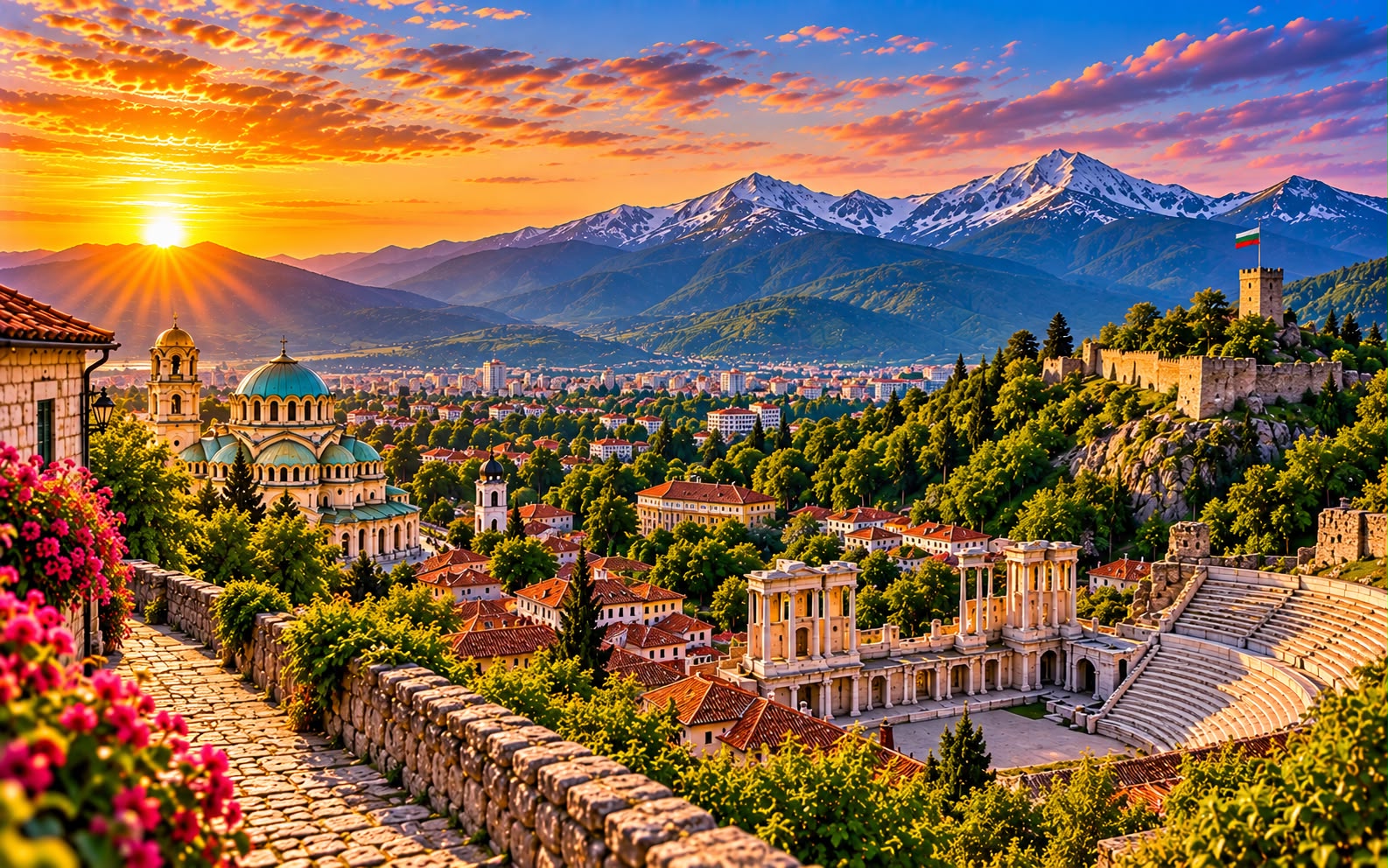
Bulgaria in 8 days: Sofia, Plovdiv and the Rila mountains
One of Europe's oldest continuously inhabited cities, a monastery of painted arcades under 2,900-metre peaks, and a medieval capital stacked on a river gorge — with the Cyrillic that was invented here, the head-shake that means the opposite of what you think, and prices that are the lowest in the EU.
- Eastern Europe
- 8 days
- ≈ AED 2,450 / person
- Old towns + monasteries
Before you go
Bulgaria gets skipped, which is why it is still cheap and still quiet. It should not be: Plovdiv has been continuously inhabited for around eight thousand years and has a Roman theatre still used for concerts; Rila Monastery sits in a mountain valley under black-and-white striped arcades covered in frescoes; and Veliko Tarnovo stacks itself up a gorge around the fortress of the Second Bulgarian Empire.
Sofia itself is an unhurried capital where a Roman street runs under the shopping centre, a mosque, a synagogue and an Orthodox cathedral stand within a few hundred metres, and the mountain behind the city is a ski resort in winter and a hike in summer.
Eight days, mostly by road, in the cheapest country in the European Union.
Before you go: Schengen, the alphabet and the head-shake
Entry, and where Bulgaria now sits
- Bulgaria joined the Schengen area — air and sea borders first, land borders following — so the same visa rules apply as the rest of the area. The process is in our Schengen visa guide.
- It is not yet in the euro. Bulgaria uses the lev (BGN), pegged to the euro at a fixed rate, with euro adoption repeatedly discussed and repeatedly moved.
- Visa-free nationalities need only a passport.
Two things that catch visitors out
- The head-shake is inverted. A nod means no; a shake means yes. Bulgarians dealing with tourists often switch to the Western version, which makes it worse rather than better. When it matters, ask for a verbal answer.
- Cyrillic was created here, in the First Bulgarian Empire, and road signs outside the main routes are often only in Cyrillic. Learn to sound out the alphabet on the plane — it takes twenty minutes and transforms the driving.
Getting around
- Hire a car for Rila and Veliko Tarnovo. It is the difference between seeing the country and seeing three cities.
- Sofia to Plovdiv is a good motorway, about ninety minutes. Sofia to Veliko Tarnovo is around three hours.
- Rila Monastery is two hours from Sofia on winding mountain road, and worth a night nearby rather than a rushed day trip.
- Trains are slow; buses are better and cheap if you would rather not drive.
- Parking in Plovdiv’s old town is restricted; stay below it and walk up.
Money and the cost
- The lev, and Bulgaria is the cheapest country in the EU — noticeably below Romania, and a fraction of western Europe.
- Cards work in cities; carry cash for monasteries, village restaurants and small guesthouses.
- Tipping around 10% is normal.
- Mehanas — traditional taverns — are where to eat: grilled meat, shopska salad, and rakia, which is the national spirit and taken seriously.
When to go
- May to June and September to October are best: warm, green or golden, and quiet.
- July and August are hot inland and busy on the Black Sea coast.
- Winter is for skiing at Bansko, which is a different trip and a genuinely cheap one.
Day by day
Day 1 — Land in Sofia
- 14:00 — Land at Sofia (SOF). Metro Line 1 runs from Terminal 2 to the centre in 20 minutes for about a euro, which makes a taxi pointless.
- 15:30 — Drop bags. Leave the car hire until day three — Sofia is walkable and central parking is a nuisance.
- 16:30 — Vitosha Boulevard, pedestrianised, with Mount Vitosha standing 2,290 m at the end of it. Sofia is the only European capital with a mountain of that size on its doorstep.
- 18:00 — The mineral baths square behind the former bathhouse, where locals still fill bottles from the public fountains, free, with hot mineral water.
- 19:30 — Dinner in a mehana — a traditional tavern. Shopska salad, kavarma, and rakia, which arrives before the food and is drunk with it, not after.
Day 2 — Sofia
- 09:30 — Alexander Nevsky Cathedral, neo-Byzantine, gold domes, built 1882–1912 as a memorial to the 200,000 Russian soldiers who died freeing Bulgaria from Ottoman rule. The crypt holds the best icon collection in the country.
- 11:00 — The Serdica Roman ruins, exposed under the city centre during metro construction and left open — you can see 2nd-century streets from the platform and walk among them at ground level. Sofia has been continuously inhabited for 7,000 years and this is where you can see it.
- 12:00 — The Square of Tolerance: an Orthodox cathedral, a mosque, a synagogue and a Catholic church within 300 m of each other, which the city is rightly pleased about.
- 13:30 — Lunch at the Central Market Hall.
- 15:00 — Boyana Church on the edge of town — UNESCO-listed for frescoes painted in 1259 that anticipate the Renaissance by a century, with individualised faces and real perspective. Entry is limited to small groups for a few minutes at a time, and it is worth the trip out.
- 16:30 — The National History Museum next door, in the former communist residence.
- 19:30 — Dinner.
Day 3 — Rila Monastery
- 08:30 — Collect the car, then two hours south into the Rila mountains.
- 10:30 — Rila Monastery, founded in the 10th century, rebuilt in the 1830s, and the single most recognisable place in Bulgaria. The courtyard — black-and-white striped arches in tiers, a frescoed porch of 1,200 panels, the Hrelyo Tower, and forested mountains straight above the walls — is one of those places that is exactly as good as the photographs.
- 12:00 — The Hrelyo Tower (1335, the only part to survive the fire), the museum with Rafail’s Cross — a wooden crucifix carved with 104 biblical scenes and 650 figures, which took the monk twelve years and his eyesight.
- 14:00 — Lunch — trout, from the river, at the stalls outside the gate, with mekitsi.
- 15:30 — The walk up the valley to St Ivan’s cave, about an hour each way. Tradition says squeezing through the hole in the rock absolves your sins; it is a tight fit.
- 18:00 — Stay nearby rather than driving back. The monastery after the day buses leave, with monks and nobody else, is the reason to.
Day 4 — East to Plovdiv
- 09:00 — Drive across to Plovdiv, about three hours.
- 12:00 — Arrive. Plovdiv claims to be the oldest continuously inhabited city in Europe — around 8,000 years — and has the layers to show for it.
- 13:00 — Lunch.
- 14:30 — The Roman theatre, cut into the saddle between two hills, built under Trajan, lost under a landslide for centuries and only rediscovered in the 1970s. It seats 5,000 and is still used — check whether anything is on while you are there.
- 16:30 — The Roman stadium, most of it still under the main shopping street, with one curved end excavated and visible below pavement level.
- 19:00 — Kapana — “the trap” — the craft quarter of narrow lanes, where Plovdiv’s 2019 European Capital of Culture money went and went well. Bars, galleries, and dinner.
Day 5 — Plovdiv, and the old town
- 09:00 — The Old Town on the hill: National Revival houses from the 1800s, timber-framed, each storey overhanging the one below, painted in ochre and blue. The Balabanov and Kuyumdzhioglu houses are open and furnished.
- 11:30 — Nebet Tepe, the hilltop ruin at the top, for the view over the whole city and the plain.
- 13:00 — Lunch.
- 14:30 — Bachkovo Monastery, 30 minutes south — the country’s second largest, founded 1083, with a frescoed refectory and a miracle-working icon that draws queues on feast days.
- 16:30 — Or Asen’s Fortress on its crag above the river gorge, a 13th-century church on a rock with a long drop on three sides.
- 19:30 — Back in Kapana.
Day 6 — North to Veliko Tarnovo
- 08:30 — North over the Balkan range, about three hours.
- 10:30 — The Shipka Pass, where in 1877 a few thousand Bulgarian volunteers and Russian troops held the summit against far larger Ottoman forces — the fight that decided the war of liberation. The Shipka Memorial Church below, with its gold onion domes among pine, holds the bones of the dead in its crypt.
- 12:30 — Lunch, and the Valley of the Thracian Kings around Kazanlak if you detour — the UNESCO-listed tomb has a replica open to visitors because the originals cannot take the breath.
- 15:00 — Veliko Tarnovo, the medieval capital, built in tiers above a double meander of the Yantra.
- 16:30 — Tsarevets, the fortress on its own hill, reached across a saddle — palace, patriarchate, and Execution Rock at the far end where traitors were thrown into the river.
- 19:00 — Dinner on Samovodska Charshia, the craft street, with the fortress lit across the gorge.
Day 7 — Arbanasi and the villages
- 09:30 — Arbanasi, five minutes up the hill — a village of stone merchants’ houses built like small fortresses, with blank outer walls, iron doors and gardens hidden inside.
- 10:30 — The Nativity Church: plain and low outside, deliberately, so the Ottoman authorities would not notice it, and completely covered inside with 17th-century frescoes — over 2,000 figures on every surface including the ceiling. One of the best interiors in the Balkans.
- 13:00 — Lunch in Arbanasi.
- 14:30 — Tryavna for the woodcarving school and the clock-tower square, or the Etar open-air museum with working water-powered craft workshops.
- 17:30 — Back to Veliko Tarnovo, or start west toward Sofia.
- 19:30 — Last dinner.
Day 8 — Fly home
- Morning — Veliko Tarnovo to Sofia airport is about three hours. Leave early and allow for it.
- Alternative — Varna or Burgas on the coast are roughly the same distance east and may suit your routing better.
- Note — Bulgaria uses the lev, pegged to the euro. Spend them; they are hard to change elsewhere.
Costs and practicalities
Best time to visit
May–June and September–October for the country as a whole, with two quite separate peak seasons on top — the Black Sea in summer and the mountains in winter.
- May–June — the Valley of the Roses is harvested in late May and early June, which is a real event and the one date worth planning around. The mountains are green and the coast is empty.
- July–August — hot, and Sunny Beach and Golden Sands are at full volume. The Rila and Pirin ranges are the escape.
- September–October — the best month: warm sea into late September, the wine harvest, and Plovdiv and Veliko Tarnovo quiet again.
- December–March — Bansko and Borovets ski at prices well below the Alps, and Sofia is cold but cheap.
Travel tips
- The head gestures are inverted. A nod can mean no and a shake can mean yes. Bulgarians dealing with foreigners often switch deliberately, which makes it worse — ask for a spoken answer.
- Bulgarian uses Cyrillic. Road signs on major routes are transliterated; smaller ones are not. Learning the alphabet takes an hour and pays for itself.
- Bulgaria joined the eurozone in January 2026. Older price lists and guides still quoting lev may be out of date; check what you are being charged in.
- Marshrutkas and intercity buses are better than the trains for most routes. The railways are slow, cheap and scenic.
- Rila Monastery is a two-hour day trip from Sofia and worth doing early, before the coaches.
- Cards are widely accepted in cities, less so in villages and at monasteries.
- Tipping is around 10% and usually rounded into the cash you hand over.
What this trip actually costs
Two people, 7 nights, mid-range, excluding international flights:
| Item | Cost |
|---|---|
| Hotels and guesthouses, 7 nights | BGN 1,000 (≈ AED 2,093) |
| Car hire, 7 days, fuel and tolls | BGN 700 (≈ AED 1,465) |
| Monasteries, museums, Roman theatre, fortresses | BGN 160 (≈ AED 335) |
| Food and drink, 8 days | BGN 400 (≈ AED 837) |
| eSIM, parking, extras | BGN 60 (≈ AED 126) |
| Total for two | BGN 2,320 (≈ AED 4,857) |
- Roughly BGN 1,160 (≈ AED 2,428) per person — the cheapest country in the EU, below Romania and well below anywhere further west.
- Mehana dinners cost a fraction of western European prices and are the best food on the trip.
- The car is the largest line and the one that makes the itinerary possible.
What to pack
- Layers. Rila and the Balkan range are cool even in summer, and Plovdiv can be 35°C the same week.
- Shoes for cobbles and monastery hills.
- Modest cover for monasteries — shoulders and knees, and some provide wraps.
- European Type C/F plugs.
- Cash in lev for villages and monastery entries.
FAQ
Is Bulgaria really the cheapest in the EU? Yes, on most measures — food, accommodation and fuel all sit below Romania’s, which is itself well below western Europe.
Do I need a car? For Rila and the villages, effectively yes. Sofia to Plovdiv is easy by bus, but the monasteries and the Balkan range are not usefully served.
Is the head-shake thing real? Yes. A nod means no and a shake means yes, and people who deal with tourists sometimes invert it back, which is worse. Ask for words when it matters.
How does it compare with Romania? Bulgaria is cheaper and flatter to travel — better roads, shorter distances. Romania has the Saxon villages and the higher mountains. See our Romania guide; the two combine well over two weeks.
Prices and entry rules change, and what you need depends on your passport; last checked 8 October 2026, so confirm with the embassy or your airline before booking.


