 The Itinerary
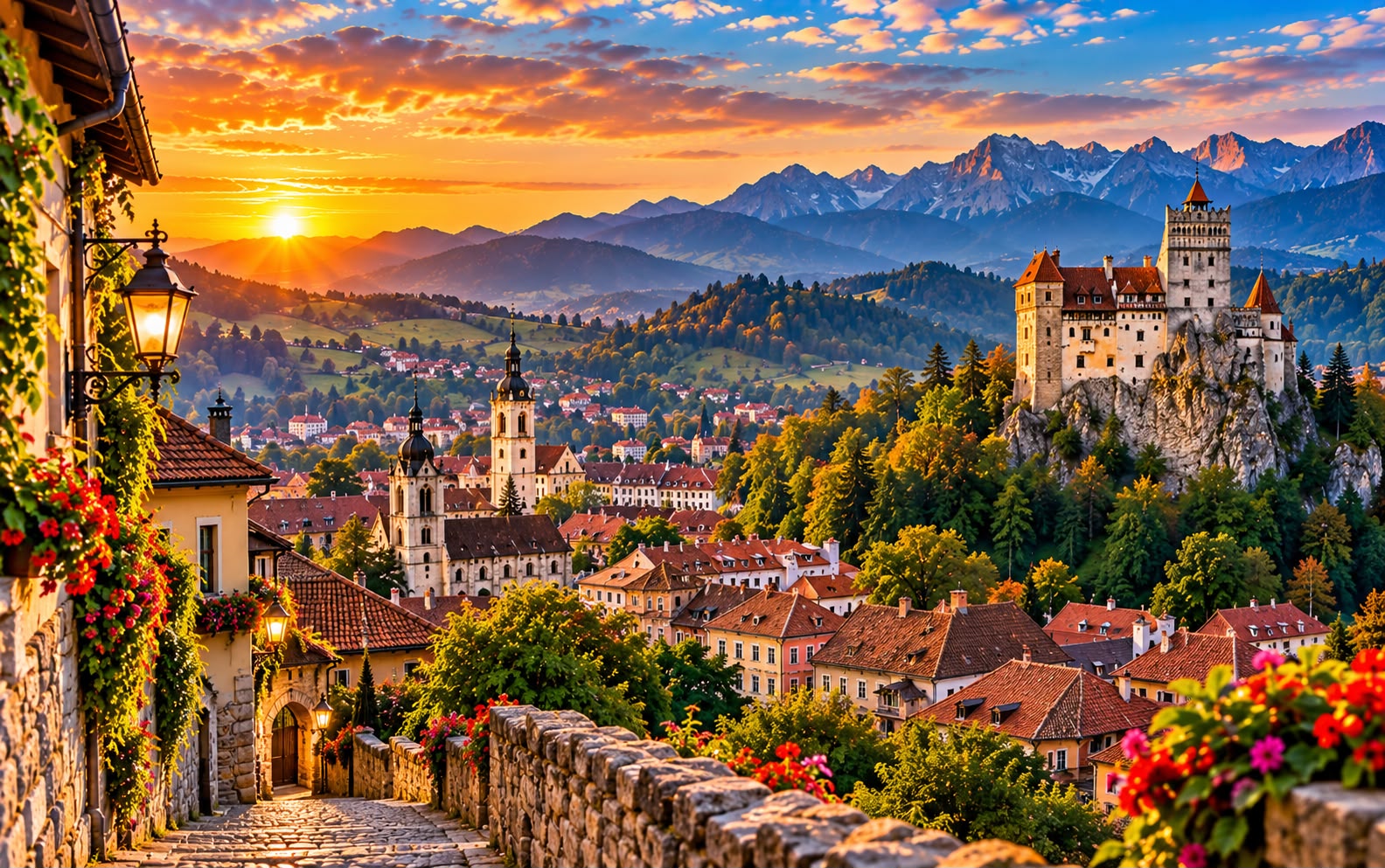
Romania in 8 days: Transylvania, Bucharest and the mountains
Saxon towns with watchtowers and pastel squares, fortified churches in villages that have not changed in centuries, a mountain road engineered by a dictator's vanity, and the castle everyone calls Dracula's — with the honest version of that story, the driving, and why Romania is the best-value country in the EU.
- Eastern Europe
- 8 days
- ≈ AED 4,000 / person
- Castles + old towns
Before you go
Transylvania is not what the films made of it. It is a high plateau ringed by the Carpathians, settled eight hundred years ago by German speakers who built fortified churches and walled towns, and left behind some of the best-preserved medieval streetscapes in Europe. Then it is villages of hay ricks and horse carts that look like a century ago, because in parts they still work that way.
Brașov sits under a forested mountain with a Gothic church so soot-blackened it is called the Black Church. Sighișoara is a walled citadel with a clock tower and a house where Vlad Țepeș was born. Sibiu has pastel squares and roofs with eyes.
And yes, Bran Castle is marketed as Dracula’s. The honest version of that is below — it is worth visiting anyway.
Romania is also the best-value country in the European Union by a clear margin, which makes eight days here cost what four would in the west.
Before you go: driving, Dracula and the Schengen question
Entry, and where Romania now sits
- Romania joined the Schengen area — air and sea borders first, land borders following — so the same visa rules apply as the rest of the area. The process is in our Schengen visa guide.
- It is not in the euro. Romania uses the leu (RON), and will for some years yet.
- Visa-free nationalities need only a passport.
Drive, and here is why
- Hire a car. This is the rare European route where the car genuinely beats the train: the Saxon villages, the fortified churches and the mountain roads are where the trip lives, and none of them is on a rail line.
- Roads are good between cities and rough in villages. A normal car is fine; drive in daylight.
- Horse carts, dogs and unlit cyclists share rural roads. Speeds are low for good reason.
- The Transfăgărășan — the mountain road built on Ceaușescu’s orders, hairpinning to over 2,000 m — is only open roughly July to October, weather permitting. Outside that window it is closed by snow and there is no argument to be had with it. The Transalpina nearby has the same seasonality.
- If you would rather not drive, trains link Bucharest, Brașov, Sighișoara and Sibiu, slowly but cheaply, and you lose the villages.
The Dracula question, honestly
- Bram Stoker never visited Romania. He took a name from a history book and a setting from a travelogue.
- Vlad III Țepeș was a real fifteenth-century ruler, brutal by modern standards and a national hero for resisting the Ottomans. He was born in Sighișoara.
- Bran Castle has almost no connection to either of them. It is a genuine, handsome fourteenth-century fortress that was assigned the Dracula story for tourism. Go for the castle, not the myth.
- Corvin Castle at Hunedoara is the more spectacular building if castles are why you came.
Money and the practicalities
- The leu, and prices will feel low. A good restaurant meal costs what a sandwich does in western Europe.
- Cards are widely accepted in cities; carry cash for villages, church donations and small guesthouses.
- Tipping around 10% is normal.
- Guesthouses (pensiuni) are the best accommodation on this route — family-run, often with breakfast and dinner included, and far nicer than the hotels at the same price.
When to go
- May to September is the season. July to October if you want the Transfăgărășan open.
- September is the sweet spot: warm, harvest-time, and the mountain road still open.
- Winter is cold and rural roads become difficult, though Brașov’s Christmas market is lovely.
Day by day
Day 1 — Land in Bucharest
- 14:00 — Land at Otopeni (OTP), 17 km north. The 783 bus runs to the centre; a taxi should be ordered from the official app terminals in arrivals rather than taken from a tout.
- 15:30 — Drop bags. Leave the car hire until you head north on day two — Bucharest traffic and parking are not worth a day of paying for a vehicle you will not use.
- 16:30 — The Palace of the Parliament from outside: the heaviest building in the world, 365,000 m², built by Ceaușescu at the cost of a fifth of historic Bucharest, which was demolished for it. The interior tour needs booking and a passport; the scale from the boulevard tells you most of it.
- 18:00 — Calea Victoriei and the Revolution Square balcony where Ceaușescu’s last speech turned on him in December 1989. The memorial is in the square.
- 19:30 — The Old Town — Lipscani — for dinner. Caru’ cu Bere is the beer hall everyone photographs; the back streets feed you better.
Day 2 — Bucharest, then north
- 09:30 — The Village Museum on Herăstrău lake: 300 original rural buildings — houses, churches, windmills, a sunken dwelling from Transylvania — moved here from across the country. Two hours, and it sets up everything you will see over the next week.
- 12:00 — Collect the car, and lunch.
- 13:30 — Drive north to Brașov, about three hours, up the Prahova Valley between the Bucegi mountains.
- 17:00 — Arrive. Brașov is a Saxon town founded by German settlers in the 13th century, and it looks it.
- 18:00 — Piața Sfatului, the council square, with the old town hall in the middle and cafés on every side.
- 20:00 — Dinner. Romanian food is heavier than you expect — sarmale, mămăligă, ciorbă de burtă if you are brave.
Day 3 — Brașov and Bran
- 09:00 — The Black Church, the largest Gothic church between Vienna and Istanbul, named for the soot that blackened it after the Habsburg fire of 1689. Its collection of Anatolian carpets, donated by Saxon merchants, is the biggest outside Turkey.
- 10:30 — Strada Sforii — Rope Street — one of the narrowest in Europe at 1.1 m, and 80 m long.
- 11:30 — The Tâmpa cable car for the view down over the terracotta roofs, with the Hollywood-style BRAȘOV sign on the ridge.
- 13:30 — Lunch, then drive 30 minutes to Bran.
- 14:30 — Bran Castle. Be clear about what it is: a real 14th-century border fortress with a genuine Habsburg royal history, and essentially no connection to Vlad Țepeș or to Stoker’s novel. Go for the building and the Queen Marie rooms, not the Dracula gift shops below it.
- 16:30 — Râșnov fortress on the way back — a peasant citadel on a hill, emptier than Bran and with much better views.
- 19:30 — Back in Brașov.
Day 4 — Peleș, and the Saxon villages
- 08:30 — Drive to Sinaia, an hour south.
- 09:30 — Peleș Castle, and it is the most beautiful building in Romania: a neo-Renaissance summer palace built for Carol I in the 1870s, with 160 rooms of carved walnut, Murano glass and a retractable glass ceiling. It had electricity and a central vacuum system before most European palaces. Closed Mondays and Tuesdays — check before you drive.
- 12:00 — Pelișor next door, the art-nouveau smaller one, if you want more.
- 13:00 — Lunch, then drive east into the Saxon villages.
- 15:30 — Viscri or Biertan: fortified churches built by German settlers so that an entire village could shelter inside the walls during Ottoman raids. UNESCO-listed, frequently empty, and Viscri’s lanes still have horse carts on them.
- 18:00 — A village pensiune. Dinner is cooked by your hosts from what they have, and it is the best meal of the trip.
Day 5 — Sighișoara
- 09:30 — Drive to Sighișoara, an hour or so.
- 10:30 — The citadel, and the thing that distinguishes it: it is the last inhabited medieval citadel in Europe — people live in the houses, children go to school up here, and it is not a preserved shell.
- 11:00 — The Clock Tower with its wooden figures that turn at midnight, and the history museum inside it.
- 13:00 — Lunch inside the walls. The house where Vlad Dracul lived is a restaurant now; the sign is more interesting than the food.
- 15:00 — The covered stairway — 175 roofed steps built so schoolchildren could climb in winter — up to the Church on the Hill and the German cemetery behind it.
- 16:30 — The lanes, which take an afternoon and no plan at all.
- 19:30 — Dinner inside the walls, when the day visitors have gone.
Day 6 — Sibiu
- 09:30 — Drive to Sibiu, about two hours.
- 11:30 — The Piața Mare and Piața Mică, the large and small squares, with the Bridge of Lies between them — cast iron from 1859, and the story is that it creaks when someone lies on it.
- 13:00 — Lunch. Sibiu eats well — it was European Capital of Culture in 2007 and has not let it slip.
- 14:30 — The Brukenthal Museum, one of the oldest in Europe, in the baron’s own baroque palace.
- 16:00 — Climb the Council Tower, then walk the old walls and the Lower Town below them.
- 18:00 — Look up: the roofs have eyelid dormers, narrow slits that look exactly like half-closed eyes watching the street. Once you see them you cannot stop.
- 20:00 — Dinner.
Day 7 — The mountain road, or the gorge
- In season (roughly July–October), 08:00 — The Transfăgărășan, built by Ceaușescu through the Făgăraș ridge: hairpins to 2,042 m, Bâlea Lake at the top, a tunnel through the mountain, and the Vidraru dam on the south side. Allow the whole day — it is 90 km that takes four hours of driving plus stops, and the pass is closed by snow the rest of the year.
- Out of season, 09:00 — Corvin Castle at Hunedoara instead, two hours west. Drawbridge, towers, and a courtyard — this is the castle Bran pretends to be, and almost nobody outside Romania has heard of it.
- 17:00 — Begin the drive back toward Bucharest, or sleep at Curtea de Argeș or Pitești to break it.
- 20:00 — Dinner wherever you land.
Day 8 — Fly home
- Morning — Bucharest is about four hours from Sibiu, less if you slept en route. Leave margin: the Prahova valley road backs up badly on Sunday afternoons.
- Return the car with time in hand and check the fuel policy.
- Note — Romania uses the leu, not the euro, despite being in the EU. Spend them; they are awkward to change anywhere else.
Costs and practicalities
Best time to visit
May–September, with the Transfăgărășan’s own calendar the hard constraint on any mountain itinerary.
- May–June — the best of spring. The Carpathians green, the painted monasteries of Bucovina at their best, and the hay meadows of Maramureș in flower.
- July–August — warmest and busiest, and the Transfăgărășan highway is usually open only from late June or early July to late October. The Transalpina has a similar window.
- September–October — autumn colour, the wine harvest, and the quietest good month. Bear activity is high before hibernation.
- November–April — cold and snowy, with skiing at Poiana Brașov and the Carpathian villages at their most atmospheric. The high roads are shut.
Bran and Peleș castles are open year-round; Peleș closes on Mondays and in November for maintenance.
Travel tips
- Check the Transfăgărășan’s opening dates before planning around it. They move each year with the snow and it is closed far more of the year than it is open.
- The leu, not the euro. Decline dynamic currency conversion at card machines.
- Romania joined Schengen fully in 2025 — land borders with Hungary and Bulgaria are now open.
- Bears are genuinely present in the Carpathians and roadside feeding has made them bold. Do not stop to photograph them from a car, and do not leave food at a guesthouse.
- Rural guesthouses — pensiuni — are the best of Romania and often half-board, cash, and excellent value.
- Trains are slow; the roads are better. Hiring a car is the way to do Transylvania and Maramureș.
- Dress modestly at the painted monasteries — they are working religious houses, not museums.
What this trip actually costs
Two people, 7 nights, mid-range, excluding international flights:
| Item | Cost |
|---|---|
| Guesthouses and hotels, 7 nights | RON 3,800 (≈ AED 2,916) |
| Car hire, 7 days, and fuel | RON 2,200 (≈ AED 1,688) |
| Bran, Peleș, Corvin, fortified churches, cable car, museums | RON 900 (≈ AED 691) |
| Food and drink, 8 days | RON 2,500 (≈ AED 1,919) |
| eSIM, tolls, extras | RON 1,000 (≈ AED 767) |
| Total for two | RON 10,400 (≈ AED 7,981) |
- Roughly RON 5,200 (≈ AED 3,991) per person — the lowest European total on this site, and not by a small margin.
- Guesthouses with half board are the best value available here and usually the best meals of the trip.
- Fuel and the car are the largest lines; everything else is inexpensive.
What to pack
- Layers. Transylvania sits high and the evenings cool sharply even in August.
- Walking shoes for citadel cobbles and church hills.
- A rain jacket — mountain weather changes fast.
- European Type C/F plugs.
- Cash in small notes for village churches, which often ask a few lei from a caretaker with a key.
FAQ
Do I have to drive? Not strictly — the trains connect the cities — but the Saxon villages and the mountain roads are the best of the country and the train does not reach them.
Is Bran Castle worth it? As a castle, yes. As a Dracula site, it is a marketing exercise. Go knowing that and you will enjoy it; go expecting Stoker and you will not.
Is the Transfăgărășan open when I am there? Only roughly July to October. Check before building a day around it, and have Corvin Castle as the alternative.
Is Romania cheap? It is the best value in the EU by a distance. Expect good food and comfortable guesthouses at a fraction of western European prices.
Prices and entry rules change, and what you need depends on your passport; last checked 8 October 2026, so confirm with the embassy or your airline before booking.


