 The Itinerary
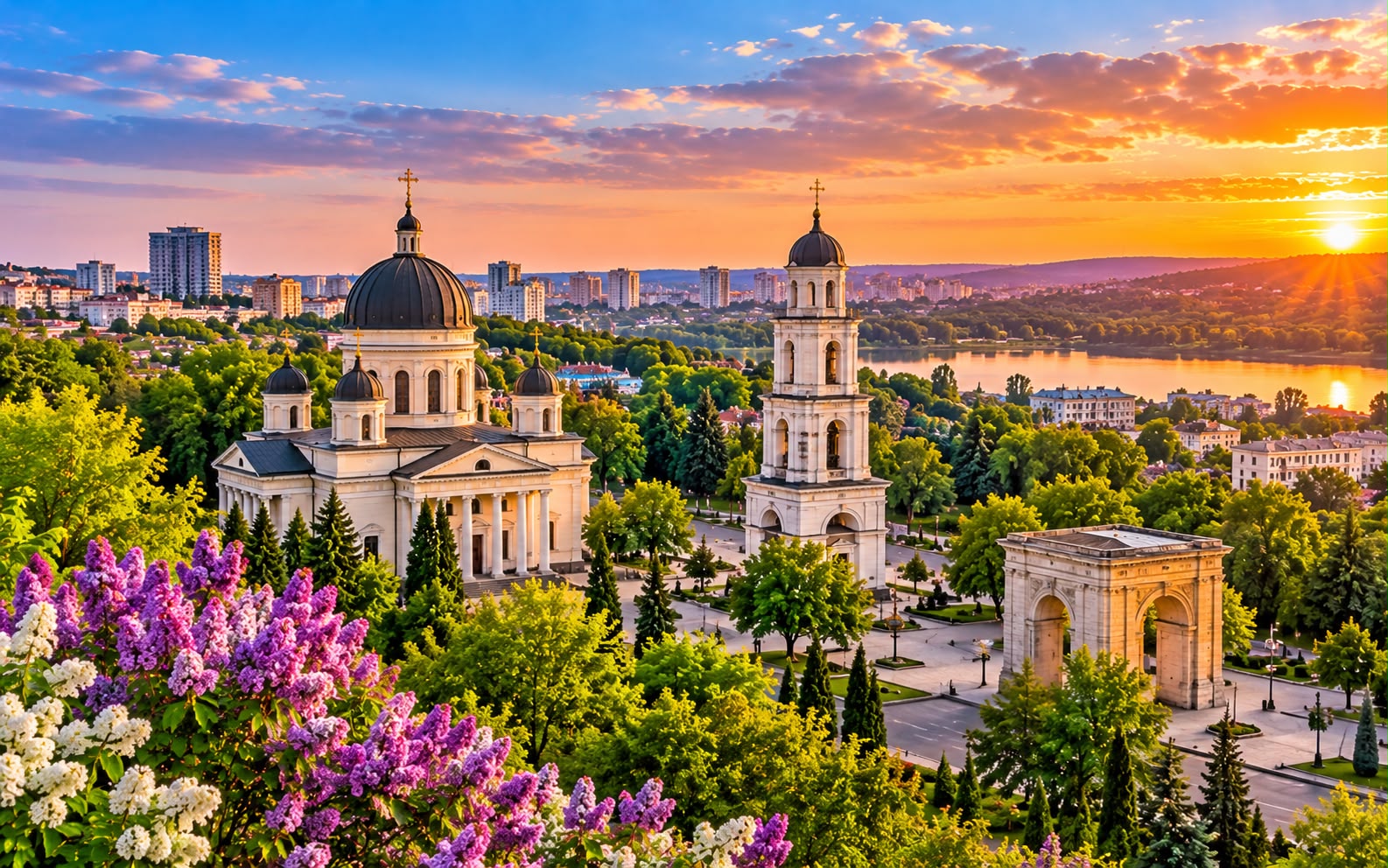
Moldova in 5 days: wine cellars, a cave monastery and Europe's least visited country
Two hundred kilometres of limestone tunnels holding the largest wine collection on earth, a monastery dug into a cliff above a river bend, a breakaway republic with its own non-convertible currency, and the cheapest week in Europe — in the country fewer people visit than any other on the continent.
- Eastern Europe
- 5 days
- ≈ AED 1,450 / person
- The world's largest wine cellar, and a monastery cut into a cliff
Before you go
Moldova is the least visited country in Europe, which is the first thing anyone writes about it and the least interesting. Here is the more useful version.
It has more vineyard per head than anywhere on earth, and the two cellars under the villages south of the capital are not wineries with a tour bolted on — they are limestone mines, worked out and repurposed, with roads inside them. Mileștii Mici runs to around 200 kilometres of tunnel and holds the largest wine collection in the world, which is a Guinness record and also just a fact about the place. You tour it by vehicle, because walking it is not realistic. Cricova, closer to town, has about 120 kilometres of tunnel with street signs naming each one after the wine stored down it.
Orheiul Vechi is the image of the country: a monastery cut into the limestone cliff above a bend in the Răut, with a village of stone houses on the ridge behind it and nothing modern in the frame. Monks dug it in the thirteenth century and monks are back in it now.
The wine is genuinely good and barely exported — Fetească Neagră and Rara Neagră are grapes grown almost nowhere else — and Purcari, founded in 1827, was winning medals in Paris in 1878.
And it is cheap. Not Balkan cheap: cheaper. Five days runs about EUR 360 (≈ AED 1,474) per person excluding flights. Go May–June or September–October; the first weekend of October is National Wine Day, when the whole industry sets up in the main square in Chișinău, and it is the best week of the year to be here.
Before you go: the 15-minute admin
Transnistria is a separate decision
- A strip of land along the Dniester calls itself Transnistria and has run its own affairs since 1992. No UN member recognises it. Moldova considers it Moldovan; in practice it has its own checkpoints, administration and currency.
- Several foreign ministries advise against travel there, and that advice has been firmer since 2022 because of the war across the border in Ukraine. Check what your own government currently says, and check it close to the date — this is the one piece of planning here that genuinely moves.
- If you do go: you pass a checkpoint and register your stay. Take your passport, expect questions, and allow far more time than the distance suggests.
- The Transnistrian rouble is not convertible anywhere else and cannot be spent, changed or taken out meaningfully. Change a small amount, spend it, and do not expect cards to work.
- Photographing checkpoints, soldiers and government buildings is a bad idea and is the usual cause of trouble.
- This itinerary does not route through it. Day 4 offers it as an alternative, flagged, so the decision is yours and not one you make by accident.
Visas and entry
- Many nationalities — including EU, UK, US, Canadian, Australian and Japanese passport holders — enter visa-free for short stays. Moldova has been an EU candidate country since 2022 and entry has been getting simpler, not harder.
- Check your own case on the official government site.
- Moldova borders Ukraine, and while the country itself is calm and functioning normally, read your government’s current travel advice before you book rather than assuming it reads the same as last year.
Money
- The Moldovan leu (MDL). Not the Romanian one — they share a name and are different currencies.
- Chișinău takes cards almost everywhere. Outside it, carry cash: village churches, rural guesthouses and smaller wineries are cash-only.
- Exchange offices in the capital are plentiful and give better rates than the airport.
- Prices are the lowest in Europe. A good dinner for two with a bottle of local wine comes in around €30.
Booking the cellars, which you must do in advance
- Cricova and Mileștii Mici are not walk-in attractions. Both are working industrial cellars and both require a booked tour with a guide and a vehicle. Turning up at the gate does not work.
- Book at least a few days ahead, more in September and October. Tours run in Romanian, Russian and English — ask for English explicitly when you book.
- Both include tastings, and you will be driving. Either hire a driver for the cellar day or put the two cellars on the day you are not at the wheel. This catches people out.
SIM and data
- Local SIMs from Orange or Moldcell are cheap and sold at the airport. EU roaming does not apply.
- Coverage is good along the main roads and patchy in the countryside.
Getting around
- Chișinău airport is 13 kilometres from the centre, fifteen minutes by taxi.
- A hired car works on the main routes and is the cheapest way to reach Orheiul Vechi and Purcari. Secondary roads are poor; a sealed road on the map is not always a good one.
- A driver for the day costs little more than the hire car — around €60–70 — and solves the tasting problem. For a wine trip it is the better answer.
- Everything in this itinerary is within 90 minutes of the capital.
Travelling with kids?
- Wine cellars are the trip, and children are generally allowed on the tours but it is a long time underground in the cold.
- Orheiul Vechi is the one they will remember — a cliff, a cave, a river and a long view.
- Valea Morilor park in Chișinău has a lake, a beach and enough space to run.
- Monasteries want covered shoulders and knees, and women are usually asked to cover their heads.
Day by day
Day 1 — Chișinău
- Afternoon — Land, taxi in, check in. The city is low-rise, green and much more pleasant than its Soviet reputation.
- 16:00 — Ștefan cel Mare park and the statue of Stephen the Great at its head, then the Triumphal Arch and the Nativity Cathedral behind it in the central square.
- 17:30 — The National Museum of History, which handles a complicated past — Ottoman, Russian, Romanian, Soviet, independent — more honestly than you might expect.
- 19:30 — Dinner. Chișinău’s restaurant scene has improved sharply and the wine lists are the cheapest good ones in Europe.
Where to stay in Chișinău (four nights, unpacked once)
- Mid-range: the centre around Ștefan cel Mare boulevard, walkable to everything on this day.
- Value: the streets behind the cathedral, ten minutes out and half the price.
Day 2 — The cellars
- 09:30 — Cricova, 15 kilometres north. You go in by vehicle and drive the underground streets, each signposted with the name of the wine stored along it. The tasting rooms are cut into the rock at the far end.
- 13:00 — Lunch back in the city.
- 15:00 — Mileștii Mici, 20 kilometres south, and the bigger of the two: around 200 kilometres of tunnel, of which perhaps 55 are in use, holding the largest wine collection in the world. The scale is the point — you are driven past racks for a quarter of an hour before anything is poured.
- 18:30 — Back to Chișinău. Have a driver today. Two cellars and two tastings is not a day to be behind a wheel.
Day 3 — Orheiul Vechi
- 09:00 — Drive north-east, about an hour.
- 10:00 — Orheiul Vechi. The cave monastery is cut into the limestone cliff above the Răut, reached through a tunnel in the rock, with a small church and cells inside and a terrace looking out over the river bend. There has been something here since the Dacians; monks dug this in the thirteenth century and returned to it in the 1990s.
- 12:00 — The village of Butuceni on the ridge, all stone and whitewash, with the archaeological complex — Geto-Dacian, Golden Horde, Moldavian — spread across the plateau around it.
- 13:30 — Lunch in a village guesthouse. This is the best food on the trip: home cooking, home wine, and plăcinte straight out of the pan.
- 16:00 — Back via Căpriana Monastery if the light holds — one of the oldest in the country, set in the Codri woods, and the burial place of its own medieval patrons.
Day 4 — Purcari and the south-east
- 09:00 — Drive south-east towards the Dniester, about an hour and a half through the vineyards.
- 10:30 — Purcari, founded in 1827 and the oldest working estate in the country. Negru de Purcari took a gold medal at the 1878 Paris exhibition and the estate has been trading on it ever since, fairly. The grounds have been restored into something closer to a Bordeaux château than anything else in Moldova.
- 13:00 — Lunch at the estate, then Castel Mimi on the way back — a nineteenth-century château winery restored into the most photogenic building in the country.
- 17:00 — Back to Chișinău.
The alternative: Tiraspol. If — and only if — your government’s current advice and your own judgement allow it, Day 4 is the day people use for Transnistria: Tiraspol’s Soviet-era main street, the tank monument, and the Bender fortress on the way. Read the section above first. It is a long day, it involves a checkpoint, and it is not a casual add-on.
Day 5 — Fly home
- Morning — The Central Market for a last hour, and a bottle of something you will not find at home. Moldovan wine is barely exported, which is the best argument for carrying it.
- Midday — Airport, fifteen minutes.
Costs and practicalities
Best time to visit
May–June and September–October. Moldova is continental — hot summers, cold winters — and the wine calendar makes autumn the obvious choice.
- May–June — green, warm, and the vineyards in leaf. Comfortable for walking in Orheiul Vechi.
- July–August — hot, up to 35°C, and the quietest for visitors.
- September–October — the best of the year. The grape harvest, and National Wine Day on the first weekend of October, which fills Chișinău’s main square with every winery in the country.
- November–March — cold, grey, and snowy. Cricova and Mileștii Mici are underground and the same temperature all year, which makes them a good winter day.
Mileștii Mici has the largest wine cellar in the world — over 200km of galleries — and you tour it by car.
Travel tips
- Book the big cellars ahead. Cricova and Mileștii Mici are not walk-up; tours are scheduled and include a driver taking you through the tunnels.
- Do not drive to a wine tasting. Moldova has a zero-tolerance drink-driving limit and enforces it.
- Transnistria is a separate matter. It is a breakaway region with its own border controls, its own currency and no international recognition. Day trips run from Chișinău; check current advice, carry your passport, and keep the entry slip you are given.
- Cash is common outside Chișinău. The leu is the currency; cards work in the capital.
- Romanian is the language and is mutually intelligible with Romanian proper; Russian is widely spoken.
- Rural guesthouses are the best of Moldova and often cash-only.
- Marshrutkas cover the country and leave when full from the central bus stations.
What this trip actually costs
Two people, 4 nights, mid-range comfort, flights excluded:
| Item | Cost |
|---|---|
| Hotels, 4 nights | EUR 200 (≈ AED 819) |
| Car hire, 3 days + fuel | EUR 170 (≈ AED 696) |
| Food and drink, 5 days | EUR 170 (≈ AED 696) |
| Cellar tours and tastings | EUR 140 (≈ AED 573) |
| Monastery, museums, entrances | EUR 40 (≈ AED 164) |
| Total for two | EUR 720 (≈ AED 2,948) |
- Roughly EUR 360 (≈ AED 1,474) per person — the cheapest week in Europe, and not by a small margin.
- Swap one day’s car hire for a driver on the cellar day. It costs about €20 more and removes the only real problem with a wine itinerary.
- National Wine Day, the first weekend of October, fills the capital’s hotels. Book early or go the week after.
- Hotel picks here are chosen on location, not on commission — always check prices and recent reviews before booking.
What to pack
- A warm layer for the cellars. They hold around 12–14°C all year and you will be down there for two hours.
- Covered shoulders and knees for the monasteries, and a scarf for women’s heads.
- Cash in lei for villages, guesthouses and churches.
- Shoes you do not mind on rough ground — the cave monastery and the Butuceni ridge are both uneven.
- Space in the bag for bottles, which is the standard mistake.
FAQ
Is Moldova safe? Moldova itself is calm, with low crime and ordinary tourism. The complications are Transnistria and the fact that Ukraine is across the border — neither of which affects a trip to Chișinău, the cellars and Orheiul Vechi, but both of which mean you should read your government’s current advice rather than a guide written last year.
Do I have to visit Transnistria? No, and this itinerary deliberately does not. It is a separate decision with its own risks, covered above.
Is the wine actually good? Yes, and it is the main reason to come. Moldova has been making wine for centuries, was the Soviet Union’s vineyard, and kept indigenous grapes that exist almost nowhere else. Barely any of it reaches Western shelves.
Can I combine it with Romania? Easily — Iași in Romania is close to the border and there are trains and buses between the two countries. Bucharest to Chișinău is a short flight.
What language do they speak? Romanian, called Moldovan in some official contexts and the same language. Russian is widely spoken, especially by older people and in Transnistria. English works in Chișinău hotels and tour companies and not much beyond them.
Prices and entry rules change, and what you need depends on your passport; last checked 8 October 2026, so confirm with the embassy or your airline before booking.


