 The Itinerary
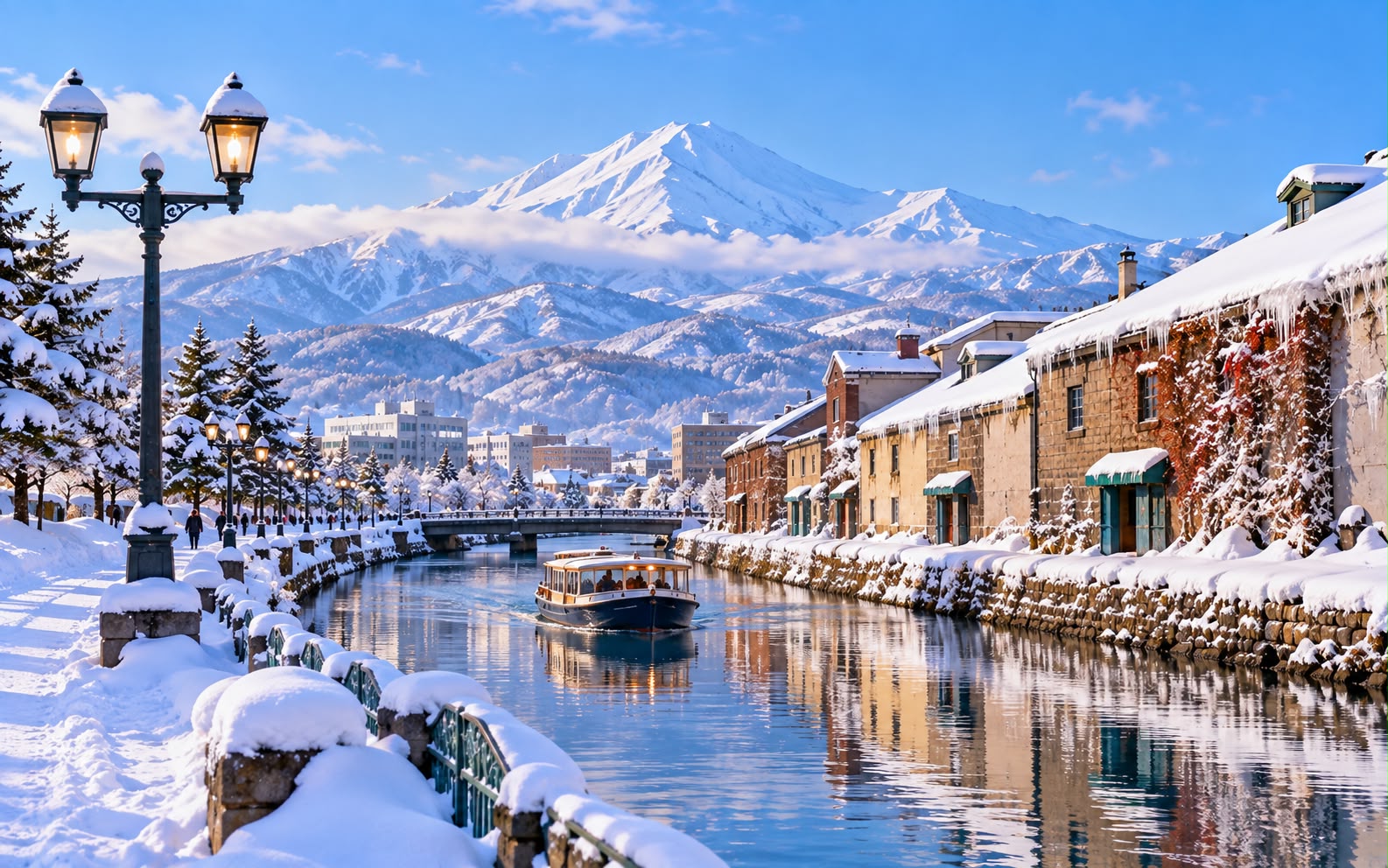
Hokkaido in winter: snow festivals, penguins and powder
February in Japan's snow country — the Sapporo Snow Festival, Otaru's candlelit canal, marching penguins in Asahikawa, a beginner-friendly powder day in Furano, and a steaming hell-valley onsen night.
- East Asia
- 8 days
- ≈ AED 4,150 / person
- Winter travellers
Before you go
Hokkaido is Japan running a different operating system: wider streets, bigger portions, and metres of the driest snow on earth falling on cities that simply carry on. For one week in early February, it becomes the best winter destination in Asia — Sapporo builds a city of snow sculptures, Otaru lights its canal with candles, penguins parade through a zoo, and the powder that made Hokkaido famous falls fresh most nights.
This is winter done in comfort — heated trains between every stop, ramen at every low point — which makes it the friendly sibling of our Siberian winter expedition: same season, same latitude-ish magic, none of the −50°C.
Go the first half of February. The Sapporo Snow Festival runs 4–11 February 2027, Otaru’s Snow Light Path usually overlaps its second half (dates confirmed each autumn), the penguin walk is in full swing, and the powder is peak. Book hotels 3–6 months out — festival week doubles Sapporo prices and sells out.
All costs are in Japanese yen (JPY), with conversions calculated at today’s exchange rate. Opening hours are approximate — treat anything marked ~ as a guide, not a contract.
Before you go: the short version of the admin
Visas, money, Suica and eSIMs are identical to our first Japan guide, where they’re covered in depth. Route-specific notes:
Getting there, and no rail pass
- Getting to Hokkaido: fly into New Chitose (CTS) via Tokyo — Haneda⇄CTS is ~1.5 h and one of the busiest air routes on earth (ANA, JAL, and LCCs like Peach). Book festival-week seats early; they surge like the hotels.
- No rail pass needed — this route’s trains bought point-to-point total ~¥21,000 per person.
- IC card caveat: Suica covers Sapporo and the main JR lines, but several local buses (including the Asahiyama Zoo bus) are cash only — keep coins and small notes handy.
Weather, and booking ahead
- Weather is a feature and a variable: heavy snow occasionally delays trains and cancels the penguin walk. Build slack, don’t stack tight connections, and pack proper boots — pavements are polished ice.
- Book ahead: festival-week hotels (3–6 months), the Noboribetsu ryokan, and any Biei winter tour. Ski rental and lessons can wait until arrival.
Travelling with kids?
- Hokkaido in February might be Japan’s best family trip: the Snow Festival’s Tsudome site is literally a snow-play park (rafting, slides, mazes; 10:00–16:00), the penguin walk is peak-childhood material, and Furano’s beginner slopes teach kids free (under-12 lift passes cost nothing).
- Cold is manageable (−5 to −10°C days) but constant: proper snowsuits, waterproof gloves, and a sled beats a stroller on snow-packed pavements.
- Trains between every city mean no long car seats.
Day by day
Day 1 — Land, ramen, first ice sculptures
- Afternoon — Fly into New Chitose, rapid train to Sapporo (~40 min, ~¥1,150). Check in near Odori or Susukino.
- 17:30 — If the festival is on, start with the Susukino Ice World site — a hundred crystal-clear ice sculptures (some with whole crabs and salmon frozen inside), lit until 23:00, right in the neon district.
- 19:00 — Dinner in Ganso Ramen Yokocho — the narrow alley where Sapporo’s miso ramen was born; 17 counters, steam on the windows, ~¥1,000–1,400 a bowl. The queue moves; join it.
Where to stay in Sapporo (three nights — book far ahead for festival week)
- Upscale: JR Tower Hotel Nikko Sapporo — above the station: big rooms, big views, zero snow-trudging with luggage.
- Mid-range: Solaria Nishitetsu Hotel Sapporo — between the station and Odori Park, public bath to thaw in.
- Budget: Sotetsu Fresa Inn Susukino — small, clean, in the middle of the nightlife and noodles.
Day 2 — The Snow Festival day
The festival’s three sites, all free:
- 9:30 — Odori Park — the main event: ~200 snow sculptures along 1.5 km, from building-sized palaces to fan-made anime heroes, best photographed in morning light before the crowds peak.
- 12:00 — Lunch from the festival food stalls (grilled Hokkaido corn, butter potatoes, hot wine) or duck into the Nijo fish market area for a crab-and-uni rice bowl (~¥2,500–4,000).
- 13:30 — Tsudome site (10:00–16:00; free entry, small fees for some slides) — snow rafting and slides; the family afternoon. Non-family alternative: the Okurayama Ski Jump Observatory (~9:00–17:00 winter, lift ~¥1,000) — stand at the top of the 1972 Olympic jump with the whole white city below.
- 17:00 — Sapporo Beer Museum (closed Mon; ~11:00–18:00, free entry, tastings ~¥400–800) in the old red-brick brewery, then a Genghis Khan (grilled lamb) dinner in the beer hall next door (~¥3,000–4,500).
- 20:00 — Back to Odori for the night illuminations and projection mapping (lit until 22:00) — the sculptures are better after dark.
Day 3 — Otaru: canal, glass and candlelight
- 9:30 — Train to Otaru (~40 min, ~¥750) — the herring boom town turned prettiest port in Hokkaido.
- 10:30 — Sakaimachi Street: stone warehouses full of glassblowers (Kitaichi Garasu), the Music Box Museum with its steam clock, and LeTAO’s cheesecake — Otaru’s edible landmark.
- 13:00 — Sushi lunch — Otaru’s harbour standing means its conveyor-belt shops embarrass most cities’ top counters (~¥2,500–4,000); the famous splurge counters on Sushiya-dori run higher.
- 15:00 — The canal in daylight, then the Temiya line — an abandoned railway that becomes a candlelit snow path during the festival.
- 17:00 — Otaru Snow Light Path (usually ~10 Feb days overlapping the Sapporo festival; 17:00–21:00) — thousands of candles in hand-carved snow lanterns, floating lights on the canal, gas lamps in the snowfall. The most romantic hour in winter Japan; it’s also why you stay past dark.
- 20:30 — Train back to Sapporo; late soup curry — Sapporo’s other signature dish (~¥1,300–1,800) — near the hotel.
Day 4 — North to Asahikawa: the penguin walk
- 9:00 — Limited express Lilac/Kamui to Asahikawa (~1h25, ~¥5,000). Drop bags at the station lockers or hotel.
- 10:45 — Bus 41/47 from station stop 6 to Asahiyama Zoo (~40 min, ¥500 cash only).
- 11:30 — Asahiyama Zoo (winter ~10:30–15:30, last entry 15:00; ¥1,000, kids free) — Japan’s famous “behaviour” zoo: seals torpedoing through a glass tube, polar bears diving at the window.
- 14:30 — The Penguin Walk — the reason you came: a waddling column of king penguins parades through the snow at 11:00 and 14:30 daily (roughly mid-December to mid-March; snow-dependent, occasionally cancelled). Claim a front-row spot 15 minutes early; small children get the best sightlines by sitting kerbside.
- 17:00 — Back in town: Asahikawa Ramen Village (eight famous shoyu-ramen shops in one building, ~¥900–1,300) or the izakaya lanes by the station.
Where to stay in Asahikawa (one night)
- Station-side business hotels are the play here (the JR Inn and Dormy Inn class, ~¥9,000–14,000 double) — comfortable, cheap, and 30 seconds from tomorrow’s train.
Day 5 — Biei’s blue pond, then into the hills
- 10:00 — Join a Biei winter tour (half-day, ~¥6,000–10,000 per person from Asahikawa/Biei) — in winter the patchwork hills become white minimalist art: the lone Christmas Tree, Shirohige Falls steaming into a blue river, and the Blue Pond winter illumination — the famous pond, frozen and lit at dusk. Tours exist because winter buses are sparse and the sights are spread along icy roads; this is the one day to outsource.
- 17:30 — Local train down the valley to Furano (~40 min from Biei / ~1h10 from Asahikawa, ~¥750–1,300).
- 19:00 — Check in; dinner in town — Furano’s omelette curry is the local dish, and the izakaya scene runs on Hokkaido cheese, potatoes and wine.
Where to stay in Furano (two nights)
- Stay in town near the station for restaurants and the ski shuttle, or ski-in at the resort’s Prince hotels. Town doubles run ~¥12,000–18,000; resort hotels more.
Day 6 — Powder day at Furano
Hokkaido’s snow is the product: cold, dry, abundant. Furano is the friendliest place on the island to meet it.
- 8:30 — Shuttle to Furano Ski Resort (season late Nov– early May; 1-day pass ~¥7,500, children 12 and under free). The Furano Zone’s wide, gentle runs are built for beginners and families; rental gear in town or at the base (~¥5,000–7,000/day full set), English-friendly ski schools take absolute first-timers.
- 12:30 — Lunch on the mountain, or descend for town soup curry.
- 15:00 — Non-skiers and half-day skiers: snowmobiling, banana-boat sledding, or simply the ropeway up for the view.
- 17:00 — Ningle Terrace — a lamplit boardwalk village of craft cottages in the forest, at its best under falling snow.
- 19:30 — Second Furano dinner; night skiing (weekends to 19:30, from ¥2,700) for anyone with legs left.
Day 7 — Across to Hell Valley for the onsen finale
A travel-morning, rewarded: today ends in the best hot-spring town in Hokkaido.
- 9:00 — Train Furano → Sapporo (~2 h via Takikawa, ~¥4,500), then the Limited Express Hokuto to Noboribetsu (~1h10, ~¥3,900); ryokan shuttles or the local bus (~¥380) climb to the onsen village. (~4.5 h door to door — lunch at Sapporo station’s ekiben halls in between.)
- 15:00 — Jigokudani, “Hell Valley” (free, boardwalks open always) — a steaming volcanic crater at the village’s edge: sulfur vents hissing through the snow, the valley glowing at dusk when the footpath lanterns come on. Walk it before dinner while the light is blue.
- 18:00 — The ryokan evening: kaiseki dinner, then the baths — Noboribetsu’s springs deliver nine different mineral waters, and soaking outdoors in falling snow is the image you’ll keep.
Where to stay in Noboribetsu (one night, meals included)
- The famous one: Dai-ichi Takimotokan — 35 baths across seven spring types, a bathing city in itself (~¥22,000–55,000 per person with meals).
- Mid-range: Kashoutei Hanaya — intimate 35-room ryokan, respected kaiseki, gentler prices.
- Budget: Yumoto Noboribetsu — the value pick with real sulfur and salt spring baths and breakfast.
Day 8 — One last bath, fly home
- 8:00 — Morning soak — the baths are emptiest and best at dawn.
- 10:30 — Shuttle to Noboribetsu Station, train toward Sapporo as far as Minami-Chitose, change for New Chitose Airport (~1 h total, ~¥3,500) — the airport itself is very Hokkaido: a ramen street, a chocolate factory outlet and an onsen, in a terminal.
- Afternoon — Fly to Tokyo and connect home.
Costs and practicalities
Tickets and day trips
Snow Festival shuttles, Asahiyama Zoo entry and ski-day packages book out through February. Compare both before you pick.
Getting there
Fares swing hard by season and by day of the week — moving a trip by a few days is often the biggest single saving on the whole budget.
Best time to visit
The first half of February is the single best fortnight — the deepest reliable snow, the Sapporo Snow Festival, and the drift ice all coinciding.
- December — the season starts; Niseko and Furano open and the powder builds through the month.
- January — the coldest and the driest snow. Niseko averages around 14m of snowfall a season and January is the heart of it.
- Early February — the Sapporo Snow Festival, usually the first week, and the Okhotsk drift ice reaching Abashiri roughly late January to early March, with the icebreakers running then.
- Late February–March — still excellent snow, longer days, and the red-crowned cranes at Kushiro are at their most active in the courtship dance from January to March.
- April onwards — the season ends quickly; lifts close and the lavender season does not begin until July.
Travel tips
- Dress for genuine cold. Minus 15°C with wind is routine. Layers, a proper outer shell, mittens rather than gloves, and boots with grip.
- Winter driving needs studless snow tyres and experience. Hire cars come fitted, but if you have not driven on packed snow, take the trains and buses instead.
- Book Niseko and Furano accommodation by September. Australian and Asian demand fills the good places almost a year ahead.
- The Sapporo Snow Festival fills the whole city. Hotels are booked months before and prices multiply that week.
- Drift ice is not guaranteed. It depends on the Amur outflow and wind; the icebreaker sails regardless and sometimes finds open water.
- Carry cash. Rural Hokkaido is far less card-friendly than Tokyo, and 7-Eleven ATMs are the reliable option.
- Onsen after skiing is the point. Wash thoroughly before entering, and note that tattoos may be refused.
What this trip actually costs
Two people, 7 nights (including one ryokan night with meals), international flights excluded but Tokyo⇄Sapporo included:
| Item | Cost |
|---|---|
| Flights Tokyo ⇄ New Chitose, 2 pax return | JPY 50,000 (≈ AED 1,160) |
| Hotels, 7 nights (3 Sapporo festival week + 1 Asahikawa + 2 Furano + 1 Noboribetsu ryokan w/ meals) | JPY 145,000 (≈ AED 3,363) |
| Trains and local buses across the route | JPY 43,000 (≈ AED 997) |
| Activities: zoo, Biei tour, ski day with rentals, 2 pax | JPY 48,000 (≈ AED 1,113) |
| Food and drink, 8 days | JPY 61,000 (≈ AED 1,415) |
| eSIM, lockers, extras | JPY 9,000 (≈ AED 209) |
| Total for two | JPY 356,000 (≈ AED 8,258) |
- Roughly JPY 178,000 (≈ AED 4,129) per person — festival week is the premium: the same trip in late February or early March (no festivals, same snow and penguins) runs ~20–30% cheaper, and skipping the ski day saves ~JPY 12,000 (≈ AED 278) each.
- Book in this order: Sapporo festival-week hotel (3–6 months out — this is the scarce item) → Tokyo⇄CTS flights → Noboribetsu ryokan → Biei tour → everything else a week out is fine.
- Hotel and restaurant picks here are unsponsored — no affiliate links in this article. Chosen on location and current ratings; always check prices and recent reviews before booking.
What to pack
- Boots with real grip — Sapporo’s pavements are polished ice; strap-on ice cleats (¥1,000 at any convenience store there) are the cheap insurance.
- Proper winter layers: thermal base, fleece, insulated waterproof shell. Days run −4 to −10°C — cold but civilised.
- Waterproof gloves (snow sculptures get touched, snowballs get thrown) and a warm hat that survives wind.
- Sunglasses — sun on fresh snow is blinding.
- Hand warmers, lip balm, moisturiser; the air is desert-dry.
- Swim-modesty is not needed for onsen (bathing is unclothed, gender-separated) — but pack the small towel habit and check tattoo policies or book private baths.
- Ski gear: rent everything there; bring only thermal layers and ski socks.
FAQ
Do I need to hit the festival dates exactly? For the sculptures, yes — Sapporo Snow Festival 2027 runs 4–11 February, and Otaru’s Snow Light Path usually overlaps its second half. But the rest of this route — penguins, powder, blue pond, hell valley — is identical from January through early March, at lower prices. Two different trips: pick sculpture-spectacle or quiet snow.
Is Hokkaido colder than the rest of Japan? Yes, but gently: Sapporo days sit around −4°C, nights −10°C — a Moscow winter, not a Yakutsk one. Everything indoors is heated to tropical levels; dressing in layers matters more than dressing heavy.
Can I do this without skiing? Entirely — the ski day is one modular day. Swap it for a Furano snow-activity morning, more Biei, or a second Otaru evening. The reverse is also true: powder hunters should add Niseko days and treat this route as the cultural half.
Is driving an option? Winter driving in Hokkaido means snow tyres, whiteouts and black ice — locals manage, visitors shouldn’t learn here. The trains cover this whole route; the one gap (Biei’s sights) is exactly what the tour solves.
What about halal / vegetarian food? Sapporo has Japan’s easiest non-Tokyo halal scene outside Osaka — several certified ramen and Genghis Khan restaurants (search current halal listings) — and soup curry is endlessly adaptable. Vegetarians: miso ramen shops usually have a meat-free broth option in tourist areas, but confirm dashi; the ryokan needs advance notice as always.
How does this compare with your Siberian winter trip? Same season, opposite philosophy: Siberia is an expedition where the cold is the destination; Hokkaido is a holiday where snow is the scenery. Do this one first. If you finish it wanting things colder — Yakutsk is waiting.
Prices and entry rules change, and what you need depends on your passport; last checked 23 October 2026, so confirm with the embassy or your airline before booking.


