 The Itinerary
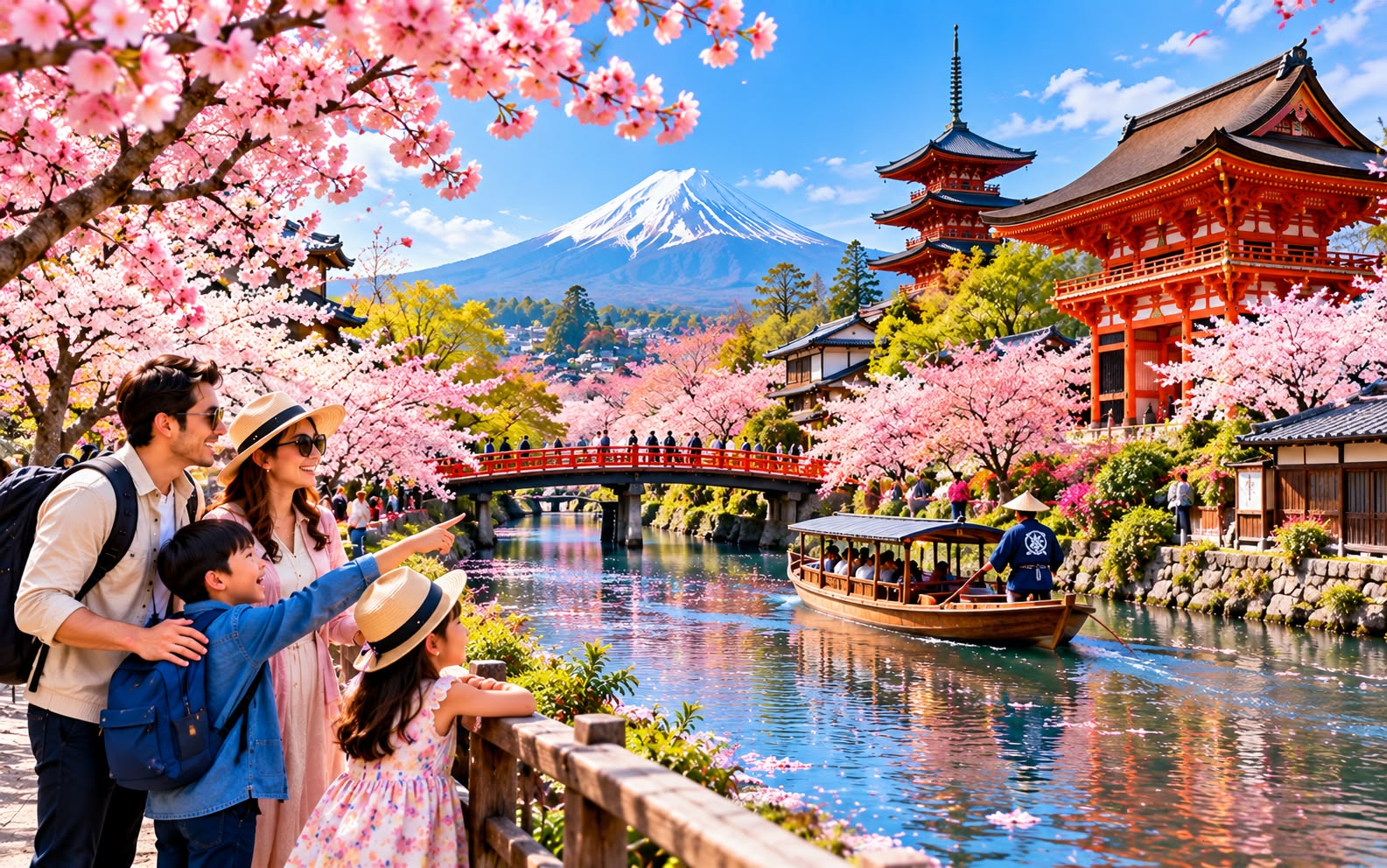
Japan cherry blossom in 7 days: routed around the bloom forecast
Sakura moves by a week or more each year and the forecast only firms up in March, which is the whole planning problem. How the bloom travels north, which Tokyo and Kyoto spots are worth the crowd, the night illuminations, and how to build a route that still works if you guess the week wrong.
- East Asia
- 7 days
- ≈ AED 4,050 / person
- The two weeks the country is at its best, booked before anyone knows the dates
Before you go
Cherry blossom is the only trip on this site where you book the flights before anyone knows the dates. Full bloom lasts about a week at any one place, the date moves by a week or more between years, and the forecasts only become useful in early March — by which time flights and hotels for late March have been gone for months.
The seven-day Japan route works in any season. This is the same spine — Tokyo, Kyoto, Osaka — re-planned so the blossom is the subject, and so that a week either side of peak is still a very good trip.
The hedge is built in: Tokyo blooms earlier than Kyoto most years, so doing Tokyo first and Kyoto second follows the bloom rather than racing ahead of it.
Figure JPY 174,000 (≈ AED 4,036) per person. Late March to mid-April, with the detail below.
Before you go: the admin
Entry
- Visa-free for around 70 nationalities for 90 days, including the GCC states, the EU, the UK and the US.
- Indian passport holders need a visa, applied for in advance; an e-visa is available for some applicants.
- Last checked: 30 October 2026.
How the bloom actually works
- It moves south to north, starting in Kyushu and reaching Hokkaido weeks later. Tokyo and Kyoto are usually within a few days of each other, Tokyo generally first.
- The sequence at one spot is roughly: first bloom, then full bloom about a week later, then petal fall a week after that. “Full bloom” is the few days people mean.
- Private forecasters publish bloom and full-bloom predictions from January, refined through February and March. The January numbers are not reliable; the March ones largely are.
- Warm winters pull the date earlier. The long-term trend has been earlier.
- Elevation buys you time. If the city bloom is over, go up — mountain and northern spots run later.
Booking against an unknown date
- Book flights and hotels for the last week of March into the first week of April. That window catches peak in Tokyo and Kyoto in most years.
- Book refundable where you can. The premium is worth it here.
- Do not book a single-city trip. A route gives you altitude and latitude to play with if you are early or late.
- This is the most expensive and most crowded fortnight of the Japanese year, alongside Golden Week. Rates are double and hotels sell out months ahead.
Practicalities
- Hanami means picnicking under the trees, and it is a real social institution rather than a tourist activity. Join in.
- Popular parks require tarpaulins to be laid early; companies send junior staff at dawn.
- Do not picnic directly under branches at the busiest sites where it is signed, and never shake a tree for petals.
- Forward your luggage between cities — takuhaibin sends bags hotel to hotel overnight — which matters more in a crowded season.
Day by day
Day 1 — Tokyo
- Arrive and go to the park nearest your hotel. Do not schedule day one.
- Chidorigafuchi — the moat beside the Imperial Palace, with rowing boats under the branches and an evening illumination in season. The best single spot in Tokyo and the most crowded.
- Go early or go at night. The middle of the day is a queue.
Day 2 — Ueno, Yanaka and the old city
- 07:30 — Ueno Park. Over a thousand trees along the central avenue, and by ten it is a street party. At half seven it is empty and the light is best.
- 10:00 — Yanaka, the old low-rise quarter nearby — the cemetery avenue is lined with cherries and almost nobody goes.
- 13:00 — Rest.
- 16:00 — Meguro River. Four kilometres of trees arching over a narrow canal, lit at night, with food stalls along it. This is the evening one.
Day 3 — Shinjuku Gyoen, or go up
- 09:00 — Shinjuku Gyoen — a large paid garden with more than a thousand trees of many varieties, which is the point: the late varieties here bloom when everything else has gone. If you are late, this is your insurance.
- No alcohol is permitted inside, which keeps it calm.
- If you are early instead, go south or low — Kawazu on the Izu peninsula blooms in February, and Tokyo’s own early varieties appear in March.
- 14:00 — The shinkansen to Kyoto. Reserve seats weeks ahead in this season.
- 18:00 — Kyoto. Walk the Kamo riverbank.
Day 4 — Kyoto: Philosopher’s Path and Higashiyama
- 07:00 — The Philosopher’s Path early — two kilometres of canal lined with cherries between Ginkaku-ji and Nanzen-ji. By nine it is shoulder to shoulder.
- 09:00 — Nanzen-ji and its aqueduct at the southern end.
- 11:00 — Rest through the middle of the day.
- 16:00 — Maruyama Park, Kyoto’s hanami park, with a famous weeping cherry lit at night.
- 18:30 — Gion and the Shirakawa canal — a short stretch of willow, cherry and old wooden houses that is the best evening walk in the city.
Day 5 — Arashiyama, and the west
- 07:30 — Arashiyama early. The Togetsukyo bridge with the mountain behind it, the bamboo grove, and Tenryu-ji’s garden.
- The hillside cherries here run later than the city — useful if you are at the end of the window.
- 12:00 — The Sagano scenic railway along the gorge if it is running.
- 16:00 — Daigo-ji or Ninna-ji — Ninna-ji’s Omuro cherries are famously among the last to bloom in Kyoto, which makes it the single best late insurance in the city.
Day 6 — Osaka, or Nara
- Osaka Castle — the park has several thousand trees and the castle behind them is the picture. The Nishinomaru garden is paid, calmer and better.
- Or Nara — the deer park has cherries and far more space, and Mount Yoshino is the most famous blossom site in the country, with tens of thousands of trees in four groves at rising elevations that bloom in sequence over about two weeks. It is a long, crowded day and it is the one people travel for.
- Yoshino is the answer if your dates slipped late.
- Evening — Dotonbori, which is the opposite of a quiet garden.
Day 7 — Out
- A last park before the airport.
- Kansai is about an hour from central Osaka.
- Allow three hours. This is a peak season and the airport shows it.
Costs and practicalities
Best time to visit
Late March to mid-April, and the detail is the point.
- Mid-to-late March — southern and early-variety blooms. Tokyo typically opens late in the month.
- Late March to early April — the window that catches full bloom in Tokyo and Kyoto in most years. This is what to book.
- Mid-April — the cities are usually over, but Yoshino’s upper groves, Ninna-ji’s Omuro cherries and northern Japan are still going.
- Late April and early May — Golden Week, the busiest domestic travel period of the year. Avoid.
- Blossom in Hokkaido runs into May, which is the fallback if everything else has finished.
Travel tips
- Book the last week of March into the first week of April, and book refundable.
- Do not plan a single-city trip. A route lets you chase altitude and latitude.
- Check the March forecast, not the January one.
- Every good spot is empty at 07:30 and unbearable at 11:00. This is the single most useful fact on this page.
- Night illuminations are a second chance at the same place, and they are quieter than they used to be.
- Reserve shinkansen seats weeks ahead. This season sells out.
- Forward your luggage between cities.
- Late-blooming varieties are your insurance — Shinjuku Gyoen, Ninna-ji, Yoshino’s upper groves.
- Do not shake branches, and respect the signs about where to sit.
What this trip actually costs
Two people, 6 nights, mid-range hotels at peak-season rates, international flights excluded:
| Item | Cost |
|---|---|
| Hotels, 6 nights at sakura rates | JPY 185,000 (≈ AED 4,291) |
| Intercity rail, two people | JPY 50,000 (≈ AED 1,160) |
| Garden entries and night illuminations | JPY 28,000 (≈ AED 649) |
| Local transport and luggage forwarding | JPY 15,000 (≈ AED 348) |
| Food and drink, 7 days | JPY 70,000 (≈ AED 1,624) |
| Total for two | JPY 348,000 (≈ AED 8,072) |
- Roughly JPY 174,000 (≈ AED 4,036) per person, and the hotel line is where the season shows — the same rooms cost far less in June.
- Most of the best spots are free. Parks, riversides and the Philosopher’s Path cost nothing; the paid gardens are the quiet ones.
- A refundable rate costs more and is worth it when you are booking against a date nobody knows yet.
- Hotel picks here are chosen on location, not on commission — always check prices and recent reviews before booking.
What to pack
- Layers. Late March swings between 5°C and 18°C and the evenings are cold.
- A rain layer. Rain and wind end a bloom early, and it does happen.
- Comfortable shoes. This is a walking trip.
- A picnic blanket if you intend to do hanami properly.
- Antihistamines — cedar pollen season overlaps the bloom and catches a lot of visitors out.
- A Type A adapter, 100V.
Part of a bigger trip?
- Japan in 7 days is the same spine in any season.
- Japan in autumn is the other half of the year, and a calmer trip.
- Japan in 10 days adds Hakone.
- Japan with kids is the slower family version.
- Kyoto in 2 days if one city is the trip.
FAQ
When exactly is cherry blossom season? There is no fixed date. Full bloom lasts about a week at any given place and moves by more than a week between years. Late March into the first week of April catches Tokyo and Kyoto in most years, which is what to book — but the forecast only becomes reliable in early March, long after flights need buying.
What if we arrive too early or too late? Build in the hedge. Late-blooming varieties at Shinjuku Gyoen and Ninna-ji, and the upper groves of Mount Yoshino, run well after the city trees are done. If you are early, southern and low-elevation spots bloom first. A route gives you these options; a single city does not.
Is it worth the crowds and the prices? It is the most expensive and most crowded fortnight of the Japanese year. It is also genuinely extraordinary, and the crowd problem is mostly solvable by being at every site before eight in the morning.
Should we book refundable? Where you can, yes. You are committing to dates months before anyone knows whether they are the right ones, and the premium on a flexible rate is small against a trip that misses the bloom entirely.
Are the night illuminations worth seeing? Yes, and they are a second chance at the same place with a fraction of the daytime crowd. Meguro River in Tokyo and Maruyama Park in Kyoto are the two to prioritise.
Prices and entry rules change, and what you need depends on your passport; last checked 30 October 2026, so confirm with the embassy or your airline before booking.


