 The Itinerary
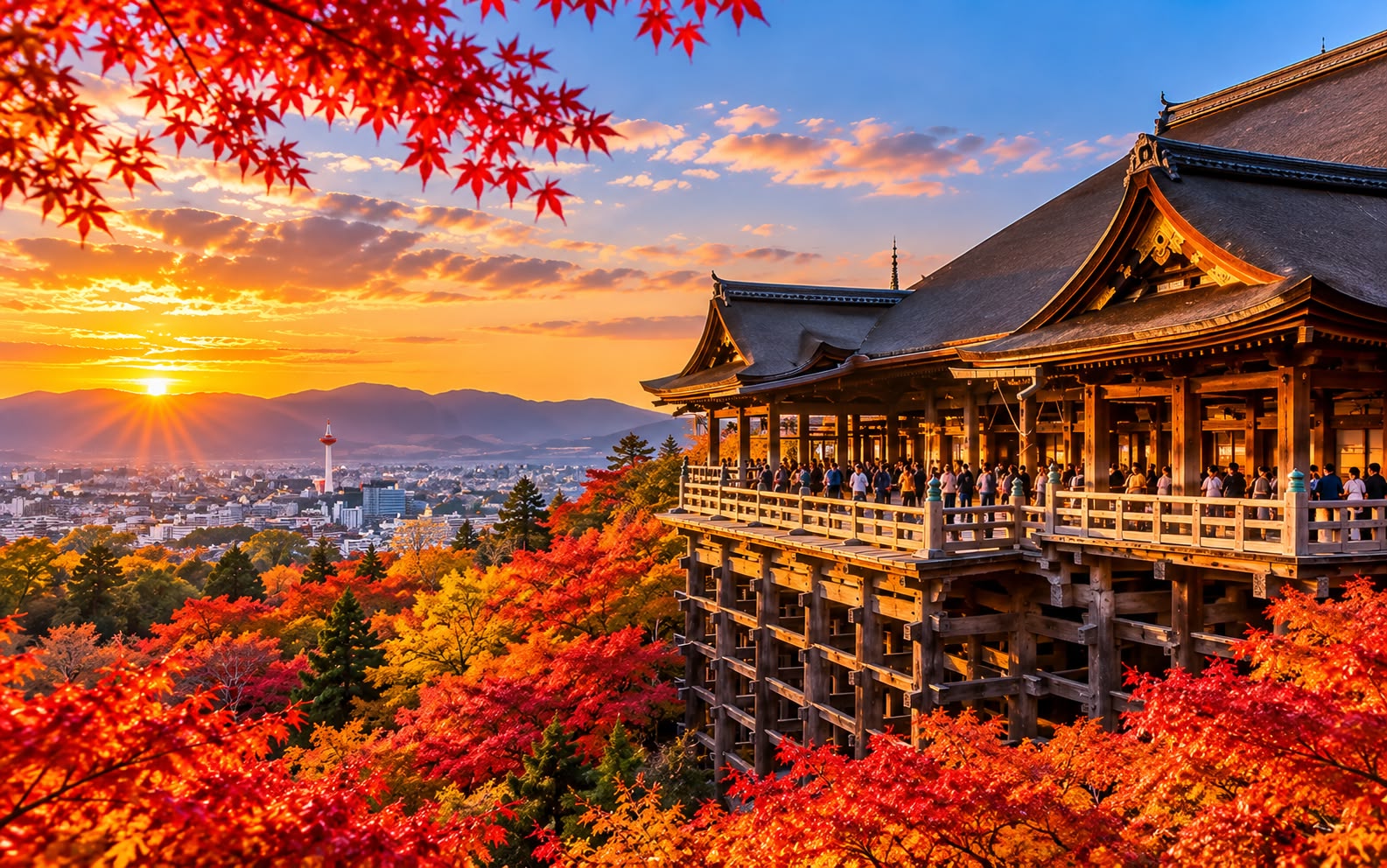
Kyoto in 2 days: Fushimi Inari, Gion and Arashiyama
Kyoto's famous sights are famous, so this plans around the hours they are empty — Fushimi Inari before seven, the bamboo grove before nine. Plus the geiko photography rules that now carry fines.
- East Asia
- 2 days
- ≈ AED 650 / person
- Two days that beat the crowds by starting before them, twice
Before you go
Kyoto in two days is entirely a question of timing. The sights are extraordinary and they are also on every itinerary in Japan, so the difference between a good day and a frustrating one is being somewhere at seven rather than eleven.
This plan does that twice: Fushimi Inari before the first train crowds, and the Arashiyama bamboo grove before nine. Both are free, both take an hour, and both are unrecognisable later.
The city splits east and west. Day one is the eastern hills — Fushimi, Kiyomizu, Gion. Day two is Arashiyama and the north-west — the bamboo, the golden pavilion, the rock garden.
Part of a Japan trip? See Japan in 7 days.
Figure the budget below. April and November are the best and the busiest.
Before you go: the short version
Getting there and around
- Kyoto is 2h15 from Tokyo on the Shinkansen, city centre to city centre.
- The subway is two lines and covers less than you want. Buses cover the rest and are slow and crowded — a journey that looks like fifteen minutes takes forty in season.
- Use the IC card — Suica, Pasmo or ICOCA, all interchangeable.
- Hire a bicycle. Kyoto is flat, compact and the single best city in Japan to cycle, and it removes the bus problem entirely.
- Taxis are good value for two people on the awkward hops.
The one rule that now carries a fine
- Do not photograph geiko and maiko. Several lanes in Gion are now closed to tourists entirely and photography on private streets carries fines, after years of harassment — women being chased, grabbed and blocked on their way to work.
- The main Hanamikoji street is still public. The side lanes are not.
Day by day
Day 1 — Fushimi Inari, Kiyomizu and Gion
Walking order: Fushimi Inari → train two stops → Kiyomizu-dera (15 min uphill from the station) → Sannenzaka and Ninenzaka (on the way down) → Yasaka Shrine (15 min) → Gion (5 min). About 6km, and the Fushimi climb adds 400m of ascent if you do the full loop.
- 06:30 — Fushimi Inari. It is open 24 hours, it is free, and it is empty before eight — which matters more here than anywhere in Japan.
- The thousands of vermilion torii run up the mountain in a tunnel. The full loop to the summit takes two hours and almost everyone turns back after twenty minutes — which is why the upper slopes are genuinely quiet at any hour.
- Go at least as far as the Yotsutsuji intersection, about 45 minutes up, where the city opens out below.
- 09:30 — Two stops north, then Kiyomizu-dera, on its wooden stage over the hillside — built without nails, and the approach streets are the best-preserved in the city.
- 11:30 — Sannenzaka and Ninenzaka downhill — stone-paved lanes of wooden shopfronts. Do not run down them; the local superstition says a fall here brings three years’ bad luck, and the steps genuinely are uneven.
- 13:00 — Lunch in Higashiyama, and yudofu — simmered tofu — is the Kyoto dish.
- 15:00 — Yasaka Shrine and Maruyama Park behind it.
- 17:00 — Gion, walking Hanamikoji at dusk. Photography rules above apply and are enforced.
- 19:00 — Pontocho, the narrow lane along the Kamo river, for dinner. In summer the restaurants build platforms out over the water.
Day 2 — Arashiyama and the north-west
Walking order: bamboo grove → Tenryu-ji (adjacent) → Okochi Sanso (5 min) → Togetsukyo bridge (15 min) → bus or train → Kinkaku-ji → Ryoan-ji (20 min walk between them). About 5km.
- 07:30 — Arashiyama’s bamboo grove. By nine it is a queue and the photograph is impossible; at half seven there is nobody in it.
- 08:30 — Tenryu-ji’s garden, which is the real reason to be in Arashiyama — a fourteenth-century pond garden, unaltered, and the temple opens at eight.
- 09:30 — Okochi Sanso, the villa garden above the grove that the crowds walk straight past. Tea is included in the ticket and the path circles a hillside with the city below.
- 11:00 — The Togetsukyo bridge and the river, or the Iwatayama monkey park above it — a twenty-minute climb, and the macaques are outside the enclosure while you are inside it.
- 13:00 — Lunch in Arashiyama, then across the city.
- 15:00 — Kinkaku-ji, the golden pavilion, which takes twenty minutes and a great many other people. It is a single view from a fixed path and there is no more to it.
- 16:00 — Ryoan-ji, twenty minutes’ walk away — fifteen stones in raked gravel, and you cannot see all fifteen from any one position. It takes as long as you let it, and it is the better of the two.
- 18:00 — Nishiki Market back in the centre, which closes around six, or the Kamo riverbank in the evening.
If you have a third day
- Nara is 45 minutes — Todai-ji’s Great Buddha in the largest wooden building in the world, and the deer, which bow for crackers and will also headbutt you for them.
Costs and practicalities
Getting around, and what it costs
| Subway or bus, single | ¥230–280 |
| Bicycle hire, per day | ¥1,000–1,500 |
| Shinkansen from Tokyo | ¥13,900 |
| Fushimi Inari | free |
| Kiyomizu-dera | ¥500 |
| Tenryu-ji garden | ¥500 |
| Okochi Sanso, including tea | ¥1,000 |
| Kinkaku-ji | ¥500 |
| Ryoan-ji | ¥600 |
- Temple entries are cheap — most are ¥300–600, so a full day costs little.
- Hire a bicycle. It is the single best decision in Kyoto and it solves the bus problem.
Best time to visit
- April — cherry blossom, and the city is at its most beautiful and most crowded simultaneously. Book months ahead.
- November — autumn colour, which in Kyoto is arguably better than the blossom and just as busy.
- May and October — the comfortable shoulders, and much easier.
- June–August — humid, 35°C, and the city sits in a basin that holds it. Gion Matsuri in July is the great festival.
- December–February — cold, quiet and cheap, and snow on the golden pavilion is the photograph of a lifetime if you are lucky.
Travel tips
- Fushimi Inari before eight. Arashiyama before nine. Those two decisions make this itinerary work.
- Do not photograph geiko or maiko, and stay off the closed lanes.
- Hire a bicycle rather than fighting the buses.
- Kinkaku-ji is twenty minutes, not an afternoon.
- Many temples close at 16:30 or 17:00 — earlier than you expect.
- Carry cash; many temples take nothing else.
What this trip actually costs
Two people, 1 night, mid-range comfort, excluding travel to Kyoto:
| Item | Cost |
|---|---|
| Hotel, 1 night | JPY 22,000 (≈ AED 510) |
| Food and drink, 2 days | JPY 20,000 (≈ AED 464) |
| Temple entries, two people | JPY 6,400 (≈ AED 148) |
| Bicycles, buses and a taxi | JPY 5,600 (≈ AED 130) |
| Total for two | JPY 54,000 (≈ AED 1,253) |
- Kyoto is cheap to see and expensive to sleep in. The temples cost a few hundred yen each; the room is the whole cost, and in blossom season it doubles.
- Hotel picks here are chosen on location, not on commission — always check prices and recent reviews before booking.
What to pack
- Shoes that come off easily — you will remove them at most temples.
- Socks without holes, for the same reason.
- A layer for early starts; the basin is cold at dawn.
- A Type A adapter, 100V.
Part of a bigger trip?
- Japan in 7 days gives Kyoto these two days within a Tokyo–Hakone–Kyoto route.
- Japan in 14 days adds Hiroshima, Nara and the Alps.
- Tokyo in 3 days is 2h15 north by Shinkansen.
- Osaka in 2 days is fifteen minutes away and the obvious pairing.
FAQ
Is two days enough for Kyoto? For the eastern hills and Arashiyama, yes — if you start early both days. It is not enough to add Nara, which needs its own day.
How early is early enough at Fushimi Inari? Before eight, and ideally before seven. It is open all night and free, so a 6:30 start costs you nothing but sleep.
Can I photograph geisha in Gion? Not on the private lanes, where it now carries fines, and not people without consent anywhere. The main Hanamikoji street is public, and discretion is still the expectation.
Kinkaku-ji or Ryoan-ji? Ryoan-ji, if you have to choose. The golden pavilion is one photograph; the rock garden is somewhere you sit.
Should I buy a bus pass? Generally not any more. Hire a bicycle instead — Kyoto is flat and compact and the buses are the slowest part of the city.
Prices and entry rules change, and what you need depends on your passport; last checked 29 October 2026, so confirm with the embassy or your airline before booking.


