 The Itinerary
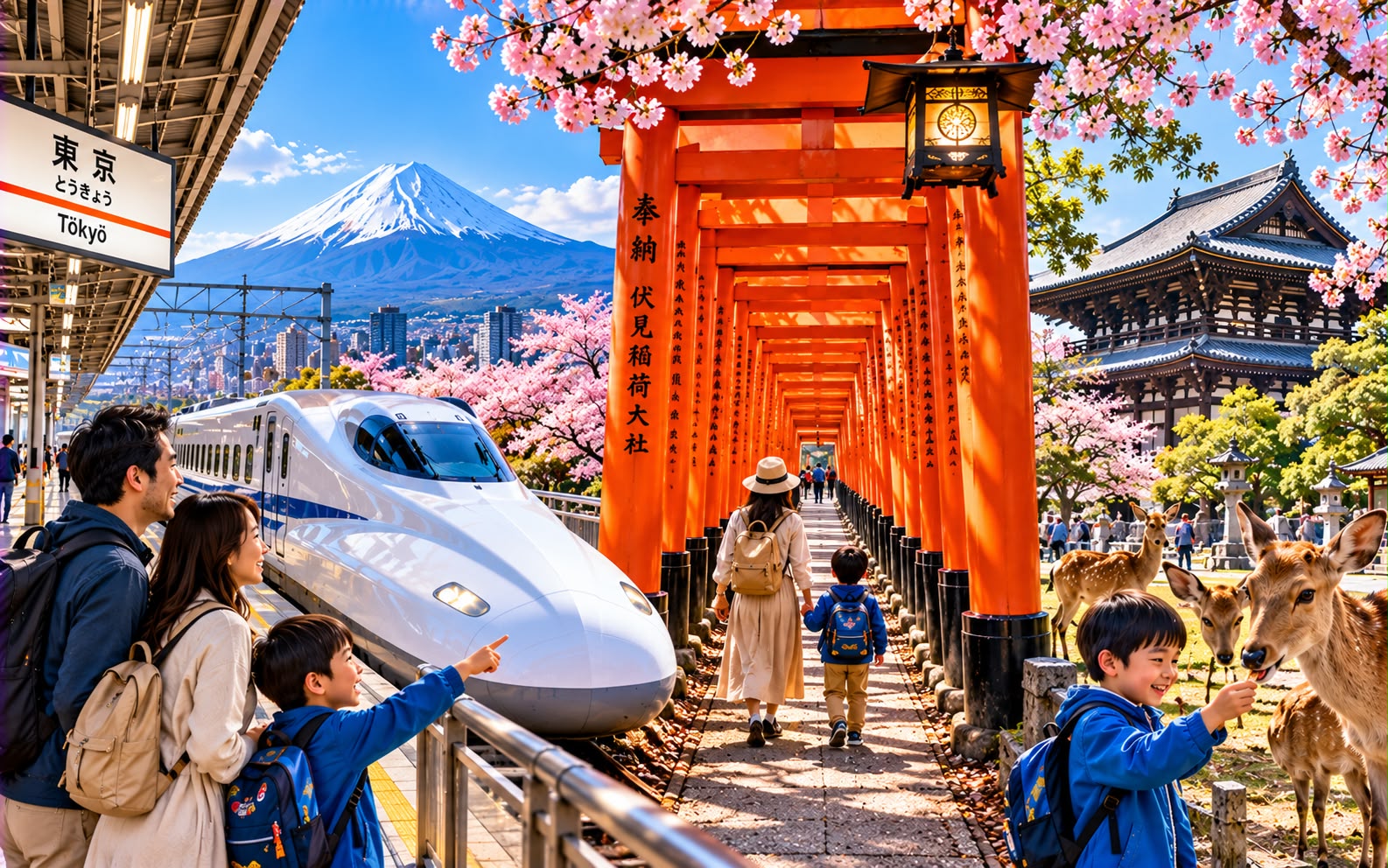
Japan with kids in 10 days: Ghibli, trains and a slower Kyoto
The same four stops as the standard route, re-planned for small legs: Ghibli and teamLab instead of a third museum, one temple a day in Kyoto rather than six, luggage forwarded so nobody carries bags, and the shinkansen treated as an event rather than a transfer.
- East Asia
- 10 days
- ≈ AED 5,100 / person
- A country where the trains are the attraction and the temples are optional
Before you go
Japan is one of the best countries in the world to take a small child, for reasons that have nothing to do with attractions: everything runs on time, nothing is dirty, nobody minds a child, and you can send your suitcases ahead so you are not carrying them.
What does not work is the standard sightseeing pace. The ten-day route fits a great deal into Kyoto. This version keeps the same four stops and cuts the temples to one a day, puts Ghibli, teamLab and a hands-on museum in their place, and treats the shinkansen as an attraction rather than a transfer — which, to a four-year-old, it very much is.
Figure JPY 220,000 (≈ AED 5,103) per adult. March to May and October to November.
Before you go: the admin
Entry
- Visa-free for around 70 nationalities for 90 days, including the GCC states, the EU, the UK and the US.
- Indian passport holders need a visa, applied for in advance; an e-visa is available for some applicants.
- Children need their own passport and visa.
- Last checked: 30 October 2026.
Luggage forwarding, which changes the trip
- Takuhaibin (takkyubin) forwards your suitcase hotel to hotel overnight for a modest fee per bag.
- Use it for every intercity move. You travel with a day bag and a child instead of a child and three suitcases.
- Hotel front desks arrange it. Send bags before 10:00 for next-day delivery.
- This is the single best piece of advice on this page.
Trains, and whether to buy a rail pass
- The JR Pass has become much more expensive and no longer pays for itself on a simple Tokyo–Kyoto–Osaka route. Price point-to-point tickets first.
- Children aged 6–11 pay half fare; under-6s travel free on a lap or in a shared seat.
- Reserve seats on the shinkansen. Ask for seats at the end of the carriage — there is luggage space behind the back row and more room for a buggy.
- Some shinkansen have a dedicated multi-purpose room for nursing or a distressed child. Ask the conductor.
- Get an IC card (Suica or Pasmo) for each of you, including children. It works on almost every local train and bus.
Practicalities with small children
- Nappy-change tables are in virtually every station and department store. Nursing rooms are standard.
- Convenience stores are everywhere and genuinely good — onigiri, fruit, milk — which solves the fussy-eater problem.
- Buggies are awkward on older station stairs — look for the lift, which always exists but is sometimes a long way round.
- Elevator queues at peak are real. Travel outside 07:30–09:00.
- Restaurants are small. Many have no high chair and no space — department store restaurant floors do, and so do family chains.
Day by day
Day 1 — Arrive in Tokyo
- Land, get IC cards, and go to the hotel.
- Stay in Shinjuku or Tokyo Station for the transport, not in a quiet neighbourhood.
- Afternoon — nothing. The time difference and the flight are enough.
- Evening — a conveyor-belt sushi place or a family restaurant. Both have high chairs and pictures on the menu.
Day 2 — Tokyo: teamLab and a park
- 09:30 — teamLab, which is an immersive digital art space and the single most reliably successful thing you can take a small child to in Tokyo. Book timed tickets well in advance — they sell out.
- Wear shorts or rollable trousers; parts involve walking through shallow water.
- 13:00 — Lunch, then back to the hotel.
- 16:00 — Ueno Park — ponds, space to run, and the Ueno Zoo if there is appetite. Or Yoyogi Park if you are west.
- Skip Shibuya Crossing with a buggy at rush hour. It is a genuinely bad idea.
Day 3 — The Ghibli day
- Ghibli Museum in Mitaka — tickets are sold in advance on a strict monthly cycle and sell out immediately. Buy the moment they release, before you book anything else about this trip.
- It is small, slow and designed for children, with a short original film you cannot see anywhere else.
- If you cannot get tickets, Ghibli Park near Nagoya is the alternative, also ticketed in advance, and is a detour rather than a day trip from Tokyo.
- Afternoon — Inokashira Park beside the museum, with swan boats on the pond. This pairs perfectly and most people miss it.
- Evening — back into the city, early dinner.
Day 4 — Disney, or a quieter alternative
- Tokyo Disneyland or DisneySea. Disneyland is the better choice for under-fives; DisneySea is more beautiful and aimed slightly older.
- Go at opening, leave by four. A full day defeats small children and you will have paid for the evening you spend carrying them.
- Buy tickets in advance. Entry is date-specific.
- If Disney is not for you: the Railway Museum at Omiya — real trains, simulators and a huge model layout — is the best non-Disney day in greater Tokyo for a train-obsessed child.
Day 5 — Hakone, slowly
- 09:00 — Send the bags ahead to Kyoto. Pack an overnight bag.
- 10:00 — Train to Hakone. The Hakone Free Pass covers the loop — mountain railway, cable car, ropeway and a pirate boat on Lake Ashi. The transport is the attraction here, which suits this age exactly.
- Do the loop in whichever direction is quiet. You do not have to complete it.
- Owakudani — a volcanic valley where they boil eggs black in the sulphur springs. Can close at short notice for volcanic activity.
- Stay in a ryokan with a private onsen bath. Public baths are usually fine with small children, but a private family bath removes every question — and note that visible tattoos are still refused at many onsen.
- Dinner is served at the ryokan and children’s portions are standard.
Day 6 — To Kyoto, on the shinkansen
- 10:00 — Back to Odawara and onto the shinkansen.
- The train is the event. Sit on the right leaving Odawara for Fuji on a clear day, reserve seats, and buy an ekiben — a station lunch box — which is half the fun.
- 13:00 — Kyoto. The bags are already at the hotel.
- 15:00 — Nishiki Market briefly, then the hotel.
- 17:00 — The Kyoto Station building itself — the roof terrace and the enormous staircase are free and a good hour.
Day 7 — Kyoto: one temple, one forest
- 08:00 — Fushimi Inari early. The vermilion torii gates up the hillside are the best thing in Kyoto for a child — it is a tunnel, and they run through it. You do not need to go to the top; twenty minutes up is enough.
- By nine it is crowded. This is the reason for the early start.
- 11:00 — Back for an early lunch and a rest.
- 15:00 — Arashiyama — the bamboo grove, short and flat, and the Iwatayama Monkey Park if legs allow (it is a 20-minute climb). The riverside is pleasant and free.
- One temple a day is the rule here. Kyoto has hundreds and a four-year-old has one in them.
Day 8 — Nara, or a day off
- Nara is 45 minutes away and the deer in the park bow for crackers, which is the single most memorable hour of many family trips to Japan.
- The deer are wild and can be pushy. Hold the crackers above your head and feed them one at a time; keep maps and tickets in a bag, as they will eat them.
- Todai-ji’s Great Buddha is next door and is one temple worth the effort — it is enormous, which reads to a child where architecture does not.
- Alternatively, take the day off entirely. Day eight of ten is usually when a small child has had enough, and a pool afternoon saves the last two days.
Day 9 — Osaka
- 10:00 — Send the bags to the airport hotel or ahead.
- 11:00 — Train to Osaka, 15 minutes by shinkansen or 30 on the rapid service.
- 13:00 — Osaka Aquarium Kaiyukan — one of the largest in the world, built as a spiral walk down around a central tank with whale sharks in it. Indoors, cool, and excellent at any age.
- 16:00 — The Tempozan Ferris wheel next door, or Osaka Castle park for space to run.
- 18:30 — Dotonbori — neon, the Glico running man, and takoyaki from a stall. Busy, and short.
- Universal Studios Japan is here if that is the trip, but it needs a full day and this itinerary does not have one spare.
Day 10 — Out
- Kansai airport is about an hour from central Osaka.
- Morning — one last convenience-store breakfast, which children seem to rate above most restaurants.
- Allow three hours. Kansai is busy and the train in is not fast.
Costs and practicalities
Best time to visit
March to May and October to November.
- Late March to early April — cherry blossom. Beautiful, extremely busy and expensive, and the dates move every year with the forecast.
- Late April and May — warm, dry and comfortable, and after the blossom crowds. Golden Week, in late April and early May, is the busiest domestic travel period of the year — avoid it.
- June and July — the rainy season, then hot and very humid. August is hard work with small children.
- October and November — the best window. Autumn colour, clear skies, mild days. Arguably better than spring with children, because the pace is calmer.
- December to February — cold, clear and quiet. Cheaper, and the illuminations are good.
Travel tips
- Buy Ghibli Museum tickets before anything else. They release monthly and go immediately.
- Forward your luggage on every intercity move. It transforms the trip.
- Price point-to-point tickets against the JR Pass. The pass no longer wins on this route.
- Reserve shinkansen seats at the end of a carriage for the luggage space behind the back row.
- One temple a day in Kyoto. No more.
- Fushimi Inari before 09:00.
- Book a ryokan with a private family bath to sidestep the onsen question entirely.
- Convenience stores are a legitimate meal. Do not feel bad about it.
- Get IC cards for the children too.
- Avoid trains between 07:30 and 09:00. With a buggy it is genuinely unpleasant.
What this trip actually costs
Two adults, 9 nights, mid-range hotels and one ryokan, international flights excluded. Children’s costs are listed separately below.
| Item | Cost |
|---|---|
| Hotels, 9 nights including one ryokan with meals | JPY 229,000 (≈ AED 5,312) |
| Intercity rail, two adults | JPY 58,000 (≈ AED 1,345) |
| Ghibli, teamLab, Disney and the aquarium, two adults | JPY 40,000 (≈ AED 928) |
| Local transport and luggage forwarding | JPY 23,000 (≈ AED 534) |
| Food and drink, 10 days | JPY 90,000 (≈ AED 2,088) |
| Total for two | JPY 440,000 (≈ AED 10,206) |
- Roughly JPY 220,000 (≈ AED 5,103) per adult.
- A child under six travels free on trains and is free or heavily reduced at most attractions. Hotels are the exception — Japanese rooms are small and many charge per person, including children. Check the room policy before booking; this is where a family budget goes wrong here.
- Luggage forwarding is a few thousand yen per bag per move and is the best money spent on this page.
- Disney is the largest optional line. Dropping it takes a significant amount off and loses a day you can give to Nara.
- Hotel picks here are chosen on location, not on commission — always check prices and recent reviews before booking.
What to pack
- A compact, foldable buggy. Station lifts and train aisles are narrow.
- Shoes that come off easily — temples, ryokan and some restaurants require it, several times a day.
- A small backpack for the child, since you will be forwarding the luggage.
- Hand towel each. Many public toilets have no dryer or paper, which surprises everyone once.
- Layers for spring and autumn.
- A Type A adapter, 100V.
Part of a bigger trip?
- Japan in 10 days is the adult-paced version of the same route.
- Japan in 7 days is the shorter Tokyo–Kyoto run.
- Tokyo in 5 days if one city is enough.
- Japan in 14 days adds Hiroshima and the Alps.
- Hokkaido in winter is the snow-festival trip.
FAQ
Is Japan easy with a four-year-old? Unusually so. Trains run to the minute, nothing is dirty, nappy-change facilities are everywhere and convenience-store food solves fussy eating. The two things that catch families out are the sightseeing pace and hotel room sizes.
How do we get Ghibli Museum tickets? They are sold in advance on a strict monthly release and sell out within minutes. Buy them before you book flights or hotels, and treat the date you get as the fixed point the rest of the trip is built around. Ghibli Park near Nagoya is the fallback.
Should we buy a JR Pass? Probably not on this route. The price rose substantially and a simple Tokyo–Hakone–Kyoto–Osaka itinerary is usually cheaper on point-to-point tickets. Price both before deciding.
Can children go in an onsen? Generally yes, and Japanese families do it constantly. If you would rather avoid the question — or if anyone has visible tattoos, which many onsen still refuse — book a ryokan with a private family bath.
What about luggage with a small child? Forward it. Takuhaibin sends suitcases hotel to hotel overnight for a modest fee, so you travel with a day bag. It is the single best thing you can do for a family trip here.
Prices and entry rules change, and what you need depends on your passport; last checked 30 October 2026, so confirm with the embassy or your airline before booking.


