 The Itinerary
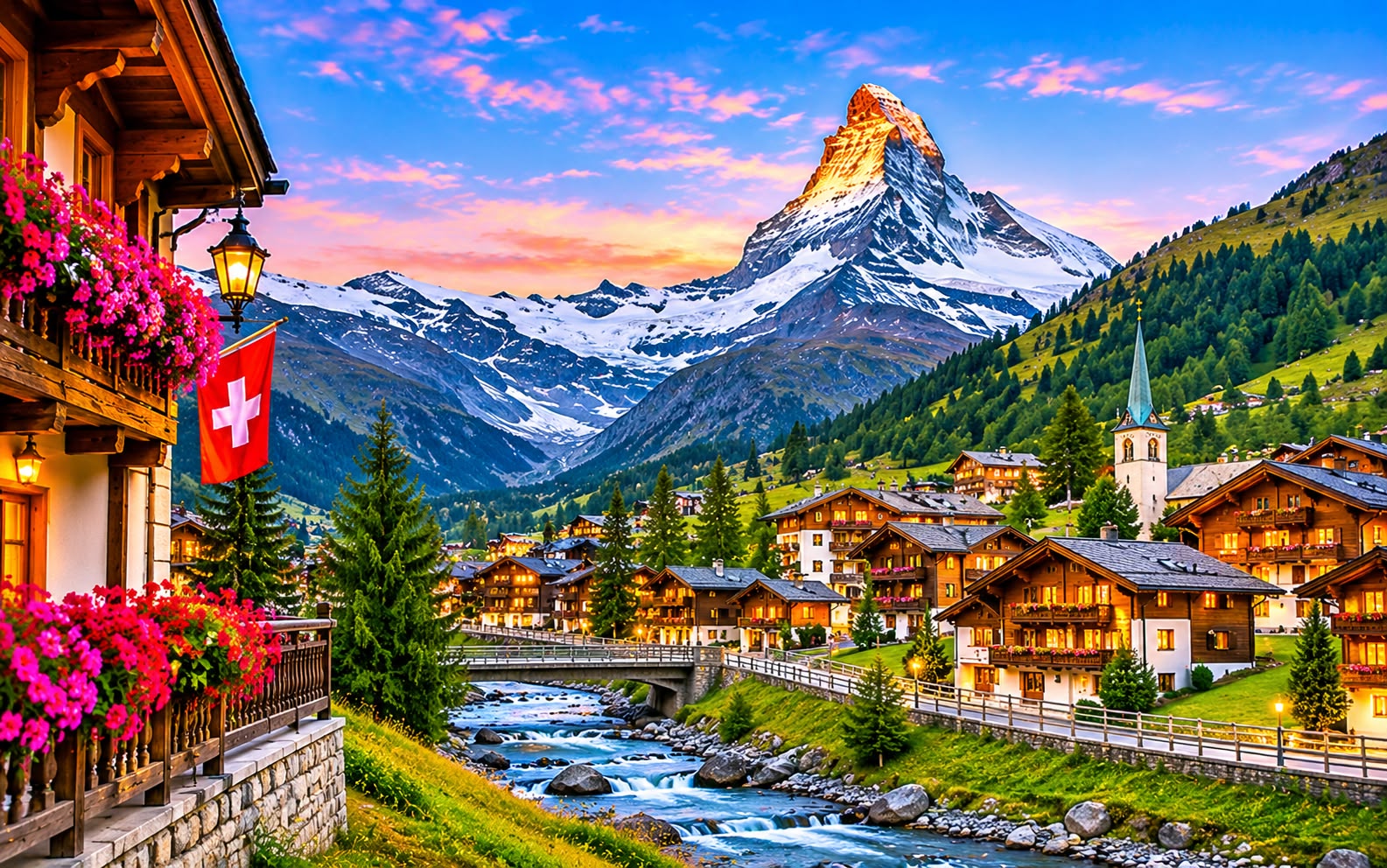
Italy and Switzerland in 10 days: Milan, Lake Como, Zermatt and Lucerne
Two days in Milan, two on Lake Como, then the Matterhorn and the Swiss lakes — no car, no internal flights, and one visa for both countries. What the Swiss Travel Pass is actually worth, the one ticket to book months ahead, and why Zermatt gets three nights.
- Western Europe
- 10 days
- ≈ AED 11,000 / person
- Lakes then mountains, entirely by train, on one Schengen visa
Before you go
This is the trip people imagine when they imagine Europe: a lake with villas on it, a mountain that looks like a mountain should, and trains that leave when the timetable says.
Four days in Italy and six in Switzerland, entirely by rail, with no internal flights and no hire car. Switzerland takes the larger share because it is the slower half — Zermatt alone is worth three nights, and the mountain railways are the point rather than the transport.
Italy in 10 days and Switzerland in 10 days are each country at length.
Figure USD 3,000 (≈ AED 11,018) per person. June to September.
Before you go: the admin
One visa covers both
- Switzerland is not in the European Union but it is in the Schengen area. A single Schengen visa admits you to both countries, and there is no border check on the train.
- Apply to the country where you will spend the most nights, which on this itinerary is Switzerland.
- An ETIAS authorisation is being phased in for visa-exempt travellers. The start date has moved repeatedly — check whether it has begun before you fly.
- Last checked: 2 November 2026.
The Swiss Travel Pass, and whether it pays
- It covers all trains, buses and lake boats, plus free entry to around 500 museums, and half price on most mountain railways including Gornergrat and Pilatus.
- On this itinerary it pays for itself, because the Swiss half is six days of near-daily rail plus two mountain ascents.
- It does not cover the Italian half. Buy Italian tickets separately; they are cheap.
- Seat reservations are not needed on ordinary Swiss trains. Turn up and board. The scenic panoramic trains are the exception and must be reserved.
The one ticket to book months ahead
- Leonardo’s Last Supper in Milan admits 30 people at a time for 15 minutes. Tickets are released in blocks and sell out the day they appear, often two to three months out.
- If you miss it, you miss it. There is no queue and no same-day option worth chasing.
- Everything else on this trip can be booked a week out.
Two currencies
- Italy uses euros, Switzerland uses francs. Swiss shops will often take euros and give change in francs at a poor rate.
- Both are cashless countries. Cards work everywhere, including mountain huts.
- Switzerland is expensive and there is no trick to it. A sandwich and a coffee is what a restaurant meal costs in Italy.
Day by day
Day 1 — Land in Milan
- Arrive and stay near the Duomo or Porta Garibaldi. Milan’s metro is quick and the city is compact.
- Afternoon — the Duomo. Buy the rooftop ticket, which is the thing worth doing: you walk among the spires and the statues, 3,400 of them.
- Evening — the Galleria Vittorio Emanuele II, then Navigli for an aperitivo, which in Milan comes with enough food to be dinner.
Day 2 — The Last Supper, and the rest of Milan
- Your booked Last Supper slot, at Santa Maria delle Grazie. Fifteen minutes, and arrive twenty early or they give it away.
- Afterwards — Sforza Castle and the park behind it, which is where Milan goes to sit down.
- Afternoon — the Brera district for the gallery and the narrow streets, or the Quadrilatero if the shopping is the point.
- Milan is not Florence or Rome and does not pretend to be. Two days is right; it is a working city with three extraordinary things in it.
Day 3 — To Lake Como
- Morning — the train to Varenna, about an hour from Milano Centrale.
- Stay in Varenna, not Como town. Como is a city at the wrong end of the lake; Varenna is a village on the ferry crossroads, which is where you want to be.
- Afternoon — Villa Monastero’s gardens, terraced down to the water.
- Evening — the passerella, the lakeside walkway, and dinner looking at it.
Day 4 — Bellagio, and the villas
- 09:30 — the ferry to Bellagio, fifteen minutes across. The mid-lake ferries run constantly between Varenna, Bellagio, Menaggio and Cadenabbia and are the correct way to see this lake.
- 11:00 — Bellagio’s stepped streets, then Villa Melzi’s gardens along the shore.
- 14:00 — Villa del Balbianello at Lenno, reached on foot along a wooded path or by water taxi, and the most photographed garden on the lake.
- Check the ferry timetable before you commit to the afternoon. The last crossing back is earlier than you think, especially outside July and August.
Day 5 — Over the Alps to Zermatt
- A long and genuinely beautiful travel day — Varenna → Milan → Brig → Visp → Zermatt, about five and a half hours, all by train.
- Zermatt is car-free. Everything arrives by rail, and you change at Täsch if you have driven, which you have not.
- Arrive by late afternoon and walk to the Kirchbrücke — the bridge where the Matterhorn appears at the end of the street, which is the photograph everyone takes and should.
- Stay three nights. The mountain is cloud-covered more often than not, and three mornings is what buys you a clear one.
Day 6 — Gornergrat
- 07:30 — the Gornergrat cog railway, climbing to 3,089 m in 33 minutes. Sit on the right going up.
- At the top — the Matterhorn, and 29 peaks over 4,000 m, with the Gorner glacier below.
- Go early. The mountain clouds over by late morning in summer, reliably, and the first trains are also the empty ones.
- Walk down one stage — Rotenboden to Riffelberg is about an hour and passes the Riffelsee, where the Matterhorn reflects.
- Half price with the Swiss Travel Pass, which is most of the reason the pass pays.
Day 7 — Glacier Paradise, or the Five Lakes Walk
- The Matterhorn Glacier Paradise — the highest cable car in Europe at 3,883 m, with a glacier palace cut into the ice. It is cold up there in August; dress for below freezing.
- Or the Five Lakes Walk — about two and a half hours from Blauherd down to Sunnegga, past five tarns, three of which hold the Matterhorn’s reflection. The better day if the weather is clear.
- Afternoon — Zermatt’s old quarter, the Hinterdorf, where the 16th-century timber granaries stand on stone discs to keep the mice out.
- Altitude is real here. Drink water and do not plan anything strenuous for the hour after you come down.
Day 8 — To Lucerne
- Morning — Zermatt → Visp → Bern → Lucerne, about three and a half hours.
- Afternoon — the Chapel Bridge, a covered wooden walkway from 1333 with painted panels in the rafters, and the Lion Monument, which Mark Twain called the saddest piece of stone in the world.
- Evening — the old town squares, which are painted facades and small restaurants, and walkable end to end.
Day 9 — Pilatus, and the lake
- The golden round trip — boat across Lake Lucerne to Alpnachstad, the world’s steepest cog railway up Pilatus at 48%, then cable cars down to Kriens. Runs May to November.
- Or Mount Titlis, via Engelberg, for the rotating cable car and the cliff walk, which runs all year.
- Pilatus is the better day if it is running. The boat leg is free with the Swiss Travel Pass and is a third of the pleasure.
- Evening — a last dinner on the waterfront.
Day 10 — Out
- Zurich airport is about an hour from Lucerne by direct train, and the trains run to the terminal.
- Allow three hours, and more if you are claiming VAT back on anything bought in Switzerland.
- Spend the francs. They convert badly and nowhere else takes them.
Costs and practicalities
Best time to visit
June to September. The mountain railways and the lake boats define the season, and outside it, half of this itinerary does not run.
- June — lakes green, alpine flowers out, and the high passes just open. Some high trails still hold snow.
- July and August — everything open, longest days, warmest water on Como, and the busiest and priciest it gets. Book Zermatt and Varenna months ahead.
- September — the best of the four. Clear mountain air, warm days, the crowds gone after the first week, and the Gornergrat views at their sharpest.
- October — beautiful and shortening. Some mountain lifts close for maintenance in late October; check the specific ones.
- November to May — the lake villas and gardens close, and the Como ferries run a reduced winter timetable. Zermatt becomes a ski resort, which is a different and excellent trip — see Switzerland in winter.
Travel tips
- Book the Last Supper two to three months out. Nothing else on this trip needs that.
- Buy the Swiss Travel Pass for the Swiss days only. It does not cover Italy.
- Three nights in Zermatt, because the Matterhorn hides.
- Take the first Gornergrat train. Empty, and before the cloud.
- Stay in Varenna rather than Como town.
- Check the last mid-lake ferry before planning a late afternoon at Balbianello.
- Dress for below freezing at Glacier Paradise, in any month.
- Swiss trains leave exactly on time. A minute late is a missed train, and nobody will hold it.
- Tap water is drinkable everywhere, including from the fountains in Zermatt and Lucerne. Carry a bottle.
- Do not hire a car. Zermatt will not let you in and the trains are better.
What this trip actually costs
Two people, 9 nights, mid-range throughout, international flights excluded:
| Item | Cost |
|---|---|
| Hotels, 9 nights across both countries | USD 2,600 (≈ AED 9,549) |
| Food and drink, 10 days | USD 1,300 (≈ AED 4,774) |
| Swiss Travel Pass, two people | USD 960 (≈ AED 3,526) |
| Gornergrat, Glacier Paradise and Pilatus | USD 620 (≈ AED 2,277) |
| Italian trains and the Lake Como ferries | USD 300 (≈ AED 1,102) |
| Milan entries, including the Last Supper | USD 220 (≈ AED 808) |
| Total for two | USD 6,000 (≈ AED 22,035) |
- Roughly USD 3,000 (≈ AED 11,018) per person for ten days.
- This is the most expensive trip on this site per day, and the Swiss half is why. Six Swiss days cost roughly twice what four Italian ones do.
- The Swiss Travel Pass looks enormous and is the line that saves money, not the one that costs it: it halves two mountain railways, covers every train and bus, and makes the Lucerne lake boat free.
- Eat your main meal at lunch in Switzerland. The same restaurant’s lunch menu runs well under half the dinner price, and that difference across six days is real.
- Milan and Lake Como are where the food budget relaxes. Make the most of it.
- Hotel picks here are chosen on location, not on commission — always check prices and recent reviews before booking.
What to pack
- A proper warm layer and a windproof shell. Gornergrat is 3,089 m and Glacier Paradise is 3,883 m — it is below freezing up there in August.
- Walking shoes with grip, for the Riffelsee descent and the Five Lakes Walk.
- Sunglasses and high-factor sunscreen. Snow and altitude together burn fast.
- Swimwear for Lake Como, which is warm enough from late June.
- A Type C/F adapter for Italy, Type J for Switzerland — Switzerland’s three-pin socket is its own, and a standard European plug does not always fit.
- A refillable bottle. Both countries’ tap water is excellent.
- One smart outfit for a Como dinner.
Part of a bigger trip?
- Switzerland in 10 days adds Interlaken, the Jungfrau and the Bernina line.
- Italy in 14 days runs Venice, Florence and Rome.
- France and Switzerland in 11 days approaches the same Alps from Paris.
- Switzerland in winter is this country from December to March.
- Italy and Greece in 14 days heads south instead.
FAQ
Do I need separate visas for Italy and Switzerland? No. Switzerland is outside the European Union but inside the Schengen area, so one Schengen visa covers both and there is no border check on the train between them. Apply to the country where you will spend the most nights, which here is Switzerland.
Is the Swiss Travel Pass worth buying? On this itinerary, yes. Six Swiss days with near-daily train travel, two mountain railways at half price and a free lake boat is more than the pass costs. It would not be worth it for two Swiss days or for a trip based in one valley, and it covers nothing on the Italian side.
Why three nights in Zermatt? Because the Matterhorn is cloud-covered more often than not, and one morning is a coin flip. Three mornings gives you a realistic chance of a clear Gornergrat sunrise, and the walking — the Five Lakes route, the Riffelsee descent — is worth the days even when the summit hides.
What has to be booked far in advance? The Last Supper in Milan, and only that. Thirty people are admitted for fifteen minutes at a time, and tickets are released in blocks that sell out the day they appear, typically two to three months out. Everything else on this trip can be arranged a week ahead.
Can I do this without a car? Yes, and you should. Zermatt is car-free and will not admit one, the Lake Como ferries beat the lakeside road in both time and pleasure, and Swiss trains run to the minute. A hire car on this route is a parking problem you have paid for.
Prices and entry rules change, and what you need depends on your passport; last checked 2 November 2026, so confirm with the embassy or your airline before booking.


