 The Itinerary
Provence and the Riviera in 7 days: Nice, the Luberon and Avignon
Three days on the coast by train, then a car west into Provence for the hill villages, Avignon and the Pont du Gard. When the lavender is actually out, why the car arrives on Day 3, and what the mistral does to a week here.
- Western Europe
- 7 days
- ≈ AED 4,900 / person
- The south of France without Paris
Before you go
France’s two guides on this site both start in Paris. This one never goes near it. The south is a separate country in everything but administration — a different light, a different lunch, and a pace that punishes anyone trying to see six things in a day.
The coast by train, the interior by car. The Riviera has a frequent local railway running the length of it and nowhere to park; the Luberon has no useful trains at all. So the car gets collected on Day 3 and dropped in Marseille.
Fly into Nice and out of Marseille. Both are well connected, and an open-jaw ticket saves a whole day of backtracking.
France in 9 days is the Paris-and-Riviera version if you want the capital too.
Figure EUR 1,200 (≈ AED 4,913) per person. May, June, or September.
Before you go: the admin
Visas and borders
The Schengen rules are in our Schengen visa guide. Many nationalities enter visa-free, with the EES biometric border now operating — allow extra time at first entry. Monaco is not in the EU but sits inside the Schengen area, so there is no border check and no separate paperwork; you will not notice crossing it.
Last checked: 2 November 2026.
When the lavender is actually out
- Roughly the last week of June into mid-July, and it varies by altitude and by year. The Valensole plateau is the classic; Sault is higher and runs one to two weeks later, which is the trick if you are slightly too late.
- It is harvested in July. A field that was purple on the 10th can be stubble on the 20th. If lavender is the reason you are coming, check the current season reports before fixing dates, and build in a second option.
- Sunflowers overlap and are a consolation prize nobody complains about.
The car, and where not to take it
- Collect it on Day 3, in Nice or Antibes, not at the airport on arrival. Parking in Nice is expensive and the coast railway is better.
- Automatics must be requested and cost more. French hire cars default to manual.
- Village parking is the real skill. Gordes, Roussillon and Les Baux all have paid car parks below the village and narrow one-way lanes above. Park at the bottom and walk up.
- Autoroute tolls are significant on the A8 and A7 and most take contactless.
- Low-emission zones apply in Nice, Marseille and others; a hire car registered in France will usually carry the sticker, but check at the desk.
The mistral
- A cold, dry, violent north wind that funnels down the Rhône valley, most often in winter and spring, and typically blows for three days or six.
- It is not a storm and it does not bring rain — in fact it clears the sky, which is why Provençal light is what it is.
- What it does is make exposed places unpleasant, cancel boat trips, and shut terrace lunches. Have an indoor option for Avignon and Aix.
Day by day
Day 1 — Land in Nice
- Stay in Vieux Nice or near the Promenade. The tram from the airport reaches the centre in about half an hour.
- Afternoon — The Promenade des Anglais and the pebble beach, which is pebbles and not sand, and surprises people every year. Beach shoes are a real purchase here.
- 17:00 — Vieux Nice: the ochre lanes, the Cours Saleya market square, socca eaten standing up from a copper pan.
- 19:00 — Up Castle Hill by the free lift for the view over the bay at sunset. There is no castle; there is the best viewpoint in the city.
- 21:00 — Dinner in the old town. Niçoise cooking is not Provençal — pissaladière, petits farcis, a proper salade niçoise with no potato and no dressing to speak of.
Where to stay in Nice (three nights)
- Grand: Le Negresco — the 1912 belle-époque landmark on the Promenade, with the art collection in the corridors.
- Mid-range: a hotel in the Carré d’Or, between the old town and the sea.
- Simple: guesthouses around the Libération market, ten minutes out by tram and noticeably cheaper.
Day 2 — Èze, Monaco and the Corniches
- 09:00 — The bus or train east. The three Corniche roads run parallel at different heights; the Moyenne Corniche is the one with the views, and the bus takes it.
- 10:00 — Èze, a village welded to a rock 400 metres above the sea. The Jardin Exotique at the top is the reason to climb through it. Go early; it is small and it fills.
- 13:00 — Monaco. The Rocher with the palace and the Oceanographic Museum built into the cliff, the harbour, and the Casino square for the car-watching. Dress codes apply inside the casino and bare shoulders are turned away at the cathedral.
- 17:00 — Back west. Villefranche-sur-Mer is the stop worth making — a deep natural harbour and a beach that is actually sand.
- 20:30 — Dinner in Nice.
Day 3 — Antibes, then west to Aix
- 09:00 — Collect the car.
- 10:00 — Antibes: the ramparts, the covered Marché Provençal, and the Musée Picasso in the Château Grimaldi, where he worked in 1946 and left the contents behind.
- 12:30 — Cannes for the Croisette and the handprints, which takes forty minutes and is enough, or skip it for Saint-Paul-de-Vence and the Fondation Maeght, which is one of Europe’s great small modern-art collections and the better choice.
- 15:00 — Drive west to Aix-en-Provence, about two hours on the A8.
- 18:00 — Cours Mirabeau: plane trees, fountains, and the café terraces that have been there since Cézanne used them.
- 20:30 — Dinner in the old town.
Where to stay in Aix (two nights)
- Grand: a restored hôtel particulier in the Mazarin quarter.
- Mid-range: a hotel just off the Cours Mirabeau, which puts you inside the ring road and out of the parking problem.
- Simple: a guesthouse in the outer old town; everything in Aix is within fifteen minutes on foot.
Day 4 — Aix, Cézanne and a market
- 08:00 — The market. Aix has one almost every morning — produce on Place Richelme daily, the big one on Tuesday, Thursday and Saturday. This is the best hour of the day in Provence and it is free.
- 10:30 — Atelier Cézanne, his studio left as it was, a twenty-minute walk uphill. Small, and worth it. Book ahead; it admits a few at a time.
- 13:00 — Long lunch.
- 15:30 — The Montagne Sainte-Victoire, the mountain he painted sixty times. Drive the D17 along its southern flank; the Barrage de Bimont is a short walk to water and rock.
- Alternative: Marseille for the day instead, if cities appeal more than mountains — it is thirty minutes by motorway.
Day 5 — The Luberon villages
- This is the day the car earns its keep. The villages are twenty minutes apart and none has a railway.
- 09:00 — Gordes, stacked up a hillside in pale stone. The viewpoint is on the way in from the D15 and there is a pull-off for it.
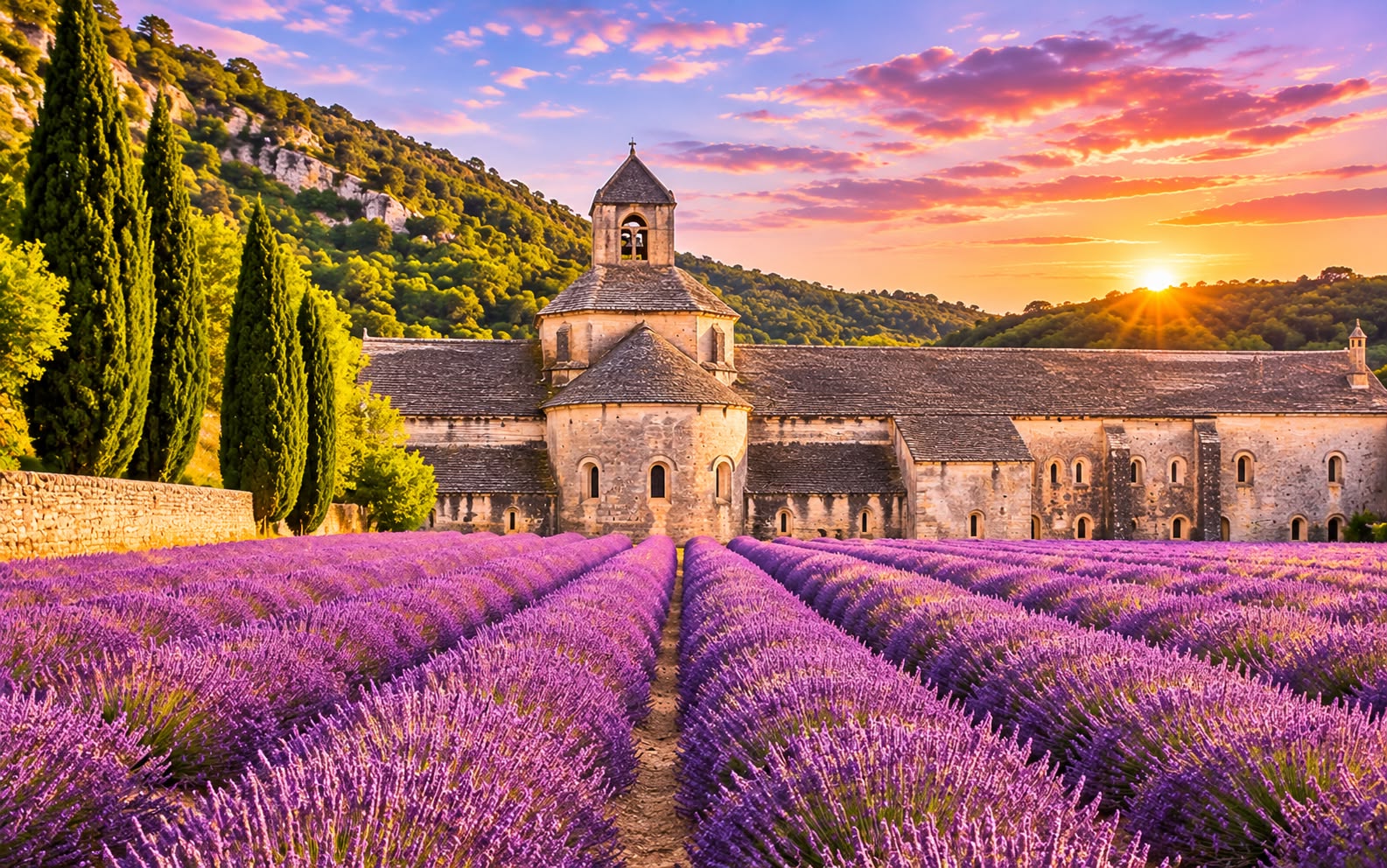
- 10:30 — The Abbaye de Sénanque below it — twelfth-century Cistercian, austere, and with the lavender field in front of it that is the most photographed in France. It is a working monastery, visits are limited and ticketed, and silence is expected.
- 12:30 — Roussillon, built from the ochre it sits on — orange, red and pink, and the Sentier des Ocres walk through the old quarry. The dust stains light shoes permanently.
- 15:00 — Bonnieux or Ménerbes for the afternoon and the valley view; Lacoste above them for the ruined château.
- 18:00 — Back towards Avignon, about an hour.
- In season: detour to the Valensole plateau instead, which is east and adds an hour each way but is where the lavender is at scale.
Where to stay near Avignon (one night)
- Grand: a mas — a converted Provençal farmhouse — in the countryside outside, with a pool.
- Mid-range: a hotel inside Avignon’s walls, which saves the morning drive.
- Simple: Villeneuve-lès-Avignon across the river, quieter and cheaper, ten minutes away.
Day 6 — Avignon and the Pont du Gard
- 09:00 — The Palais des Papes. Seven popes ruled from here in the fourteenth century and the building is enormous, bare and strange. Ninety minutes with the tablet guide.
- 11:00 — The Pont Saint-Bénézet — the half-bridge of the song, which stops in the middle of the Rhône because the rest washed away.
- 13:00 — Lunch in the old town. In July the Festival d’Avignon fills the entire city with theatre and with people; book months ahead or avoid the dates deliberately.
- 15:00 — The Pont du Gard, half an hour west. A Roman aqueduct bridge three tiers and fifty metres high, built without mortar. You can swim in the river beneath it, which is the thing most visitors do not realise.
- 18:00 — Back, or push on towards Marseille.
Day 7 — Marseille, and out
- Morning — Drive to Marseille, an hour, and drop the car.
- If the flight is late: the Vieux-Port, Le Panier quarter, and MuCEM on its lace-concrete footbridge. Notre- Dame de la Garde sits above the whole city.
- If there is a half-day: the Calanques — limestone inlets with turquoise water, reached by boat from the Vieux-Port or on foot from Cassis. Access is restricted in high summer on fire- risk days and the restrictions are decided each morning, so check before committing.
- Allow the usual margin at Marseille airport, which is thirty minutes out of the city.
Costs and practicalities
Best time to visit
May, June or September. July and August are hot, full and expensive; winter is quiet but much is shut.
- April and May — green, flowering, and uncrowded. The sea is cold. The mistral is at its most likely.
- June — arguably the best month: warm, long evenings, the lavender starting at the end of it, and the schools not yet out.
- July and August — peak everything. The Avignon festival in July, the lavender in early July, and the whole Riviera at capacity. Book far ahead and expect traffic.
- September — the second-best month. Warm sea, the vendange in the Rhône vineyards, and the crowds gone by the middle of it.
- October to March — Nice stays mild and the museums stay open, but hill villages shut their restaurants and the lavender is a photograph on a postcard.
Travel tips
- Fly into Nice, out of Marseille. Backtracking this coast is a wasted day.
- No car for the first two days. The coast railway is frequent and parking in Nice is not worth the fight.
- Park below the villages and walk up. Every time.
- Check the lavender season before fixing dates, and know that Sault runs later than Valensole.
- Nice’s beach is pebbles. Bring or buy beach shoes.
- Shoulders covered for the cathedral in Monaco and the abbey at Sénanque.
- Lunch is 12:00 to 14:00 and then it stops. Arriving at 14:30 in a village means a sandwich.
- Many village shops and restaurants close on Mondays, and some for all of February.
What this trip actually costs
Two people, 6 nights, mid-range throughout, international flights excluded:
| Item | Cost |
|---|---|
| Hotels, 6 nights | EUR 1,000 (≈ AED 4,095) |
| Food and drink, 7 days | EUR 620 (≈ AED 2,539) |
| Hire car, 4 days, with fuel and tolls | EUR 330 (≈ AED 1,351) |
| Entries: Palais des Papes, Pont du Gard, Maeght, Picasso, Sénanque | EUR 180 (≈ AED 737) |
| Coast trains, buses, village parking | EUR 150 (≈ AED 614) |
| A tasting, the markets, extras | EUR 120 (≈ AED 491) |
| Total for two | EUR 2,400 (≈ AED 9,827) |
- Roughly EUR 1,200 (≈ AED 4,913) per person for seven days.
- The Riviera nights cost more than the Provence ones — Nice in July is the single biggest variable in this budget.
- A mas with a pool outside Avignon often costs less than a hotel inside the walls, and is the better evening.
- Lunch is where the money is saved. The formule at midday is half what the same kitchen charges at eight.
- Hotel picks here are chosen on location, not on commission — always check prices and recent reviews before booking.
What to pack
- Beach shoes for Nice’s pebbles, genuinely.
- Shoes you can walk a steep village in — Èze, Gordes and Roussillon are all uphill on uneven stone.
- A layer for the mistral, which is cold out of proportion to the temperature.
- Something with sleeves for churches and the abbey.
- Sunglasses and a hat. The light here is the reason painters came and it is unrelenting in summer.
- Dark shoes for Roussillon unless you are prepared to lose the pale ones to ochre.
- A Type E adapter, 230V.
Part of a bigger trip?
- France in 9 days adds Paris to this coast.
- Paris in 3 days is the capital on its own, and the obvious bolt-on by TGV — Avignon to Paris is under three hours.
- France and Italy in 12 days carries on east into Italy rather than west into Provence.
- Italy in 10 days picks up where the Riviera leaves off.
FAQ
When exactly is the lavender out? Roughly the last week of June into mid-July on the Valensole plateau, and one to two weeks later at Sault, which sits higher. It is harvested through July, so the window closes abruptly. Years vary by a fortnight either way — check current season reports before you fix the dates, and treat Sault as the backup if you are late.
Do I need a car for the whole week? No, and you are better off without one for the first two days. The Riviera has a frequent coastal railway and Nice parking is expensive. The Luberon has essentially no public transport, so the car is collected on Day 3 and dropped in Marseille.
Is Monaco worth half a day? About that much, yes. The Rocher, the Oceanographic Museum and the Casino square are the whole of it for a visitor, and the museum is genuinely good. There is no border formality — it is inside the Schengen area — so it costs you nothing but the bus fare.
What is the mistral going to do to my week? Most likely nothing, and occasionally it takes a day. It is a strong, cold, dry northerly that blows for three or six days at a time, mostly in winter and spring. It brings clear skies rather than rain, so the damage is to boat trips and terrace lunches rather than to sightseeing. Keep an indoor option for Aix and Avignon.
Is this a good trip with children? Reasonable rather than ideal. The villages involve a lot of uphill cobbles and the days have long lunches built in. What works is the sea at Villefranche, the Oceanographic Museum, swimming under the Pont du Gard and the ochre trail at Roussillon. What does not is three hill villages in one afternoon.
Prices and entry rules change, and what you need depends on your passport; last checked 3 November 2026, so confirm with the embassy or your airline before booking.


