 The Itinerary
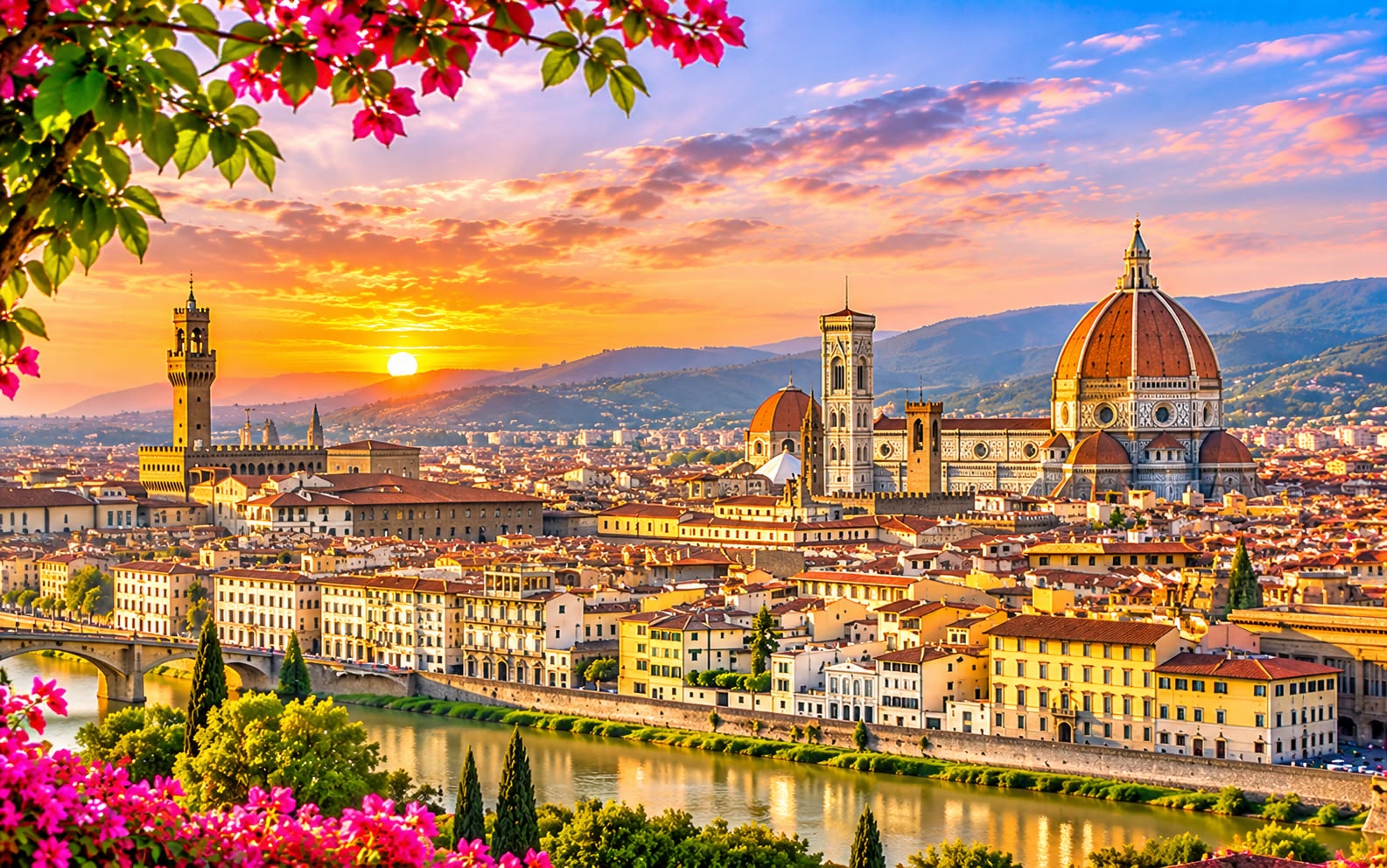
France and Italy in 12 days: Paris, the Riviera, Florence and Rome
Three days in Paris, two on the Riviera, three in Florence and three in Rome, joined entirely by train. Which museums actually need booking, why Nice is the right stop in the middle rather than a detour, and the ticket that is worth buying months ahead.
- Western Europe
- 12 days
- ≈ AED 8,800 / person
- Four cities, one visa, no hire car and no internal flights
Before you go
Paris to Rome is the classic first trip to Europe, and the mistake most people make is flying between the cities instead of taking the trains. The railway does this route well, and the Riviera in the middle turns two long legs into three pleasant ones.
Five days in France and seven in Italy. Italy gets the extra days because Florence and Rome are both dense — the Uffizi and the Vatican are each a half-day on their own, and nothing here rewards rushing.
Paris in 3 days, Rome in 3 days and Italy in 14 days cover the same ground at other lengths.
Figure USD 2,400 (≈ AED 8,814) per person. April to June, or September to October.
Before you go: the admin
One Schengen visa
- France and Italy are both in the Schengen area. One visa, no border check on the train.
- Apply to the country where you will spend the most nights, which here is Italy.
- An ETIAS authorisation is being phased in for visa-exempt travellers. The start date has moved repeatedly — check whether it has begun before you fly.
- Last checked: 2 November 2026.
The trains, and when to book them
- Paris to Nice is about six hours on the TGV, Nice to Florence is about seven with a change, and Florence to Rome is an hour and a half.
- Book the TGV and the Italian high-speed trains as early as you can. Both use airline-style pricing, and the Paris–Nice fare in particular multiplies in the last fortnight.
- Italian regional trains do not need booking and are cheap. You must validate a paper regional ticket before boarding; the fine for not doing so is real and is enforced.
- No internal flights, and no hire car. Every city here is worse with a car in it, and parking in Florence’s centre is effectively prohibited.
The two things to book months ahead
- The Vatican Museums and the Sistine Chapel. Timed entry, and the early slots go first.
- The Uffizi in Florence. Same shape, same problem.
- The Louvre, the Colosseum and the Accademia can be booked a week or two out. The Eiffel Tower lift wants longer.
- Everything else on this trip is walk-up.
Money, and the small charges
- Both use euros — which is the one simplification this itinerary offers.
- Italian restaurants add a coperto, a per-person cover charge, which is normal and is printed on the menu. It is not a scam and it is not a tip.
- In France, service is included by law. Rounding up is enough.
- Decline the card machine’s offer to charge in your home currency, in both countries.
Day by day
Day 1 — Land in Paris
- Stay central. Paris is walkable and the Métro covers the rest; a cheap hotel in the outer arrondissements costs you the evenings.
- Afternoon — the Seine. Île de la Cité, Notre-Dame from outside, the booksellers’ boxes along the quays.
- Evening — the Latin Quarter, one street back from the main tourist run.
Day 2 — The Louvre, and the Tower
- 09:00 — the Louvre, booked, entering through the Carrousel rather than the pyramid. Three hours is the honest maximum before everything stops registering.
- 13:00 — the Tuileries, Place de la Concorde, the Champs-Élysées.
- 16:00 — the Arc de Triomphe. Climb this rather than the Eiffel Tower if you only climb one — the view from here has the Eiffel Tower in it.
- 19:00 — the Eiffel Tower at dusk, which sparkles for five minutes on the hour after dark.
Day 3 — Versailles, or Montmartre and the Orsay
- Versailles — 45 minutes on the RER C, booked for a timed entry, and the gardens are the better half.
- Or the Musée d’Orsay for the Impressionists in a converted railway station, then Montmartre and Sacré-Cœur in the late afternoon.
- Do not try both. It is the day people ruin by attempting it.
- Evening — a long dinner. French service is not slow; it is simply not hurrying you, and the bill comes when you ask.
Day 4 — TGV to Nice
- Morning — about six hours from Gare de Lyon, through Burgundy and down the Rhône.
- Afternoon — arrive Nice. The Promenade des Anglais, and the pebble beach, which is pebbles and not sand and surprises people every year.
- Evening — Vieux Nice, the old town, for socca — a chickpea pancake sold from street ovens — and the Cours Saleya.
- Nice is the right stop in the middle. It breaks the longest leg, it costs less than either Paris or Rome, and it is the only place on this route where the plan is to do nothing.
Day 5 — The Riviera
- 09:00 — the train along the coast. Villefranche-sur-Mer is six minutes and is the prettiest harbour on the stretch.
- 11:00 — Èze, a medieval village on a crag with a cactus garden at the top, reached by bus from Nice or a steep path from Èze-sur-Mer.
- 15:00 — Monaco, twenty minutes by train: the palace, the casino from outside, the harbour.
- Or stay put — the Matisse and Chagall museums are both in Nice, and so is the beach.
- The coastal train is cheap, frequent and scenic. No car needed.
Day 6 — To Florence
- A long travel day — about seven hours with a change, along the Ligurian coast through Genoa.
- Or fly Nice to Florence or Pisa, which saves four hours and costs the scenery.
- Evening — arrive, drop bags, and walk to the Duomo. Brunelleschi’s dome at night, lit and almost empty, is the best first impression in Italy.
- Stay inside the centro storico. Florence is small and the whole point is walking it.
Day 7 — The Duomo, and the Uffizi
- 08:30 — climb the dome, 463 steps, booked for a timed slot — it is the only way in. The Baptistery and Giotto’s campanile are on the same combined ticket.
- 11:00 — the Uffizi, booked: Botticelli’s Birth of Venus and Primavera, Leonardo, Caravaggio.
- 15:00 — the Ponte Vecchio and the Oltrarno, which is the workshop side of the river and where Florentines actually eat.
- 18:00 — Piazzale Michelangelo at sunset, up the hill on the far bank, for the city and the dome from above. Walk up; it takes twenty minutes.
Day 8 — The David, and Tuscany
- 09:00 — the Accademia for Michelangelo’s David, which is 5.17 m and is not what the photographs prepare you for. Thirty minutes is enough.
- Afternoon — Siena and San Gimignano by bus or tour, or a Chianti wine afternoon, or stay in Florence for the Bargello and the Mercato Centrale.
- Pisa is an hour away and is one photograph. Go only if the photograph matters to you.
- Evening — bistecca alla fiorentina, if you eat beef. It is sold by weight and is for two people.
Day 9 — To Rome
- Morning — the train, an hour and a half, Florence to Roma Termini.
- Afternoon — the centro storico on foot: the Pantheon, which is free, 1,900 years old and still has the largest unreinforced concrete dome on earth; Piazza Navona; the Trevi Fountain.
- Evening — Trastevere, across the river, for dinner.
- Rome is bigger and louder than Florence. Expect the first evening to feel like a step up in intensity.
Day 10 — Ancient Rome
- 08:30 — the Colosseum, booked, with the Roman Forum and Palatine Hill on the same ticket. Do the Forum second, when the light is better and the coach groups have moved on.
- 13:00 — lunch in Monti, the quarter behind the Forum.
- 15:00 — the Capitoline Museums, or a long walk: the Circus Maximus, the Bocca della Verità, the Jewish Ghetto.
- 18:00 — the Spanish Steps and a passeggiata, which is what Romans do with the hour before dinner.
Day 11 — The Vatican
- 08:00 — the Vatican Museums, on the earliest slot you could get. Eight kilometres of galleries ending at the Sistine Chapel. Go straight through if you only want the chapel; the signage allows it.
- 11:30 — St Peter’s Basilica, which is free and separate. The dome climb is 551 steps and the queue for it is its own thing.
- Shoulders and knees covered, enforced at both.
- Afternoon — Castel Sant’Angelo, Hadrian’s tomb turned fortress, with the papal escape corridor running to the Vatican.
- Evening — a last dinner. Rome does carbonara, cacio e pepe and amatriciana, and does them better than anywhere.
Day 12 — Out
- Fiumicino is about 32 minutes by Leonardo Express from Termini, which runs every fifteen minutes.
- Allow three hours. The airport is large and the security queues are not quick.
- Morning — a last coffee standing at a bar, which costs a third of the seated price and is how it is done.
Costs and practicalities
Best time to visit
April to June, or September to October.
- April to June — warm, long and green, with the Tuscan countryside at its best and the Riviera warming up. The best window.
- July and August — hot and full. Rome and Florence regularly pass 35°C with no shade in the Forum, and much of Paris closes for August. The Riviera is at its most expensive.
- September and October — the other good window. Warm sea on the Riviera into September, harvest in Tuscany, and the queues shortening.
- November to March — short grey days, but the museums are empty and the prices halve. Rome in winter is genuinely pleasant at around 14°C; Paris is not.
- Italian cities are quiet on Sundays and many museums close on Mondays. Check before building a day around one.
Travel tips
- Book the Vatican Museums and the Uffizi months ahead.
- Book the TGV early. It is the most volatile fare on the trip.
- Validate paper regional tickets in Italy before boarding. The fine is enforced.
- Climb the Arc de Triomphe, not the Eiffel Tower, if you pick one.
- Pick one big museum a day, not two.
- Shoulders and knees covered at St Peter’s, the Vatican and Florence’s churches.
- Drink coffee standing at the bar in Italy. A third of the price.
- The coperto on an Italian bill is a cover charge, not a tip, and it is legitimate.
- Watch your bag at Termini, on the Métro and around the Trevi Fountain. That is where it happens.
- Do not hire a car. Florence’s centre is a restricted zone and the cameras bill you by post, months later.
What this trip actually costs
Two people, 11 nights, mid-range throughout, international flights excluded:
| Item | Cost |
|---|---|
| Hotels, 11 nights across four cities | USD 2,100 (≈ AED 7,712) |
| Food and drink, 12 days | USD 1,150 (≈ AED 4,223) |
| Trains: Paris–Nice, Nice–Florence, Florence–Rome | USD 620 (≈ AED 2,277) |
| The Louvre, the Uffizi, the Vatican and the Colosseum | USD 500 (≈ AED 1,836) |
| Versailles, and a day in Tuscany | USD 260 (≈ AED 955) |
| City transport and airport transfers | USD 170 (≈ AED 624) |
| Total for two | USD 4,800 (≈ AED 17,628) |
- Roughly USD 2,400 (≈ AED 8,814) per person for twelve days.
- Paris and Rome are the expensive beds; Nice and Florence are noticeably cheaper and are where the budget recovers.
- The train line assumes early booking. Left late, Paris–Nice alone can cost what all three legs cost here.
- Entries are high because four of Europe’s biggest museums are on this route. The Pantheon and St Peter’s are free, which helps more than it sounds.
- Eat your main meal at lunch where you can. Italian set lunch menus are a fraction of dinner and the kitchen is the same.
- Hotel picks here are chosen on location, not on commission — always check prices and recent reviews before booking.
What to pack
- Shoes for 15,000 steps a day. This trip is entirely walked.
- Clothing that covers shoulders and knees, for St Peter’s, the Vatican and the Florentine churches. A light scarf solves it.
- A light waterproof. Paris rains in every month.
- A hat and sunscreen for the Forum, which has no shade at all.
- One smart outfit for a Paris or Rome dinner.
- A bag that closes properly, worn in front on the Métro and around Termini.
- A Type C/E adapter for France, Type C/F/L for Italy — Italy’s three-pin L socket is its own and a two-pin plug is loose in it.
- A refillable bottle. Rome’s public fountains run constantly and the water is excellent.
Part of a bigger trip?
- Italy in 14 days adds Venice and the south.
- France in 9 days goes beyond Paris and the Riviera.
- Italy and Switzerland in 10 days turns north for the Alps.
- France and Switzerland in 11 days is the other Alpine pairing.
- Italy and Greece in 14 days continues east by ferry.
FAQ
Should I fly between these cities instead of taking the train? No, with one possible exception. Florence to Rome is ninety minutes by train against half a day door to door by air, and Paris to Nice is six scenic hours against roughly four once you have added two airports. Nice to Florence is the long one at about seven hours, and that is the single leg where a flight is defensible.
What has to be booked months in advance? The Vatican Museums and the Uffizi. Both are timed-entry, both release slots in blocks, and the early morning slots go first. The Louvre, the Colosseum, the Accademia and the Florence dome climb can be booked a week or two out, and the Eiffel Tower lift wants a little longer.
Why stop at Nice rather than going straight to Italy? Because Paris to Florence in one day is about eleven hours and nobody enjoys it. Nice splits it into two manageable legs, costs less per night than either Paris or Rome, and gives you two days where the plan is a beach and a coastal train. It is the rest stop that happens to be lovely.
Is three days enough for Rome? For the Colosseum and Forum, the Vatican, and the centro storico on foot, yes. It is not enough to add Ostia Antica, the catacombs or a day in the Castelli, and it means choosing between the Borghese Gallery and the Capitoline Museums. Three days is the headline; five is the city.
Do I need to speak French or Italian? No, but a greeting in the local language changes the reception noticeably in both countries — more so in France. “Bonjour” before anything else in a French shop is close to compulsory politeness, and “buongiorno” does the same work in Italy. English is widely spoken in all four cities.
Prices and entry rules change, and what you need depends on your passport; last checked 2 November 2026, so confirm with the embassy or your airline before booking.


