 The Itinerary
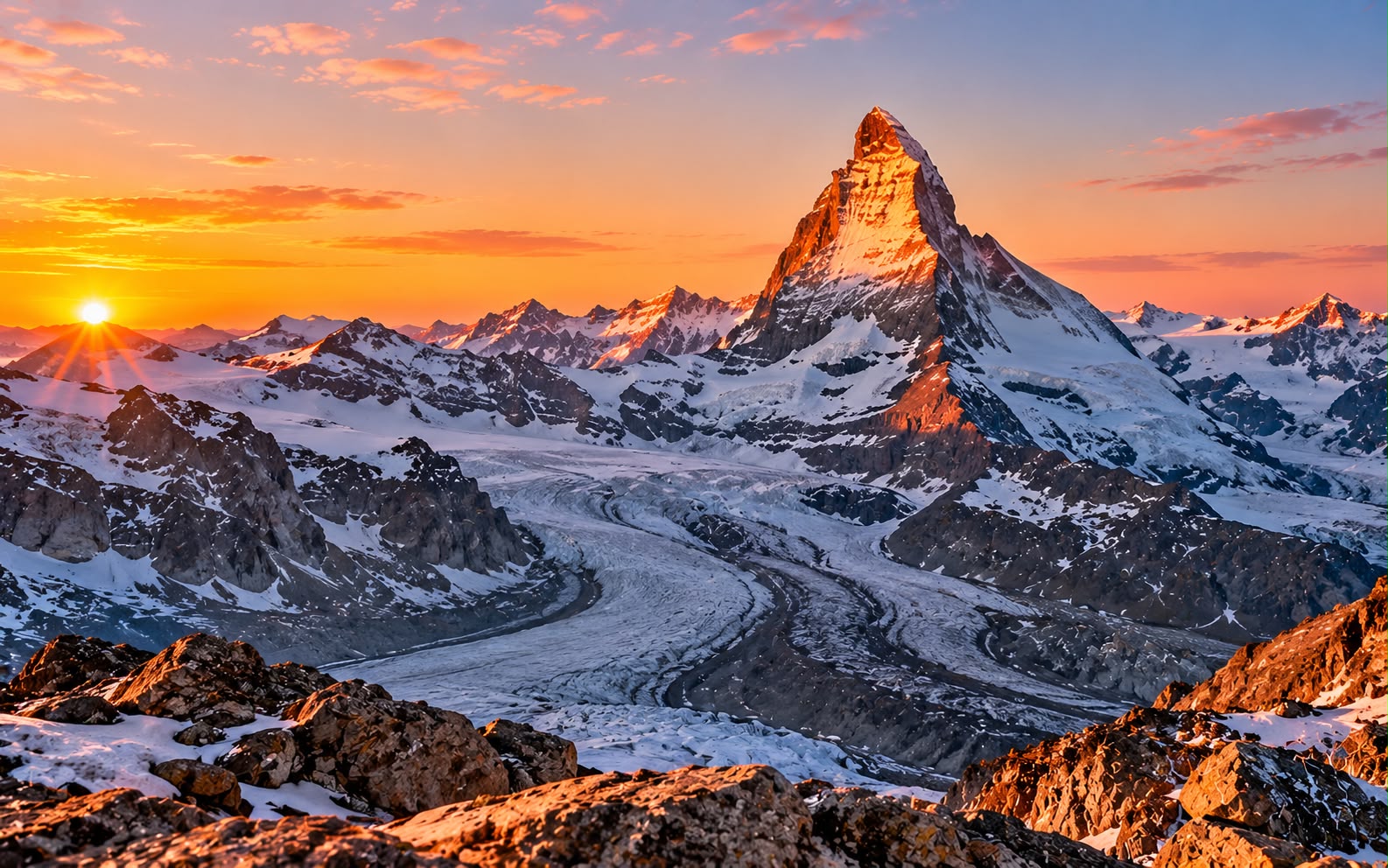
France and Switzerland in 11 days: Paris, the Jungfrau and the Matterhorn
A week of museums, boulevards and a glass pyramid, then a train into the Alps for cogwheel railways, a mountain that looks like the chocolate wrapper, and lakes the colour of antifreeze.
- Western Europe
- 11 days
- ≈ AED 9,000 / person
- The city and the mountains, joined by a three-hour train
Before you go
Before you go: the admin
One visa, two countries, no border
- Both are in Schengen, so one visa covers the trip and the border is invisible.
- France is in the EU and the eurozone; Switzerland is in neither. It is in Schengen and uses the Swiss franc, and it is outside the customs union — which means duty-free limits apply when you cross, and the meat and dairy allowances are low and enforced.
- Passports need three months’ validity beyond departure.
Trains, which are the whole point
- Paris to Geneva on the TGV Lyria is three hours, and Paris to Basel or Zurich about four. Book on SNCF Connect as far ahead as possible — fares are released months out and triple close to departure.
- Swiss trains do not need booking and do not need to: they are turn-up-and-go, and they leave exactly on time. A minute late on the platform is a missed connection.
- The Swiss Travel Pass covers trains, buses, boats and many mountain railways at a discount, and most museums. Do the maths — it pays off on a multi-region Swiss week and not on a short one.
- The scenic trains need seat reservations even with a pass — the Glacier Express and the GoldenPass in particular.
Money
- Euros in France, Swiss francs in Switzerland. Switzerland is not in the eurozone and paying in euros gets you a poor rate and change in francs.
- Cards work everywhere in both.
- Switzerland is expensive — roughly double France for food and accommodation. Coop and Migros, picnics, and the tap water, which is excellent and free from every public fountain.
One gentle brief
- Say bonjour on entering any shop in France. Not doing so reads as rudeness and shapes the whole interaction.
- The mountain weather decides the itinerary, not the other way round. Jungfraujoch and the Matterhorn are frequently in cloud; check the webcams each morning and swap the days around.
- Pace it. Four days in Paris and six in the Alps is the right shape. Trying to add Nice or Lucerne’s neighbours makes it a train holiday.
Day by day
Day 1 — Paris, arrival and the Marais
- Land, drop bags, and walk. The city is best met on foot.
- 15:00 — Le Marais for the afternoon — the Place des Vosges, the lanes behind it, and falafel on the Rue des Rosiers.
- 17:30 — Notre-Dame, which reopened in December 2024 after the fire. Entry is free and timed slots are released days in advance — book the moment you have dates.
- 19:30 — Dinner. Lunch is 12 to 2 and dinner from 7.30. Outside those hours the kitchen is shut, which catches out everyone arriving hungry at five.
Day 2 — The Louvre, and the river
- 09:00 — The Louvre, booked with a timed slot, and go in with a plan — three rooms properly beats nine at a trot. It closes on Tuesdays.
- The Denon wing holds the Mona Lisa and the Italian painting; Richelieu holds the French and is nearly empty by comparison.
- 13:00 — Lunch in the Tuileries, then the gardens.
- 15:00 — The Orangerie for Monet’s water lilies in two oval rooms, which takes forty minutes and is the best forty minutes in Paris.
- 18:00 — Walk the Seine to the Pont Alexandre III.
- 20:00 — Saint-Germain for the evening.
Day 3 — Orsay, Montmartre and the tower
- 09:30 — The Musée d’Orsay in a converted railway station, the better museum for most people — the Impressionist floor under the old station clock.
- 13:00 — Montmartre. Go early, before the Sacré-Cœur steps fill — though by afternoon the trick is simply to use the back lanes rather than the Place du Tertre.
- 16:00 — The vineyard and the Lapin Agile on the quiet side of the hill.
- 18:30 — The Eiffel Tower, booked online. Walking up is an hour of queue avoided and the second floor is the better view — you can see the tower’s own shape from it, which you cannot from the top.
- 21:00 — The hourly sparkle from the Champ de Mars or the Trocadéro.
Day 4 — Versailles
- 08:00 — Versailles as a day trip. Go at opening — the RER C takes 45 minutes and the queue at ten is an hour.
- 09:00 — The State Apartments and the Hall of Mirrors before the groups.
- 12:00 — The gardens are the half most people shortchange. Hire a bike or a golf buggy; the estate is 800 hectares and the Trianons are a long walk out.
- 14:00 — The Petit Trianon and the Hameau de la Reine, Marie Antoinette’s model farm, which is the part worth the effort.
- The fountains run only on show days — check before you pick the date, because the gardens are a different place with the water on.
- 18:00 — Back in Paris, and pack for the south.
Day 5 — Annecy, or straight to Switzerland
- 08:00 — The TGV south to Annecy — a lake town with a canal through it and water clear enough to see the bottom at ten metres. Under four hours from Gare de Lyon.
- 13:00 — The old town and the Palais de l’Isle, the castle in the middle of the canal.
- 15:00 — The lake path on a hired bike, flat and entirely along the water.
- Or go direct to Geneva and on to Zermatt, which saves a day if the Alps are the point — and if the forecast for the Matterhorn is good, take that option without hesitating.
Day 6 — Zermatt and the Gornergrat
- 08:00 — To Zermatt. Zermatt is car-free. You park at Täsch and take the shuttle train, which is ten minutes and frequent.
- 12:00 — The Matterhorn from the Kirchbrücke in the middle of the village, which is where the photograph is taken.
- 14:00 — The Gornergrat railway climbs to 3,089m in 33 minutes and puts the Matterhorn directly in front of you with the Gorner glacier below.
- Check the webcam before buying the ticket. In cloud you are paying a lot to see nothing.
- 17:00 — Walk down one stage to Rotenboden and the Riffelsee, where the mountain reflects on a still evening.
Day 7 — The high day, or the lakes
- 07:00 — Go on the first train if you did not get the mountain yesterday — it clouds over by mid-morning more often than not.
- Or the Matterhorn Glacier Paradise, the higher option at 3,883m, the highest cable car station in Europe, with the ice palace inside the glacier.
- 09:00 — The Five Lakes walk for the reflection shots, two to three hours downhill from Blauherd.
- 15:00 — Zermatt village, the Matterhorn Museum, and the cemetery with the graves of climbers from the 1865 first ascent, four of whom died coming down.
Day 8 — To the Jungfrau region
- 09:00 — The Glacier Express from Zermatt to Chur is eight hours and is the famous ride; the direct route to Interlaken is faster and goes over the Furka or through the tunnel. On eleven days, take the direct route.
- 13:00 — Into Lauterbrunnen, and stay in the valley rather than Interlaken.
- 15:00 — The Lauterbrunnen valley with its seventy-two waterfalls, and the Staubbach dropping 300m past the village.
- 16:30 — The Trümmelbach Falls inside the cliff, which is ten glacial waterfalls in a mountain, reached by a lift cut into the rock.
- 18:30 — Mürren or Wengen, both car-free and reached by cable car, for the evening light.
Day 9 — Jungfraujoch, or better
- 07:30 — Jungfraujoch, the “Top of Europe”, is 3,454m and is reached by cogwheel railway through the Eiger. It is expensive and it is frequently in cloud — the same webcam rule applies.
- Schilthorn, Männlichen or First are cheaper, lower and often better in marginal weather — and the Männlichen to Kleine Scheidegg walk is ninety easy minutes with the Eiger north face in front of you.
- 12:30 — Lunch at Kleine Scheidegg, where both plans meet.
- 16:00 — The First Cliff Walk above Grindelwald if the legs and the light hold.
Day 10 — Lucerne
- 09:00 — Two hours by train, over the Brünig pass.
- 11:00 — The Chapel Bridge with its painted panels, rebuilt after the 1993 fire, and the Lion Monument that Mark Twain called the saddest piece of stone in the world.
- 13:00 — A paddle steamer on Lake Lucerne to Vitznau, then the Rigi cogwheel railway, which was the first mountain railway in Europe and is gentler than the Jungfrau in every sense.
- Or Mount Pilatus by the steepest cogwheel railway in the world at 48%, which runs May to November only.
- 19:00 — Dinner on the Reuss.
Day 11 — Zurich and out
- 09:00 — An hour by train.
- 10:30 — The Old Town and the Lindenhof for an hour, and the Kunsthaus if the flight is late.
- Zurich airport is 10 minutes by train from the Hauptbahnhof and is one of the easiest in Europe — so this is a civilised last morning rather than a scramble.
Costs and practicalities
Best time to visit
June and September are the two best months — the mountain season is open, the passes are clear, and neither is the August peak.
- June — alpine meadows in flower, waterfalls at full snowmelt, and the high passes open from roughly late May or June to October. Long days.
- July–August — warmest and busiest, with Zermatt and Interlaken at capacity and prices at their highest. Paris in August is quiet and many restaurants close for weeks.
- September — the best of the year: clear air, warm days, the Alpabzug cattle descents from the high pastures in late September, and the crowds gone.
- December–March — ski season; the mountain railways run for it and Paris has the Christmas markets and empty museums. Many high passes close entirely from October to May.
- April–May and late October–November — the two gaps, when many mountain lifts and hotels close for maintenance. Check before booking a mountain base in those weeks.
Travel tips
- Check the Gornergrat and Jungfraujoch webcams every morning and reorder the days accordingly. Both are expensive and both are frequently in cloud, and the mountains do not care about your itinerary.
- Book the TGV Lyria months ahead. Fares triple close to departure and it is the one leg that cannot be turned up for.
- Do the Swiss Travel Pass maths against point-to-point tickets. It pays off across a multi-region week and not on a short stay.
- Swiss trains leave exactly on time. Not approximately.
- Switzerland is outside the EU customs union — the meat and dairy allowances crossing from France are low and enforced.
- Drink from the fountains. Swiss public fountains run continuously with drinking water and buying bottled is pure waste.
- Say bonjour, and round up rather than tipping a percentage. Service is included in both countries.
What this trip actually costs
Two people, 10 nights, mid-range comfort, international flights excluded:
| Item | Cost |
|---|---|
| Hotels, 10 nights | EUR 1,800 (≈ AED 7,370) |
| Food and drink, 11 days | EUR 900 (≈ AED 3,685) |
| Mountain railways, museums and entries | EUR 800 (≈ AED 3,276) |
| TGV Lyria and Swiss rail, two people | EUR 700 (≈ AED 2,866) |
| City transport and transfers | EUR 200 (≈ AED 819) |
| Total for two | EUR 4,400 (≈ AED 18,016) |
- Roughly EUR 2,200 (≈ AED 9,008) per person, and the Swiss half costs roughly double the French one for the same standard.
- The mountain railways are the surprise. Jungfraujoch and Gornergrat together run to around €300 for two before anything else, which is most of the entries line.
- Booking the TGV late can add €200 on its own.
- Hotel picks here are chosen on location, not on commission — always check prices and recent reviews before booking.
What to pack
- Layers and a windproof. Jungfraujoch is 3,454m and below freezing in July.
- Sunglasses and SPF 50 — the glare off snow and glacier at altitude burns faces that have been in Paris all week.
- Proper walking shoes for the alpine trails, which are well-made and still steep.
- Something smart for Paris, and shoes that handle cobbles.
- A reusable bottle for the Swiss fountains.
- A card and a backup; both countries are near-cashless.
FAQ
Jungfraujoch or Gornergrat? Gornergrat, if you only do one — it is cheaper, the Matterhorn view is unobstructed, and it is less often clouded. Jungfraujoch is higher and more of an engineering spectacle.
Is the Swiss Travel Pass worth it? On this routing, usually yes — it covers the trains, the boats, most museums and gives a discount on the mountain railways. Do the sum against point-to-point before buying.
How many days in Paris? Four, including Versailles. Three works if you skip Versailles; fewer means choosing between the Louvre and the d’Orsay.
Can I add Nice or the Loire? Not on eleven days without gutting the Alps. Either is a separate trip.
Is Switzerland really that expensive? Yes — roughly double France. Supermarket lunches, picnics and the free fountains are how people manage it, and they are also how the Swiss manage it.
Prices and entry rules change, and what you need depends on your passport; last checked 29 October 2026, so confirm with the embassy or your airline before booking.


