 The Itinerary
Italy and Greece in 14 days: Rome, Pompeii, Matera and the ferry to Meteora
The Greek temples in southern Italy are older than most of the ones in Greece — the Greeks got there first and called it Magna Graecia. Rome, a city buried by a volcano, a town of cave dwellings, then an overnight ferry across the Adriatic to monasteries on rock pillars.
- Southern Europe
- 14 days
- ≈ AED 9,850 / person
- The classical world in the order it actually happened
Before you go
Before you go: the admin
One visa, two countries, one boat
- Both are in Schengen and the eurozone. One visa, one currency, no border check — not even on the ferry, which is an internal Schengen crossing.
- Passports need three months’ validity beyond departure.
- The EES biometric system is now running, so allow extra time at your first Schengen entry.
The ferry, which is the joint
- Bari or Brindisi to Igoumenitsa or Patras, overnight, roughly 9 to 16 hours depending on the pairing. Bari to Igoumenitsa is the shortest and lands you nearest Meteora.
- Book a cabin, not a reclining seat. The price difference is modest and it is the difference between arriving rested and arriving ruined.
- Sailings are daily in summer and drop to a few a week from November, and are cancelled for weather. Check the current timetable before committing; the whole route hangs off one crossing.
- You can take a hire car across, but most Italian companies prohibit leaving the country — check before assuming, and dropping in Italy and hiring again in Greece is usually simpler.
Trains, cars and the gaps
- Italy’s Frecciarossa does Rome to Naples in an hour. Book on Trenitalia or Italo ahead for the cheap fares.
- Matera needs a car or a bus — the railway is a private narrow-gauge line from Bari and is slow.
- Greece’s trains are limited. Hire a car at Igoumenitsa for Meteora and Delphi; drop it in Athens.
- Fly into Rome and out of Athens, open-jaw.
One gentle brief
- The order matters and it is deliberate. Rome, then the Greek colonies in Italy, then Greece itself — which runs the history backwards and makes the point better than doing it forwards.
- Lunch is 1 to 3 in Italy and dinner from 8; in Greece dinner starts at 9 and later. Neither country feeds you at six.
- Both are hot and shadeless in summer, and the archaeology is all outdoors.
Day by day
Day 1 — Rome, ancient
- 08:30 — Book the Colosseum, Roman Forum and Palatine on one timed ticket, and go at opening. The Colosseum arena floor and the underground are separate add-ons and worth it.
- 11:00 — Straight into the Forum and up the Palatine, which the same ticket covers and most people are too tired to use.
- 14:00 — Lunch in Monti, the quarter behind the Colosseum, where Romans actually eat.
- 16:30 — The Pantheon, which has been standing with the largest unreinforced concrete dome in the world since 126 AD and now charges a small entry.
- 20:00 — Trastevere in the evening, across the river.
Day 2 — The Vatican
- 08:00 — The Vatican Museums and the Sistine Chapel, booked with a slot, always. The queue without one runs for hours and the touts outside sell the same ticket at a markup.
- Cover shoulders and knees for St Peter’s and the Vatican — they turn people away, men included.
- 11:30 — St Peter’s is free with its own security queue — go at seven when it opens, or late. From the Sistine Chapel there is a shortcut through that saves the whole queue if your guide has access.
- 13:00 — The dome climb, 551 steps, with the last stretch leaning with the dome.
- 16:00 — Castel Sant’Angelo, Hadrian’s tomb turned fortress, with the covered escape corridor to the Vatican along the wall top.
- 19:00 — Dinner in Prati, which is where the neighbourhood eats rather than the tourists.
Day 3 — Borghese, and the Appian Way
- 09:00 — The Borghese Gallery, booked weeks ahead in two-hour slots — Bernini’s Apollo and Daphne alone justifies it.
- 12:00 — The Villa Borghese gardens, and the Pincio terrace over Piazza del Popolo.
- 15:00 — The Appian Way on a Sunday when it is closed to traffic — hire a bike at the park office, and the catacombs are along it.
- Any other day, swap in the Capitoline Museums or the Baths of Caracalla.
- 19:00 — The Trevi Fountain and the Spanish Steps late, when they are passable.
Day 4 — Naples, and Herculaneum
- 09:00 — An hour by Frecciarossa.
- 11:30 — Herculaneum is the better site for most visitors: smaller, far less crowded, and buried in pyroclastic surge rather than ash, so the wooden beams, doors and furniture survived. Two hours is enough, which Pompeii never is.
- 15:00 — Naples itself — the Spaccanapoli, the straight Greek street that cuts the old city, and the sotterranea, the Greek cisterns and wartime shelters under it.
- 19:00 — Pizza where it was invented. The famous places have queues and take names; the one round the corner is usually as good.
Day 5 — Pompeii, and the museum
- 08:30 — Pompeii at opening — 44 hectares, and you need three hours minimum. The Villa of the Mysteries and the Lupanar are the two most people miss — the first is a fifteen-minute walk beyond the main site, which is exactly why it is quiet.
- 13:00 — Lunch, and out of the sun. There is very little shade on the site.
- 15:00 — The Naples Archaeological Museum holds everything portable from both, including the Farnese collection and the Secret Cabinet. See it after the sites, not before — the frescoes make sense once you have stood in the rooms they came out of.
- 18:30 — Back for the evening, and pick up the car in the morning.
Day 6 — To Matera
- 09:00 — Three hours east, best by car.
- 13:00 — Matera’s Sassi are cave dwellings carved into a ravine and continuously inhabited for around 9,000 years — among the oldest continuously occupied settlements on earth.
- 15:00 — The Casa Grotta museum, which tells the story honestly: they were evacuated in the 1950s as a national disgrace, then reoccupied and UNESCO-listed in 1993. That arc is the story.
- 17:30 — The rock churches across the gorge in the Murgia, with Byzantine frescoes — and the view back at the Sassi from that side at dusk.
- Stay in a cave hotel. It is the obvious move and it is right.
Day 7 — Bari, and the crossing
- 10:00 — An hour and a half to Bari. Drop the Italian car.
- 13:00 — Bari Vecchia for the afternoon — the old town where women still make orecchiette in the street, which is not staged, and the Basilica di San Nicola, which holds the relics of the man who became Father Christmas and is a pilgrimage site for Orthodox Christians.
- 18:00 — Board in the evening. Check in two hours ahead; the ferry takes vehicles and foot passengers and the queue is slow.
- 20:30 — Dinner on deck as Italy goes.
Day 8 — Igoumenitsa, and up to Meteora
- 07:00 — Dock in the morning, hire a car, and drive inland.
- 09:00 — Three hours to Kalambaka, climbing out of Epirus.
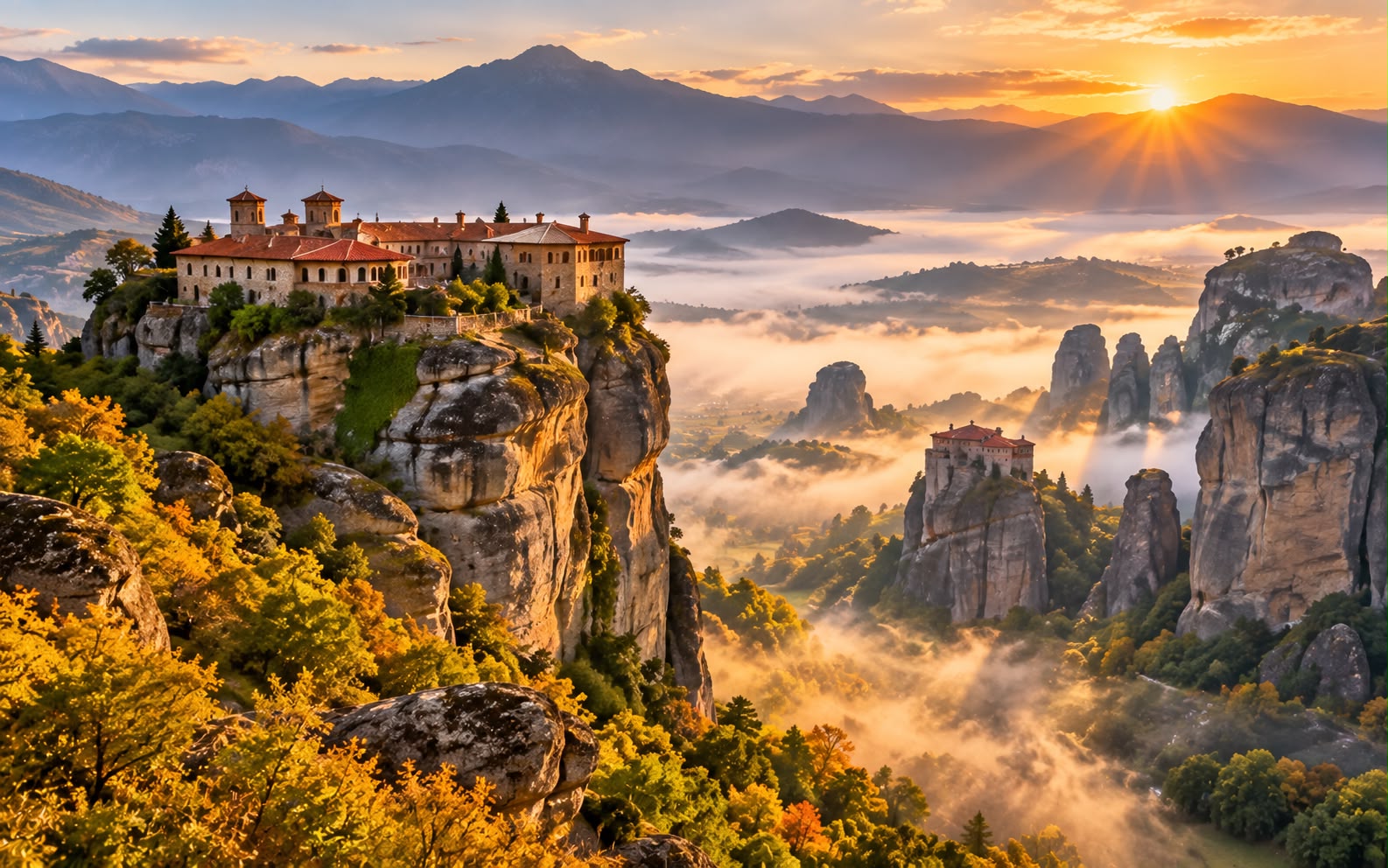
- 13:00 — Meteora — six monasteries on sandstone pillars up to 400m high, built from the fourteenth century by monks who were hauled up in nets. UNESCO-listed for both nature and culture.
- 19:00 — Sunset from the Psaropetra viewpoint, which is where everyone goes and deserves to be.
Day 9 — Meteora
- 08:30 — Go at opening. The coaches from Thessaloniki arrive at ten.
- Each monastery has its own closing day and they rotate — check before setting out or you will drive to a locked gate.
- Dress code is enforced: shoulders and knees covered, women must wear a skirt, and wraps are lent at the door.
- 09:00 — Great Meteoron is the largest and has the ossuary.
- 11:30 — Rousanou and St Nicholas Anapafsas are the most photogenic, and both are short climbs.
- 15:00 — Holy Trinity is the one from the Bond film and the hardest climb — 140 steps cut into the rock.
- 18:00 — The back road loop between the pillars, which almost nobody drives.
Day 10 — Delphi
- 08:00 — Four hours south through the Pindus, which is the best drive in Greece.
- 13:00 — Go at opening or late. There is no shade on that slope — so an early afternoon arrival means waiting until four.
- 16:00 — Delphi was the centre of the world to the Greeks — the omphalos stone marked it — and the Pythia gave oracles here for a thousand years. The site runs up a mountainside above an olive valley to the sea. Climb to the stadium at the top; most people stop short of it.
- 18:30 — The museum holds the Charioteer, one of the few surviving large bronzes from the classical period, and it alone justifies the trip.
Day 11 — To Athens, and the Acropolis
- 09:00 — Three hours to Athens, dropping the car.
- 13:00 — Drop bags in Plaka, Koukaki or Monastiraki.
- 16:30 — The Acropolis has a daily cap and timed entry. Book online, and go at opening or in the last two hours — the midday heat on that rock is serious.
- 19:30 — Plaka and Anafiotika for the evening.
- 21:00 — Psyrri for the eating.
Day 12 — The museums
- 09:00 — The Acropolis Museum below it, which lays out the Parthenon frieze at the original spacing with the gaps where the Elgin Marbles are.
- 12:30 — The Ancient Agora, Hadrian’s Library and the Kerameikos on one combined ticket — Kerameikos is the old cemetery and is almost always empty.
- 15:30 — The National Archaeological Museum — the Mask of Agamemnon, the Antikythera mechanism, the Artemision Bronze. It is the best classical collection anywhere and most visitors skip it.
- 19:00 — A rooftop in Monastiraki facing the rock lit up.
Day 13 — The coast, or an island
- 09:00 — Aegina or Hydra by hydrofoil, both under two hours from Piraeus. Hydra has no cars at all — donkeys and water taxis, and it is the better of the two.
- 16:00 — Back to Piraeus.
- Or a day to Cape Sounion for the Temple of Poseidon at sunset, ninety minutes down the coast, with the Aegean on three sides and Byron’s name carved into a column.
Day 14 — Out
- 09:00 — A last walk through the Plaka lanes, quiet before the shops open.
- 11:00 — The Benaki Museum or the Cycladic Art Museum if the flight is late; both are small and excellent.
- Athens airport is 45 minutes from Syntagma on the metro, which is the cheapest and most reliable way out.
Costs and practicalities
Best time to visit
April–June and September–October. Both countries are hot and shadeless in summer and this route is almost entirely outdoor archaeology.
- April–June — the best of the year. Wildflowers at Delphi and in the Murgia, comfortable at Pompeii and the Acropolis, and the ferry on full summer schedules from about May.
- July–August — Rome and Athens both pass 38°C, Pompeii has no shade whatever, and Italy largely shuts for Ferragosto around 15 August. The ferries are busiest and need booking weeks ahead.
- September–October — the best single window: warm, the sea still swimmable into October, the vendemmia in Italy, and the sites quiet again.
- November–March — mild, cheap and often wet. The museums are empty and the Acropolis in February with nobody on it is a real experience. But the Adriatic ferries drop to a few sailings a week and are cancelled for weather more often, which makes this particular route a gamble.
Travel tips
- Check the ferry timetable before you book anything else. It is daily in summer, thins out sharply from November, and the whole route depends on it.
- Book a cabin. An overnight Adriatic crossing in a reclining seat is a false economy.
- Meteora’s monasteries each close on a different day and the rota changes seasonally. Check, or drive to a locked gate.
- Women need a skirt for Meteora — wraps are provided but there are queues for them.
- Book the Colosseum, the Vatican and the Acropolis online with timed entry. All three sell out, and the Vatican queue without one is hours.
- Do not drive into Italian city centres. ZTL zones are camera-enforced and the fines arrive months later via the hire company.
- Cover shoulders and knees at St Peter’s, the Vatican and every Greek monastery — men included.
What this trip actually costs
Two people, 13 nights, mid-range comfort, international flights excluded:
| Item | Cost |
|---|---|
| Hotels, 13 nights | EUR 1,820 (≈ AED 7,452) |
| Food and drink, 14 days | EUR 980 (≈ AED 4,013) |
| Trains in Italy and car hire in Greece | EUR 700 (≈ AED 2,866) |
| Museums, sites and guides | EUR 700 (≈ AED 2,866) |
| Adriatic ferry with cabin, two people | EUR 400 (≈ AED 1,638) |
| Transfers and city transport | EUR 200 (≈ AED 819) |
| Total for two | EUR 4,800 (≈ AED 19,654) |
- Roughly EUR 2,400 (≈ AED 9,827) per person, and Greece is cheaper than Italy by a clear margin outside Athens.
- Rome is the expensive end and Matera the best value.
- Timed-entry tickets are a real line — the Colosseum, the Vatican and the Acropolis together run to around €150 for two.
- Hotel picks here are chosen on location, not on commission — always check prices and recent reviews before booking.
What to pack
- A sun hat and SPF 50. Pompeii, Delphi and the Acropolis have no shade at all.
- Shoes with grip. Pompeii’s basalt paving and the Acropolis rock are both polished and lethal.
- Something covering shoulders and knees, and a skirt or long wrap for Meteora.
- A layer for the ferry deck, which is cold at night even in July.
- A refillable bottle. Rome’s nasoni fountains run drinkable water all over the city.
- A day bag that closes, for Termini and the Athens metro.
FAQ
Why do Italy before Greece? Because the Greek colonies in southern Italy came first — Magna Graecia predates most of what survives in Greece — and running it in this order makes that land rather than reading as a footnote.
Is the overnight ferry worth it over flying? It is the joint that makes this one trip rather than two, and a cabin crossing is comfortable. Flying Rome to Athens takes two hours and loses the point.
Pompeii or Herculaneum? Both if you can. Pompeii is bigger and more famous; Herculaneum is smaller, far quieter, and the organic material — beams, doors, furniture — survived there and did not at Pompeii.
Can I take a hire car on the ferry? Technically yes, and most Italian hire contracts prohibit leaving the country. Dropping in Bari and hiring again in Greece is simpler and usually cheaper.
Is Matera worth the detour? It is the most unusual place on the route — cave dwellings occupied for nine thousand years, condemned as a national disgrace in the 1950s and now UNESCO-listed. Yes.
Prices and entry rules change, and what you need depends on your passport; last checked 29 October 2026, so confirm with the embassy or your airline before booking.


