 The Itinerary
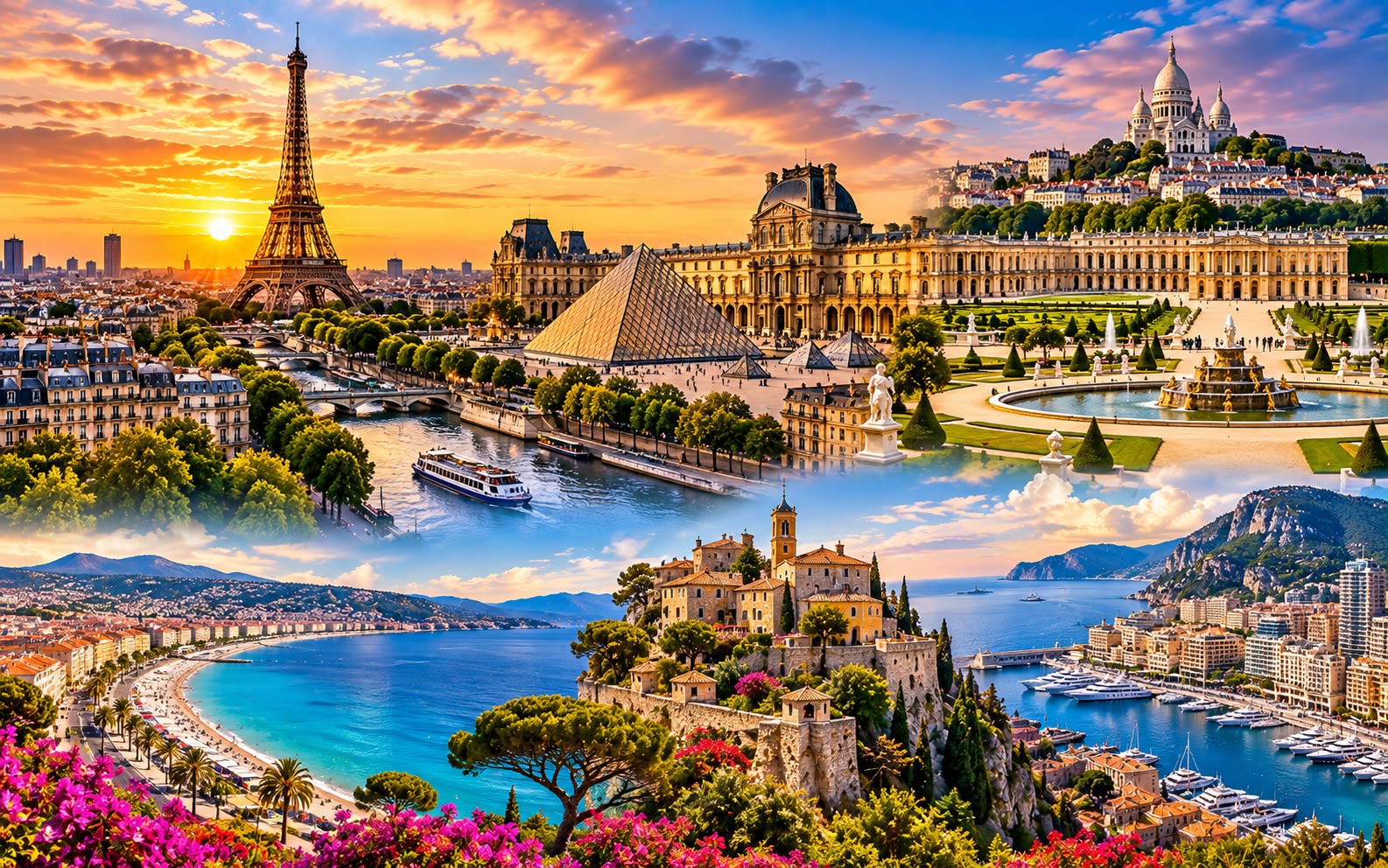
France in 9 days: Paris and the Riviera
The classic first France — five Paris days done in the right order (closed-day traps avoided), then the TGV south to Nice, Èze and Monaco — with the 2026 border changes, ticket prices and visa realities most guides haven't caught up with.
- Western Europe
- 9 days
- ≈ AED 5,850 / person
- First-time visitors
Before you go
France invented the tourist itinerary, and the first-timer version still beats its imitators: five days in Paris — museums, the tower, one royal palace — then a single high-speed train to a different country that happens to share the flag: the Riviera, where Nice’s old town smells of socca and the day trips are Èze’s eagle-nest village and an actual principality. Two Frances, one rail ticket, no internal flights.
What’s changed for 2026 — and what this guide gets right that older ones don’t: the EU’s new Entry/Exit System is fully live (biometrics at the border), the Louvre now charges non-EEA visitors €32 under its new dual pricing, and the closed-day chessboard (Louvre shut Tuesdays, Versailles Mondays, Orsay Mondays) is built into the day order below so you never stand before locked doors.
Go April–June or September–October. July–August is crowded and hot (Nice is at its best, Paris at its most queued); winter Paris is cheap and moody with short days.
All costs are in euros (EUR).
Before you go: the admin, 2026 edition
Visas and the new EU border tech
- Visa-free passports (US, UK, GCC, Japan and ~60 others): no
visa for 90 days — but two new systems apply:
- EES (live now, full rollout 10 April 2026): first entry to the Schengen area registers your face and fingerprints instead of a passport stamp. Nothing to do in advance — just allow extra queue time on your first arrival.
- ETIAS (no confirmed date): a €20 online travel authorisation for visa-exempt visitors, valid 3 years, free under 18 and over 70. The timetable has slipped more than once and is not yet set. Not operational at writing — any site selling ETIAS today is a scam; check the official EU page near your travel date.
- Schengen visa passports (India included): apply to the French consulate or its visa partner where you live — €90 consular fee plus a service fee, biometrics in person. France is among the faster deciders at 5–10 working days (allow 2–3 weeks in peak). The classic rejection reason is thin proof of funds — France expects ~€65/day per person with hotels prepaid; bank statements matter more than cover letters. Apply 4–6 weeks out, and good travel history often earns multi-entry. Full process in our Schengen visa guide.
- Travel insurance with €30,000 medical coverage is mandatory with the visa — and sensible for everyone.
Money and the honesty list
- Cards everywhere, contactless is life; carry €50–100 cash for markets and small bakeries.
- Tipping is not American: service is included by law (“service compris”) — rounding up or leaving €1–2 for good service is plenty.
- Pickpockets are Paris’s one real crime problem: metro line 1, Montmartre’s fabric of bracelet-sellers, Trocadéro and museum queues. Phones off café tables, bags zipped and forward. That paragraph, taken seriously, is your whole security plan.
- Sunday/Monday closures are real in France — markets thrive Sunday morning, much else rests.
SIM and getting around
- EU roaming eSIMs are cheap (~€10–20 for the trip); French operators’ tourist SIMs (Orange Holiday) work too.
- Paris: the Métro is the fastest way everywhere — buy a Navigo Easy card and load a carnet of t+ tickets; a single flat fare (~€2.50) now covers the network. Airport: RER B or the flat-rate taxis (CDG → right bank €56).
- Paris → Nice: the TGV from Gare de Lyon — 5h40, city-centre to seafront. Fares from €19 (OUIGO low-cost) and €29–45 on TGV inOui booked early; sales open ~4 months out on SNCF Connect. Sit on the right side after Marseille — the final hour runs along the Mediterranean. (Budget romantic alternative: the Paris–Nice night train with couchettes.)
- The Riviera runs on trains: Nice ⇄ Monaco/Villefranche/ Antibes every 20–30 minutes for a few euros. No car needed anywhere in this guide.
- Fly open-jaw: into Paris CDG, home from Nice (NCE) — both have direct Gulf links — and skip the return leg entirely.
Travelling with kids?
- Paris with children is better than its reputation: carousels everywhere, Luxembourg Gardens’ sailboats, the Eiffel’s glass-floor first level, and crêpes as negotiation currency.
- Métro stairs punish strollers — carrier for the city, stroller for the parks; museums free for under-18s almost everywhere.
- The famous family swap: trade Day 5 for Disneyland Paris (RER A, 40 min; book dated tickets online) — this guide’s structure absorbs it cleanly.
Day by day
Day 1 — Land in Paris, the river and the sparkle
Stay central: Marais, Saint-Germain, Opéra or the 7th — anywhere inside the first ring of arrondissements repays its price in walked minutes.
- Afternoon — Land at CDG; RER B or flat-fare taxi in. Check in, shake off the flight with coffee and a people-watch.
- 17:30 — First walk: the Seine banks from Pont Neuf toward the Louvre’s courtyards (free, open, glowing).
- 20:00 — Dinner in your quarter — a classic bistro plat du jour (€18–26) beats a “tourist menu” every time.
- 21:00 sharp — Be at Trocadéro or the Champ de Mars when the Eiffel Tower sparkles (five minutes every hour after dark). The correct first-night ending.
Where to stay in Paris (five nights)
- Luxury: Park Hyatt Paris-Vendôme — the modern palace standard, steps from Opéra.
- Mid-range: Hôtel Maison Mère (9th) — superbly rated boutique, metro on the doorstep.
- Budget: Hotel Astoria – Astotel — the reliable well-located pick; the Astotel group generally is Paris budget-mid done right.
Day 2 — Louvre morning, island afternoon
The Louvre is closed Tuesdays — this itinerary parks it on Day 2; shuffle accordingly if your Day 2 lands on one.
- 8:45 — Be early for a 9:00 timed slot at the Louvre (book at ticket.louvre.fr weeks ahead in season; €32 for non-EEA visitors under 2026’s new dual pricing, €22 EEA, under-18s free). Go straight to the Mona Lisa first, then wander back through the Grande Galerie in peace. Three hours; you cannot “finish” it, so don’t try.
- 12:30 — Lunch in the Palais-Royal gardens or the Tuileries kiosks.
- 14:30 — Île de la Cité: Sainte-Chapelle (~€13, timed entry — book; the upper chapel’s walls of 13th-century glass are Paris’s single most gasped-at interior) and Notre-Dame, gloriously reopened — free, with a reservation app for the queue-averse.
- 17:30 — Cross to the Latin Quarter: Shakespeare & Company, the winding streets, an early-evening crêpe.
- 20:00 — Dinner in Saint-Germain or the Latin Quarter.
Day 3 — The tower, the Orsay, the river by night
- 9:00 — Eiffel Tower — pre-booked (tickets open ~60 days ahead and summit slots vanish): summit by lift €36.70, second floor €23.50, and the stairs option (€14.80, now reservation-required) is genuinely fun with kids. Morning slots mean thinner crowds and Alps-clear air.
- 12:00 — Picnic assembly on Rue Cler (fromagerie, boulangerie, rotisserie) eaten on the Champ de Mars — the best-value great meal in Paris.
- 14:30 — Musée d’Orsay (closed Mondays; ~€16, book) — the Impressionists in a Beaux-Arts railway station; the clock-window photo is upstairs.
- 17:30 — Rest, or Saint-Germain shopping.
- 20:30 — Seine cruise by night (~€16–20, one hour, Vedettes/Bateaux from the islands or Eiffel) — monuments lit, bridges overhead; unironically worth it.
Day 4 — Versailles, then Montmartre at dusk
Versailles is closed Mondays — hence Day 4.
- 8:00 — RER C to Versailles Château Rive Gauche (~35–40 min, ~€7.30 return; 5-min walk to the gates).
- 9:00 — First entry slot at the Palace (book the Passport ticket — €35 April–Oct including the Musical Fountains days, €25 winter; palace-only €21): the Hall of Mirrors is nearly empty at 9:10 and a scrum by 11. Then the gardens, the Grand Canal (rowboats, kids), and the Trianon estate — Marie-Antoinette’s hamlet is the sleeper hit.
- 15:30 — Train back; recovery coffee.
- 18:00 — Montmartre: funicular or the stairs to Sacré-Cœur for sunset over all of Paris, then the Place du Tertre lanes when the day-trippers thin. Watch for the bracelet-and-petition hustlers on the steps; a firm non suffices.
- 20:30 — Dinner on the hill’s back streets (rue des Abbesses end, not the square-side tourist menus).
Day 5 — Your Paris day
The margin day — four proven shapes:
- The flâneur: Le Marais morning (falafel on rue des Rosiers, Place des Vosges), Luxembourg Gardens afternoon, Galeries Lafayette rooftop (free) for the golden-hour skyline.
- The art continuation: Rodin’s garden museum + the Orangerie’s Water Lilies (both bookable same-day off-season).
- The families’ swap: Disneyland Paris (RER A, 40 min; dated tickets online ahead).
- The pastry pilgrimage: a morning bakery crawl — croissant rankings are a legitimate itinerary item in this city.
- Evening — Pack; early TGV tomorrow. Farewell-to-Paris dinner accordingly.
Day 6 — The TGV south, first Riviera evening
- 9:00 — Gare de Lyon → Nice (5h40; buy the moment your dates fix — €29–45 early inOui, €19+ OUIGO). Right-side seats after Marseille: the last hour skims the Mediterranean’s edge.
- 15:00 — Arrive Nice Ville, tram or walk to your hotel; first swim or promenade shakedown.
- 18:00 — Promenade des Anglais at golden hour — the bay earns the name Baie des Anges nightly.
- 20:00 — Old Town (Vieux Nice) dinner: socca (chickpea pancake) from a counter as the opener, then niçoise cooking — the real salade niçoise has no cooked vegetables and locals will tell you so.
Where to stay in Nice (three nights)
- Icon: Hôtel Negresco — the pink-domed grande dame of the promenade; part hotel, part art museum.
- Mid-range: Hôtel du Centre (Ammi) — superbly rated, walkable to Old Town and beach.
- Budget: Hôtel Byakko — rooftop terrace, tram at the door, honest prices.
Day 7 — Nice itself: market, old town, castle hill
- 9:00 — Cours Saleya market (mornings, closed Mondays for produce — antiques instead): flowers, fruit, olive stalls; breakfast standing up.
- 10:30 — Vieux Nice’s lanes properly: Sainte-Réparate cathedral, gelato at the famous fenocchio counters (the lavender flavour is the local dare).
- 12:30 — Lunch in the old town or beach-club style on the pebbles (yes, pebbles — water shoes make Nice beaches lovely).
- 15:00 — Castle Hill (Colline du Château) — free lift or stairs to the panorama over the bay and port; the waterfall and playgrounds make it the family hour too.
- 18:00 — Port side aperitif, or the promenade by bike (city-bike stations everywhere).
- 20:30 — Dinner reservation somewhere you loved at lunch — Nice rewards repeat visits within the same day.
Day 8 — Èze and Monaco: the eagle’s nest and the principality
The Riviera’s greatest-hits day, entirely by public transport.
- 9:00 — Bus or train+shuttle to Èze village — the medieval eagle’s-nest 400 m above the sea. Wander the stone lanes early, then the Jardin Exotique (~€7–8) crowning the ruin: cacti, sculptures, and the coast’s best viewpoint.
- 12:00 — Lunch in Èze or push on and eat in Monaco.
- 13:30 — Train or bus onward to Monaco (Nice–Monaco trains run every ~20–30 min, ~€5): the palace square’s 11:55 guard change if you time it, the old town (Le Rocher) and cathedral, the port’s absurd yachts, and Casino Square, Monte-Carlo — where the cars outside are the free museum (casino atrium visitable; gaming rooms ticketed, dress up).
- 17:30 — Optional add-on stop on the way home: Villefranche-sur-Mer’s perfect crescent for a golden-hour drink (one train stop from Nice).
- 20:30 — Farewell Riviera dinner in Vieux Nice.
Day 9 — Fly home from Nice
- Morning — One last promenade coffee; tram T2 runs straight to Nice airport (NCE) — direct Gulf and European departures, no Paris backtrack. Au revoir being the operative phrase.
Costs and practicalities
Best time to visit
April–June and September–October. July and August are when France goes on holiday itself, which means the coast is full, Paris is emptier but hot, and many small restaurants simply close.
- April–June — the best of the year. Blossom, long days, and the Loire and Provence before the crowds.
- July–August — peak everywhere on the coast and in the Alps. Lavender in Provence flowers from late June to mid-July, which is worth timing precisely. Paris in August is quiet and many shops shut for weeks.
- September–October — the vendange, the wine harvest, across Burgundy, Bordeaux and the Rhône. Warm, quieter, and the best month for eating.
- November–March — museums without queues, the Alps for skiing from December, and Christmas markets in Strasbourg and Colmar from late November, which are the best in France.
Travel tips
- Say bonjour on entering any shop, bakery or restaurant. Not doing so reads as rudeness and shapes the whole interaction. Bonjour, madame/monsieur and au revoir on the way out.
- Book TGV tickets well ahead. Fares rise steeply close to departure, and the cheap ones go months in advance.
- Lunch is served roughly 12 to 2 and dinner from 7.30. Outside those hours many kitchens are closed, especially outside cities.
- Service is included by law. Round up or leave a couple of euros for good service; a percentage tip is not expected.
- Many museums close on Monday or Tuesday, and the Louvre on Tuesday. Check before building a day around one.
- Book the Eiffel Tower, the Louvre and Versailles online with timed entry. Walking up is an hour or more of queue in season.
- Pickpockets work the Métro, Montmartre and the area around the Eiffel Tower. Bag in front, phone away.
What this trip actually costs
Two people, 8 nights (5 Paris + 3 Nice), mid-range comfort, international flights excluded:
| Item | Cost |
|---|---|
| Hotels, 8 nights | EUR 1,500 (≈ AED 6,142) |
| TGV, métro, RER, Riviera trains, airport links | EUR 300 (≈ AED 1,228) |
| Entries: Louvre, Eiffel summit, Versailles Passport, Orsay, Sainte-Chapelle, cruise, Èze | EUR 320 (≈ AED 1,310) |
| Food and drink, 9 days (picnics to bistros) | EUR 630 (≈ AED 2,580) |
| eSIM, extras | EUR 100 (≈ AED 409) |
| Total for two | EUR 2,850 (≈ AED 11,670) |
- Roughly EUR 1,425 (≈ AED 5,835) per person — the most expensive guide on this site, and honestly stated: Paris hotels are the engine (€150 buys little; €210 buys nice). The levers: Astotel-tier rooms + picnic lunches pull it near EUR 1,100 (≈ AED 4,504); palace hotels and starred dinners have no ceiling. July–August adds 20–30%.
- Book in this order: flights (open-jaw CDG in / NCE out) → Schengen visa if needed (4–6 weeks) → Paris hotel → Eiffel summit (60 days out) and Versailles Passport → TGV (when sales open ~4 months) → Louvre and Orsay slots → everything else walks up.
- Hotel and restaurant picks here are unsponsored — no affiliate links in this article. Chosen on location and current ratings; always check prices and recent reviews before booking.
What to pack
- Real walking shoes — this guide is 15,000 steps a day on cobbles and museum marble.
- Smart-casual layers: Paris dresses up slightly and so will you by day three; a scarf is the universal French adapter.
- Water shoes or thick soles for Nice’s pebble beaches; swimwear May–October.
- A packable tote for market picnics; corkscrew in checked luggage, obviously.
- Rain layer for Paris any season; sunscreen for the Riviera.
- Patience for queues and none for bracelet-sellers.
FAQ
Is 5 days too many for Paris? No — it’s the minimum for this list without sprinting. The closed-day chess (Louvre Tue, Versailles Mon, Orsay Mon) is why winging it fails; this order exists so you never lose a morning to a shut door.
TGV or fly to Nice? Train, almost always: city centre to seafront in 5h40 beats airport theatre both ends, luggage rides free, and the last hour is a sea view. Fly only if a €25 promo fare meets a schedule the train can’t.
Is Paris safe? What about the pickpockets? Violent crime against tourists is rare; theft-by-distraction is industrial. The metro-and-hotspots paragraph above is the whole game — travellers who zip bags and keep phones off tables almost never report problems.
Halal and vegetarian food? Both easier than reputation suggests: Paris has one of Europe’s largest halal dining scenes (from Le Marais falafel to south-Asian Faubourg Saint-Denis), and vegetarians eat well everywhere the menu says légumes — though classic bistros remain butter-and-beef country; the picnic strategy solves all diets deliciously.
Can we add a third stop? The graceful add-ons: Avignon or Aix-en-Provence as a TGV break between Paris and Nice (+1–2 days), or Antibes/Cannes as a second Riviera day. Resist adding a third region — this route’s calm is the feature.
When do the new EU border rules bite? EES is already live — build in slower first-entry queues (biometrics once per passport, faster after). ETIAS’s €20 authorisation for visa-exempt travellers is expected from late 2026: check the official europa.eu page before travel and buy it nowhere else.
Prices and entry rules change, and what you need depends on your passport; last checked 8 October 2026, so confirm with the embassy or your airline before booking.


