 The Itinerary
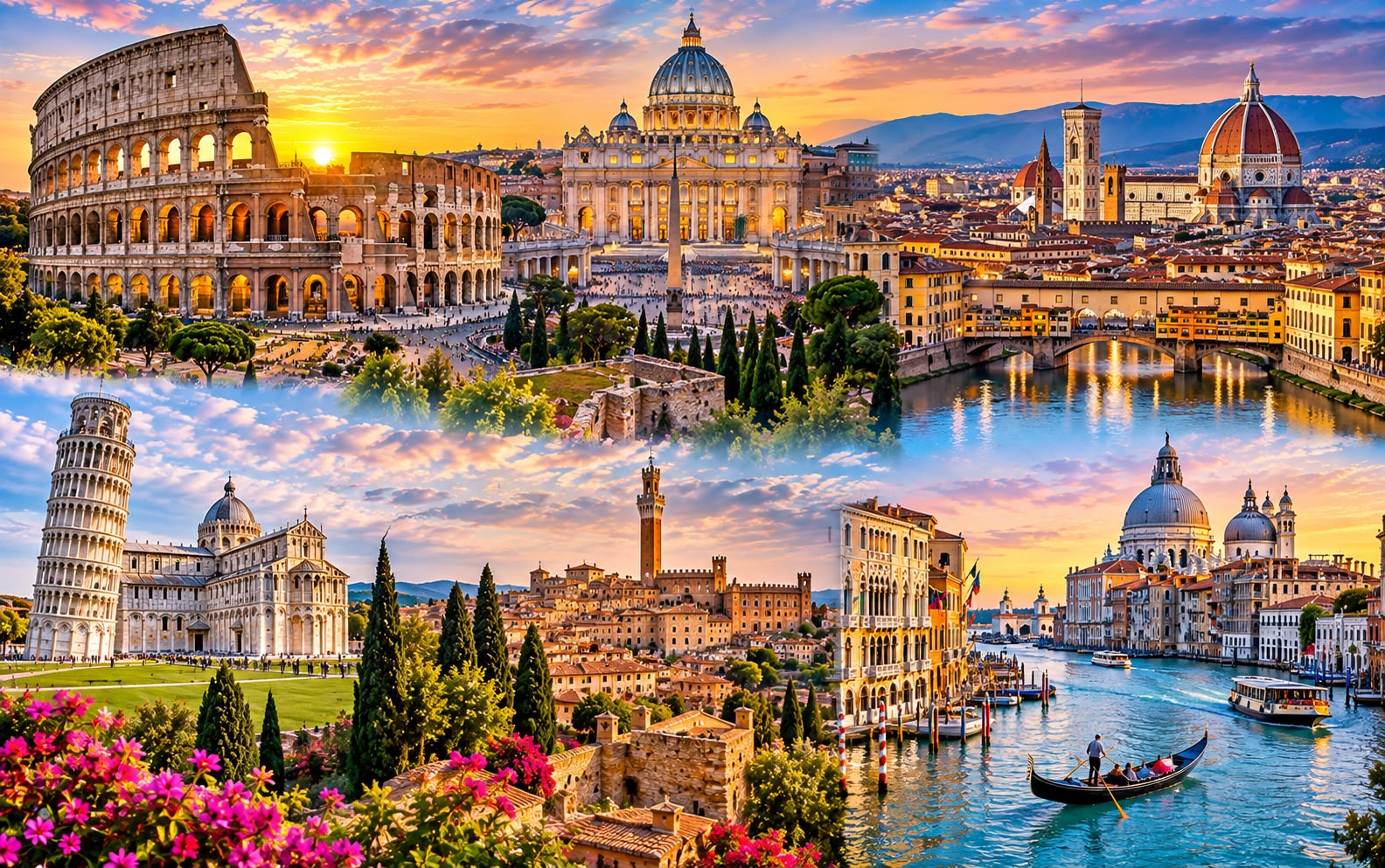
Italy in 10 days: Rome, Florence and Venice
The classic triangle by high-speed rail: four Roman days from the Colosseum to the Sistine ceiling, Florence's Renaissance in walking distance, then the impossible city on the water — with 2026's booking windows, Venice's new access fee, and the coperto decoded.
- Southern Europe
- 10 days
- ≈ AED 7,550 / person
- First-time visitors
Before you go
Italy is the trip people measure other trips against. Rome is three thousand years stacked in layers you walk through on the way to breakfast; Florence invented the Renaissance and still fits inside an afternoon stroll; Venice should not exist, and does, and floats. The high-speed line sews all three together in under-two-hour hops — this is Europe’s easiest great itinerary and its most heavily booked.
That last part is the 2026 catch: Italy now runs on timed tickets. The Colosseum releases 30 days out and evaporates in hours; the Uffizi charges extra for certainty; Venice charges day-trippers just to walk in on peak dates. This guide’s job is mostly to put the right booking dates in your calendar — the beauty handles itself.
Go April–June or September–October. July–August is 35°C+, queue-crushed, and half of Italy closes for its own holidays in mid-August; winter is short-queued, moody and cheap (Venice fog is a feature). All costs are in euros (EUR).
Before you go: the admin
Visa and borders
Schengen rules are covered in depth in our Schengen visa guide; the essentials: ~60 nationalities enter visa-free (the EES biometric border has been fully operational since April 2026 — allow extra time at first entry — and the €20 ETIAS authorisation still has no confirmed start date); Schengen-visa passports (India included) apply with the usual file. Italy’s applications run through VFS Global — fee €90 + service charges, typical processing ~15 days, but appointment slots in season need 4–8 weeks of lead, so start early. Proof of funds, confirmed refundable bookings and insurance (€30,000 cover) remain the make-or-break documents.
Money and the small print
- Cards work everywhere; keep €50 in small notes for gelato, markets and church-crypt donations.
- The coperto is not a scam: €1.50–3 per person appears on most restaurant bills as a cover charge. It’s legal and universal. Service is included beyond that — no 20% tipping; rounding up is generous.
- Tourist taxes are real and rising: Rome charges ~€4–7.50 per person per night, Florence ~€5–8, Venice ~€1–5 — paid at the hotel. Budgeted below.
- Venice’s access fee (2026): on ~60 peak dates (April–July, mornings-to-16:00), day visitors pay €5 (€10 if booked under 4 days ahead). Overnight guests are exempt — but must still register online for an exemption QR code; fines run to €300. Your hotel will remind you; do it anyway.
- Free water: Rome’s nasoni street fountains run cold and drinkable — refill, don’t buy.
The Italian clock (and the tourist-trap radar)
- Lunch 12:30–14:30, dinner from 19:30 — earlier than Spain, stricter than you think. Many kitchens close 15:00–19:00.
- Never eat where a host waves a laminated photo menu — especially within sight of the Trevi, San Marco or the Rialto. Walk two streets; prices halve and food doubles.
- Cappuccino is breakfast; after lunch it’s espresso. Nobody will stop you — but now you know why the barista smiled.
- Pickpocket honesty: Termini station, the Rome metro, vaporetto crushes and every queue you’ll stand in are prime territory. Zipped crossbody in front, phone off the café table — the whole defence.
Trains, SIM, kids
- Two operators compete on the triangle: Trenitalia’s Frecciarossa and private Italo. Rome→Florence ~1h35, Florence→Venice ~2h05; fares from €20–40 booked 2–4 months out, double walk-up. Compare both (Trainline/Omio show them together); seats are reserved, luggage free.
- eSIM ~€10–20 for the trip; Italy’s 4G is fine, Venice’s alleys defeat GPS — screenshot your hotel’s walking route.
- Kids: Italy adores them. Under-18s enter the Colosseum and Accademia free, under-7s the Vatican; gelato is the universal negotiation currency; Venice is one giant hide-and-seek map. The trains are the nap slots.
Day by day
Day 1 — Land in Rome, the centro at dusk
Stay in the centro storico (Pantheon/Navona — walk everywhere, pay for it) or Monti (village-in-the-city near the Colosseum, our pick for value).
- Afternoon — Land at FCO, which takes non-stops from most of the world. Leonardo Express to Termini (€14, 32 min), check in.
- 17:30 — First passeggiata: Piazza Navona → the Pantheon’s porch (interior tomorrow — it’s ticketed now) → Trevi Fountain as the lights come on. Coin over the left shoulder; the €0.50 is the best value in Rome.
- 20:00 — First dinner near Campo de’ Fiori: cacio e pepe, carciofi if it’s season, house wine by the litre (~€25–35 a head).
Where to stay in Rome (four nights)
- Luxury: Albergo del Senato — 4.8/5 on TripAdvisor (~5,100 reviews), your window opens onto the Pantheon’s portico. ~€280–400.
- Mid-range: Hotel Artemide — 4.8/5 (~9,600 reviews), rooftop bar and spa on Via Nazionale, 10 minutes’ walk from everything. ~€180–250.
- Budget: iQ Hotel Roma — 4.7/5 (~5,600 reviews), fresh rooms by Termini, family-run efficiency. ~€130–180.
Day 2 — Ancient Rome, timed to the minute
- 08:30 — The Colosseum, first slot. The ticket (€18, includes Forum + Palatine Hill within 24 h) releases exactly 30 days ahead at 08:45 Rome time on ticketing.colosseo.it and morning slots go within hours — set an alarm, this is the trip’s hardest ticket. The €24 Full Experience adds arena floor or underground. Under-18s free.
- 11:00 — Walk the Roman Forum (Caesar’s burial site, the Senate house) up the Palatine Hill for the overview of it all.
- 13:30 — Lunch in Monti: pizza al taglio standing up or a trattoria pasta (~€12–20).
- 15:30 — Capitoline Hill — Michelangelo’s piazza, the she-wolf — then the Vittoriano terrace lift (~€15) for the 360° skyline, or free views from behind the monument.
- 18:00 — Aperitivo hour in Monti (Aperol, crisps, people in very good trousers, ~€8–10).
- 20:30 — Dinner: Roman classics — amatriciana, saltimbocca (~€25–35 a head).
Day 3 — The Vatican and Trastevere
Dress code is real: shoulders and knees covered for the basilica and museums.
- 08:00 — Vatican Museums at opening (€20 + €5 online reservation — the €5 is mandatory in practice; only tickets.museivaticani.va is official, everything else resells). Head straight down the one-way river to the Sistine Chapel before the crowds compress, then walk back for the Raphael Rooms and the maps gallery. Three hours. Closed Sundays (free but chaotic on the month’s last Sunday).
- 12:30 — Lunch in Borgo Pio (~€15–20), two quiet streets of it.
- 14:00 — St Peter’s Basilica (free; security queue 30–60 min): Michelangelo’s Pietà, Bernini’s baldachin. The dome climb (~€10–17, 551 steps or lift+320) earns the best view in Rome.
- 17:30 — Cross Ponte Sant’Angelo (Bernini’s angels, castle photo) and walk the river down to Trastevere.
- 20:00 — Trastevere dinner and a wander: fried artichokes, supplì, nightcap in Piazza Santa Maria (~€25–40 a head).
Day 4 — Rome’s second layer
- 09:00 — The Pantheon interior (€5, book online or queue early): the 2,000-year-old concrete dome with its open eye. Still the best building in Europe; fifteen minutes is enough, an hour is better.
- 10:30 — The tridente: Spanish Steps, Via dei Condotti window-pain, then Villa Borghese gardens — and, if you booked it, the Borghese Gallery (~€17, reservation mandatory, releases well ahead): Bernini’s Apollo and Daphne mid-transformation.
- 13:30 — Market lunch at Campo de’ Fiori or Testaccio Market (~€10–15).
- 15:30 — The quiet hits: the Aventine Hill — the keyhole view of St Peter’s, the Orange Garden terrace — and Santa Maria in Cosmedin’s Mouth of Truth (hand in, honesty optional).
- 19:00 — Last Roman dinner; gelato benediction at a proper gelateria (look for covered tubs and pistachio the colour of actual pistachios). Pack for the 09:00 train.
Day 5 — The Frecciarossa to Florence
- 09:00 — Roma Termini → Firenze S.M.N., 1h35 (from €20–30 booked ahead). Drop bags.
- 11:30 — Walk into the Piazza del Duomo cold — no photo prepares you for the marble. Circle the Baptistery’s Gates of Paradise, then climb: Brunelleschi’s dome (Brunelleschi Pass ~€30, timed slots that sell out weeks ahead) or Giotto’s bell tower for the view of the dome (the photographer’s choice).
- 13:30 — Lunch: All’Antico Vinaio’s €8 schiacciata (the queue moves fast) or Mercato Centrale’s upstairs food hall.
- 15:00 — Piazza della Signoria (the open-air sculpture gallery, the Palazzo Vecchio) → Ponte Vecchio and its goldsmiths.
- 18:00 — Cross to the Oltrarno and walk (or bus 12/13) up to Piazzale Michelangelo for the sunset over the whole postcard. Every Florentine cliché is up here being true.
- 20:30 — Oltrarno dinner — ribollita, pappardelle al cinghiale (~€25–35 a head).
Where to stay in Florence (three nights)
- Luxury: Portrait Firenze — 4.9/5 (~1,200 reviews), Ferragamo-family suites over the Arno by the Ponte Vecchio. ~€600+.
- Mid-range: Hotel David — 4.9/5 (~4,900 reviews), family-run riverside warmth, free evening drinks. ~€160–220.
- Budget: Hotel Pendini — 4.7/5 (~4,700 reviews), vintage rooms on Piazza della Repubblica, unbeatable position. ~€120–170.
Day 6 — The Renaissance, both galleries
Both close Mondays — this is why it’s Day 6, not Day 7.
- 08:15 — The Uffizi at opening (€25 gate / €29 with the advance reservation — pay the €4, certainty is the point; from 2026 there’s also a €16 after-16:00 discount slot). Botticelli’s Venus and Primavera, Leonardo, Titian, Caravaggio; the corridor windows over the Arno are their own gallery. Three hours minimum. Closed Monday.
- 12:30 — Lunch at Mercato Centrale (~€10–15), then the leather-market gauntlet of San Lorenzo.
- 15:00 — The Accademia (€16 + €4 booking): one long hall of Michelangelo’s unfinished Prisoners fighting out of their marble, and then David, absurdly better in person. Ninety minutes. Book the slot when you book the Uffizi.
- 17:30 — Santa Croce (Michelangelo’s and Galileo’s tombs, ~€8) or gelato-and-wander.
- 20:00 — The bistecca alla fiorentina night: sold by the kilo (~€50–60/kg, feeds two), rare or not at all, at a proper Tuscan grill.
Day 7 — A Tuscan day: Pisa and Lucca, or Siena
Two honest options by train/bus — no tour bus required:
- The classic combo: regional train to Pisa (1 h, ~€9 each way): the Leaning Tower delivers exactly the photo and climb (~€20, timed) it promises, the Duomo beside it is the underrated masterpiece — two hours covers the Field of Miracles. Then 30 minutes to Lucca: rent bikes and ride the intact Renaissance city walls (4 km of tree-lined ramparts), climb the tower with oaks on top, dinner back in Florence.
- The hill-town day: bus (~1h15) to Siena — the shell-shaped Campo, the zebra-striped Duomo, medieval Italy with the volume up. Deeper than Pisa; photo less famous.
- Either way: 20:30 back in Florence for a last aperitivo on a rooftop (view of the dome, ~€12).
Day 8 — To Venice, the reveal
- 09:00 — Firenze S.M.N. → Venezia Santa Lucia, ~2h05 (from €25–40). Sit left for lagoon glimpses.
- 11:30 — Walk out of the station doors: the Grand Canal is simply there. Ride vaporetto line 1 the slow way down the whole canal to San Marco (single €9.50 — buy the 48-hour pass, ~€35, it pays for itself by ride four).
- 13:00 — Check in, lunch standing at a bacaro: cicchetti (€1.50–3 each) and an ombra of wine — Venice’s tapas, Venice’s prices’ one mercy.
- 15:00 — St Mark’s Square: the Basilica’s golden mosaics (€3 timed entry — book online, skip the €6 no-booking queue; modest dress), the Campanile lift (~€12) or save the tower for Day 9’s empty morning.
- 18:30 — Get lost on purpose — Venice rewards no map between 6 and 8 p.m. — surfacing at the Rialto Bridge at dusk.
- 20:30 — Seafood dinner away from San Marco’s laminated menus (Cannaregio or Castello back streets, ~€30–45 a head).
Where to stay in Venice (two nights)
- Luxury: Hotel Palazzo Stern — 4.8/5 (~2,600 reviews), Grand Canal terrace breakfasts by the Accademia bridge. ~€300–450.
- Mid-range: Hotel Antiche Figure — 4.8/5 (~5,800 reviews), canal-front opposite the station — arrival could not be easier. ~€200–280.
- Value-boutique: Rosa Salva Hotel — 4.9/5 (~1,700 reviews), steps from San Marco above the city’s old pastry house. ~€180–250. (True budget in Venice means Mestre on the mainland — 40% cheaper, 10-minute trains, still inside the access-fee-exempt comune — a fair trade for families.)
Day 9 — Empty Venice, then the painted islands
- 07:00 — The trip’s secret hour: San Marco before the day-trippers — the square shared with pigeons and photographers only. Coffee standing at a bar (€1.30; the same cup seated on the square costs €7 and rents you the orchestra).
- 09:00 — Doge’s Palace (~€30, book online): the Tintoretto-ceilinged council halls, then across the Bridge of Sighs into the prisons. Two hours.
- 11:30 — Vaporetto 12 to the islands: Murano for a glass-furnace demonstration, then Burano — the fisherman’s houses in forty shades of defiance, the leaning campanile, lunch of risotto de gò (~€25). Half a day; the boat rides are the lagoon’s best tour.
- 17:30 — Back for golden hour. The gondola question, honestly: the official rate is €90 for 30 minutes (€110 after 19:00), per boat not per person — split six ways it’s a bargain, as a couple it’s a splurge that many call the trip’s peak anyway. The €2 traghetto ferry crossing is the sixty-second budget version.
- 20:00 — Farewell dinner in Dorsoduro, spritz on the Zattere as the lagoon goes pink.
Day 10 — Home from Venice
- Morning — One last campo coffee, then Alilaguna boat (~€15) or bus to VCE — home via a Gulf or European hub. Open-jaw (into Rome, out of Venice) means the triangle never backtracks.
Costs and practicalities
Best time to visit
April–June and September–October. Italy in August is hot, and much of it is shut because Italians are on holiday themselves.
- April–June — the best of the year. Warm, long days, and Rome, Florence and Venice before the peak.
- July–August — over 35°C in the cities, and Ferragosto on 15 August closes family-run restaurants and shops for a fortnight around it. The coast and the lakes are full; the cities are hot and oddly empty.
- September–October — the vendemmia, the wine harvest, in Tuscany, Piedmont and the Veneto; white truffles in Alba from October. Warm, and the queues shorter.
- November–March — cold and damp in the north, mild in Sicily, and the museums without queues. Venice’s acqua alta is most likely from October to January.
Venice has a day-visitor access fee on peak days — check the calendar before a day trip.
Travel tips
- Book the Uffizi, the Vatican Museums, the Colosseum and the Last Supper weeks ahead with timed entry. The Last Supper in particular sells out months in advance.
- Validate regional train tickets in the green machines before boarding. Fast trains with a reserved seat do not need it; regional ones do, and the fine is immediate.
- Coperto and servizio appear on restaurant bills — a cover charge and sometimes service. Tipping beyond rounding up is not expected.
- A cappuccino after about 11am marks you out, and coffee standing at the bar costs a third of what it does sitting down. Both prices are posted by law.
- Cover shoulders and knees in churches. St Peter’s and the Duomo will turn you away, and this applies to men too.
- ZTL zones in historic centres are camera-enforced and the fines arrive months later via the hire company. Do not drive into a city centre.
- Pickpockets work Termini, the 64 bus in Rome and the Rialto in Venice. Bag in front.
What this trip actually costs
Two people, 9 nights (4+3+2), mid-range comfort, international flights excluded:
| Item | Cost |
|---|---|
| Hotels, 9 nights (incl. all three cities’ tourist taxes) | EUR 1,700 (≈ AED 6,961) |
| Trains: two high-speed legs + the Tuscan day trip | EUR 150 (≈ AED 614) |
| Local transport: Leonardo Express, vaporetto passes, metros | EUR 120 (≈ AED 491) |
| Entries: Colosseum, Vatican, Pantheon, dome climb, Uffizi, Accademia, Doge’s Palace, Basilica slots | EUR 320 (≈ AED 1,310) |
| Food and wine, 10 days (coperti included) | EUR 1,050 (≈ AED 4,299) |
| eSIM, Venice registrations, extras | EUR 60 (≈ AED 246) |
| Buffer: a gondola, a rooftop aperitivo, leather-market weakness | EUR 300 (≈ AED 1,228) |
| Total for two | EUR 3,700 (≈ AED 15,150) |
- Roughly EUR 1,850 (≈ AED 7,575) per person — the priciest of our European triangles (compare Spain at €1,400): Venice’s beds and Italy’s ticket-everything culture are the difference. Mestre nights, bacaro dinners and free-church art (half the Renaissance hangs in churches) pull it toward EUR 1,450 (≈ AED 5,937); canal-view suites and bistecca every night push past EUR 2,500 (≈ AED 10,236).
- Book in this order: Schengen visa (VFS, 4–8 weeks) → flights (open-jaw FCO in / VCE out) → hotels free-cancel → Colosseum at exactly 30 days, 08:45 Rome time → Vatican and Uffizi/Accademia slots → Brunelleschi dome → trains (2–4 months out for the cheap buckets) → Doge’s Palace and St Mark’s €3 slot → Venice access-fee exemption registration the week you travel → gondolas never need booking.
- Hotel and restaurant picks here are unsponsored — no affiliate links in this article. Chosen on location and current ratings; always check prices and recent reviews before booking.
What to pack
- The 20,000-step shoes — cobbles, dome stairs, bridges; Venice alone is 400 bridges of them.
- Shoulder/knee cover for the Vatican, St Mark’s and every church you’ll duck into (a light scarf solves it).
- A zipped crossbody worn in front (see pickpockets, above).
- Refillable bottle (Rome’s nasoni), sunglasses, and a light layer for train air-conditioning.
- Comfortable smart-casual for evenings — Italians notice, and so will your photos.
- Kids: a gelato budget line and a Venice “find the lion” scavenger list (winged lions are everywhere — it works).
FAQ
Is 10 days enough for three cities? Yes — the 4+3+2 weighting is deliberate: Rome needs the four, Venice concentrates. With 2 extra days, add a Tuscany night (Siena) or the Dolomites from Venice. With fewer than 8, cut the Tuscan day trip before you cut Venice to one night.
Which tickets actually sell out? In order of panic: Colosseum (30-day window, gone in hours), Brunelleschi’s dome (weeks ahead), Borghese Gallery (small timed batches), Uffizi/Accademia summer slots, Vatican morning slots. And remember the Monday trap: Uffizi and Accademia both close Mondays.
The Venice access fee — do we pay it? Staying overnight in Venice (or Mestre): no — but you must register the exemption online and carry the QR; fines reach €300. On the ~60 peak dates (April–July 2026), day-trippers pay €5 (€10 last-minute). If your Venice leg is a day trip from Florence, budget it and book it.
Halal and vegetarian food? Vegetarians live magnificently — pasta pomodoro, cacio e pepe, margherita, ribollita, risottos and gelato are all meat-free by birth. Halal takes more work than Spain’s big cities: Rome’s Esquilino/Termini quarter and Florence’s station area have solid halal kitchens; Venice thins out — seafood (everywhere, unambiguous) is the workhorse. Say “senza guanciale” where pork lurks in sauces.
Gondola or skip? Officially €90/30 min per boat (six seats) — split with another family it’s €30 a couple and unambiguous yes; alone, ride vaporetto line 1 at dusk first (€9.50, same canal, longer) and see if the itch survives. The €2 traghetto crossing is the honest micro-dose.
Rome in a wheelchair / with a stroller? Harder than most capitals — cobbles, steps, packed metros — but improving: the Colosseum, Vatican and Uffizi all run step-free routes and free companion entry; Venice is the tough one (bridges), though line-1 vaporetti and the main routes are manageable. Plan museum-heavy, hill-light days.
Should we add the Amalfi Coast? Not to this trip — it deserves its own (Naples, Pompeii, Positano, Capri: the south is a different country in the best way). It’s first in line for our second Italy guide.
Prices and entry rules change, and what you need depends on your passport; last checked 8 October 2026, so confirm with the embassy or your airline before booking.


