 The Itinerary
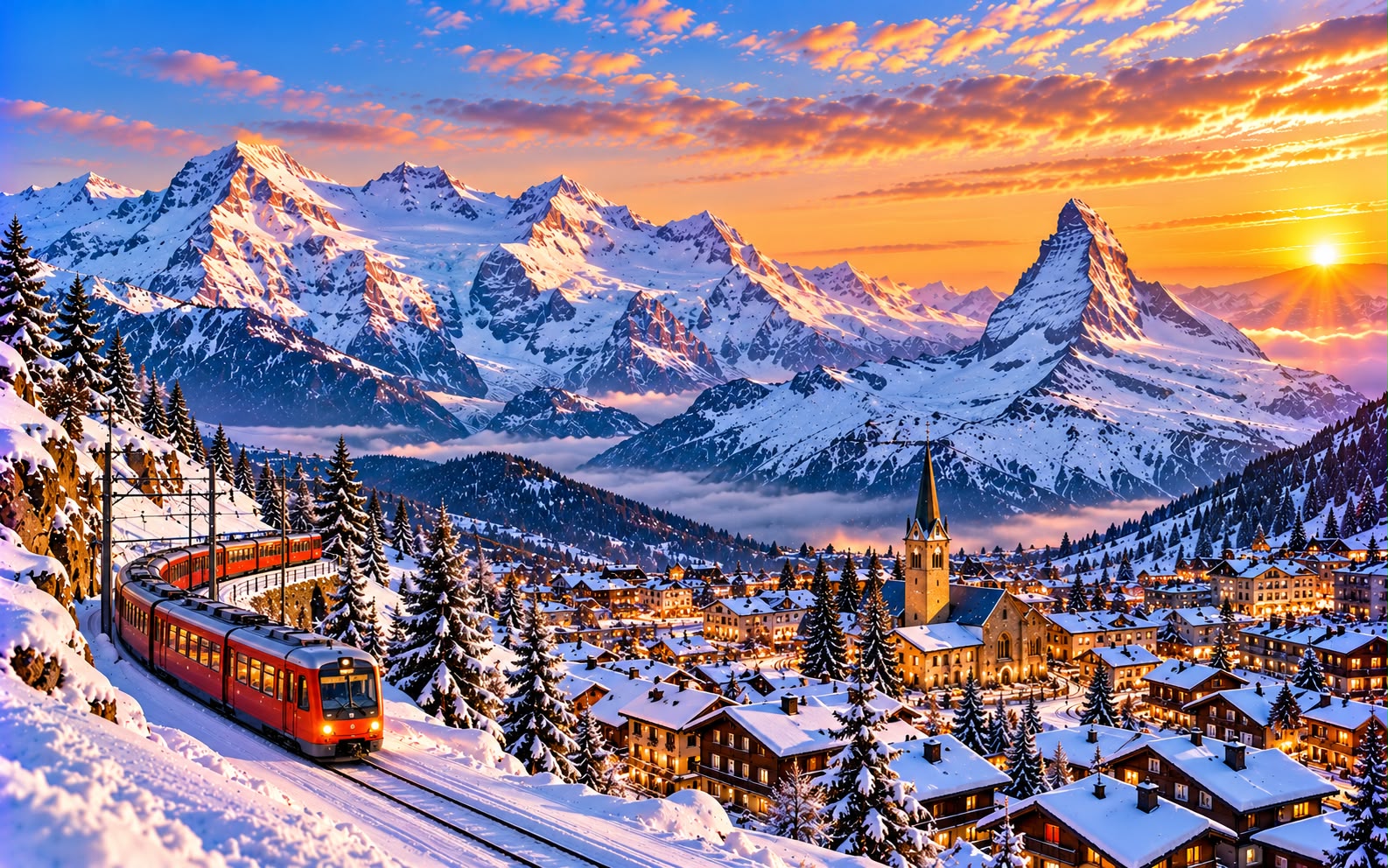
Switzerland in winter: Jungfraujoch, Zermatt and the snow trains
The winter version of the classic Swiss route: Lucerne and a Christmas market, two nights under the Eiger at Grindelwald with Jungfraujoch and a sledge run, and two in car-free Zermatt for Gornergrat and a ski day. Which mountain railways close in winter, which do not, and what the Travel Pass actually covers.
- Central Europe
- 7 days
- ≈ AED 11,000 / person
- The scenic rail country with snow on it, costed honestly including the mountain railways
Before you go
Switzerland in winter is the same route as the summer one and a different trip. The trains still run — that is the point of the country — but half the summer mountain excursions are shut, the ones that stay open are the better ones, and the whole thing costs more.
Six nights: one in Lucerne, two at Grindelwald under the Eiger, two in Zermatt, one back in Zurich. The seven-day summer route does the same four stops with hiking instead of snow.
Two things change the plan rather than the mood. Pilatus’s cogwheel railway closes for the winter and you go up the cableway from Kriens instead. And the Jungfrau region’s value in winter is not only Jungfraujoch — it is sledging, the Eiger Express and First, which in summer are a sideshow.
Figure CHF 2,450 (≈ AED 10,977) per person, excluding international flights. Mid-December to March.
Before you go: the winter admin
Entry
- Switzerland is in the Schengen area. Many nationalities enter visa-free for 90 days in any 180; others need a Schengen visa.
- See how the Schengen visa works for the rules, the 90/180 arithmetic and which country to apply to.
- Last checked: 30 October 2026.
The Swiss Travel Pass, and what it does not cover
- The pass covers trains, buses and boats across the network, plus most museums. For this route it is worth buying.
- It does not cover the high mountain railways in full. Most give a discount rather than free travel — Jungfraujoch and Gornergrat both cost extra on top of the pass, and the size of the reduction differs by railway.
- Check each excursion’s current pass discount before you budget. This is the single most common costing mistake on a Swiss trip.
- Lift passes for skiing are separate again and are not a transport product at all.
Winter closures that change the itinerary
- Pilatus: the cogwheel railway from Alpnachstad is summer only. The aerial cableway from Kriens runs year round — same mountain, different approach.
- Some high passes and panoramic rail routes run reduced winter timetables. The Glacier Express runs in winter, on a different schedule.
- Jungfraujoch runs year round. So does Gornergrat.
- Check the day’s mountain weather before buying any excursion ticket. At 3,400m in cloud you have paid a great deal to see fog.
Money
- Swiss francs, and Switzerland is expensive in a way that surprises people who have been warned. Cards work everywhere.
- Supermarket lunches are how people manage this. Coop and Migros are in every station.
Day by day
Day 1 — Zurich, then Lucerne
- Arrive and move. Zurich airport has direct trains; Lucerne is about an hour.
- 13:00 — Lucerne. The Chapel Bridge — fourteenth century, covered, with painted panels in the roof — and the Water Tower beside it.
- 14:30 — The Lion Monument, a dying lion cut into the rock face, which Mark Twain called the saddest piece of stone in the world.
- 16:00 — In December, the Christmas market by the lake; the rest of the winter, the old town and the covered bridges in the dark, which are lit and nearly empty.
- 18:30 — Dinner in the old town. Cheese fondue is a winter dish here, not a tourist one.
Day 2 — Pilatus the winter way, then to the Jungfrau
- 09:00 — Bus to Kriens and the aerial cableway up Pilatus. The cogwheel railway is shut until spring, which is why this is the route. 2,128m, and on a clear winter day you are above the fog with the Alps in a ring.
- The Lucerne basin sits under cloud for days in winter. Going up is often the only way to see the sun — check the webcam before you buy.
- 12:30 — Down, and the train to Interlaken, about two hours through the Entlebuch.
- 15:30 — Change for Grindelwald. Stay here rather than Interlaken in winter — it is under the Eiger, the lifts are at the door, and Interlaken is a transport town with the mountains an hour away.
- 17:00 — The village, and the north face above it.
Day 3 — Jungfraujoch, the Top of Europe
- 08:00 — Early, and only if it is clear. This is the most expensive few hours of the trip and in cloud it is money for nothing.
- 08:30 — The Eiger Express gondola from Grindelwald Terminal to Eigergletscher, then the train up to the Jungfraujoch at 3,454m — the highest railway station in Europe.
- The tunnel through the Eiger is the engineering story: cut between 1896 and 1912, with windows in the north face.
- 10:30 — At the top — the Sphinx observatory terrace, the Ice Palace cut into the glacier, and the Aletsch, the longest glacier in the Alps, running away below you.
- Altitude is real here. You have come from 1,000m to 3,454m in under two hours — move slowly and expect to feel it.
- 14:00 — Back down, stopping at Kleine Scheidegg for the classic view of the Eiger, Mönch and Jungfrau in a row.
- 16:00 — Grindelwald, and a long dinner.
Day 4 — First, sledging, and over to Zermatt
- 08:30 — The gondola to First at 2,166m. The Cliff Walk is open in winter and the view across to the Eiger is the one people photograph.
- 09:30 — The sledge run back down. Toboggan runs are a proper Swiss winter activity rather than a children’s one — hire a sledge at the top, and the descent takes most of an hour.
- 12:00 — Down to Interlaken and the long train to Zermatt, about three hours via Spiez and Visp.
- Zermatt is car-free. You change to the shuttle train at Täsch; private cars stop there.
- 16:30 — Arrive. Walk to the Kirchbrücke for the view up the street to the Matterhorn, which is the photograph.
- 18:30 — Dinner. Zermatt is expensive even by Swiss standards; the supermarket is by the station.
Day 5 — Gornergrat, and the Matterhorn
- 08:00 — The Gornergrat cogwheel railway — it runs all winter, climbing to 3,089m in about 35 minutes.
- At the top: the Matterhorn directly opposite, and the Gorner glacier below. Morning light is on the east face, which is the side you are looking at — go early, not after lunch.
- 11:00 — Ski down, or ride back. The runs from Gornergrat to Riffelberg and on down are long, wide and intermediate — one of the better lift-served descents anywhere.
- 13:00 — Lunch at Riffelalp or back in the village.
- 15:00 — The Matterhorn Museum in the village, which tells the 1865 first ascent and the four men who died coming down.
- 17:00 — A last walk. The Matterhorn turns pink at sunset and the whole village stops to look at it.
Day 6 — A ski day, or the glacier
- The flexible day.
- If you ski, Zermatt’s area is enormous and runs over the ridge into Cervinia in Italy — take your passport if you intend to cross.
- If you do not, the Matterhorn Glacier Paradise cable car climbs to 3,883m, the highest you can get in Europe on a lift, with an ice palace cut into the glacier at the top.
- Afternoon — the Gorner gorge walk, or a sledge run, or simply the village.
- 18:00 — The last evening under the mountain.
Day 7 — Back to Zurich, and out
- 09:00 — The long run back — Täsch, Visp, and on to Zurich, about three and a half hours. The window seat is the point.
- 13:00 — Zurich. The Old Town, the Fraumünster’s Chagall windows, and Lindenhof above the river.
- 15:00 — In December, the Christmas market in the main station, which is indoors and enormous.
- The airport is ten minutes by train from the centre.
Costs and practicalities
Best time to visit
Mid-December to March.
- Mid-December — Christmas markets in Lucerne and Zurich, thinner snow low down, and the high excursions all running. Christmas and New Year are the most expensive weeks of the year.
- January — the coldest and quietest month, the best value, and the most reliable snow low down. Short days and frequent low cloud in the valleys.
- February — the best combination of snow and daylight, and the month to pick if you are skiing. Swiss school holidays make it busy.
- March — the most sun, the longest days, and spring snow up high. Lower resorts start to go patchy.
- April–November — the hiking seasons, which is what the summer route covers.
Travel tips
- Buy mountain excursions a day at a time, on the weather. Jungfraujoch and Gornergrat in cloud are expensive disappointments.
- Check the webcams every morning. Every Swiss mountain railway publishes them, and they are the most useful thing on the internet here.
- Winter fog sits in the valleys for days. Above about 1,500m it is usually sunny — this is an argument for going up, not staying in.
- The Travel Pass does not cover the high railways in full. Budget the extras separately.
- Stay in Grindelwald, not Interlaken, in winter.
- Zermatt is car-free — leave the car at Täsch and take the shuttle.
- Eat from Coop and Migros at lunch. It is what residents do and it halves the food line.
- Take your passport to Zermatt if you might ski over to Cervinia.
- Altitude at Jungfraujoch and Glacier Paradise is real. Move slowly for the first twenty minutes.
What this trip actually costs
Two people, 6 nights, mid-range comfort, international flights excluded:
| Item | Cost |
|---|---|
| Hotels, 6 nights across four towns | CHF 1,680 (≈ AED 7,527) |
| Swiss Travel Pass, 8 days, two people | CHF 1,160 (≈ AED 5,197) |
| Jungfraujoch and Gornergrat, two people, pass discount applied | CHF 740 (≈ AED 3,316) |
| One ski day — lift passes and hire, two people | CHF 440 (≈ AED 1,971) |
| Food and drink, 7 days | CHF 880 (≈ AED 3,943) |
| Total for two | CHF 4,900 (≈ AED 21,954) |
- Roughly CHF 2,450 (≈ AED 10,977) per person, and the two mountain excursions alone are more than many countries’ entire weekly budget. That is Switzerland.
- Jungfraujoch is the line people query. It is the single most expensive ticket in the country. Gornergrat gives you the better mountain view for a fraction of it — if you only do one, there is a real argument for Gornergrat.
- Skip the ski day and this drops by about 440 francs.
- Christmas and New Year add 30–50% to the hotel line. January is the value month.
- Hotel picks here are chosen on location, not on commission — always check prices and recent reviews before booking.
What to pack
- A proper winter coat, waterproof boots with grip, gloves and a hat. Village streets ice over.
- Sunglasses and sunscreen. At 3,400m on snow the sun is ferocious even at −10°C.
- Layers — you will go from a heated train to 3,883m and back in a morning.
- Ski gear only if you are skiing; hire in Zermatt is straightforward.
- A refillable bottle. Swiss tap water is excellent and drinks are not cheap.
- A Type J adapter, 230V — Swiss sockets are their own standard and a Europlug fits, but a three-pin does not.
Part of a bigger trip?
- Switzerland in 7 days is this route in the hiking season.
- Switzerland in 10 days adds the Ticino and the south.
- France and Switzerland in 11 days runs Paris in with the Alps.
- Germany’s Christmas markets is the December trip next door.
FAQ
Is the Swiss Travel Pass worth it in winter? For this route, yes — it covers the trains between four towns, the buses and the boats. Be clear that it does not cover the high mountain railways in full: Jungfraujoch and Gornergrat both cost extra on top of it, and the discount differs by railway.
Which mountain railways close in winter? The Pilatus cogwheel railway from Alpnachstad is summer only, though the Kriens cableway runs year round. Jungfraujoch and Gornergrat both run all winter. Check each excursion’s winter timetable rather than assuming.
Jungfraujoch or Gornergrat if I can only do one? Gornergrat, on value. It is far cheaper, the Matterhorn view from the top is the better sight, and you can ski or walk back down. Jungfraujoch is the bigger engineering experience and the higher price.
Do I need to ski to make this trip worthwhile? No. Sledging at First, the Gornergrat railway, the Glacier Paradise cable car and the Christmas markets fill the week comfortably without a lift pass. The ski day is one line in the budget and easy to drop.
Is Switzerland very cold in winter? The valleys sit around freezing and often under fog for days; above about 1,500m it is colder, sunnier and clearer. The fog is the thing to plan around, and the answer is almost always to go up.
Prices and entry rules change, and what you need depends on your passport; last checked 30 October 2026, so confirm with the embassy or your airline before booking.


