 The Itinerary
Eastern Europe on a budget in 14 days: Prague, Kraków and Budapest
Hostels, milk bars and intercity coaches across three countries that still cost a fraction of Western Europe. Three currencies and none of them the euro, the free walking tours that are not free, and the one day trip that should not be done on the cheap.
- Central Europe
- 14 days
- ≈ AED 3,150 / person
- Three great cities, two long bus rides and a fortnight on about fifty-five euros a day
Before you go
Prague, Kraków and Budapest are three of the best-looking cities in Europe and none of them uses the euro. That is most of why this works: a hostel bed, a plate of pierogi and a tram ticket all cost a fraction of what they do four hours west.
Central Europe in 10 days runs Prague, Vienna and Budapest at mid-range. This one swaps Vienna for Kraków — which is cheaper, and the better city for this kind of trip — and takes coaches between all three.
Fourteen days, three cities, about fifty-five euros a day. Figure EUR 770 (≈ AED 3,153) per person. April to June and September to October.
Before you go: the admin
Entry
- Czechia, Poland and Hungary are all in the Schengen area. Many nationalities enter visa-free for 90 days in any 180; others need a Schengen visa.
- One Schengen visa covers all three. See how the Schengen visa works for the 90/180 arithmetic and which country to apply to.
- Last checked: 30 October 2026.
Three currencies, none of them the euro
- Czech koruna, Polish złoty, Hungarian forint.
- Never accept “dynamic currency conversion” when an ATM or card terminal offers to charge you in your own currency. The rate is always worse. Choose the local currency, every time.
- Avoid the branded tourist ATMs — Euronet and similar — which charge heavily. Use a bank’s own machine.
- Exchange booths in Prague’s old town and near Budapest’s Parliament are the worst rates in each city. Several are outright scams.
- Cards are accepted almost everywhere. Carry a little cash for markets and small bars.
Getting between the three
- Intercity coaches are the cheap option and the network between these cities is good. Booked a few weeks ahead the fares are very low.
- Prague to Kraków is about seven to eight hours by coach.
- Kraków to Budapest is about ten to eleven, and the overnight service saves a night’s bed.
- Trains cost more and are more comfortable. Book ahead for the cheap advance fares, which are sometimes close to the coach.
Where the money goes
- Beds: hostels in all three cities are plentiful and good, and a private twin in a hostel often costs little more than two dorm beds.
- Food: Polish milk bars (bar mleczny) are the cheapest proper meal in Europe. Budapest’s market halls and Prague’s neighbourhood pubs are the equivalents.
- Beer is cheaper than water in Czechia, which is literally true in some pubs.
- “Free” walking tours are tip-based — budget ten to fifteen euros a head for a good one. They are not free and the guides live on it.
Day by day
Days 1–4 — Prague
- Arrive and stay in Žižkov or Holešovice — a tram ride out, and half the price of the old town.
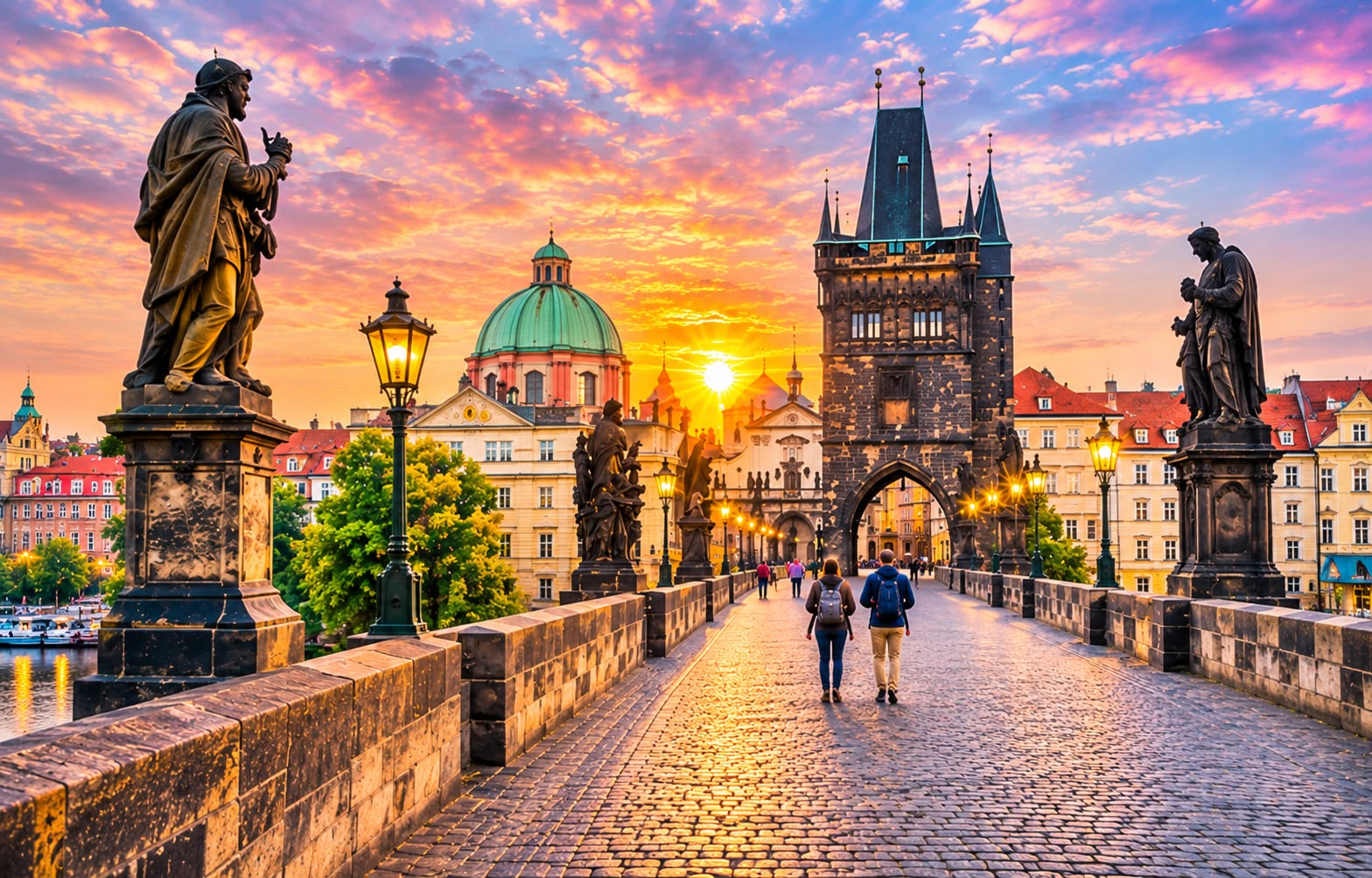
- The Charles Bridge at 06:00 is empty and free. At 10:00 it is a crush.
- The Old Town Square and the astronomical clock cost nothing to stand in front of; the clock’s hourly show is famously underwhelming and worth seeing once.
- Prague Castle — the grounds are free to walk; the circuit ticket for St Vitus, the Old Royal Palace and Golden Lane is the paid part. Go late in the day.
- Petřín hill — walk up rather than take the funicular; the view is the same and the walk is through orchards.
- Vyšehrad — the other castle, free, with the best view of the river and almost no visitors.
- Eat in a neighbourhood hospoda, not on the square.
Days 5–8 — Kraków
- The overnight or early coach from Prague.
- Stay in Kazimierz — the old Jewish quarter, cheap, and the best eating and drinking in the city.
- The Main Market Square is the largest medieval square in Europe and costs nothing. St Mary’s Basilica has a small entry and the trumpet call from the tower every hour.
- Wawel Castle — the grounds are free; individual exhibitions are ticketed separately and you do not need all of them.
- Kazimierz and Podgórze on foot — the ghetto wall fragments, Plac Bohaterów Getta’s empty chairs, and Schindler’s Factory, which is a proper museum and needs booking.
- Milk bars — Bar Mleczny Pod Temidą and the like — a full meal for a couple of euros.
Auschwitz-Birkenau — the one not to do cheaply
- Entry is free, but you must book a timed slot far in advance, and in peak months a guided tour is compulsory.
- Go with the official museum guide, not a cheap bus tour that rushes both sites.
- Allow the full day. Birkenau is the larger site and the one most day tours shortchange.
- The cheap coach from Kraków gets you there for very little; it is the tour, not the transport, worth paying for.
Days 9–14 — Budapest
- The overnight coach from Kraków, which saves a bed.
- Stay in District VII, the old Jewish quarter, which is the cheap and lively one.
- The Danube embankment, the Chain Bridge, Fisherman’s Bastion’s lower terraces and the view from Gellért Hill are all free.
- The Parliament interior is ticketed and worth it; book ahead.
- A thermal bath is the one thing to spend on — Széchenyi is the grand one, Gellért the beautiful one, Rudas the small sixteenth-century one with the rooftop pool. Weekday mornings are cheapest and emptiest.
- The Great Market Hall for lángos and a cheap lunch upstairs.
- Ruin bars — Szimpla Kert is the original — and the drinks are cheap by any European standard.
- The Shoes on the Danube Bank memorial, free, and the quietest ten minutes in the city.
Costs and practicalities
Best time to visit
April to June and September to October.
- April to June — mild, long days, everything open, and before the July crowds. The best window.
- July and August — hot, busiest and dearest, and Budapest in August regularly passes 35°C.
- September and October — the other good window, with autumn colour and lower prices.
- November to March — cold and grey, and the cheapest by a distance. The Christmas markets in all three cities are genuinely good and raise December prices sharply.
- Budapest’s baths are at their best in winter, steaming in the cold.
Travel tips
- Always choose the local currency at an ATM or card terminal. Dynamic currency conversion is a bad rate every time.
- Avoid Euronet-style ATMs and old-town exchange booths.
- Book the overnight coach for one of the two legs. It saves a bed.
- Stay a tram ride out of each old town. It halves the room cost.
- Milk bars in Kraków, market halls in Budapest, neighbourhood pubs in Prague.
- Tip the free walking tour properly. Ten to fifteen euros.
- Book Auschwitz and Schindler’s Factory well ahead.
- Validate your tram ticket. Inspectors are frequent in all three cities and the fines are not small.
- Thermal baths on a weekday morning are cheapest and quietest.
What this trip actually costs
Two people, 13 nights, hostels and coaches, international flights excluded:
| Item | Cost |
|---|---|
| Hostels and budget twins, 13 nights | EUR 650 (≈ AED 2,661) |
| Markets, milk bars and street food, 14 days | EUR 420 (≈ AED 1,720) |
| Coaches between the three cities, two people | EUR 150 (≈ AED 614) |
| Museums, castle tickets and walking-tour tips | EUR 170 (≈ AED 696) |
| City transport passes | EUR 90 (≈ AED 369) |
| A thermal bath and a beer hall night | EUR 60 (≈ AED 246) |
| Total for two | EUR 1,540 (≈ AED 6,306) |
- Roughly EUR 770 (≈ AED 3,153) per person for a fortnight, which is about fifty-five euros a day across three countries.
- Two overnight coach legs remove two nights of accommodation, which is most of the gap to a mid-range version.
- A private twin in a hostel often costs little more than two dorm beds — worth checking before defaulting to dorms.
- Auschwitz entry is free; the guided tour and the coach are the cost, and that is the tour not to cut.
- Travel insurance is not in this figure and should be.
- Hotel picks here are chosen on location, not on commission — always check prices and recent reviews before booking.
What to pack
- A padlock for hostel lockers.
- Layers and a rain jacket. All three cities are changeable.
- Comfortable shoes — this is a cobblestone fortnight.
- A card that does not charge foreign transaction fees, and a little cash in each currency.
- Flip-flops and a towel for the thermal baths.
- A Type C/E/F adapter, 230V.
Part of a bigger trip?
- Central Europe in 10 days is Prague, Vienna and Budapest at mid-range.
- Poland in 7 days goes deeper into Kraków’s country.
- Czechia in 7 days adds Bohemia beyond Prague.
- Hungary in 6 days adds the Danube bend and Lake Balaton.
- Prague in 3 days and Budapest in 3 days are the city versions.
FAQ
How much does Eastern Europe cost a day? On this itinerary about fifty-five euros per person per day covering beds, food, intercity coaches, city transport and entries. Prague is the dearest of the three and Kraków the cheapest.
Is the overnight coach worth it? For the Kraków to Budapest leg, yes — it is ten or eleven hours either way, and doing it overnight saves a night’s accommodation. Book a reputable operator rather than the very cheapest.
What is a milk bar? A Polish state-era canteen serving traditional food at subsidised prices — pierogi, żurek, naleśniki — for a couple of euros a meal. They are still everywhere in Kraków and they are the cheapest proper food in Europe.
Should I take the cheap Auschwitz tour? No. Entry is free but you must book a timed slot well ahead, and in peak months a guided tour is compulsory. Go with the official museum guide and allow the full day — the cheap bus tours rush Birkenau, which is the larger and more affecting site.
How do I avoid losing money on currency? Always choose the local currency when an ATM or card machine offers to charge you in your own. Use bank ATMs rather than the branded tourist ones, and never change money at an old-town exchange booth.
Prices and entry rules change, and what you need depends on your passport; last checked 2 November 2026, so confirm with the embassy or your airline before booking.


