 The Itinerary
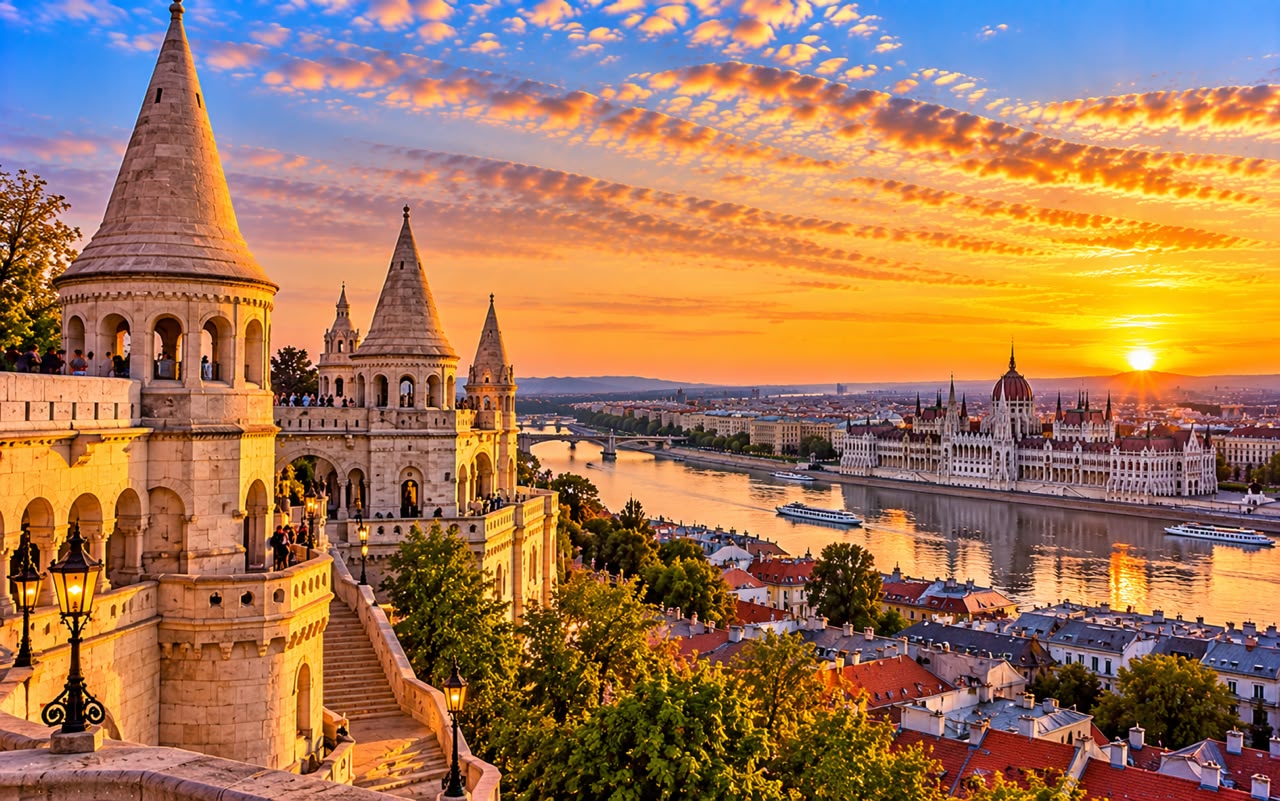
Budapest in 3 days: Buda Castle, the baths and the ruin bars
Buda is the hill and Pest is the flat, and the river between them is the point. The baths that are open at six in the morning, the Parliament tour that must be booked, and the shoes on the embankment.
- Central Europe
- 3 days
- ≈ AED 1,450 / person
- Two cities either side of a river, a thermal bath in a palace, and the best value in Europe
Before you go
Budapest is two cities joined in 1873 — Buda, the hill with the castle, and Pest, the flat grid with the boulevards — and the Danube between them is the whole reason it looks the way it does.
Three days: Buda and the castle hill, Pest and Parliament, and a third for the Jewish Quarter, the ruin bars and the river. A thermal bath belongs in whichever day you most need it, and the answer is usually the second.
It is also the best-value capital in Europe. The baths, the food and the rooms all cost a fraction of Vienna, two and a half hours up the line.
Figure the budget below. April–May and September–October.
Before you go: the short version
Entry and visas
- Hungary is in the Schengen area. Around 60 nationalities enter visa-free for 90 days in any 180; everyone else needs a short-stay (Type C) Schengen visa in advance.
- ETIAS is being phased in — check whether it applies by your dates.
- Our full guide: how Schengen visas actually work.
Money and transport
- Hungary uses the forint, not the euro, and paying in euros gets you a poor rate. Cards work almost everywhere.
- Avoid street exchange booths and decline ATM currency conversion — the same rule as Prague.
- Ferenc Liszt Airport (BUD) — bus 100E runs direct to Deák Ferenc tér for about HUF 2,200 and takes 40 minutes. A taxi is around HUF 9,000 and only the official Főtaxi rank should be used.
- Metro, tram and bus share one ticket. Metro line 1 is the oldest underground railway in continental Europe, from 1896, and is UNESCO-listed.
- Tram 2 runs along the Pest embankment and is regularly called one of the most scenic tram routes in the world.
Day by day
Day 1 — Buda: the castle hill
Walking order: Chain Bridge → funicular or the steps up → Castle district (1.5km along the hill) → Fisherman’s Bastion → Matthias Church → walk down to Batthyány tér (15 min). About 4km, and the hill is the only climb.
- 09:00 — The Chain Bridge, the first permanent bridge between Buda and Pest, opened 1849, and the lions at each end famously have tongues — the long-standing joke that they do not is wrong.
- 09:30 — Up the hill, by funicular or on foot, which takes fifteen minutes.
- 10:00 — Buda Castle and its courtyards. The Hungarian National Gallery is inside, and the castle’s cellars and the labyrinth beneath are a separate attraction.
- 11:30 — Matthias Church, with its diamond-patterned tiled roof and an interior painted in a Hungarian national romantic style quite unlike anywhere else.
- 12:30 — The Fisherman’s Bastion beside it — seven towers for the seven Magyar chieftains, built 1902 as a viewing terrace rather than a fortification. The upper terraces charge a small fee; the lower ones are free and the view is nearly the same.
- 14:00 — Lunch in the castle district, or down in Batthyány tér which is cheaper.
- 16:00 — Gellért Hill and the Citadella for the whole river bend, which is a half-hour climb and the best view in the city.
- 19:00 — Dinner in Buda, and the Danube panorama from the hill at night is the photograph.
Day 2 — Pest: Parliament, the basilica and a bath
Walking order: Parliament → Shoes on the Danube (5 min) → St Stephen’s Basilica (10 min) → Andrássy út (2.5km, or metro line 1) → Heroes’ Square and Széchenyi. About 5km.
- 09:00 — The Hungarian Parliament, booked — tours sell out and are the only way in. It is the third-largest parliament building in the world and holds the Holy Crown of Hungary.
- 11:00 — Shoes on the Danube Bank, a few minutes along the embankment — sixty pairs of iron shoes memorialising Jews shot into the river by the Arrow Cross in 1944–45, who were made to remove their shoes first because leather had value. It takes five minutes and it is the most affecting thing in the city.
- 12:00 — St Stephen’s Basilica, and the dome has a lift as well as steps. St Stephen’s mummified right hand is in a side chapel, which is displayed exactly as that description suggests.
- 14:00 — Andrássy út, the UNESCO-listed boulevard, on foot or on metro line 1, which runs beneath it. The House of Terror is on it — the former secret police headquarters, under both regimes — and is a hard hour.
- 16:00 — Heroes’ Square at the top, and the Széchenyi Baths behind it.
- The baths are the point of the afternoon. Széchenyi is the big neo-baroque one with the outdoor pools where people play chess in the steam; it opens at six in the morning and the early hours are the quiet ones.
- Bring a swimsuit, flip-flops and a towel, or hire them at a markup. A cabin is worth the small extra over a locker.
- 20:00 — Dinner in the Jewish Quarter.
Day 3 — The Jewish Quarter, the market and the river
Walking order: Great Synagogue → Jewish Quarter and the ruin bars (1.5km of lanes) → tram 2 → Great Market Hall (10 min) → the embankment. About 4km.
- 09:30 — The Dohány Street Synagogue, the largest in Europe and the second largest in the world, with the Holocaust memorial garden behind it — a weeping willow whose leaves carry names.
- 11:30 — The Jewish Quarter on foot — District VII, which was the wartime ghetto and is now the nightlife district, a juxtaposition the city has not fully resolved.
- 13:00 — The Great Market Hall — three floors of produce, paprika and lángos, which is fried dough with sour cream and cheese and is the thing to eat standing up.
- 15:00 — Tram 2 along the embankment, which costs a single fare and is the scenic ride.
- 16:30 — Margaret Island, in the middle of the river — a car-free park with a musical fountain, a running track and the ruins of a convent.
- 19:00 — The ruin bars. Szimpla Kert is the original — a derelict building filled with salvaged furniture, a Trabant you sit in, and no coherent design whatever. It is now very well known; the smaller ones nearby are what it was.
- 21:00 — A Danube night cruise if you want the illuminated Parliament from the water, which is genuinely worth it and costs very little.
Costs and practicalities
Getting around, and what it costs
| Single transport ticket | HUF 450 |
| 24-hour travelcard | HUF 2,500 |
| Bus 100E from the airport | about HUF 2,200 |
| Parliament tour | HUF 5,000–12,000 |
| Széchenyi Baths, cabin | HUF 10,000–12,000 |
| Fisherman’s Bastion upper terrace | HUF 1,500 |
| Great Synagogue | HUF 9,000 |
| Buda funicular, one way | HUF 2,000 |
| Lángos at the market | HUF 1,200 |
- Budapest is the cheapest capital in this group by a clear margin, and the baths are the one thing worth paying full price for.
Best time to visit
- April–May and September–October — mild, and the baths are pleasant without being essential.
- June–August — hot, and the outdoor pools and Margaret Island come into their own. Sziget Festival in August fills the city.
- November–February — cold, and this is when the thermal baths are at their best — sitting outdoors in 38°C water at 2°C is the Budapest experience.
- The Christmas markets at Vörösmarty tér and the basilica run from mid-November.
Travel tips
- Book the Parliament tour well ahead; it is the only way in.
- Széchenyi opens at six — the early morning is the quiet version.
- Take a cabin, not a locker, at the baths.
- Use only Főtaxi from the airport rank, or the 100E bus.
- Decline ATM currency conversion and avoid exchange booths.
- Tram 2 and metro line 1 are sightseeing at the price of a fare.
- The lower Fisherman’s Bastion terraces are free.
What this trip actually costs
Two people, 2 nights, mid-range comfort, international flights excluded:
| Item | Cost |
|---|---|
| Hotel, 2 nights | HUF 90,000 (≈ AED 1,014) |
| Food and drink, 3 days | HUF 70,000 (≈ AED 789) |
| Parliament, synagogue, baths, two people | HUF 60,000 (≈ AED 676) |
| Transport and the airport both ways | HUF 20,000 (≈ AED 225) |
| Danube cruise and incidentals | HUF 20,000 (≈ AED 225) |
| Total for two | HUF 260,000 (≈ AED 2,930) |
- Roughly half what Vienna costs, two and a half hours up the same railway line.
- The baths are the biggest discretionary line and the one nobody regrets.
- Hotel picks here are chosen on location, not on commission — always check prices and recent reviews before booking.
What to pack
- A swimsuit, flip-flops and a towel for the baths — hiring them costs more than bringing them.
- Shoes for the castle hill and Gellért.
- A warm layer; Budapest winters are properly cold.
- A Type C/F adapter, 230V.
Part of a bigger trip?
- Central Europe in 10 days runs Prague, Vienna and here.
- Vienna in 2 days is 2h40 by train.
- Prague in 3 days is seven hours direct, or via Vienna.
- The Balkans in 12 days runs south from this region.
FAQ
Which thermal bath should I choose? Széchenyi for the big neo-baroque outdoor pools and the chess players; Gellért for the art nouveau interior; Rudas for the sixteenth-century Ottoman dome and the rooftop tub with the river view. Széchenyi if you only do one.
Do I need to book Parliament? Yes. Tours are the only way inside and they sell out, particularly the English-language slots.
Is Budapest cheaper than Vienna? Substantially — roughly half on accommodation, food and entries, two and a half hours apart on the same line.
What are the ruin bars? Bars built into derelict buildings in District VII, furnished with salvage. Szimpla Kert is the original and is now firmly on the tourist circuit; the smaller ones around it are closer to what it was.
What are the shoes on the embankment? A memorial to Jews shot into the Danube by the Arrow Cross in 1944–45, who were ordered to remove their shoes first because leather was valuable. Sixty iron pairs, left as they were.
Prices and entry rules change, and what you need depends on your passport; last checked 29 October 2026, so confirm with the embassy or your airline before booking.


