 The Itinerary
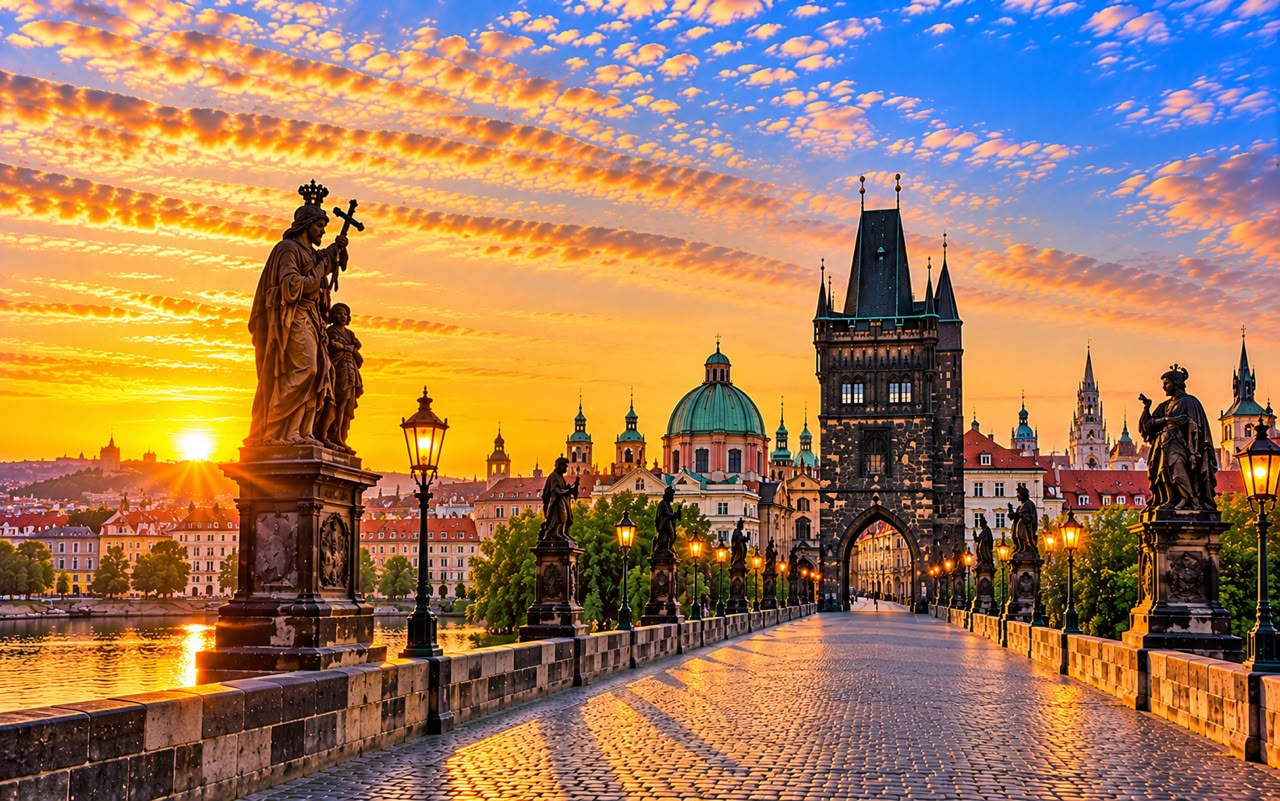
Prague in 3 days: the Old Town, the Castle and Vyšehrad
Charles Bridge at six in the morning is a different bridge, the Castle is a complex rather than a building, and Vyšehrad is the fortress almost nobody climbs. Plus the currency-exchange scam and the restaurants that still bring unasked-for bread.
- Central Europe
- 3 days
- ≈ AED 1,350 / person
- Three days, the bridge at dawn, and beer cheaper than water
Before you go
Prague’s problem is its own popularity: Charles Bridge at midday is a slow-moving crowd, and the Old Town Square is a ring of people photographing a clock.
At six in the morning both are empty, and that single fact organises this itinerary. Day one does the Old Town early. Day two does the Castle at opening. Day three is Vyšehrad, which is the other fortress, has better views, and has almost nobody on it.
Three practical warnings are below — the exchange-rate scam, the unasked-for bread, and the taxi situation — because all three catch visitors routinely.
Figure the budget below. April–May and September–October.
Before you go: the short version
Entry and visas
- The Czech Republic is in the Schengen area. Around 60 nationalities enter visa-free for 90 days in any 180; everyone else needs a short-stay (Type C) Schengen visa in advance.
- ETIAS is being phased in — check whether it applies by your dates.
- Our full guide: how Schengen visas actually work.
Money — read this
- The Czech Republic uses the koruna, not the euro.
- Never change money at a street exchange booth. The “0% commission” ones use a punitive rate and the small print is a separate “tourist rate” board. People lose a third of their money this way.
- Use an ATM from a real bank — ČSOB, Komerční, Česká spořitelna — and always decline the machine’s offer to convert to your home currency. That conversion is the worst rate on offer.
- Cards work nearly everywhere.
Getting in and around
- Václav Havel Airport (PRG) — bus 119 to Nádraží Veleslavín then the metro is about CZK 40 and takes 35 minutes. A taxi is CZK 600–800 — book through your hotel or use Bolt rather than taking one at the rank.
- Trams, metro and buses share one ticket — CZK 30 for 30 minutes, CZK 40 for 90. Validate it in the machine as you board; inspectors are frequent and fines are on the spot.
- Tram 22 runs from the New Town up past the Castle and is the single most useful line in the city.
Day by day
Day 1 — The Old Town, early
Walking order: Old Town Square → Charles Bridge (5 min) → back via the Jewish Quarter (10 min) → Wenceslas Square (10 min). About 4km, flat.
- 06:30 — Charles Bridge at dawn. This is the single best decision available in Prague. Thirty statues, no people, and the castle catching the first light upstream. By ten it is a market and a crush.
- 08:00 — The Old Town Square before the tour groups. The Astronomical Clock, from 1410, is the oldest still operating, and the hourly show is famously underwhelming — watch it once, then look at the calendar dial below, which is the interesting half.
- 09:30 — The Old Town Hall tower for the square from above — there is a lift, and the view is better than the clock.
- 11:00 — The Jewish Quarter (Josefov) — six synagogues and the Old Jewish Cemetery, where around 12,000 gravestones stand in layers because the community was not permitted to expand the ground and buried up to twelve deep.
- The Pinkas Synagogue carries the names of nearly 80,000 Czech and Moravian Jews murdered in the Holocaust, hand-written on the walls.
- 14:00 — Lunch. Watch for the bread and nuts brought to your table unasked — they are charged for, and sending them back is normal and expected.
- 16:00 — Wenceslas Square, which is a boulevard rather than a square, and the National Museum at the top.
- 19:00 — A beer hall. U Fleků has brewed on site since 1499; the local pubs away from the centre are half the price. Czech beer is often cheaper than bottled water, which is not a figure of speech.
Day 2 — The Castle and Malá Strana
Walking order: tram 22 up → Castle complex (1.5km within the walls) → Golden Lane → walk down through the gardens to Malá Strana (20 min) → Kampa. About 5km, downhill after the tram.
- 08:30 — Prague Castle at opening, by tram 22 to Pražský hrad, which saves the climb. It is the largest ancient castle complex in the world at about 70,000 square metres — a district, not a building.
- St Vitus Cathedral inside it — 600 years to build, and the Mucha window in the north nave is the one to find.
- The Old Royal Palace, St George’s Basilica and Golden Lane, the row of tiny houses where Kafka’s sister had a flat he wrote in.
- The changing of the guard at noon at the main gate is the full version with a band.
- 12:30 — Walk down through the castle gardens to Malá Strana, which is the better descent than the main steps.
- 14:00 — Lunch in Malá Strana, then the Lennon Wall — repainted constantly and officially sanctioned — and Kampa Island below the bridge.
- 16:30 — Petřín Hill by funicular, with a lookout tower modelled on the Eiffel that you can climb, and a mirror maze.
- 19:00 — Dinner in Malá Strana, away from the bridge approaches.
Day 3 — Vyšehrad, the river and the beer
Walking order: Vyšehrad (2km around the ramparts) → the riverside walk north (3km) → Náplavka. About 6km, flat after the initial climb.
- 09:30 — Vyšehrad, the other castle, on a rock south of the centre. Almost nobody comes here, and the ramparts have the best view in Prague — the whole river bend with the castle upstream.
- The cemetery holds Dvořák, Smetana and Mucha, and the neo-Gothic basilica beside it is genuinely strange inside.
- 12:00 — Walk north along the river to Náplavka, the embankment with converted vaults in the wall — the farmers’ market runs on Saturday mornings and it is where young Prague drinks in summer.
- 14:00 — The Dancing House on the way, by Gehry and Milunić.
- 15:30 — Pick one: the Mucha Museum; the Museum of Communism, which is clear-eyed and unsentimental; or Letná park, across the river, for the beer garden with the whole city below it.
- 18:00 — Letná beer garden regardless — it is the best evening view in Prague and a beer costs about CZK 60.
- 20:00 — Dinner in Vinohrady or Žižkov, which is where the city eats rather than where it feeds visitors.
Costs and practicalities
Getting around, and what it costs
| Transport ticket, 30 minutes | CZK 30 |
| Transport ticket, 90 minutes | CZK 40 |
| 24-hour pass | CZK 120 |
| Bus 119 + metro from the airport | about CZK 40 |
| Prague Castle, circuit B | CZK 450 |
| Jewish Museum combined ticket | CZK 600 |
| Old Town Hall tower | CZK 300 |
| Petřín funicular | CZK 40 (transport ticket) |
| Vyšehrad grounds | free |
| A half-litre of beer | CZK 50–80 |
- Vyšehrad, the Lennon Wall, Kampa and Letná are free, and between them they make a very good day.
Best time to visit
- April–May and September–October — mild and far less crowded than summer.
- June–August — hot and extremely busy; the Old Town is at capacity.
- December — the Christmas markets in the Old Town Square, which are among Europe’s best and bring their own crowds.
- January–February — cold, often snowy, cheap, and the city looks its best under it.
Travel tips
- Charles Bridge before seven. Everything else is secondary.
- Never use a street exchange booth, and decline ATM currency conversion.
- Send back the unasked-for bread unless you want it.
- Book a taxi or use Bolt; the ranks at tourist spots overcharge.
- Validate your tram ticket as you board.
- Tram 22 to the Castle saves the hill.
- Eat in Vinohrady or Žižkov, not within sight of the Old Town Square.
What this trip actually costs
Two people, 2 nights, mid-range comfort, international flights excluded:
| Item | Cost |
|---|---|
| Hotel, 2 nights | CZK 7,000 (≈ AED 1,177) |
| Food and drink, 3 days | CZK 5,000 (≈ AED 841) |
| Castle, Jewish Museum, towers, two people | CZK 3,000 (≈ AED 505) |
| Transport and the airport both ways | CZK 1,000 (≈ AED 168) |
| Total for two | CZK 16,000 (≈ AED 2,691) |
- Prague is excellent value outside the Old Town Square, where prices are roughly double for worse food.
- Beer at CZK 50–80 a half-litre is cheaper than soft drinks in most places.
- Hotel picks here are chosen on location, not on commission — always check prices and recent reviews before booking.
What to pack
- Shoes for cobbles. Prague’s are large, round and ankle-testing.
- A warm layer — it is colder than western Europe from October.
- A Type C/E adapter, 230V.
Part of a bigger trip?
- Central Europe in 10 days runs Prague, Vienna and Budapest.
- Vienna in 2 days is four hours by train.
- Budapest in 3 days is seven hours direct, or via Vienna.
FAQ
How early is early enough on Charles Bridge? Before seven. By eight the first groups arrive and by ten it is a crush. It is a genuinely different bridge at dawn.
Is the Astronomical Clock show worth watching? Once, and expect to be underwhelmed — most people are. The calendar dial below and the building itself are more interesting than the hourly procession.
What is the exchange-rate scam? Street booths advertising “0% commission” apply a punitive rate, often with a separate board for the rate actually given to tourists. Use a bank ATM and decline any offer to convert to your home currency.
Why is bread on my table? Because it is charged for. Bread, nuts and dips brought unasked are billed by the piece. Sending them back is normal and nobody minds.
Is Vyšehrad worth a morning? Yes — it is free, it has the best panorama in Prague, and almost no visitors go. It is the most underrated thing in the city.
Prices and entry rules change, and what you need depends on your passport; last checked 29 October 2026, so confirm with the embassy or your airline before booking.


