 The Itinerary
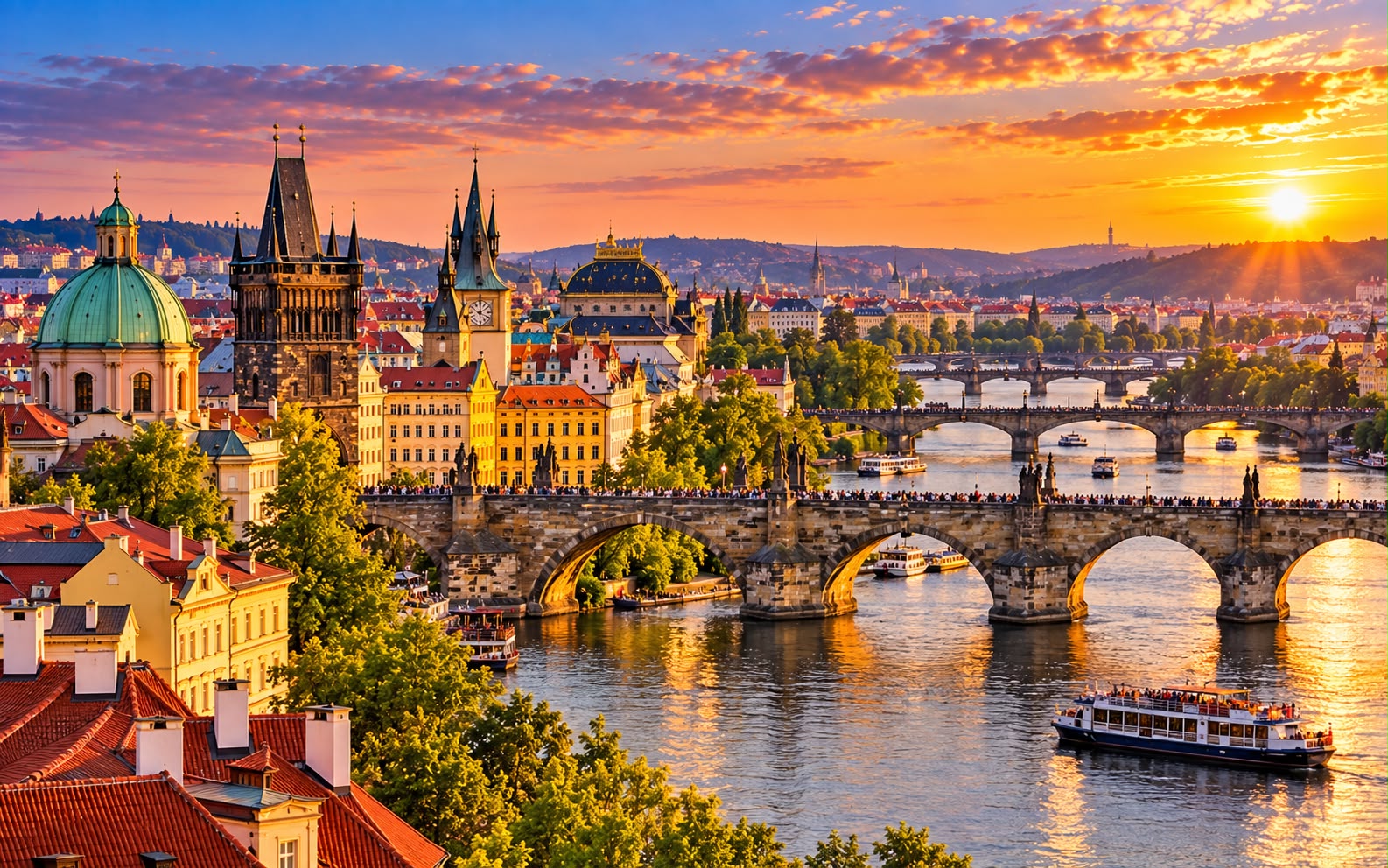
Central Europe in 10 days: Prague, Vienna and Budapest
The classic European rail triangle, done at a pace that lets each city breathe: Prague's castle-and-bridge morning, Vienna's coffee houses and palace halls, Budapest's thermal baths and its river lit gold at night — three countries, three currencies, one Schengen visa and two four-hour trains.
- Central Europe
- 10 days
- ≈ AED 7,150 / person
- Three capitals, one visa
Before you go
Three capitals sit within four hours of each other by train, and the railway between them is one of the reasons Europe is worth the paperwork. Prague for the storybook version — a castle on a hill, a bridge lined with saints, a square where the clock draws a crowd on the hour. Vienna for the imperial one — Habsburg palaces, a coffee-house culture that treats sitting down as a discipline, and concert halls that still sound the way they were designed to. Budapest for the one people remember longest — a parliament building that looks staged, and a city that solved winter by building swimming pools on top of its hot springs.
Ten days is enough for three nights in each, with two travel days that are themselves worth having. Book it open-jaw — into Prague, home from Budapest — and you never backtrack.
The catch is the small print: three countries, three currencies, and only one of them uses the euro.
Before you go: one visa, three currencies
One Schengen visa covers all three
- All three are in the Schengen area, so one visa covers the trip. Apply to the country where you will spend the most nights — on this route that is a tie at three each, which means you apply to the country you enter first: the Czech Republic. The full process, the lead times and the documents that actually cause refusals are in our Schengen visa guide.
- Visa-free nationalities need nothing beyond a passport, but the EES biometric border has been fully operational since April 2026 — allow extra queue time on your first arrival.
- Book flights open-jaw (into Prague, out of Budapest). A return into one city costs you a wasted day going back for it.
Three currencies, and the one trap
- Czech Republic: the koruna (CZK), not the euro. Prices quoted in euros on a tourist-strip menu are a markup, not a convenience.
- Austria: the euro. The only one.
- Hungary: the forint (HUF), not the euro either, whatever the menus near the river imply.
- The exchange-office warning is real in Prague, and the same trick appears in Budapest: storefronts advertising a great rate, with the real one applied after a “commission”. Use bank-branded ATMs, decline the terminal’s offer to charge you in your home currency, and walk past the blue Euronet machines in all three cities.
- Cards tap everywhere in all three capitals. Carry a small amount of local cash for markets, cloakrooms and the occasional bath locker.
The trains are the trip
- Prague → Vienna, roughly 4 hours, and Vienna → Budapest, roughly 2 hours 40. Both run several times a day on comfortable intercity services.
- Book the long legs in advance. These operators release cheap advance fares two to three months out and raise them as seats sell — the same pattern as everywhere else in Europe, and a bigger saving than any pass delivers on a route this short. Our rail pass guide explains why a pass is the wrong instrument for three long legs.
- No rail pass needed for this route. Price the two journeys point-to-point; the arithmetic will not be close.
- Seat reservations are worth taking on the Prague–Vienna leg in summer, when it fills.
The habits each city expects
- Vienna’s transport runs on trust — no barriers on the U-Bahn, and inspectors who are not charmed by tourists. Validate your ticket.
- Sundays close Austria. Shops shut; museums, cafés and bakeries stay open. Plan Vienna’s Sunday as a museum-and-coffee day and you will not notice.
- The Viennese coffee house is a place to sit, not to queue. You order, you stay, nobody hurries you, and asking for “a coffee” will get you a raised eyebrow — name one.
- Budapest’s baths have their own etiquette: bring flip-flops and a towel, rent a cabin rather than a locker if you want somewhere to change in peace, and check which pools are swim-cap-only.
Day by day
Day 1 — Land in Prague, meet the Old Town
- 14:00 — Land at Václav Havel (PRG). There is no train: the 119 bus to Nádraží Veleslavín and then metro line A is the 35-minute answer, and a single ticket covers both.
- 15:30 — Drop bags. Stay in the Lesser Town (Malá Strana) or Vinohrady rather than on the Old Town Square, where you pay double to be woken by stag parties.
- 16:30 — Walk to the Old Town Square. The astronomical clock performs on the hour: twelve apostles pass two windows, a skeleton rings a bell, and it lasts 45 seconds. The crowd’s reaction is honestly half the spectacle.
- 17:30 — Cross Charles Bridge heading west, when the day-trip coaches have gone and the light is low on the castle. Thirty statues, and at six in the evening you can actually see them.
- 19:30 — Dinner in the Lesser Town below the castle, where the streets empty early and the prices are calmer.
Day 2 — Castle hill, done before the queues
- 08:00 — Be at Prague Castle when it opens. It is a walled district rather than a building — the largest ancient castle complex in the world — and by eleven it is a slow-moving procession.
- 08:30 — St Vitus Cathedral first, for the Mucha window and the silver tomb, then the Old Royal Palace, St George’s Basilica and Golden Lane.
- 11:00 — Walk down through the vineyard to the river rather than retracing your steps — there is a terrace café halfway with the best view in Prague and almost nobody on it.
- 13:00 — Lunch in Malá Strana.
- 14:30 — The Jewish Quarter (Josefov): six synagogues and the Old Jewish Cemetery on one combined ticket, where 12,000 stones lean together over twelve layers of burials because the community was never permitted more land. The Pinkas Synagogue’s walls carry the names of 78,000 Czech Jews murdered in the Holocaust, handwritten. It is the most affecting hour in the city.
- 19:00 — A beer hall. Czech beer is often cheaper than water on the same menu, the pour is taken seriously, and the food is built around it.
Day 3 — Prague at your own pace
- A free day, deliberately. Three that reward it:
- Option A — Vyšehrad, 10:00. The other castle, on a cliff south of the centre: ramparts, a neo-Gothic church, the cemetery where Dvořák and Smetana are buried, and the view down the river without the crowd.
- Option B — Petřín, 10:00. The funicular up the hill for the lookout tower (a small Eiffel, which you climb), the mirror maze, and the rose gardens.
- Option C — Kutná Hora, 09:00. An hour each way by train, for the Sedlec Ossuary — a chapel decorated with the bones of 40,000 people, including a chandelier using every bone in the human body — and St Barbara’s Cathedral, which is the better building and gets a tenth of the visitors.
- 19:00 — Dinner, then pack. The train south is a morning departure and you want to be on it.
Day 4 — The train to Vienna
- 09:00 — Prague → Vienna, about four hours on a direct RegioJet or ČD service. Book a seat; it is cheap and they fill. Sit on the right leaving Prague for the Vltava.
- 10:30 — The restaurant car is real, and the countryside earns the window seat.
- 13:00 — Wien Hauptbahnhof. Drop bags; the U-Bahn is immediate and faultless.
- 15:00 — Walk the Ringstrasse loop — the boulevard built on the demolished city walls in the 1860s, with the opera, parliament, Rathaus and the twin museums strung along it, each one built to be looked at rather than used.
- 17:30 — Stephansdom at dusk, and the tiled roof.
- 19:30 — Dinner in the lanes behind it. Schnitzel if you must, but Tafelspitz is the actual Viennese dish.
Day 5 — Habsburg Vienna
- 08:30 — Schönbrunn, early. The state rooms fill from mid-morning and entry is timed, so book the first slot. The Grand Tour (40 rooms) is the one worth having.
- 11:00 — The gardens behind are free and worth an hour — up to the Gloriette for the view back down over the palace and the city.
- 13:00 — Lunch, then back into the centre.
- 15:00 — Either the Hofburg — the winter palace, with the Imperial Apartments and the Sisi Museum — or the Kunsthistorisches Museum, which holds the largest Bruegel collection in the world, including the Hunters in the Snow. If you have had enough palaces, take the Bruegels.
- 19:00 — A concert. Vienna sells a great deal of costumed tourist Mozart. The real thing is at the Musikverein or the Staatsoper — and standing tickets at the opera cost less than a pizza, sold from a separate door about 80 minutes before curtain. Queue, and take it.
Day 6 — Coffee, cake and the other Vienna
- 09:30 — A proper coffee house, unhurried, with a newspaper on a wooden holder. Café Central is the famous one and the queue reflects it; Sperl, Hawelka and Prückel are better and emptier. Order a Melange and a Sachertorte, and do not rush — occupying a table for two hours is the entire point and the waiter expects it.
- 12:00 — The Naschmarkt for lunch — 120 stalls, and the Saturday flea market at the far end if your timing lands.
- 14:30 — The Belvedere: Klimt’s The Kiss, which is smaller and considerably better than every poster of it, plus the best Schiele collection anywhere, in a baroque palace with gardens between its two halves.
- 17:00 — The Hundertwasserhaus if you want the opposite of everything else — a council block with no straight lines and trees growing out of the windows.
- 19:30 — Dinner, and pack for the short hop east.
Day 7 — The train to Budapest, and the river at night
- 09:30 — Vienna → Budapest, under three hours on a Railjet.
- 12:30 — Arrive at Keleti. Drop bags on the Pest side, which is the flat half where you will spend most evenings.
- 15:00 — Walk the Danube promenade: Parliament from the outside — the largest building in Hungary, built when the country was three times its current size — and then the Shoes on the Danube Bank, sixty pairs of iron shoes at the water’s edge where Arrow Cross militia shot Jews into the river in 1944–45 after making them undress. It takes a minute to walk past and you should not.
- 18:00 — Dinner early.
- 20:30 — The best hour of the trip: a night cruise, or simply walk across the Chain Bridge, with Parliament and the castle lit from the water. Budapest is better at night than either of the other two capitals.
Day 8 — Buda hill, and the baths
- 08:00 — Castle Hill. The Fisherman’s Bastion turrets are free before 9am — after that the upper terraces are ticketed — and the view across to Parliament is the shot everyone comes for.
- 09:30 — Matthias Church with its patterned tile roof, and the castle district’s quiet back streets.
- 12:00 — Down, and lunch.
- 14:00 — The baths, and give them three hours minimum. Széchenyi is the big neo-baroque outdoor one, where men play chess on floating boards in the steam at 38°C with snow on the ground. Gellért is the art-nouveau indoor one — tiles, stained glass, columns — and calmer. Bring flip-flops, a towel and a swimming cap for the lap pools, or pay for them there.
- 19:30 — Dinner.
- 21:00 — A ruin bar in the old Jewish quarter — Szimpla Kert is the original, a derelict block filled with junk furniture and a Trabant you can sit in. More interesting than its stag-do reputation.
Day 9 — Budapest at your pace
- Option A — Parliament, 09:00. The interior tour, booked well ahead because it sells out, for the Crown of St Stephen and a staircase under 40 kg of gold leaf.
- Option B — the 20th century, 10:00. The House of Terror on Andrássy — the headquarters of both the Arrow Cross and then the communist secret police, in the same building, which is the point it makes.
- Option C — food, 10:00. The Great Market Hall for paprika, salami and lángos upstairs, then Andrássy to Heroes’ Square.
- Option D — out, 09:00. The train up the Danube Bend to Szentendre, 40 minutes, for the baroque riverside town.
- 19:30 — Last dinner. Hungarian food is heavier than the other two capitals, better than either, and roughly half the price — goulash is a soup here, and pörkölt is the stew you were thinking of.
Day 10 — Fly home from Budapest
- Morning — A slow one. Budapest’s Ferenc Liszt (BUD) is small and calm by European standards; the 100E express bus from Deák Ferenc tér takes 40 minutes.
- Note — Three countries, three currencies: Czech koruna, euros in Austria, Hungarian forint. None of the three is useful in the next one, so spend down as you go rather than carrying a pocket of dead notes home.
Costs and practicalities
Best time to visit
April–June and September–October. Prague, Vienna and Budapest are all at their worst in high summer — hot, and full — and all three are at their best in the shoulder months.
- April–June — blossom, long days, and the terraces open without the queues.
- July–August — the busiest and hottest. Budapest regularly passes 35°C and Prague’s Charles Bridge is shoulder to shoulder from nine in the morning.
- September–October — the best of the year. Warm, the wine harvest in Moravia and around Lake Balaton, and the cities breathing again.
- Late November–December — the Christmas markets, which are a genuine reason to come in winter. Vienna’s and Budapest’s are the best of them.
- January–February — cold, grey and cheap, with Budapest’s thermal baths at their most appealing.
Travel tips
- Trains link all three cities comfortably — Prague to Vienna is four hours, Vienna to Budapest two and a half. Book ahead for the cheap fares; it is far better than flying.
- Three currencies, not one. Czech koruna, euro in Austria, Hungarian forint. Only Austria is in the eurozone.
- Refuse the dynamic currency conversion that card machines offer. Always pay in the local currency.
- Avoid airport and street exchange booths in Prague and Budapest. The bad rates and the “commission” are a long-running trap; use an ATM from a real bank.
- Validate your ticket. Trams and metros in all three run on inspection, and the fines are immediate.
- Budapest’s ruin bars and the thermal baths both need a plan — Széchenyi in the morning, Gellért for the architecture, and take flip-flops and a towel.
- Tipping is around 10%, and in Hungary check whether a service charge is already on the bill.
What this trip actually costs
Two people, 9 nights, mid-range, including the visa, excluding international flights:
| Item | Cost |
|---|---|
| Schengen visas ×2 | EUR 180 (≈ AED 737) |
| Hotels, 9 nights across three cities | EUR 1,500 (≈ AED 6,142) |
| Prague → Vienna → Budapest trains ×2 | EUR 180 (≈ AED 737) |
| Castle, synagogues, Schönbrunn, Belvedere, Parliament, baths | EUR 420 (≈ AED 1,720) |
| City transport ×3 cities | EUR 90 (≈ AED 369) |
| Food and drink, 10 days | EUR 1,050 (≈ AED 4,299) |
| eSIM, extras | EUR 80 (≈ AED 328) |
| Total for two | EUR 3,500 (≈ AED 14,331) |
- Roughly EUR 1,750 (≈ AED 7,166) per person — visa included, for three capitals. The single biggest lever is the trains: booked at release they are a rounding error, booked on the day they are not.
- Prague and Budapest are markedly cheaper than Vienna on food and beds. Budget the middle third of the trip higher and the outer thirds lower rather than averaging.
What to pack
- European Type C/F plugs in all three — one adapter covers the whole trip.
- Shoes for cobbles. All three old towns are paved in them, and Prague’s castle hill is a climb.
- Swimwear, flip-flops and a quick-dry towel for Budapest. Most baths rent towels, none of them cheaply.
- A layer more than you think between October and April. These are continental cities: colder than the coast, and drier.
FAQ
Is ten days enough for three capitals? For three nights each, yes, and that is the right amount. Two nights per city means you spend the trip packing; four means you run out of things you actually wanted to see.
Which direction — Prague first or Budapest first? Prague first, as written. It is the gentlest introduction, the trains run downhill in cost as you go east, and ending in Budapest means ending on the baths.
Could I add a fourth city? Bratislava sits an hour from Vienna and is a common add. It is a pleasant half-day, not a stop worth a night on a trip this length.
Do I need three sets of cash? Cards cover almost everything. Take a small amount of koruna and forint from bank ATMs on arrival in each, and do not change money at a storefront in either city.
Prices and entry rules change, and what you need depends on your passport; last checked 8 October 2026, so confirm with the embassy or your airline before booking.


