 The Itinerary
Vienna in 2 days: the Hofburg, Schönbrunn and the coffee houses
The Imperial Treasury, Klimt's Kiss, and Schönbrunn's gardens — plus the coffee-house custom that expects you to stay two hours, and the Staatsoper standing tickets that cost less than lunch.
- Central Europe
- 2 days
- ≈ AED 1,150 / person
- Two days, one palace each, and standing opera tickets for the price of a sandwich
Before you go
Vienna is a city built for an empire that no longer exists, and it is still laid out and staffed for one. Two days works if you take one palace per day rather than attempting the Habsburgs wholesale.
Day one is the Ring and the Hofburg, the winter palace in the centre. Day two is Schönbrunn, the summer one, plus the Belvedere.
Two Viennese customs are worth knowing before you arrive, both below: how a coffee house works, and the standing tickets at the Staatsoper, which cost less than a sandwich.
Figure the budget below. April–May and September–October.
Before you go: the short version
Entry and visas
- Austria is in the Schengen area. Around 60 nationalities enter visa-free for 90 days in any 180; everyone else needs a short-stay (Type C) Schengen visa in advance.
- ETIAS is being phased in — check whether it applies by your dates.
- Our full guide: how Schengen visas actually work.
Getting in and around
- Vienna International (VIE) — the City Airport Train is 16 minutes, and the ordinary S7 S-Bahn does the same journey in 25 for about a third of the price.
- The U-Bahn, trams and buses share one ticket. A 24-hour pass is about €8 and a 48-hour about €14.
- Tram 1 and tram 2 together circle the Ring — they are ordinary public transport and they do the same loop as the sightseeing trams for the price of a single fare.
- The centre is walkable; the Ring is about 5km around.
The coffee house
- Order, take a newspaper from the rack, and stay two hours. That is the custom, not an imposition on it — Viennese coffee-house culture is UNESCO-listed and being hurried would be the un-Viennese part.
- A Melange is the standard order; water is served alongside and is free.
- Café Central, Sperl and Hawelka are the famous ones. The one on your corner is usually just as good.
Day by day
Day 1 — The Ring and the Hofburg
Walking order: Hofburg complex (indoor, 1km) → Stephansdom (10 min) → Graben and Kohlmarkt (5 min) → Albertina (5 min) → the Ring by tram. About 4km.
- 09:00 — The Hofburg, the winter palace: the Imperial Apartments, the Sisi Museum, and the Imperial Treasury, which holds the Imperial Crown of the Holy Roman Empire and a narwhal tusk that was believed for centuries to be a unicorn horn.
- The Treasury is the best of the three and the one people skip.
- 11:30 — The Spanish Riding School. The morning exercise is far cheaper than a performance and nearly as good — it runs most weekday mornings, and the horses are Lipizzaners.
- 13:00 — Lunch, and Wiener Schnitzel is veal — anything else is legally labelled differently.
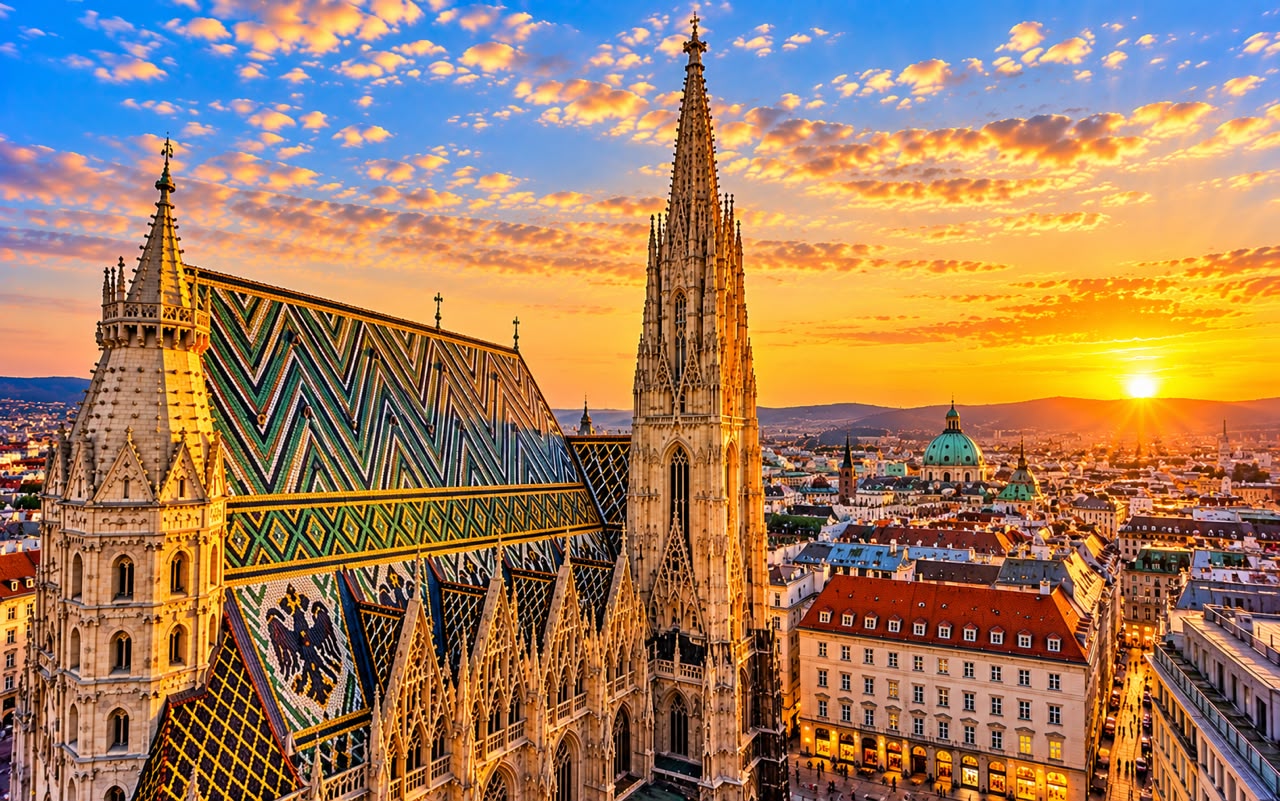
- 14:30 — Stephansdom, the cathedral, with its tiled roof of 230,000 glazed tiles and the south tower’s 343 steps, which is the better climb than the lift up the north one.
- 16:00 — The Albertina, which has the Dürer hare and a very good Impressionist collection, or the Kunsthistorisches Museum — the Habsburg collection, and the largest Bruegel holding anywhere.
- 18:00 — The Ring by tram 1 and 2, which takes 45 minutes and passes the opera, parliament, the town hall and the university.
- 19:00 — The Staatsoper. Standing tickets go on sale about 80 minutes before curtain, cost a few euro, and you queue at a separate door. It is the cheapest world-class opera anywhere — tie a scarf to the rail to hold your place, which is the accepted convention.
Day 2 — Schönbrunn, the Belvedere and a Heuriger
Walking order: Schönbrunn palace (indoor route) → gardens and the Gloriette (uphill, 1.5km) → U-Bahn → Belvedere (gardens, 1km). About 5km, with one real climb.
- 08:30 — Schönbrunn, booked with a timed slot. 1,441 rooms, of which the Grand Tour shows 40 — the Imperial Tour shows 22 and is the one to skip.
- 10:30 — The gardens, which are free, and the walk up to the Gloriette on the hill behind for the palace and the whole city laid out below. Most visitors never climb it.
- The grounds hold the oldest zoo in the world, founded 1752, if that appeals.
- 13:00 — Lunch, then across town.
- 14:30 — The Belvedere for Klimt’s The Kiss, which is smaller and better than reproductions suggest — and the Upper Belvedere’s gardens run down to the Lower one with the city behind.
- 17:00 — The Naschmarkt for the stalls, or the Hundertwasserhaus if you want the opposite of Habsburg architecture.
- 18:30 — A Heuriger in Grinzing or Nussdorf — the wine taverns on the edge of the city where the grower sells their own new wine, with cold food by the plate. A pine branch over the door means they are open. It is the most Viennese evening available.
If you have a third day
- The Prater and its 1897 ferris wheel, the Zentralfriedhof where Beethoven, Brahms and Schubert are buried, or Melk Abbey on a Danube day trip.
Costs and practicalities
Getting around, and what it costs
| U-Bahn or tram, single | €2.40 |
| 24-hour pass | about €8 |
| CAT from the airport | about €14 |
| S7 S-Bahn from the airport | about €4.30 |
| Hofburg Treasury | €16 |
| Sisi Museum and Imperial Apartments | €21 |
| Schönbrunn Grand Tour | €32 |
| Belvedere Upper | €17.50 |
| Staatsoper standing ticket | €13–18 |
| Spanish Riding School morning exercise | €16 |
- Take the S7, not the CAT. Same journey, nine minutes longer, a third of the price.
- The standing opera tickets are the best value in European culture, without much competition.
Best time to visit
- April–May and September–October — mild, and the gardens at their best.
- June–August — warm and busy, with the Danube beaches in use.
- November–December — the Christmas markets, which are the reason many people come, running from mid-November.
- January–February — cold and grey, and the ball season, which is a genuine social institution rather than a tourist event.
Travel tips
- Take the S7 from the airport, not the CAT.
- Trams 1 and 2 circle the Ring for the price of a fare.
- The Treasury is the best thing in the Hofburg.
- Climb to the Gloriette at Schönbrunn.
- Queue for standing opera tickets 80 minutes before.
- Stay two hours in the coffee house. It is expected.
- Vienna is very card-friendly, but Heurigen are often cash.
What this trip actually costs
Two people, 1 night, mid-range comfort, international flights excluded:
| Item | Cost |
|---|---|
| Hotel, 1 night | EUR 180 (≈ AED 737) |
| Food, coffee houses and a Heuriger, 2 days | EUR 170 (≈ AED 696) |
| Hofburg, Schönbrunn, Belvedere, two people | EUR 140 (≈ AED 573) |
| Opera standing tickets and transport | EUR 70 (≈ AED 287) |
| Total for two | EUR 560 (≈ AED 2,293) |
- Vienna is cheaper than Paris or Amsterdam and the public transport is among the best value in Europe.
- Hotel picks here are chosen on location, not on commission — always check prices and recent reviews before booking.
What to pack
- Shoes for 5km a day and a palace garden hill.
- Something smarter for the opera, even standing — Viennese audiences dress.
- A warm layer; the city is cold from November.
- A Type C/F adapter, 230V.
Part of a bigger trip?
- Germany and Austria in 12 days runs Munich, the Tyrol, Salzburg and here.
- Central Europe in 10 days links Vienna with Prague and Budapest.
- Budapest in 3 days is 2h40 by train.
- Prague in 3 days is four hours.
FAQ
Is two days enough for Vienna? For the Hofburg, Schönbrunn and the Belvedere, yes — one palace per day. A third day buys the Prater, the cemetery or a Danube trip.
How do the standing opera tickets work? They go on sale about 80 minutes before curtain at a separate entrance, cost a few euro, and the queue forms earlier. Tie a scarf to the rail to mark your spot — that is the accepted convention.
Which Schönbrunn tour? The Grand Tour, 40 rooms. The Imperial Tour shows 22 and leaves out the best of them. The gardens and the Gloriette walk are free.
What is a Heuriger? A wine tavern where the grower sells their own new wine, with cold food sold by the plate. A pine branch over the door means open. Grinzing and Nussdorf are the classic districts.
Is the coffee-house thing real? Entirely. It is UNESCO-listed, the newspapers on racks are there to be read, and nobody will hurry you. Ordering and leaving in fifteen minutes is the only mistake available.
Prices and entry rules change, and what you need depends on your passport; last checked 29 October 2026, so confirm with the embassy or your airline before booking.


