 The Itinerary
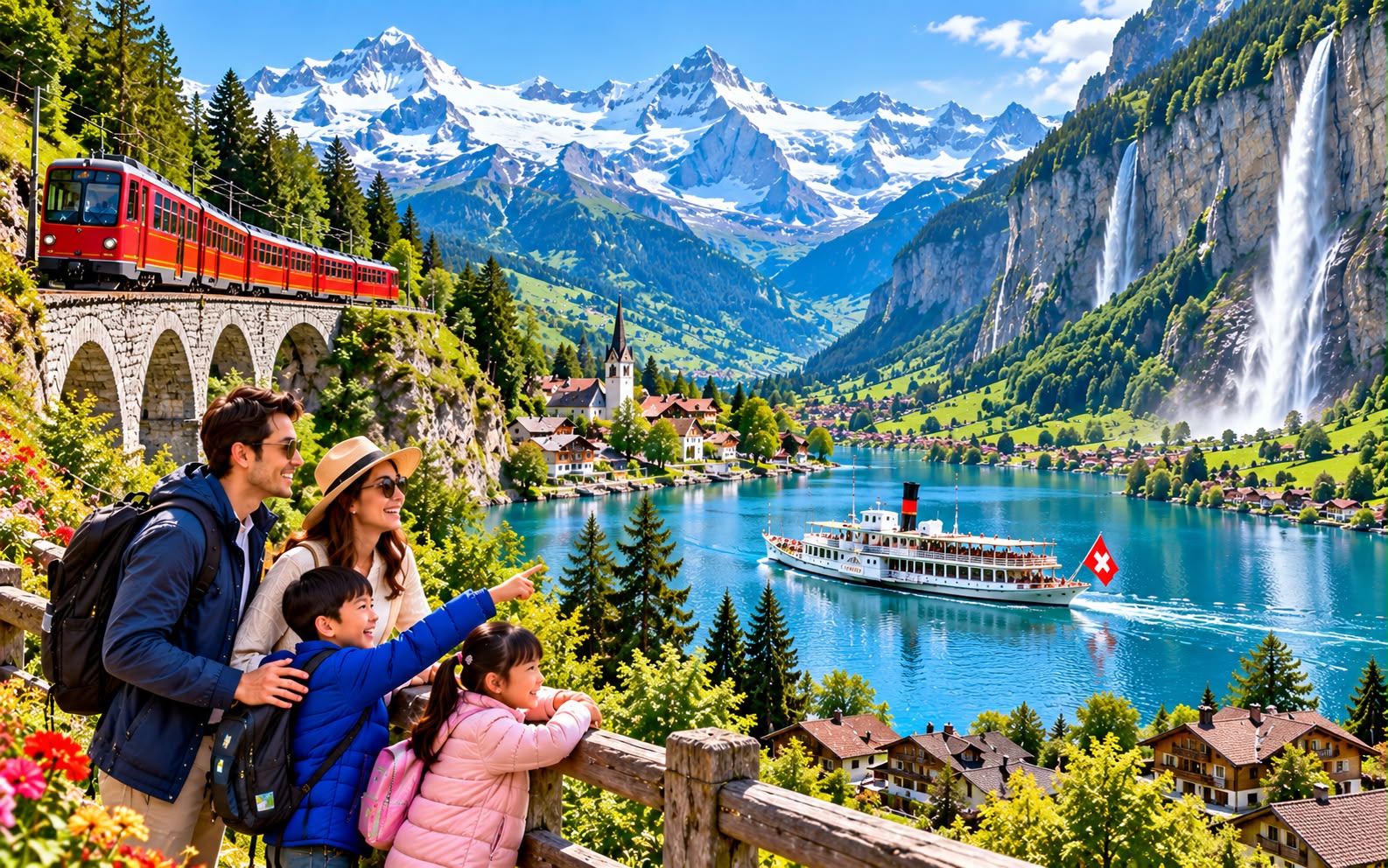
Switzerland with kids in 8 days: trains, playgrounds and easy ridges
Three bases in eight days, joined by trains and lake boats that children treat as rides. The summit excursions cut to one, the hiking swapped for buggy-friendly ridge paths and toboggan runs, and an honest look at which mountain railway is worth the money with a four-year-old.
- Central Europe
- 8 days
- ≈ AED 11,650 / person
- A country where the transport is the entertainment and every village has a playground
Before you go
Switzerland is expensive and almost perfectly built for small children. The trains, boats, funiculars, cable cars and cogwheel railways are the entertainment — a four-year-old does not need a summit, they need the thing that goes up.
The ten-day route covers Lucerne, the Jungfrau and Zermatt at an adult pace with serious hiking. This is eight days, three bases, one summit excursion — and the walking replaced with flat ridge paths, playgrounds and a toboggan run.
The one hard truth: a 3,454m summit costs a great deal and a four-year-old will like the train more than the view. Budget for one, not three.
Figure CHF 2,600 (≈ AED 11,649) per adult. June to September.
Before you go: the admin
Entry
- Switzerland is in the Schengen area. Many nationalities enter visa-free for 90 days in any 180; others need a Schengen visa.
- See how the Schengen visa works for the rules and which country to apply to.
- Children need their own passport and visa.
- Last checked: 30 October 2026.
Travel passes, and the children’s one that matters
- The Swiss Family Card is free with a Swiss Travel Pass and lets children under 16 travel free when accompanied by a parent. Ask for it explicitly — it is not always offered, and it is worth a great deal.
- The Swiss Travel Pass covers trains, buses and lake boats and gives a discount on most mountain railways rather than free travel.
- Jungfraujoch and Gornergrat both cost extra on top of the pass. Price the summit you actually want before buying anything.
- Children under 6 travel free on everything regardless.
Where to stay
- Lucerne — on the lake, for the boats and Pilatus.
- Lauterbrunnen valley — the valley floor is easiest with a buggy; Wengen and Mürren are car-free and above it, reached by rack railway or cable car. Car-free is lovely and means carrying bags onto a cable car.
- Zermatt — car-free, with the shuttle train from Täsch.
- Apartments are common and cheap relative to hotels here, and a kitchen matters when a restaurant dinner for three is what it is.
Practicalities
- Supermarket lunches are what everyone does. Coop and Migros are in every station and this is how families afford Switzerland.
- Tap water is excellent everywhere, including the village fountains, which are usually drinkable and marked if not.
- Playgrounds are everywhere and are extremely good, including at the top of mountains.
- Trains have dedicated family carriages on many routes, with a small play area. Look for the symbol.
Day by day
Day 1 — Lucerne
- Arrive at Zurich and take the train, about an hour. No need to stay in Zurich.
- 14:00 — The Chapel Bridge and the waterfront.
- 16:00 — The Lion Monument, which takes ten minutes and is worth them.
- 17:00 — The lakefront playground and the swans.
- Dinner early. Swiss kitchens close earlier than you expect.
Day 2 — The lake and Pilatus
- 09:30 — A lake steamer. Lake Lucerne is fjord-shaped with mountains coming straight down into it, the pass covers the boats, and some are restored paddle steamers — the engine room is visible and is the best part for a child.
- 11:00 — Pilatus. In summer the cogwheel railway from Alpnachstad is the world’s steepest and that fact lands with children. Down by cableway to Kriens.
- At the top there is a short, safe ridge walk and a playground.
- In winter the cogwheel railway closes and the cableway runs instead.
- 16:00 — Back by bus.
- Alternatively, the Swiss Museum of Transport in Lucerne — trains, planes, a planetarium — and it is the best wet-day option in the country.
Day 3 — Into the valley
- 10:00 — Train to Interlaken, about two hours, then into the Lauterbrunnen valley.
- Do not stay in Interlaken. It is a transport town; the valley is twenty minutes further and is the reason you came.
- 13:00 — Arrive and settle.
- 15:00 — Staubbach Falls, which drops nearly 300m off the cliff beside the village and you can walk up behind it. Short, free and genuinely impressive.
- 17:00 — The village playground, which will be better than you expect.
Day 4 — First, and the toboggan run
- 09:00 — The gondola from Grindelwald to First at 2,166m.
- The Cliff Walk is a metal walkway pinned to the rock face — safe, railed, and thrilling to a child.
- The First Flieger and Mountain Cart have height and age minimums — check before promising anything.
- The toboggan run down is the thing. Summer toboggan runs are a Swiss institution — a wheeled sledge on rails — and most take an adult and a small child together. Confirm the minimum age.
- Bachalpsee is a 50-minute walk from First to a lake that mirrors the peaks — flat, well-made and the one hike worth attempting at this age, though a carrier helps.
- 15:00 — Down, and the valley.
Day 5 — One summit, chosen carefully
- This is the expensive day, and the choice matters.
- Jungfraujoch at 3,454m — the highest railway station in Europe, a tunnel through the Eiger, an ice palace and a glacier. It is the most expensive ticket in Switzerland and altitude affects small children; some get headaches.
- The Schilthorn at 2,970m — a revolving restaurant, the Bond connection, and the Eiger, Mönch and Jungfrau in a row opposite — considerably cheaper.
- Or neither. The Männlichen to Kleine Scheidegg path is almost flat, about 90 minutes, buggy-possible in places, and has a large playground at the Männlichen end. With a four-year-old this is the better day and costs a fraction.
- Whichever you choose, go on a clear morning. Check the webcams at breakfast.
- Afternoon — Trümmelbach Falls, ten glacial waterfalls inside the mountain, reached by a lift cut into the rock. Loud, cold and extraordinary.
Day 6 — To Zermatt
- 10:00 — The long train south, about three hours via Spiez and Visp. Reserve seats if you can.
- The journey is the day. Look for a family carriage.
- 14:00 — Change at Täsch for the shuttle. Zermatt is car-free.
- 16:00 — The Kirchbrücke for the view up the street to the Matterhorn.
- 17:00 — The village. Electric taxis, no cars, and children can walk about.
Day 7 — Gornergrat, and the marmots
- 08:30 — The Gornergrat cogwheel railway to 3,089m, about 35 minutes. The Matterhorn is directly opposite and the Gorner glacier below.
- Sit on the right going up.
- Morning light is on the face you are looking at. Go early.
- Get off at Riffelberg or Rotenboden on the way down — Riffelsee reflects the Matterhorn in still water, a short walk from the station, and there are marmots on these slopes which children will spend an hour looking for.
- The Wolli children’s trail from Blauherd is designed for exactly this age if you prefer it.
- 14:00 — Back for the afternoon.
- The Gorner gorge walkway is a short, easy, railed walk from the village.
Day 8 — Out
- The long run back to Zurich, about three and a half hours, or Geneva if your flight suits.
- A window seat and a supermarket picnic is the right last morning.
- The airport is ten minutes by train from Zurich centre.
Costs and practicalities
Best time to visit
June to September.
- June — waterfalls at full volume, wildflowers, fewer people. Some high lifts and toboggan runs open mid-month — check before relying on one.
- July and August — everything open, warm, lakes swimmable. Busiest and most expensive, and valley accommodation books months ahead.
- September — the best month. Quiet, clear, still warm, and the summer attractions still running into the middle of the month.
- October — beautiful, and lifts begin closing.
- November to April — the snow season, which is a different and also excellent family trip; the winter route covers it.
Travel tips
- Ask for the Swiss Family Card. Under-16s travel free with a parent, and it is not always offered.
- One summit, not three. They are expensive and they are variations on the same view.
- Check webcams at breakfast and go up on the clear morning.
- Stay in the valley, not Interlaken.
- Check height and age minimums for toboggan runs, mountain carts and zip lines before promising them.
- Supermarket lunches. It is what Swiss families do.
- Look for the family carriage symbol on longer trains.
- Car-free villages mean carrying bags onto a cable car. Travel light.
- Altitude at 3,000m+ affects children. Keep the first twenty minutes slow.
- A Swiss plug is its own standard — a two-pin Europlug fits, a three-pin does not.
What this trip actually costs
Two adults, 7 nights, apartments and mid-range hotels, international flights excluded. Children’s costs are listed separately below.
| Item | Cost |
|---|---|
| Hotels and apartments, 7 nights | CHF 2,100 (≈ AED 9,409) |
| Swiss Travel Pass, 8 days, two adults | CHF 1,160 (≈ AED 5,197) |
| One summit excursion, two adults, pass discount applied | CHF 560 (≈ AED 2,509) |
| Lake boats, toboggan run and entries | CHF 180 (≈ AED 806) |
| Food and drink, 8 days | CHF 1,200 (≈ AED 5,377) |
| Total for two | CHF 5,200 (≈ AED 23,298) |
- Roughly CHF 2,600 (≈ AED 11,649) per adult.
- A child under 16 travels free on everything with the Swiss Family Card, which is the single biggest saving available here and the main reason a family trip to Switzerland is not as ruinous as it looks.
- Under-sixes are free regardless.
- Rooms are where a child does cost — many Swiss hotels charge per person including children. Apartments are priced by property and are usually the better answer.
- Choosing the Schilthorn or a free ridge walk over Jungfraujoch takes several hundred francs off and, at this age, loses nothing.
- Supermarket lunches roughly halve the food line.
- Hotel picks here are chosen on location, not on commission — always check prices and recent reviews before booking.
What to pack
- Walking shoes with grip for everyone, including the child.
- A carrier as well as a buggy. Mountain paths are not buggy terrain; the valley floor is.
- Warm layers and a windproof, whatever the month — a 3,000m summit is cold in August.
- Sunglasses and high-factor sunscreen for altitude and snow glare.
- Swimwear. The lakes are swimmable in summer.
- A refillable bottle each.
- A Type J adapter, 230V.
Part of a bigger trip?
- Switzerland in 10 days is the adult-paced version with more hiking.
- Switzerland in 7 days is the four-stop classic.
- Switzerland in winter is the snow version.
- France and Switzerland in 11 days adds Paris.
FAQ
Is Switzerland affordable with children? More than it looks, because of the Swiss Family Card — under-16s travel free with a parent when you hold a Swiss Travel Pass, and under-sixes are free regardless. Ask for it explicitly. Rooms and restaurant meals are where the money goes, and apartments plus supermarket lunches fix most of that.
Which summit should we do with a four-year-old? One, and probably not Jungfraujoch. The Schilthorn is much cheaper with an arguably better view of the Eiger, Mönch and Jungfrau. The Männlichen to Kleine Scheidegg path costs almost nothing, is nearly flat, and has a big playground at one end.
Can we manage with a buggy? In the valleys, lake towns and on the trains, easily. On mountain paths, no — take a carrier as well. Car-free villages like Mürren and Zermatt mean carrying bags onto a cable car or shuttle, so travel light.
Are the toboggan runs safe for small children? Generally yes, and most allow an adult and a small child on one sledge, but minimum ages vary by run. Check before you promise it — the same applies to mountain carts and zip lines, which have firmer limits.
Is altitude a problem for children? It can be above about 3,000m — headaches and tiredness are common at Jungfraujoch. Go up slowly, keep the first twenty minutes calm, and do not plan anything demanding for that afternoon.
Prices and entry rules change, and what you need depends on your passport; last checked 30 October 2026, so confirm with the embassy or your airline before booking.


