 The Itinerary
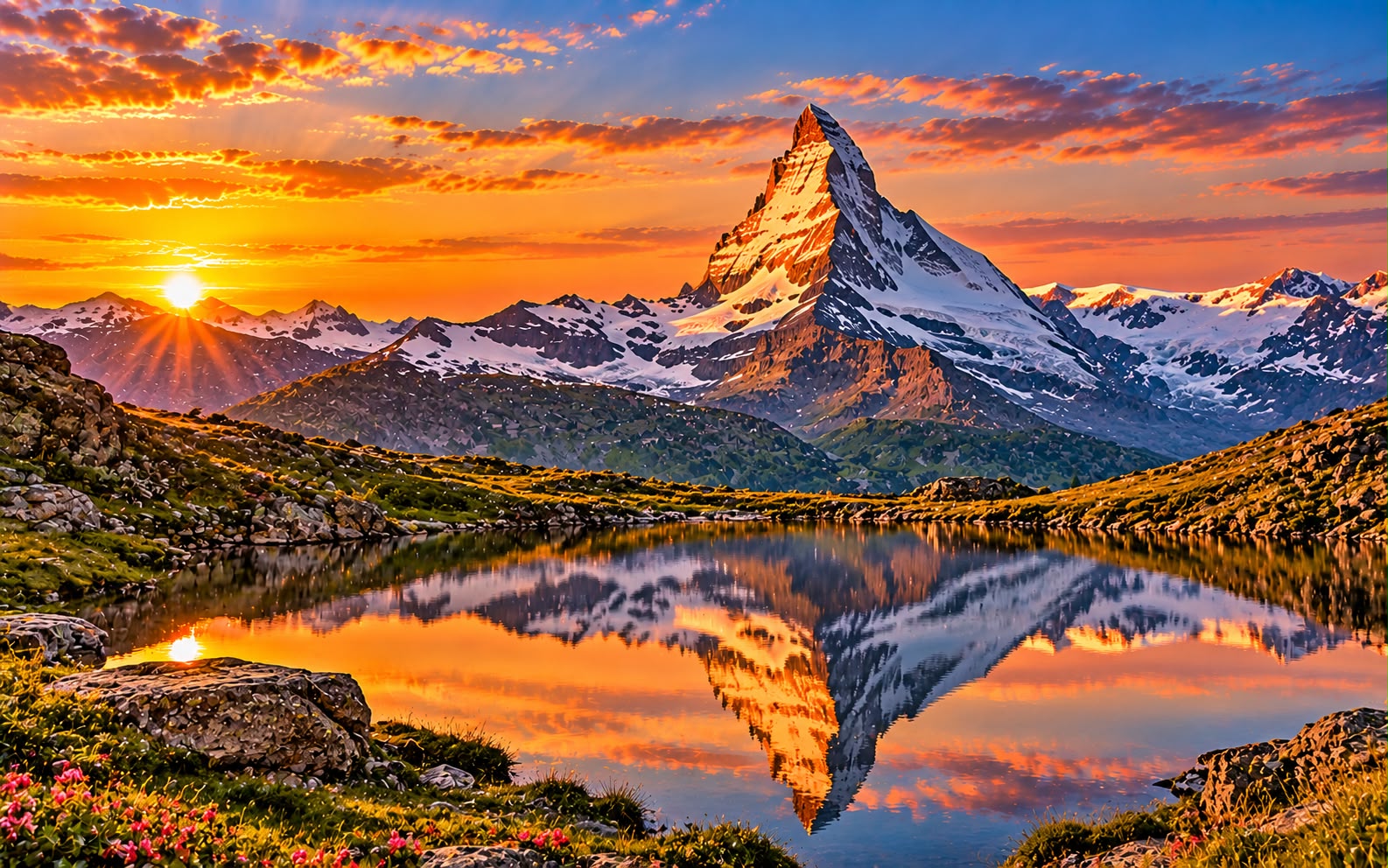
Switzerland in 7 days: Zurich, Lucerne, Interlaken and Zermatt
A week of lakes and mountains, entirely by train. The Swiss Travel Pass arithmetic that decides the budget, which summit excursion is worth its very high price, and why Zermatt is car-free and what that means for arriving.
- Central Europe
- 7 days
- ≈ AED 8,950 / person
- Four stops, all by train, with the mountain excursions costed honestly
Before you go
Switzerland is expensive and the trains are extraordinary, and those two facts shape every decision on this trip.
Zurich, Lucerne, Interlaken and Zermatt, all by rail, in seven days. No car — the mountain villages that matter are car-free or nearly so, and the rail network reaches everything.
The thing to understand before you budget: the headline mountain excursions are not covered by the Swiss Travel Pass at full value. Jungfraujoch costs around CHF 100–130 each even with a pass, and the Matterhorn Glacier Paradise is similar. This guide prices them rather than glossing over it.
Ten days adds Lauterbrunnen, Montreux and the Glacier Express.
Figure CHF 2,000 (≈ AED 8,961) per person. June to September, and December to March for snow.
Before you go: the admin
Entry
- Schengen, though not in the EU. Visa-free for many nationalities; Indian passport holders need a Schengen visa, six to eight weeks ahead.
- 90 days in any 180 across the area.
The Swiss Travel Pass question
- For this route, a 6 or 8-day consecutive Swiss Travel Pass usually pays — it covers trains, buses, boats, most city transport and over 500 museums, and it gives 50% off most mountain railways.
- It does not make the big excursions free. Jungfraujoch is roughly CHF 100–130 each even with the pass; Gornergrat and Glacier Paradise are discounted but still substantial.
- Price your actual route first. If you are doing one summit rather than three, individual tickets plus a Half Fare Card may win.
- Seat reservations are not needed on ordinary Swiss trains, and the timetable is exact to the minute.
Money
- Swiss francs, not euros — some tourist places accept euros at a poor rate.
- Cards everywhere. Switzerland is expensive and predictable about it: a restaurant main is CHF 25–40, a supermarket lunch CHF 10.
- Tap water is excellent and free, including from village fountains.
Zermatt is car-free
- Drive or take the train to Täsch, then the shuttle train up — five minutes, every twenty. You cannot drive into Zermatt.
- Electric taxis run inside the village.
Day by day
Day 1 — Zurich
- Arrive, and do not plan much. The airport is 12 minutes from the main station by train, which is the fastest airport transfer in Europe.
- 14:00 — The Altstadt on both banks, which is twenty minutes across.
- 15:00 — Grossmünster and its tower climb, 187 steps, for the lake and the rooftops.
- 16:30 — Fraumünster for the Chagall windows, five stained-glass panels he made at 83 and considered among his best work. No photographs inside, and they close earlier than you expect.
- 18:00 — The Lindenhof for the view over the old town, which is free and where the Romans put their customs post.
- 19:30 — Lake Zurich and the Seepromenade, then dinner in Niederdorf.
- Zurich is the most expensive city on this route. One night is enough.
Day 2 — Lucerne
- 09:00 — Fifty minutes by train from Zurich.
- 10:30 — The Chapel Bridge (Kapellbrücke), fourteenth century, with its painted gables, and the Water Tower beside it. The bridge burned in 1993 and was rebuilt; the gap in the paintings is where the originals were lost.
- 11:30 — The Lion Monument, carved into a cliff face for the Swiss Guards killed in 1792 — Mark Twain called it the saddest piece of stone in the world.
- 14:00 — A lake steamer on Lake Lucerne — covered by the Travel Pass, and the best-value excursion on this trip. Two hours out and back, or ride one leg and train the other.
- 17:00 — The Musegg Wall, nine towers of medieval rampart you can walk along for free, with a clock that is allowed to strike a minute before every other clock in the city.
- 19:30 — Dinner on the Reuss, where the old town meets the river.
Day 3 — A mountain, or a wet-day plan
- 08:30 — Mount Pilatus by the world’s steepest cogwheel railway (48%), up one side and down by cable car and gondola to make the round trip.
- Or Mount Rigi by cog railway and boat, which is the gentler and cheaper of the two and arguably the better day — the summit looks across to Pilatus and down on both lakes.
- 14:00 — The Swiss Museum of Transport, far better than it sounds and the best wet-day option in the country — swap it for the mountain if the cloud is down.
- 17:00 — Back in Lucerne, and pack for the valley.
Day 4 — Into the Lauterbrunnen valley
- 09:00 — Two hours by train, between two lakes.
- Interlaken itself is a base, not a destination. Stay in Lauterbrunnen or Grindelwald if you can — both are in the valley proper and both cost less.
- 12:00 — Lauterbrunnen, which has 72 waterfalls falling into a glacial trench, including the Staubbach dropping 300m past the village — you can walk behind it.
- 14:00 — Trümmelbach Falls, ten glacial waterfalls inside the mountain, reached by a lift cut into the rock. Loud, cold and extraordinary.
- 16:30 — Mürren or Wengen by cable car, two car-free villages on the shelves above the valley, for the evening light.
- Check the webcams tonight. Tomorrow’s plan depends on them.
Day 5 — The high day
- 07:30 — Jungfraujoch, “the Top of Europe”, at 3,454m — the highest railway station in Europe, with an ice palace and a glacier. It costs around CHF 100–130 each even with a Travel Pass and takes most of a day. Go only in clear weather; in cloud you have paid a great deal to see fog.
- Cheaper and often better: Schynige Platte for the alpine garden and the ridge walk, Männlichen, or the walk from Männlichen to Kleine Scheidegg, an easy ninety minutes with the Eiger north face in front of you the whole way.
- 12:00 — Lunch at Kleine Scheidegg, which is where both plans meet.
- 16:00 — Back down, and the First Cliff Walk above Grindelwald if you still have legs and light.
Day 6 — To Zermatt, and the Gornergrat
- 08:30 — Two and a half hours by train, changing at Visp. The last stretch is a cog railway up a side valley.
- Zermatt is car-free. Drivers park at Täsch and take the shuttle, five minutes up.
- 12:00 — The Matterhorn is the point, and it is visible from the village — from the Kirchbrücke in the middle of town, which is where the photograph is taken.
- 14:00 — Gornergrat railway — 33 minutes to 3,089m, with the Matterhorn and the Gorner glacier in front of you. This is the better value of Zermatt’s two big excursions.
- Matterhorn Glacier Paradise is higher at 3,883m and more expensive, with an ice palace at the top — the alternative if you want the altitude rather than the view.
- 18:30 — Dinner on the Bahnhofstrasse, and an early night if you want the sunrise.
Day 7 — Sunrise, then home
- 06:00 — Sunrise on the Matterhorn turns it pink for about ten minutes, and it is worth the alarm. The Kirchbrücke or the Sunnegga funicular both work.
- 08:30 — The Five Lakes Walk (5-Seenweg) — two to three hours, and the Matterhorn reflects in several of them on a still morning. Take the Sunnegga funicular up and walk down.
- 13:00 — Back to Zurich — three and a half hours, so take the early afternoon train on the last day and do not cut it fine.
Costs and practicalities
Best time to visit
- June to September — everything open, the high passes clear, the walking at its best. July and August are busiest; June and September are the sweet spot.
- December to March — skiing, and Zermatt and Grindelwald are world-class. The scenic trains run and the villages are at their prettiest.
- April–May and October–November — the shoulder seasons are genuinely awkward here. Many mountain lifts close entirely for maintenance, lower slopes are brown and the weather is unreliable. Cheap, and for good reason.
Mountain weather decides this trip. Check the webcams each morning and keep the summit day flexible rather than booking it in advance.
Travel tips
- Price the Swiss Travel Pass against your actual route before buying — it usually wins here, but not always.
- The pass does not make Jungfraujoch free. Budget CHF 100–130 each on top.
- Check webcams before any summit excursion. In cloud you are paying a great deal for nothing.
- Stay in Lauterbrunnen or Grindelwald, not Interlaken, if you can.
- You cannot drive into Zermatt — park at Täsch and take the shuttle.
- Supermarket lunches (Coop, Migros) halve the food budget and are genuinely good.
- Village fountains are drinking water. Carry a bottle.
- Swiss trains leave exactly on time, and connections are built to work with three minutes.
What this trip actually costs
Two people, 6 nights, mid-range comfort, international flights excluded:
| Item | Cost |
|---|---|
| Hotels, 6 nights | CHF 1,600 (≈ AED 7,169) |
| Two Swiss Travel Passes | CHF 900 (≈ AED 4,032) |
| Food and drink, 7 days | CHF 900 (≈ AED 4,032) |
| Mountain excursions above the pass discount | CHF 500 (≈ AED 2,240) |
| Local transport and incidentals | CHF 100 (≈ AED 448) |
| Total for two | CHF 4,000 (≈ AED 17,922) |
- Roughly CHF 2,000 (≈ AED 8,961) per person, and Switzerland is the most expensive country on this site — this is a realistic mid-range figure, not a frugal one.
- The excursions line assumes one big summit, not three. Doing Jungfraujoch, Gornergrat and Glacier Paradise would roughly double it.
- Self-catering lunches are the single biggest saving available, and nobody will think less of you for it.
- Hotel picks here are chosen on location, not on commission — always check prices and recent reviews before booking.
What to pack
- A warm layer and a windproof, whatever the month — 3,000m is near freezing in August.
- Sunglasses and high-factor sun cream. Glare off snow and ice at altitude burns quickly.
- Walking boots if you intend any of the trails.
- A refillable bottle for the fountains.
- A Type J adapter — Switzerland uses a three-pin plug that many European adapters do not fit.
FAQ
Is the Swiss Travel Pass worth it? For this four-stop route, usually yes — it covers trains, boats, city transport and museums and halves most mountain railways. If you are staying in one valley, a Half Fare Card may be cheaper.
Is Jungfraujoch worth the money? In clear weather, many people say yes; in cloud, nobody does. It is the most expensive single excursion in Switzerland and it is entirely weather-dependent. Schynige Platte and Männlichen cost far less and are often better.
Interlaken or Lauterbrunnen? Lauterbrunnen or Grindelwald. Interlaken is a transport hub between two lakes with no mountain of its own; the valley villages are where the scenery is.
How do I get to Zermatt? By train, or drive to Täsch and take the five-minute shuttle. The village is car-free and there is no way around that.
Can I do this on a budget? Partly. Transport and lodging are fixed costs and high. Food is where you have control — supermarket lunches and self-catering can take a third off the total.
Prices and entry rules change, and what you need depends on your passport; last checked 29 October 2026, so confirm with the embassy or your airline before booking.


