 The Itinerary
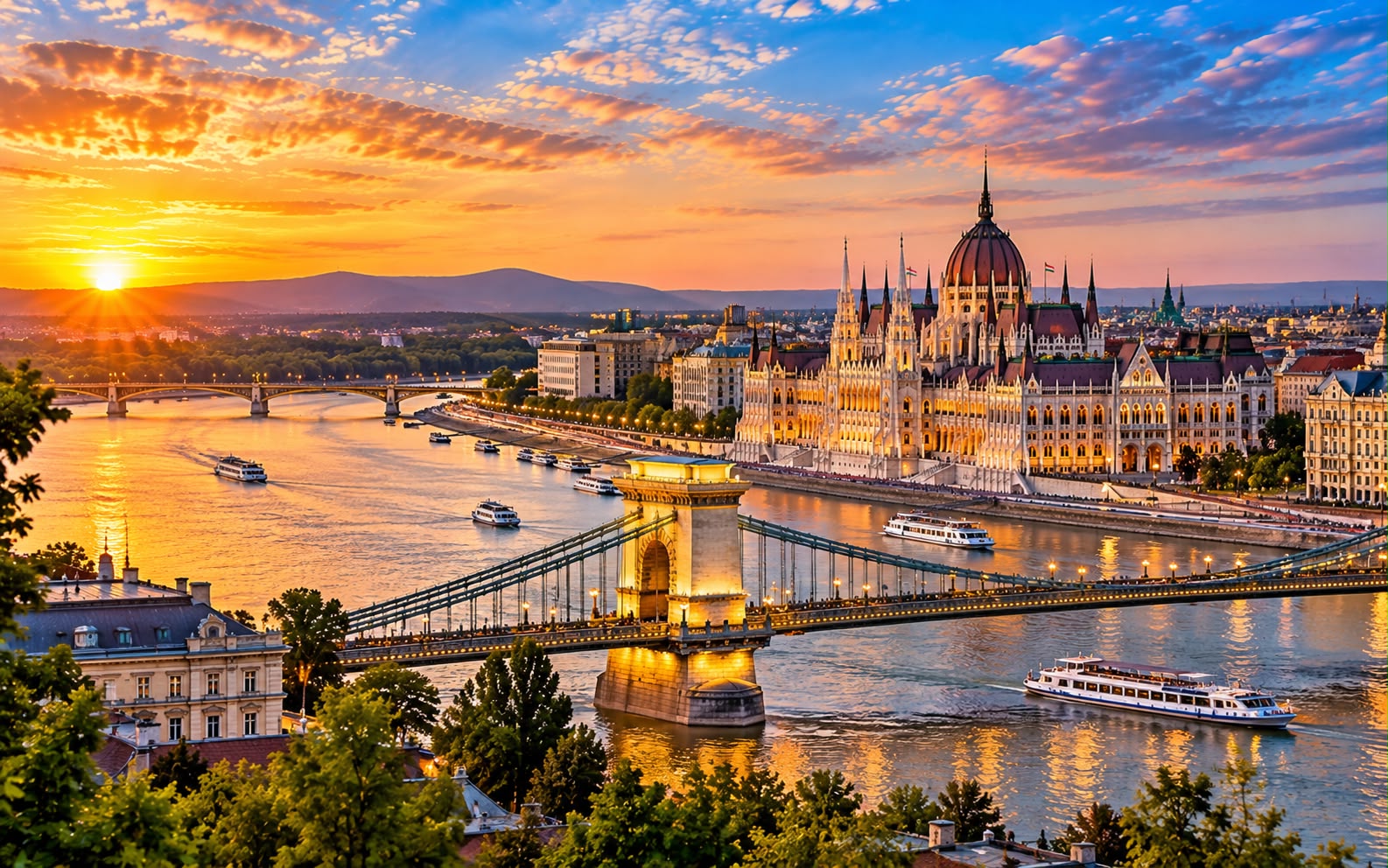
Hungary in 6 days: Budapest and the Danube Bend
The most dramatic riverfront in Europe, and you can swim in it — well, in its hot springs: Parliament by night cruise, a castle district with free-before-9am turret views, outdoor thermal pools steaming at 38°C, ruin bars in pre-war tenements — plus the artists' village up the Danube, all on low-cost flights from across Europe and the Gulf.
- Central Europe
- 6 days
- ≈ AED 3,500 / person
- City + thermal baths
Before you go
Budapest is two cities glaring at each other across a river — hilly, castled Buda and flat, café-crammed Pest — and the glare is the best urban view in Europe: Parliament’s Gothic wedding cake on one bank, the castle and bastion on the other, seven bridges stitching them together. Underneath it all, 120 hot springs bubble up, which is why this is the only capital where “let’s go to the baths” is a Tuesday plan.
The sums are friendly: low-cost carriers reach Budapest from across Europe and the Gulf (Wizz Air flies Abu Dhabi–Budapest direct), Hungary keeps its own forint (so prices undercut the euro zone), and one Hungarian Schengen visa — same drill as our France and Czech guides — opens the whole zone.
The shape: five nights in Pest’s centre, with the castle, the baths, the ruin bars, a night cruise — and a day up the Danube Bend to Szentendre’s painted lanes. Figure HUF 310,000 (≈ AED 3,494) per person including the visa, excluding flights. Go April–June or September–October; December is market-lit and cold, July–August hot and busiest.
Before you go: the admin
Schengen, Hungary flavour
- Schengen, Hungary flavour: apply via your nearest VFS Global centre with Hungary as main destination — €90 + service fee, biometrics, proof of residence valid past your return, bank statements, employment letter, insurance (€30,000), full itinerary. Apply 4–6 weeks out; summer slots go fast. Already holding a Schengen visa from our other guides’ trips? It works here — one zone, one sticker.
Flights and the forint
- Flights: low-cost carriers reach Budapest from across Europe, and Wizz Air flies Abu Dhabi–Budapest direct (~US$160–380 return from the Gulf if you pack light and book early — the site’s cheapest Europe airfare trick); connections via European hubs otherwise.
- Money: Hungary uses the forint (HUF) — not euros, whatever the tourist-strip menus imply. Cards tap everywhere; when the terminal offers to charge in your home currency, choose HUF (dynamic conversion skims 5–10%). ATMs: bank-branded only, decline conversion; avoid the blue Euronet boxes.
Taxis and the metro
- Taxis: never hail from the street. Bolt (or official yellow Főtaxi) is cheap and honest; the airport’s 100E bus runs to the centre for ~HUF 2,200.
- Getting around: the metro alone is worth a ride — Line M1 is continental Europe’s oldest underground, all wood and brass. BudapestGO app: 24h/72h travelcards (~HUF 2,500/5,500) cover metro, trams (tram 2 along the river is a sightseeing tour in disguise) and buses.
Day by day
Day 1 — Land, walk the river at night
- Afternoon — Land, 100E bus in, check in around Deák Ferenc tér.
- 17:00 — Orientation the classic way: walk the Danube Promenade past the poignant Shoes on the Danube memorial (bronze shoes for those shot into the river in 1944–45 — pause properly) to Chain Bridge, the lion-guarded 1849 original.
- 19:30 — First Hungarian dinner: goulash (it’s a soup here, not a stew — first honesty of the guide), chicken paprikash with nokedli, ~HUF 4,500–7,000 pp off the tourist strips (rule: nothing on Váci utca with a picture menu).
- 21:00 — The river at night from Chain Bridge: Parliament lit like a chandelier. Tomorrow you’re inside it.
Where to stay in Budapest (five nights, Pest side)
- Luxury: Anantara New York Palace — 4.6/5 on TripAdvisor (~5,700 reviews), the palazzo whose ground floor is the New York Café, self-styled “most beautiful café in the world”. ~HUF 160,000+.
- Mid-range: Hotel Moments, Andrássy Avenue — 4.9/5 (~5,400 reviews), the boulevard address at boutique prices, breakfast famous. ~HUF 55,000–75,000.
- Value: ROOMbach Hotel — 4.7/5 (~2,700 reviews), clean-lined rooms tucked by the Rumbach synagogue, ruin-bar district on foot. ~HUF 32,000–42,000.
Day 2 — Parliament, the basilica, a night cruise
- 09:00 — Hungarian Parliament tour — booked 1–3 weeks ahead (it sells out): 45 minutes under the gilded dome with the Crown of St Stephen. The honest price note: non-EU adults pay HUF 23,150 (~€60) — steep, and still the best interior in the city. Budget-savers: skip inside, shoot the facade from Batthyány tér across the river and spend the difference on tonight’s cruise.
- 11:30 — Kossuth tér and the changing of the guard, then tram 2 south along the river (the free sightseeing ride).
- 13:00 — Lunch at Central Market Hall (Nagyvásárcsarnok): lángos — fried dough, sour cream, cheese — upstairs (~HUF 2,000), paprika garlands downstairs for the suitcase.
- 15:00 — St Stephen’s Basilica: hall HUF 2,600, or the all-access HUF 6,800 with the 360° dome terrace (lift or 300 steps) and the treasury — plus the mummified right hand of King Stephen himself, Hungary’s oddest relic.
- 19:30 — Danube night cruise (~HUF 7,000–10,000 with a drink): Parliament, castle and bridges floodlit from the water — the reason every Budapest photo you’ve ever seen exists. Book the 21:00 sailing in summer for full dark.
Day 3 — Buda: castle hill done right
- 08:30 — Cross Chain Bridge and beat the crowds uphill (funicular ~HUF 4,000 return — or the pretty 10-minute walk up the castle gardens, free).
- 09:00 sharp — Fisherman’s Bastion: the fairy-tale white turrets are free before 9 am (after that, upper terraces HUF 1,700 — arriving early is the site’s favourite kind of discount). Parliament across the water in morning light is the picture of the trip.
- 10:00 — Matthias Church (~HUF 3,500, majolica roof and painted interior), then the castle courtyards, the President’s palace guard, and the medieval lanes of Úri utca.
- 13:00 — Lunch in the Víziváros below (~HUF 3,500), or ruin-pub brunch back in Pest.
- 15:00 — Gellért Hill: the 30-minute climb past the Liberty Statue for the second great panorama (free), descending to the art-nouveau Gellért Baths facade.
- 19:00 — Dinner in the Jewish Quarter, then the institution: Szimpla Kert, the original ruin bar — a condemned tenement filled with fairy lights, bathtub seats and twenty years of creative clutter. Go 19:00–21:00 for the magic without the 23:00 crush; Tuesday–Thursday beats weekends.
Day 4 — Széchenyi: the bath day
- 09:30 — Széchenyi Baths, City Park: 15 pools indoors and the famous canary-yellow outdoor trio steaming at 27–38°C, chess players mid-soak. Weekday locker ticket HUF 13,200 (weekends 14,800; online “fast-track” prices run higher in euros). The house economics: bring your own towel and flip-flops — rentals run HUF 6,900 and 4,200 — and go weekday morning for space. Two to three hours is the sweet spot; more and you’re soup.
- 13:00 — Recover with lunch toward Heroes’ Square and the Millennium monuments; Vajdahunyad Castle’s architectural mixtape sits in the park behind.
- 15:30 — Andrássy Avenue amble: the Opera House (guided tours ~HUF 9,000 if the interior calls), the M1 metro ride beneath it, ending with cake — either the New York Café spectacle (queue, ~HUF 4,500 with coffee, worth it once) or a classic cukrászda without one.
- 19:30 — Modern-Hungarian dinner night (~HUF 8,000–12,000 pp at the bistronomy end) — Budapest’s kitchen scene quietly outruns its prices.
Day 5 — The Danube Bend: Szentendre
- 09:00 — HÉV suburban train (H5) from Batthyány tér to Szentendre (40 min, ~HUF 700–1,000 each way on top of the travelcard): a Serbian-Orthodox-flavoured artists’ village of ochre lanes, gallery courtyards and riverside promenade.
- 10:00 — Wander: the Main Square’s crooked charm, Margit Kovács ceramics museum (~HUF 2,400 — quietly wonderful), church-hill viewpoint, and the compulsory marzipan museum for anyone under 12.
- 13:00 — Riverside lunch (~HUF 4,000), then either the summer boat back down the Danube (seasonal, ~HUF 4,000 — the scenic return) or the HÉV again. (Castle-hungry swap: Visegrád’s citadel above the Bend’s hairpin, by bus — bigger views, fewer galleries.)
- 17:30 — Back in town: last-light walk on Margaret Island — the traffic-free park island with the musical fountain.
- 20:00 — Farewell dinner + a final ruin-bar round or a concert at the basilica.
Day 6 — Fly home
- Morning — Kürtőskalács (the chimney cake — Hungarian-Transylvanian and proudly so) at the market, paprika and Tokaji into the suitcase, 100E bus out. Wizz’s afternoon rotation suits the slow morning; check your times.
Costs and practicalities
Best time to visit
April–June and September–October. Budapest in high summer is hot and full; the shoulder months give the same city with room to move.
- April–June — the best of spring. The Danube embankments in use, the baths pleasant, and the city not yet at capacity.
- July–August — over 35°C is common, and Sziget Festival in August fills the city. The thermal baths are less appealing in the heat, though Széchenyi’s outdoor pools help.
- September–October — the best month. The wine harvest around Eger, Villány and Tokaj, warm days, and the city quiet again.
- November–March — cold and grey, but this is when the thermal baths make most sense, steam rising off the outdoor pool at Széchenyi against the snow. Christmas markets from mid-November, with the Basilica one the best.
Travel tips
- Refuse dynamic currency conversion. Hungary uses the forint, not the euro, and every card machine will offer to charge you in your own currency at a bad rate. Always choose forint.
- Avoid street exchange and the booths near the tourist streets. Use a bank ATM and decline its conversion too.
- Validate transport tickets in the machines. Inspectors at metro exits are frequent and the fine is on the spot.
- Take flip-flops and a towel to the baths, and check which days are mixed. Széchenyi for the architecture and the outdoor pools, Gellért for the art nouveau, Rudas for the Ottoman dome.
- Beware the “friendly local” bar scam in the Belváros — an invitation that ends in an enormous bill. Pick your own bar.
- Tipping is 10% and should be said aloud when paying rather than left on the table.
- Ruin bars start late. Szimpla before 9pm is a different and emptier place.
What this trip actually costs
Two people, 5 nights, mid-range, including visas, excluding flights (Wizz AUH–BUD from ~US$160–380; flydubai DXB–BUD ~US$440–710):
| Item | Cost |
|---|---|
| Hungarian Schengen visas via VFS ×2 | HUF 80,000 (≈ AED 902) |
| Hotel, 5 nights, central Pest | HUF 210,000 (≈ AED 2,367) |
| Travelcards + airport bus | HUF 25,000 (≈ AED 282) |
| Parliament tour (non-EU) ×2 | HUF 46,000 (≈ AED 518) |
| Széchenyi Baths (weekday, towels from home) ×2 | HUF 26,400 (≈ AED 298) |
| St Stephen’s all-access ×2 | HUF 13,600 (≈ AED 153) |
| Fisherman’s Bastion turrets ×2 | HUF 3,400 (≈ AED 38.32) |
| Castle funicular ×2 | HUF 8,000 (≈ AED 90.17) |
| Danube night cruise ×2 | HUF 18,000 (≈ AED 203) |
| Szentendre day: HÉV + museums | HUF 7,000 (≈ AED 78.89) |
| Food, 6 days | HUF 165,000 (≈ AED 1,860) |
| eSIM | HUF 4,000 (≈ AED 45.08) |
| Buffer: cakes, lángos, ruin-bar rounds | HUF 13,600 (≈ AED 153) |
| Total for two | HUF 620,000 (≈ AED 6,988) |
- HUF 310,000 (≈ AED 3,494) per person ≈ €785 — visa included, and with Wizz’s fares this is regularly the cheapest Europe trip on the site door-to-door. The forint quietly discounts everything: the same week in Vienna, one train-hour away, costs half again as much.
- Book in this order: VFS appointment (4–6 weeks out) → flights (Wizz sale windows) → hotel → Parliament tour (sells out 1–3 weeks ahead) → night cruise + Széchenyi online → everything else walks up.
- Hotel and restaurant picks are unsponsored — no affiliate links in this article. Chosen on location and current TripAdvisor ratings; check recent reviews and prices before booking.
What to pack
- Swimwear, towel and flip-flops — the bath-day trio that saves HUF 17,000 in rentals; a swim cap only if you’ll do the lap pool.
- Cobblestone shoes; the castle district is all stones and stairs.
- Layers + rain shell; proper coat November–March.
- European Type C/F adapter.
- A zipped day bag (tram 4/6 and market crowds are the pickpocket map).
- Wizz packers: weigh the cabin bag — the fare trick dies at the gate scale.
FAQ
Is Budapest safe? Yes — comfortably so for families and solo travellers. The full watch-list: pickpockets on crowded trams and in the market, unofficial taxis (solved by Bolt), “0%-commission” exchange booths and Euronet ATMs (use bank ATMs, pay in HUF), and the ancient tourist-bar bill-padding trick on Váci utca (eat one street over). Ruin bars are rowdy-friendly, not rough.
Halal and vegetarian food? Halal: a real and growing scene — Turkish, Middle Eastern and Pakistani kitchens cluster around the centre and the Jewish Quarter’s edges (look for displayed certification; classic Hungarian places cook with pork fat by default, so ask). Vegetarian: easier than the paprika-and-pork stereotype — lángos, túrós csusza without bacon, main-course cheese dumplings, plus a strong modern-veg scene (Budapest does Europe’s best-value tasting menus, veg included). Say “disznó nélkül” — without pork — and smile.
Which bath — Széchenyi, Gellért or Rudas? Széchenyi for the icon (big, yellow, social, chess); Gellért for art-nouveau tiles and calm; Rudas for the 16th-century Ottoman dome plus a rooftop pool IN the Danube view — best at night. Doing two is normal; doing three is a lifestyle. Etiquette everywhere: shower first, flip-flops always, keep voices low indoors.
Is the Parliament tour worth €60 for non-EU visitors? If state rooms thrill you — the dome hall and crown genuinely do — yes, once. If you’re budget-tuned, the honest answer: the exterior (from the river, at night, from Batthyány tér) delivers 80% of the awe for free, and the basilica dome + cruise combo costs less than one Parliament ticket.
Budapest with kids? Excellent: bath pools (14+ at Széchenyi — take younger kids to Palatinus lido on Margaret Island instead), the marzipan museum, castle funicular, chairlift up the Buda Hills and the Children’s Railway (staffed by actual children, gloriously), plus chimney cakes as a food group.
What’s Hungary guide #2? Lake Balaton in summer — Tihany’s lavender abbey, Balatonfüred’s promenade, wine hills above the “Hungarian sea” — or the Eger wine country long weekend. Votes welcome; both on the list.
Prices and entry rules change, and what you need depends on your passport; last checked 8 October 2026, so confirm with the embassy or your airline before booking.


