 The Itinerary
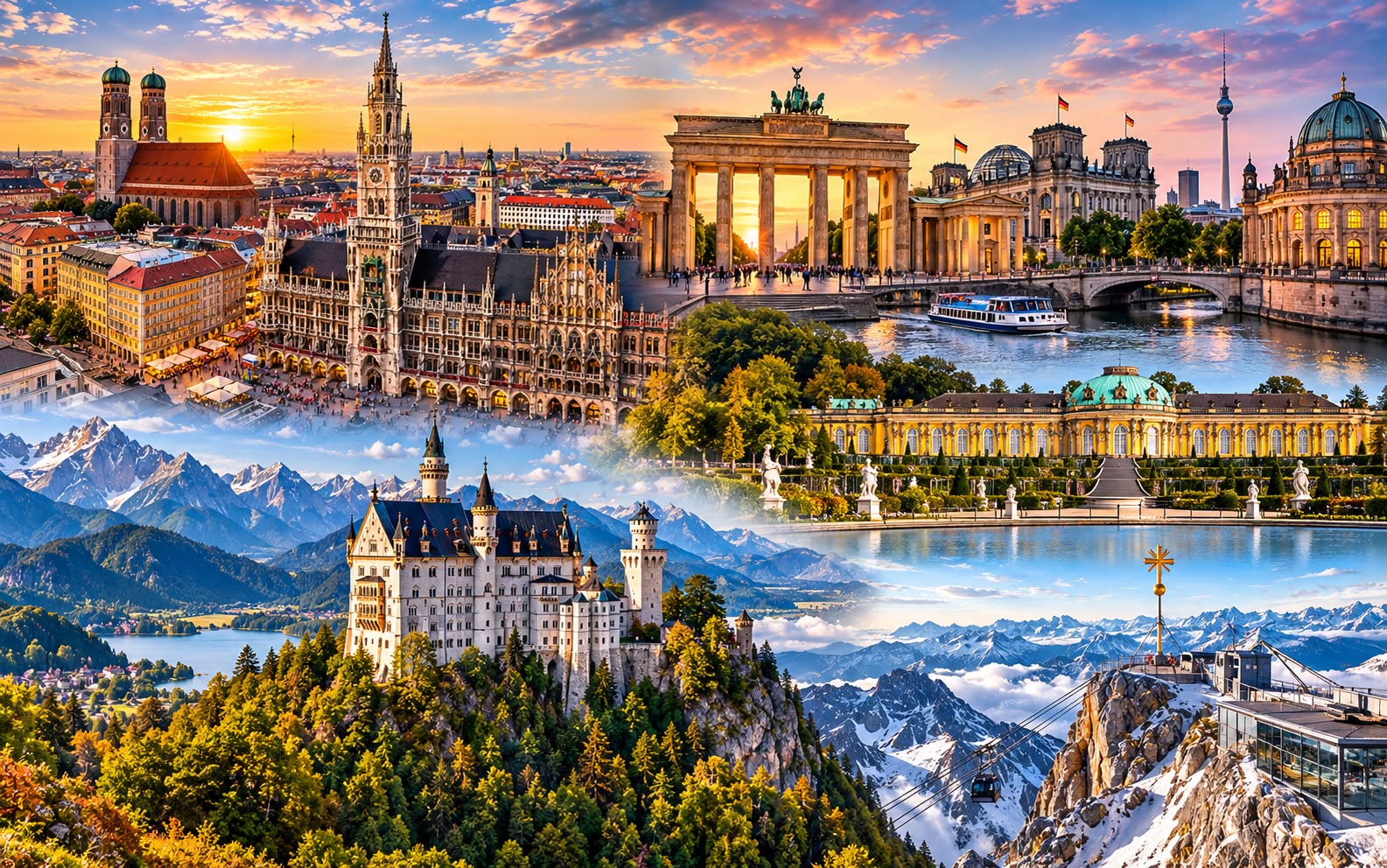
Germany in 10 days: Munich, the Alps and Berlin
Two Germanys on one fast train: beer-garden Bavaria with the fairy-tale castle and the top of the country at 2,962 m, then Berlin — the Wall, Nefertiti, a free glass dome over parliament — with the booking windows, the cash surprise and the Sunday-shutdown rule that guidebooks forget to mention.
- Western Europe
- 10 days
- ≈ AED 7,350 / person
- First-time visitors
Before you go
Germany’s two great cities disagree about almost everything, and that’s the trip. Munich is the south: church towers and beer gardens, lederhosen worn without irony, the Alps filling the end of the street on clear days — with King Ludwig’s Neuschwanstein, the castle Disney copied, two hours away. Berlin is the capital-of-the-20th-century: the Wall’s scar line, museums holding Nefertiti, techno in old power stations, and a parliament you can walk on top of, free.
An ICE train sews them together in four hours. Ten days does both properly, plus the Alps, plus a day in a second country if you feel like it — your Schengen visa doesn’t notice borders.
Go May–June or September (September in Munich means Oktoberfest — mid-September to early October: the greatest party on earth and doubled hotel prices; decide deliberately, book a year out or dodge the dates). December is the other Germany: Christmas-market season, glühwein and lights — a future guide of its own. All costs are in euros (EUR).
Before you go: the admin
Visa and borders
Schengen mechanics — the EES biometric border fully operational since April 2026, the €20 ETIAS still undated, the standard file — are covered in depth in our Schengen visa guide. Germany-specific: applications run through VFS Global, fee €90 + service charges, and summer appointment lead runs 4–8 weeks — apply where Germany is your main destination (most nights), which this itinerary satisfies. Bank statements, employment proof and refundable bookings remain the file’s spine.
Money — Germany’s cash surprise
- The country that invented the €2,000 espresso machine still loves cash: plenty of bakeries, beer gardens, market stalls and even restaurants are cash-only or card-above-€10. Carry €50–100 at all times — this catches every first-timer.
- Tipping: round up or ~5–10% (“machen Sie 28” as you hand over €30). Service is included; nobody expects US percentages.
- Pfand: bottles carry a €0.08–0.25 deposit — return them at any supermarket machine, or leave them beside bins for collectors (a quiet local courtesy).
- Tap water isn’t standard in restaurants — order “Leitungswasser” and expect the occasional frown; bottled (“still” or “sprudel”) is the default.
The Sunday rule, trains, kids
- Sundays, nearly everything retail is CLOSED — shops, supermarkets, malls. Museums, bakeries (mornings), restaurants and beer gardens stay open. Plan museum days and park days on Sundays; do shopping Saturday.
- Trains price like airlines: the ICE Munich–Berlin runs ~4 hours with Super Sparpreis fares from ~€20–40 released months out (walk-up can be €120+). Book when dates fix. Honesty: Deutsche Bahn’s punctuality is a running national joke — pad any tight connection by one train.
- The regional-ticket cheat codes: the Bayern-Ticket (~€40–45 for two, per day) covers all Bavarian regional trains and local transport — it is the Neuschwanstein and Salzburg day-trip ticket. The €58/month Deutschland-Ticket covers regional transit nationwide and can beat everything if your trip sits inside one calendar month — do the maths in the DB Navigator app (your one essential download).
- Kids: under-18s free at Neuschwanstein and most state museums, under-6s free almost universally, beer gardens are family playgrounds (really — playgrounds in the gardens), and the trains are entertainment.
Day by day
Day 1 — Land in Munich, first Maß
Stay in the Altstadt (walk everywhere) or by the Hauptbahnhof (cheaper, connected, 12 minutes’ walk in).
- Afternoon — Land MUC (non-stop from most of Europe, the Gulf and North America); S-Bahn or Lufthansa Express bus in (~€13–15, 40 min).
- 17:30 — First walk: Marienplatz — the neo-Gothic Rathaus with its glockenspiel silent until morning — through to the Viktualienmarkt’s closing hour.
- 19:30 — The initiation: a beer hall. Hofbräuhaus for the world-famous circus (oompah band, litre Maß, pretzels the size of steering wheels) or Augustiner Bräustuben for what locals actually drink (~€20–30 with dinner; alcohol-free wheat beer is a fully respectable order here).
Where to stay in Munich (five nights)
- Old-town classic: Platzl Hotel — 4.5/5 on TripAdvisor (~3,300 reviews), Bavarian-smart rooms 100 m from Marienplatz. ~€250–350.
- Historic mid-range: Hotel Torbräu — 4.6/5 (~1,800 reviews), in business since 1490, by the Isartor gate. ~€200–280.
- Value: Hotel Mirabell — 4.4/5 (~1,700 reviews), fresh and family-run near the station. ~€130–180.
Day 2 — Munich old town, properly
- 09:30 — Climb St Peter’s tower (~€5, 306 steps) for the red-roof-and-Alps panorama, positioned for the 11:00 Glockenspiel performance on Marienplatz below (also 12:00; it’s charmingly clunky — knights joust, coopers dance, tourists film).
- 11:30 — Frauenkirche’s twin onion domes, the Residenz (~€10 — the Wittelsbachs’ 130-room palace; the Antiquarium hall alone justifies it) or the tiny rococo explosion of the Asamkirche.
- 13:30 — Viktualienmarkt lunch: leberkäse semmel or cheese stalls, a shady beer-garden table in the middle (~€10–18).
- 15:30 — The English Garden: bigger than Central Park — watch the Eisbach river surfers at the south entrance (surfing, in a city park, in Bavaria), then walk north to the Chinesischer Turm beer garden for the full self-service ritual (you may even bring your own picnic food; buying the beer is the rent).
- 19:30 — Dinner in Glockenbach or Haidhausen — modern Munich beyond the halls (~€20–35).
Day 3 — Neuschwanstein: the fairy-tale day
- 07:00 — Regional train toward Füssen (~2 h; a Bayern-Ticket covers both of you + the bus), bus 73/78 to Hohenschwangau village.
- The ticket truth: castle interiors are timed guided tours only — €21 adult + €2.50 booking fee, under-18s free — and slots sell out days-to-weeks ahead (same-day tickets exist in theory, disappear by mid-morning in practice). Book on the official Hohenschwangau shop the day your dates fix.
- 10:30 — Walk up (30–40 min, or shared horse-carriage/ shuttle) to Neuschwanstein — Ludwig II’s 1869 opera-set castle, all turrets and Wagner murals, unfinished when the king died mysteriously in a lake. The 30-minute interior tour is honestly the lesser half —
- 12:00 — — because the prize is the Marienbrücke bridge view: the castle floating over the gorge, the Alpsee behind. Queue for the bridge photo, then take the path 100 m past it for the same shot minus forty elbows.
- 14:00 — Lakeside hour at the Alpsee (swans, swimming in summer) or the yellow Hohenschwangau castle where Ludwig actually grew up.
- 18:30 — Back in Munich; easy dinner near the hotel.
Day 4 — Top of Germany, or Mozart’s Salzburg
Two brilliant days; pick by weather (webcams decide):
- The Alps day: train to Garmisch (Bayern-Ticket), then the Zugspitze — cogwheel train + record-breaking cable car to Germany’s summit at 2,962 m: €78 adult / €39 child round trip (2026 summer rate), glacier terrace, 400 peaks on a clear day. Descend via the Eibsee cable car and walk part of that impossibly turquoise lake before the train home.
- The Austria day: regional train to Salzburg (~1h50 — and yes, your Schengen visa crosses this border without blinking): Getreidegasse and Mozart’s birthplace, the fortress funicular, Mirabell’s Sound of Music gardens, apfelstrudel. Cheaper than the mountain, heavier on charm.
- 19:30 — Either way: back for a Munich beer-garden evening if the weather holds.
Day 5 — Dachau, then a gentler afternoon
- 09:00 — Dachau Concentration Camp Memorial (S2 + bus, ~45 min; free, audio guide ~€4.50): the first camp, 1933, and the template. Three hours of heavy, necessary history — the “Arbeit macht frei” gate, the barracks, the memorial chapels. With kids: the site advises 12+; families with younger children should swap this for Nymphenburg Palace and read together instead.
- 14:00 — Deliberately light afternoon: Nymphenburg Palace gardens, or Olympiapark + BMW Welt (the showroom is free and the building alone earns it).
- 19:00 — Farewell-Bavaria dinner: schweinshaxe or käsespätzle done properly (~€20–35). Pack for the north.
Day 6 — The ICE to Berlin, the Gate at dusk
- 09:00 — Munich Hbf → Berlin Hbf, ~4 h (Sparpreis from ~€20–40 booked early). Germany scrolls by at 300 km/h: Franconia, Thuringia’s forests, the flat north.
- 14:00 — Check in, then walk the axis: Brandenburg Gate → the Memorial to the Murdered Jews of Europe (walk into the stelae field; it’s designed to disorient) → Pariser Platz.
- 17:30 — The Reichstag dome — free, but register online weeks ahead (passport details required; same-day slots exist at the service centre with 2+ hours’ notice, originals-only ID): Norman Foster’s glass spiral over the Bundestag chamber, sunset over the city. The best €0 in Germany.
- 20:00 — Dinner initiation: currywurst at a proper Imbiss (~€5) as starter, Berlin’s world-food scene as the main (~€15–30).
Where to stay in Berlin (four nights)
- Luxury: Hotel Adlon Kempinski — 4.6/5 (~5,200 reviews), the address beside the Brandenburg Gate since 1907. ~€400+.
- Mid-range: Meliá Berlin — 4.5/5 (~7,300 reviews), riverside between Friedrichstraße and Museum Island; TripAdvisor’s #1 value here. ~€150–220.
- Value: Holiday Inn Express Alexanderplatz — 4.3/5, breakfast included, U-Bahn on the doorstep. ~€100–140.
Day 7 — The Wall day
- 09:30 — Berlin Wall Memorial, Bernauer Straße (free): the last complete stretch — wall, death strip, watchtower — with the documentation centre’s viewing platform. This, not Checkpoint Charlie, is where the Wall makes sense.
- 12:00 — Tränenpalast (free — the “Palace of Tears” border hall at Friedrichstraße) and lunch nearby.
- 14:00 — Topography of Terror (free, on the Gestapo site) and a walk past Checkpoint Charlie (photo, ignore the actors) — then U-Bahn east.
- 16:00 — East Side Gallery: 1.3 km of the Wall turned into murals — the Fraternal Kiss, the Trabant bursting through — golden light on the Spree side.
- 19:30 — Kreuzberg evening: Berlin invented the döner kebab and Kreuzberg perfected it — from €5 masterpieces to Turkish grills, this is also the trip’s halal home turf. Finish with a canal-side bar (~€15–25 all-in).
Day 8 — Museum Island and the East
- 09:30 — Museum Island (€24 day ticket covers all four open museums + the Pergamon Panorama; single museums €14): start at the Neues Museum before 11:30 — Nefertiti holds court alone in the North Dome — then the Alte Nationalgalerie’s Romantics or the Bode’s sculpture rotunda. Honesty: the Pergamonmuseum itself is closed until June 2027; the “Das Panorama” rotunda across the canal (included) shows 80 originals with a 360° reconstruction — good, not the same, and this guide won’t pretend otherwise.
- 13:30 — Lunch at Hackescher Markt’s courtyards (Hackesche Höfe street art through the back gates).
- 15:30 — Pick your east: the DDR Museum (~€13 — hands-on Ostalgie: drive a Trabi simulator, open the listening devices) or the TV Tower at Alexanderplatz (~€25, book a slot) for the full-city sweep.
- 19:30 — Dinner in Prenzlauer Berg — leafy, stroller- thick, excellent kitchens (~€20–35).
Day 9 — Potsdam: the palace day
- 09:00 — Regional train to Potsdam (~40 min, covered by a Berlin ABC day ticket): Sanssouci — Frederick the Great’s “without worries” vineyard palace (~€22 with the park’s palaces; timed entry, book morning slots) — the terraced gardens alone are worth the trip, and they’re free.
- 13:00 — Lunch in the Dutch Quarter’s red-brick lanes.
- 14:30 — Cecilienhof (where Truman, Stalin and Churchill carved up 1945) for the history-completists, or simply more park.
- 17:30 — Back for the last Berlin evening: rooftop hour (Klunkerkranich if queues allow), then the dinner you’ve been saving — Michelin-bistro Berlin runs cheaper than anywhere comparable in Europe (~€35–60).
Day 10 — Home from BER
- Morning — Airport Express from Hbf (~30 min). Direct flights home. Two Germanys, one train line, zero rental cars.
Costs and practicalities
Best time to visit
May–June and September. German summers are warm and busy, winters are grey and cold, and the shoulder months give long days without the queues.
- May–June — the best of the year. Long light, beer gardens open, and the Rhine and Moselle valleys green.
- July–August — warm and busiest, with the Bavarian lakes and the Romantic Road at capacity.
- September — Oktoberfest actually runs from mid-September to the first Sunday in October, and it takes Munich’s entire accommodation stock with it. Plan around it in one direction or the other.
- October — autumn colour in the Black Forest and the Harz, and the wine festivals along the Rhine.
- Late November–23 December — the Christmas markets, which are a genuine reason to come. Nuremberg, Dresden and Cologne are the best known; almost every town has one.
- January–March — cold, grey, cheap, and the museums are empty.
Travel tips
- Cash is still king in a way that surprises people. Many bakeries, bars and even restaurants are cash-only. Carry euros; do not assume a card.
- Sunday closing is near-total, including supermarkets. Buy food on Saturday; station shops and bakeries are the exception.
- Deutsche Bahn’s Sparpreis fares are released six months ahead and cost a fraction of the walk-up price. The Deutschlandticket covers all regional transport nationwide for a flat monthly fee.
- Jaywalking is socially policed. Wait for the green man, especially with children around; you will be told off.
- Separate your rubbish. Bins are colour-coded and bottles carry a Pfand deposit you reclaim at supermarket machines.
- Tipping is around 5–10%, said aloud as you hand over the money rather than left on the table.
- Nazi symbols and salutes are illegal, including as a joke or a photograph. People have been arrested for it.
What this trip actually costs
Two people, 9 nights (5+4), mid-range comfort, international flights excluded:
| Item | Cost |
|---|---|
| Hotels, 9 nights (city taxes included) | EUR 1,600 (≈ AED 6,551) |
| ICE Munich→Berlin, two Sparpreis seats | EUR 100 (≈ AED 409) |
| Local + day-trip transport: Bayern-Tickets, city passes, airport links, Potsdam | EUR 270 (≈ AED 1,106) |
| Entries: Neuschwanstein, Zugspitze, Residenz audio bits, Museum Island, DDR Museum, Sanssouci (Reichstag, Dachau, Wall sites: free) | EUR 330 (≈ AED 1,351) |
| Food and beer gardens, 10 days | EUR 1,050 (≈ AED 4,299) |
| eSIM, extras | EUR 40 (≈ AED 164) |
| Buffer: TV Tower, BMW temptations, market Saturdays | EUR 210 (≈ AED 860) |
| Total for two | EUR 3,600 (≈ AED 14,740) |
- Roughly EUR 1,800 (≈ AED 7,370) per person — Italy-tier, and Berlin is the discount half: the capital’s greatest sights (Reichstag, both Wall memorials, Topography of Terror, East Side Gallery) are free, and its restaurants undercut Munich’s. Sparpreis discipline and beer-garden self-service pull it toward EUR 1,450 (≈ AED 5,937); Adlon nights and Oktoberfest dates blow past EUR 2,600 (≈ AED 10,646).
- Book in this order: Schengen visa (VFS, 4–8 weeks) → flights (open-jaw MUC in / BER out) → hotels free-cancel (a year ahead for Oktoberfest dates) → Neuschwanstein tour slot and Reichstag dome registration the day dates fix → ICE Sparpreis when booking opens → Zugspitze by webcam-checked weather, days out → Museum Island and Sanssouci slots that week → beer gardens never heard of bookings.
- Hotel and restaurant picks here are unsponsored — no affiliate links in this article. Chosen on location and current ratings; always check prices and recent reviews before booking.
What to pack
- Layers and a rain shell — Munich’s Alpine weather turns in an hour, Berlin adds wind; summer evenings still want a jacket.
- Proper walking shoes (15,000-step cities) with grip for castle paths and the Marienbrücke boards.
- Cash wallet habit: €50–100 on you, coins for Pfand machines and bakery breakfasts.
- Passport originals for the Reichstag (copies rejected) and train checks.
- A dressier layer for the nicer Berlin dinner; sunglasses for the Zugspitze glacier glare (genuinely needed).
- Kids: the wooden-toy budget for Christmas-shop windows exists whether you plan it or not.
FAQ
Is Neuschwanstein worth the day? Yes — with recalibrated expectations: the 30-minute interior tour is a curiosity (Ludwig finished only a third of it); the day — the Marienbrücke view, the Alpsee, the walk — is the masterpiece. Book the tour for the story, come for the postcard. Miss the ticket window and the exterior + bridge still justify the trip.
Oktoberfest — plan around it or into it? Into it, deliberately, or around it, strictly. Mid-September to the first October Sunday: hotel prices double-to-triple and tents are booked out months ahead (though walk-in mornings work on weekdays). Any other date, Munich’s beer gardens deliver 80% of the joy at 40% of the cost, year round.
Halal and vegetarian food? Berlin is one of Europe’s great halal cities — the Kreuzberg/Neukölln döner-and-grill economy is vast, and the city’s Turkish and Arab kitchens are everywhere. Munich is thinner but fine (halal spots cluster near the station; Türkitch is the local favourite). Vegetarians do better than Germany’s sausage image suggests: käsespätzle, obazda, pretzels (lye-baked, not lard), falafel Berlin, and every menu now carries veggie mains. The trap: many traditional soups and potato dishes hide speck — ask.
Munich or Berlin with kids? Both, differently: Munich is the outdoor parent’s city (English Garden, Alpsee swims, the toboggan-adjacent joy of the Zugspitze snowfield) — Berlin is the teenager’s (DDR Museum’s Trabi, East Side murals, food they choose themselves). Dachau is recommended 12+; Sachsenhausen likewise — plan the split day accordingly.
Can we add Prague or Vienna? Both are 4–5 ICE/railjet hours from this route’s ends and both deserve their own trips (and, being Czechia/Austria, the same Schengen visa). As a +2-day extension from Berlin, Prague is the natural add. Otherwise: future guides.
What’s Germany guide #2? December’s Christmas markets (Nuremberg–Munich– Rothenburg) or the Rhine + Romantic Road castles-and- villages loop. The markets version joins our winter specials the moment it’s written.
Prices and entry rules change, and what you need depends on your passport; last checked 8 October 2026, so confirm with the embassy or your airline before booking.


