 The Itinerary
Italy in 5 days: Rome and Florence
Five days is Rome and Florence, not Rome, Florence and Venice. Three nights and two, one 95-minute train, and the museum bookings that have to be made months rather than weeks ahead.
- Southern Europe
- 5 days
- ≈ AED 4,100 / person
- Two cities instead of three, which on five days is the difference between seeing them and passing through
Before you go
Five days in Italy is two cities. The standard advice is to add Venice, and on five days that means two nights in Rome, one in Florence and one in Venice, with three travel mornings — which is a tour of Italian railway stations.
Three nights in Rome, two in Florence, one train between them. Both cities properly, neither rushed.
Seven days adds Venice; ten adds Cinque Terre; fourteen adds the south.
Figure EUR 1,000 (≈ AED 4,095) per person. April to early June and September to October.
Before you go: the admin
Entry
- Schengen. Visa-free for many nationalities; Indian passport holders need a Schengen visa, six to eight weeks ahead.
- 90 days in any 180 across the area.
- ETIAS is being phased in — check whether it applies.
Trains and bookings
- Rome to Florence is 1h35 on Frecciarossa or Italo. Book two to three months out for the cheap fare; walk-up is three to four times more.
- Book museums the day tickets open: the Vatican, the Uffizi, the Accademia, and above all the Borghese, which admits a fixed number every two hours and sells out furthest ahead.
- On five days you cannot absorb a queue. The bookings are the itinerary.
Money and the tourist tax
- Euro, cards nearly everywhere.
- A tourist tax per person per night is collected at the hotel, usually in cash, on top of the booking. €3–10 each.
- Coperto, a €2–4 cover charge, is normal and not a scam.
Day by day
Day 1 — Ancient Rome
- 13:00 — Drop bags. Monti, Trastevere or the streets behind the Pantheon all put you within walking distance of everything below.
- 14:30 — The Colosseum, Forum and Palatine on one combined ticket with a timed entry slot, booked in advance. The ticket is valid across two days, so you do not have to rush the Forum.
- Start at the Palatine, not the Colosseum. It is uphill, it is quieter, and it gives you the Forum from above before you walk down into it.
- 18:00 — The Forum as the light goes, which is when it stops looking like rubble and starts looking like a street.
- 20:30 — Dinner in Monti, five minutes away and far better than anything beside the Colosseum.
Day 2 — The Vatican
- 08:00 — The Vatican Museums and Sistine Chapel, booked, at opening or on a late slot. The middle of the day is a crush that moves at the pace of the slowest tour group.
- Walk the museums backwards if you can — most of the crowd flows one way towards the Sistine Chapel, and the Raphael Rooms are emptier before it than after.
- 11:30 — St Peter’s, which is free, and the dome climb is 551 steps and worth it. There is a lift for the first stretch; the last 320 are on foot, up a staircase that leans with the curve of the dome.
- 14:00 — Lunch in Prati, the quarter behind the Vatican, where the city eats rather than the tourists.
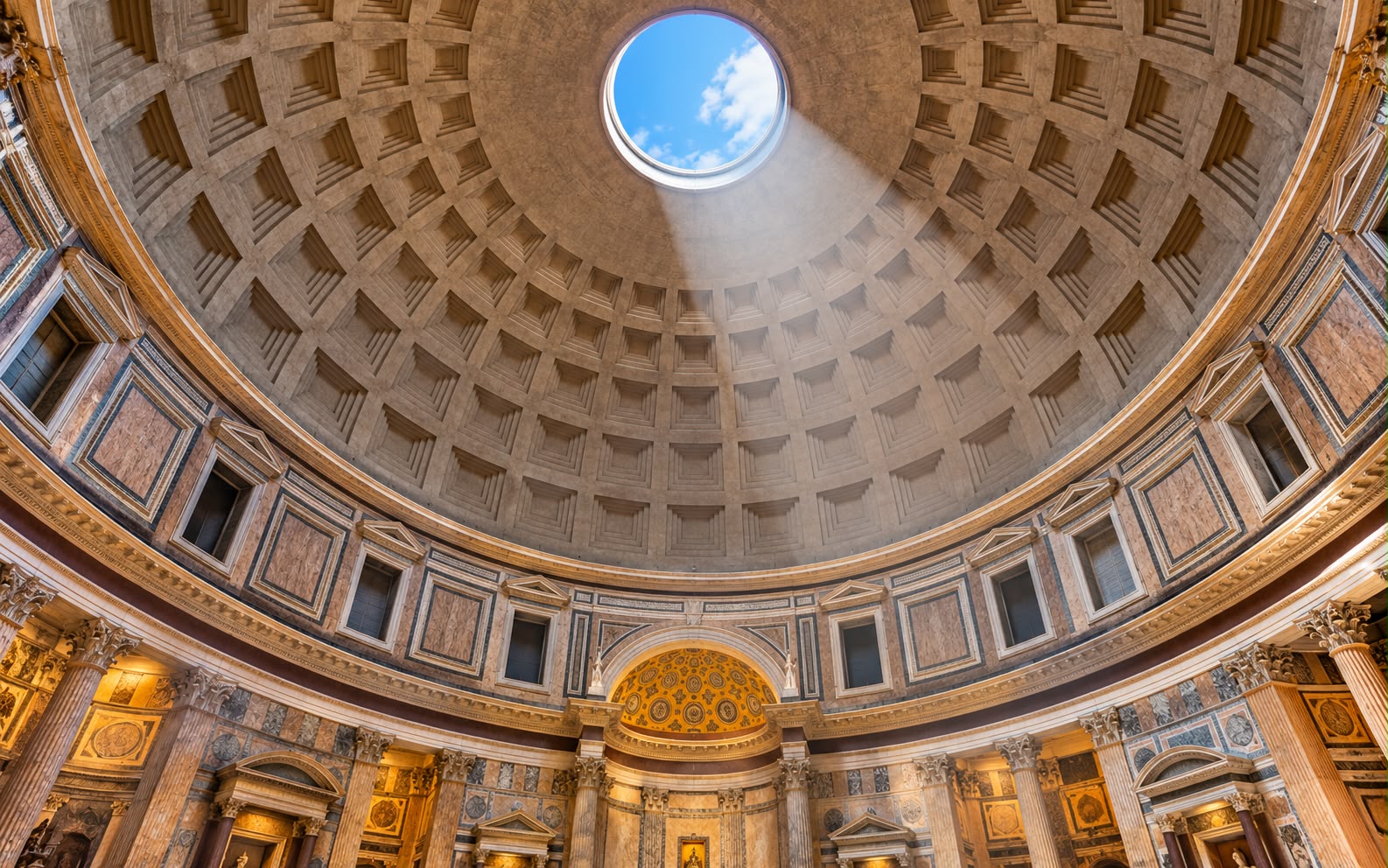
- 17:00 — The Pantheon, now ticketed: the largest unreinforced concrete dome ever built, and nearly two thousand years old. The oculus is open to the sky and the floor still drains.
- 19:00 — Trevi and the Spanish Steps, late, when the day crowds have gone.
Day 3 — Borghese, and Trastevere
- 09:00 — The Borghese Gallery, booked weeks out — entry is by two-hour slot and they do sell out. Bernini’s Apollo and Daphne and The Rape of Proserpina are here, and the marble does things marble should not do.
- 11:30 — The Villa Borghese gardens afterwards, and the Pincio terrace over Piazza del Popolo.
- 14:00 — Lunch, and the four Roman pastas — carbonara, cacio e pepe, amatriciana, gricia. None of them has cream in it, and a place that puts cream in a carbonara is telling you what it thinks of you.
- 17:00 — Trastevere on foot: the oldest quarter, narrow lanes, and Santa Maria in Trastevere, whose gold mosaics date from the twelfth century.
- 20:30 — Dinner there.
Day 4 — North to Florence
- 08:00 — The train, 1h35. Go early so day four is whole — the fast trains run every half hour and the early ones are cheapest.
- 11:00 — The Duomo complex. The dome climb is 463 steps and must be booked; Giotto’s campanile needs no booking and puts the dome in your photograph instead, which is the better picture.
- 14:30 — The Accademia, booked, for the David — at 5.17m it is larger than the photographs suggest, and the unfinished Prisoners in the corridor leading to it are the better sculpture.
- 17:00 — The Bargello, half-empty and holding Donatello’s David, the first free-standing nude cast since antiquity.
- 19:30 — Oltrarno for dinner and the artisan workshops, across the river and away from the crowds.
Day 5 — The Uffizi, and out
- 08:15 — The Uffizi at opening, booked: Botticelli, Leonardo, Caravaggio, in a corridor built so the Medici could walk from the palace to the government without touching the street.
- 12:00 — San Lorenzo market for lunch and leather.
- 17:00 — Piazzale Michelangelo at sunset, over the river, for the whole city with the dome in the middle of it.
- Back to Rome for the flight, 1h35, or fly out of Florence or Pisa if the schedule suits.
Costs and practicalities
Best time to visit
- April to early June, September to October — warm, long days, busy rather than impassable.
- July–August — 35°C and more, uncomfortable at midday, and many restaurants shut for ferragosto in mid-August.
- November–March — cold, often wet, much cheaper, and the museums are a pleasure rather than an endurance.
- Easter and the first week of May are extremely busy.
Travel tips
- Book museums the day tickets open, not the week before.
- Book the train two to three months out.
- High-speed tickets need no validation; regional ones do, and the fine is real.
- Budget the tourist tax, in cash, per person per night.
- Shoulders and knees covered for St Peter’s and the Duomo — enforced at both.
- Rome’s street fountains are cold and drinkable; carry a bottle.
- Eat away from the main squares. Two streets back halves the price and doubles the quality.
What this trip actually costs
Two people, 4 nights, mid-range comfort, international flights excluded:
| Item | Cost |
|---|---|
| Hotels, 4 nights | EUR 780 (≈ AED 3,194) |
| Food and drink, 5 days | EUR 540 (≈ AED 2,211) |
| Museums, galleries and timed entries | EUR 400 (≈ AED 1,638) |
| Trains and airport transfers | EUR 220 (≈ AED 901) |
| Metro, buses and tourist tax | EUR 60 (≈ AED 246) |
| Total for two | EUR 2,000 (≈ AED 8,189) |
- Roughly EUR 1,000 (≈ AED 4,095) per person. Museum entries are a bigger share here than on a longer trip — you are doing the expensive ones and few of the free ones.
- Late train booking is the easiest overspend, at three to four times the advance fare.
- Hotel picks here are chosen on location, not on commission — always check prices and recent reviews before booking.
What to pack
- Broken-in shoes for cobbles and marble.
- Shoulders and knees covered for the churches.
- A refillable bottle.
- A light waterproof.
- A Type C/F/L adapter.
FAQ
Can I add Venice to five days? You can, and you will spend three mornings on trains. Seven days is where the third city stops costing you the first two.
Which should I drop if I only have four days? Florence. Rome needs three nights minimum and a day trip to Florence from Rome is possible but leaves you four hours there.
Do I really need to book the Borghese in advance? Yes — it admits a fixed number every two hours and is routinely sold out weeks ahead. It is the single most booking-sensitive museum in Rome.
Is the Rome–Florence train worth booking first class? Not especially. Second class on a Frecciarossa is comfortable and the journey is ninety minutes.
Is five days enough to see Rome? Three nights covers the Colosseum, the Vatican, the Borghese and the centre on foot. It does not cover Ostia Antica, the catacombs or the Appian Way.
Prices and entry rules change, and what you need depends on your passport; last checked 26 October 2026, so confirm with the embassy or your airline before booking.


