 The Itinerary
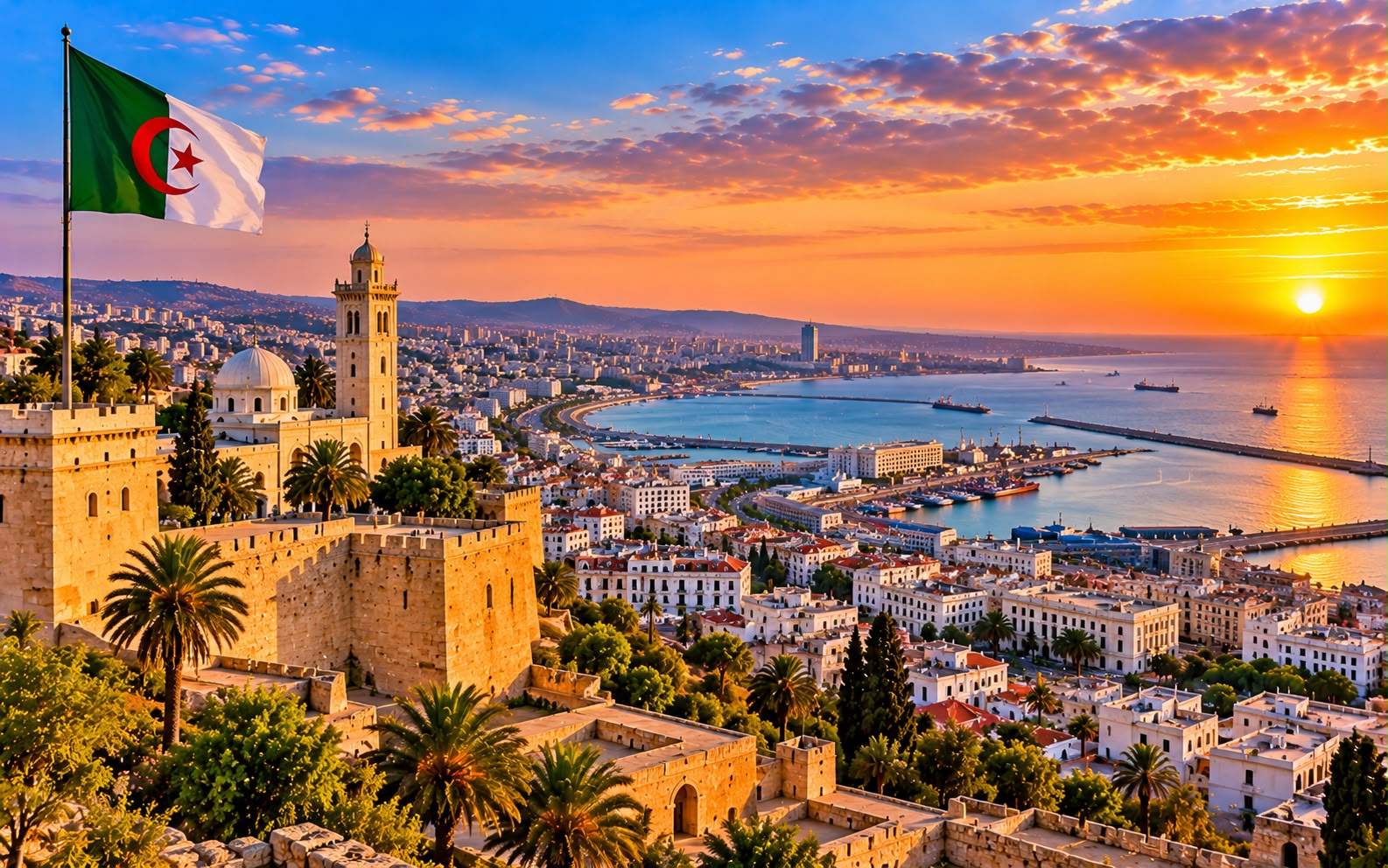
Algeria in 8 days: Roman cities, the Casbah and the M'zab valley
Africa's largest country holds Roman towns more complete than anything in Italy, a UNESCO casbah above the Mediterranean, and five fortified desert towns built by a breakaway Islamic sect a thousand years ago — behind a visa process and a cash economy that both need understanding first.
- North Africa
- 8 days
- ≈ AED 3,250 / person
- The best-preserved Roman cities in Africa, almost entirely to yourself
Before you go
Algeria is the largest country in Africa, holds some of the finest Roman remains anywhere, and receives a tiny fraction of the visitors Morocco or Tunisia do. The ruins are emptier than they have any right to be, and the reason is not the sights. It is that getting in takes planning.
Timgad is the headline. A colony founded by Trajan around 100 CE for retired legionaries, laid out on a perfect grid on a plain below the Aurès mountains, abandoned, and buried by sand that preserved it. The streets still show cart ruts. A triumphal arch still stands. It is routinely called the Pompeii of Africa and the comparison is not generous — it is accurate.
Djémila, higher up in the mountains, is the one people who know the country prefer: a town that had to bend its Roman grid to fit a ridge, with a forum, two theatres and a set of mosaics in situ, and a setting that Timgad’s plain cannot match.
Algiers stacks white up a slope above the bay, and the Casbah above it — on the UNESCO list — is a dense Ottoman labyrinth of stairways and courtyard houses. Down the hill is grand nineteenth-century French building on a scale that surprises people.
And the M’zab valley at Ghardaïa is unlike anywhere else: five fortified towns built from the eleventh century by the Ibadi, an austere Islamic sect who withdrew into the desert, each stacked in concentric rings around a mosque that doubles as a fortress. Le Corbusier studied them.
Eight days covers the north and the M’zab. Figure USD 880 (≈ AED 3,232) per person excluding flights. Go March–May or September–November; summer inland is brutal.
Before you go: the 15-minute admin
The visa, which is the hard part
- Most nationalities need a visa in advance, and it is not a formality. Expect to supply a hotel booking or an invitation, sometimes a tourist agency voucher, and to allow several weeks.
- Apply to the Algerian consulate covering where you live. Requirements vary noticeably between consulates, so read your own one’s list rather than a general account.
- Working with a local agency makes this far easier. They issue the voucher, and many handle the paperwork as part of the trip. This is the normal way visitors come.
- There is a separate, simpler route for the Sahara. Visa on arrival has been available for tourists flying into the southern airports — Djanet and Tamanrasset — when booked through an approved Algerian agency. It applies to desert trips, not to this northern itinerary. Confirm the current terms with an agency before counting on it.
- Allow much more lead time than you would for a European trip. This is the step that decides whether the holiday happens.
Current advice, and the areas it names
- Read your own government’s travel advice before booking. Algeria’s is strongly area-specific and the north, where this itinerary goes, is treated very differently from the borders.
- The areas normally named are the border regions with Libya, Mali, Niger and Mauritania, parts of the deep Sahara, and sometimes the mountains east of Algiers.
- Travel in the Sahara requires an authorised guide, and in places a police escort, which the agencies arrange as routine.
- Expect police checkpoints on intercity roads and occasional escorts between provinces. It is normal, it is not aimed at you, and your driver will handle it.
Money, and the two exchange rates
- The Algerian dinar (DZD), which cannot be bought or sold outside the country and cannot be taken out in any quantity.
- Bring euros in cash. This is a cash economy — foreign cards work in very few places and ATMs will not reliably serve them.
- There is an official bank rate and a widely used parallel rate, and the gap between them is large enough to change what the trip costs. Everyone uses the second; ask your hotel or agency how, rather than approaching strangers.
- Declare foreign currency on arrival above the threshold on the customs form, and keep the slip. It matters on the way out.
- Change only what you will spend. Converting dinars back is difficult.
SIM and data
- Djezzy, Ooredoo and Mobilis sell tourist SIMs; you need your passport. Cheap and easy once you have one.
- Coverage is good across the north and along the main desert roads.
Getting around
- Domestic flights link Algiers with Constantine, Annaba, Ghardaïa and the south, and they save whole days. Air Algérie and Tassili.
- A car with a driver is how most visitors cover the Roman sites — the sites are rural, signage is thin, and Arabic or French is needed at every checkpoint.
- Trains run Algiers–Constantine and along the coast, and are comfortable and slow.
- Self-driving is possible and not recommended for a first visit, mainly because of the checkpoints and the paperwork around them.
Language and etiquette
- Arabic and Tamazight are official; French is very widely spoken and is the practical second language for a visitor. English is limited.
- Dress modestly, particularly away from Algiers. Shoulders and knees covered for everyone.
- Alcohol is legal but not prominent — sold in a few licensed places in the cities, and essentially absent elsewhere.
- Ask before photographing people, and do not photograph police, military or airports.
Travelling with kids?
- The Roman sites are vast, unfenced and completely unshaded — a hat, water and an early start matter more than anything else.
- Distances between sites are long. Domestic flights help.
- Algerians are warm with children to a degree that can surprise visitors.
Day by day
Day 1 — Algiers
- Afternoon — Arrive, into the city in about 40 minutes.
- 16:00 — The Martyrs’ Memorial (Maqam Echahid), three concrete palm fronds on the hill above the bay, for the view over the whole city and a first sense of the shape of it.
- 17:30 — Down to the Grande Poste and the French colonial quarter around it — arcaded boulevards built to outdo Marseille, in white, above the sea.
- 19:30 — Dinner, and a walk on the seafront.
Where to stay in Algiers (three nights across the trip)
- Mid-range: the centre around the Grande Poste — walkable to the Casbah and the museums.
- Value: the streets above Audin, a short way up the hill.
Day 2 — The Casbah, and Tipasa
- 09:00 — The Casbah of Algiers. A UNESCO site and a living neighbourhood: Ottoman houses, courtyard palaces, mosques and stairways so steep they are effectively ladders. Take a local guide — it is a maze, parts of it are fragile and shored up, and a guide turns it from a walk into the best morning of the trip.
- 12:00 — The Bardo Museum or the Museum of Antiquities, depending on opening.
- 14:00 — Drive west to Tipasa, about an hour. A Roman port on the Mediterranean, UNESCO-listed, where the basilicas and the baths run right to the edge of the rock above the water. Camus wrote about the place and it is easy to see why.
- 17:00 — The Royal Mausoleum of Mauretania nearby, a stone drum on a hilltop, and back to Algiers.
Day 3 — East to Sétif and Djémila
- 08:00 — East, by road or by the morning train, into the high plains.
- 12:00 — Sétif, and in its museum the mosaic of the Triumph of Dionysus, which is the finest thing of its kind in the country.
- 14:30 — Djémila, 50 kilometres further, at 900 metres with mountains behind it. The old forum, the Severan extension that had to follow the contour, the Arch of Caracalla, the theatre cut into the slope, and a museum of mosaics lifted from the houses. Allow three hours and stay for the light.
- 18:00 — To Constantine, about two hours.
Day 4 — Constantine
- 09:00 — Constantine stands on a rock split by the Rhumel gorge, and the city crosses its own ravine on a series of bridges — one of them, the Sidi M’Cid, hangs 175 metres above the river. Walking them is the point of the city.
- 11:30 — The Palace of Ahmed Bey, a nineteenth- century courtyard palace with painted walls, and the Emir Abdelkader Mosque.
- 14:00 — The Casbah and the old quarter, and lunch.
- 16:00 — If there is energy, the Monument aux Morts on the far rim for the view back at the whole improbable arrangement.
Day 5 — Timgad
- 08:00 — South to Batna, then Timgad, about two hours.
- 10:00 — Timgad. Trajan’s colony of 100 CE, laid out as a perfect square grid for retired soldiers of the Third Augustan Legion, then expanded past its own walls. The Arch of Trajan, a 3,500-seat theatre, a library, fourteen sets of baths, and streets where the cart ruts are still cut into the paving. It is enormous; allow three or four hours, and there will be almost nobody else there.
- 14:30 — The museum on site for the mosaics.
- 16:00 — Back to Constantine, or on to Batna for the night if you want the Aurès mountains in the morning.
Day 6 — To Ghardaïa and the M’zab
- Morning — Fly from Constantine or Algiers to Ghardaïa. The road is long; the flight is an hour and worth it.
- 14:00 — First look at the M’zab valley: five towns founded from 1012 by the Ibadi, a puritan Islamic community who left the north and built in the desert. Each is a cone of houses stacked around a minaret, with a walled palm grove below for the summer.
- 16:30 — Beni Isguen, the most conservative of the five, is entered only with a local guide and keeps its own rules — no photography of people, modest dress strictly, and the gates shut at dusk. Its afternoon auction in the square has run for centuries.
Where to stay in Ghardaïa (two nights)
- Mid-range: the hotels near the Ghardaïa market, within reach of all five towns.
- Character: a restored house in one of the palm groves, which is the better memory.
Day 7 — The five towns
- 09:00 — Ghardaïa itself: the arcaded market square and the pyramid-minaret above it.
- 11:00 — Melika on its ridge and the cemetery of Sidi Aïssa, then Bounoura.
- 14:00 — El Atteuf, the oldest of the five, and the small mosque of Sidi Brahim, whose plain curved forms Le Corbusier came to study and borrowed from.
- 16:30 — Out to the palm groves at the end of the day, when the valley is at its best.
Day 8 — Back to Algiers, and out
- Morning — Fly north.
- Afternoon — Any last museum, and the airport. Remember the currency declaration you filled in on arrival.
The Sahara is a separate trip. Tassili n’Ajjer — sandstone pinnacles with fifteen thousand prehistoric paintings and engravings among them — and the Hoggar mountains around Tamanrasset are both extraordinary and both need a week of their own, an agency, and the southern visa route described above.
Costs and practicalities
Best time to visit
March–May and September–November. The country is effectively two climates and both rule out the same months: the coast is Mediterranean and pleasant, while the Sahara south of the Atlas is simply not survivable in July and August.
- March–May — almond and citrus in the Tell, and the last comfortable desert weeks.
- June–August — the coast is hot and busy with returning Algerians; the Sahara is closed in practice, with daytime temperatures above 45°C.
- September–November — the best desert window opens again and the Roman sites are empty.
- December–February — cold and wet in the north, snow on the Atlas, and cold desert nights that surprise people.
Ramadan reshapes the day across the whole country: restaurants shut until sunset, hours shorten, and intercity transport thins out.
Travel tips
- You cannot travel independently to the Sahara. The desert wilayas require an accredited agency and a permit, and the police check both.
- Bring euros in cash. Cards are close to useless outside a few Algiers hotels, and there is no practical way to draw money on a foreign card.
- French is the working second language, far more useful than English. Arabic and Tamazight are the first ones.
- Police checkpoints are frequent and routine. Carry your passport and the agency’s paperwork; let the guide speak.
- Do not photograph military, police, ports, airports or government buildings. The Roman sites are fine.
- Alcohol exists but is discreet. Do not expect it outside licensed hotels, and do not carry it around.
- Fridays are the weekend, with Saturday. Museums and offices close Friday, not Sunday.
What this trip actually costs
Two people, 7 nights, mid-range comfort, flights excluded:
| Item | Cost |
|---|---|
| Hotels, 7 nights | USD 560 (≈ AED 2,057) |
| Car with driver and domestic flights | USD 600 (≈ AED 2,204) |
| Food and drink, 8 days | USD 240 (≈ AED 881) |
| Site entries and local guides | USD 160 (≈ AED 588) |
| Agency and visa support | USD 200 (≈ AED 735) |
| Total for two | USD 1,760 (≈ AED 6,464) |
- Roughly USD 880 (≈ AED 3,232) per person. Food and site entries are very cheap; the driver and the agency are what you pay for, and both are what make the trip work.
- The exchange rate you use changes this materially. Budget on the rate you will actually get, not the bank’s.
- Site entry fees are a few hundred dinars — Timgad and Djémila together cost less than a meal.
- Local guides at the Casbah and Beni Isguen are compulsory in practice and cheap. Take them.
- Hotel picks here are chosen on location, not on commission — always check prices and recent reviews before booking.
What to pack
- Euros in cash, more than you think, and the customs declaration kept safe.
- A hat, sunglasses and serious sun protection. Timgad and Djémila have no shade at all.
- Modest clothing, and more of it than for Morocco or Tunisia.
- Walking shoes for the Casbah’s stairs and the ruins’ broken paving.
- A warm layer — Djémila is at 900 metres and the M’zab is desert, so the nights are cold.
FAQ
Is Algeria safe for tourists? The northern cities and the Roman sites are routinely visited without difficulty, and the hospitality is remarkable. The advice to read is area-specific: borders and deep desert are treated very differently from Algiers or Constantine. Check your own government’s current position before you book.
Can I travel independently? You can, but almost nobody does, and the visa process pushes you towards an agency anyway. A driver removes the checkpoints, the language and the navigation in one go.
Are the Roman sites really better than in Italy? Timgad and Djémila are more complete than almost anything comparable, because they were abandoned rather than built over. What they lack is crowds, which is the point.
Can I use my credit card? Essentially no. Bring euros in cash and change them locally.
How long before I travel should I apply for the visa? Start two to three months out. Consulate requirements differ and the paperwork is the part that slips.
Prices and entry rules change, and what you need depends on your passport; last checked 8 October 2026, so confirm with the embassy or your airline before booking.


