 The Itinerary
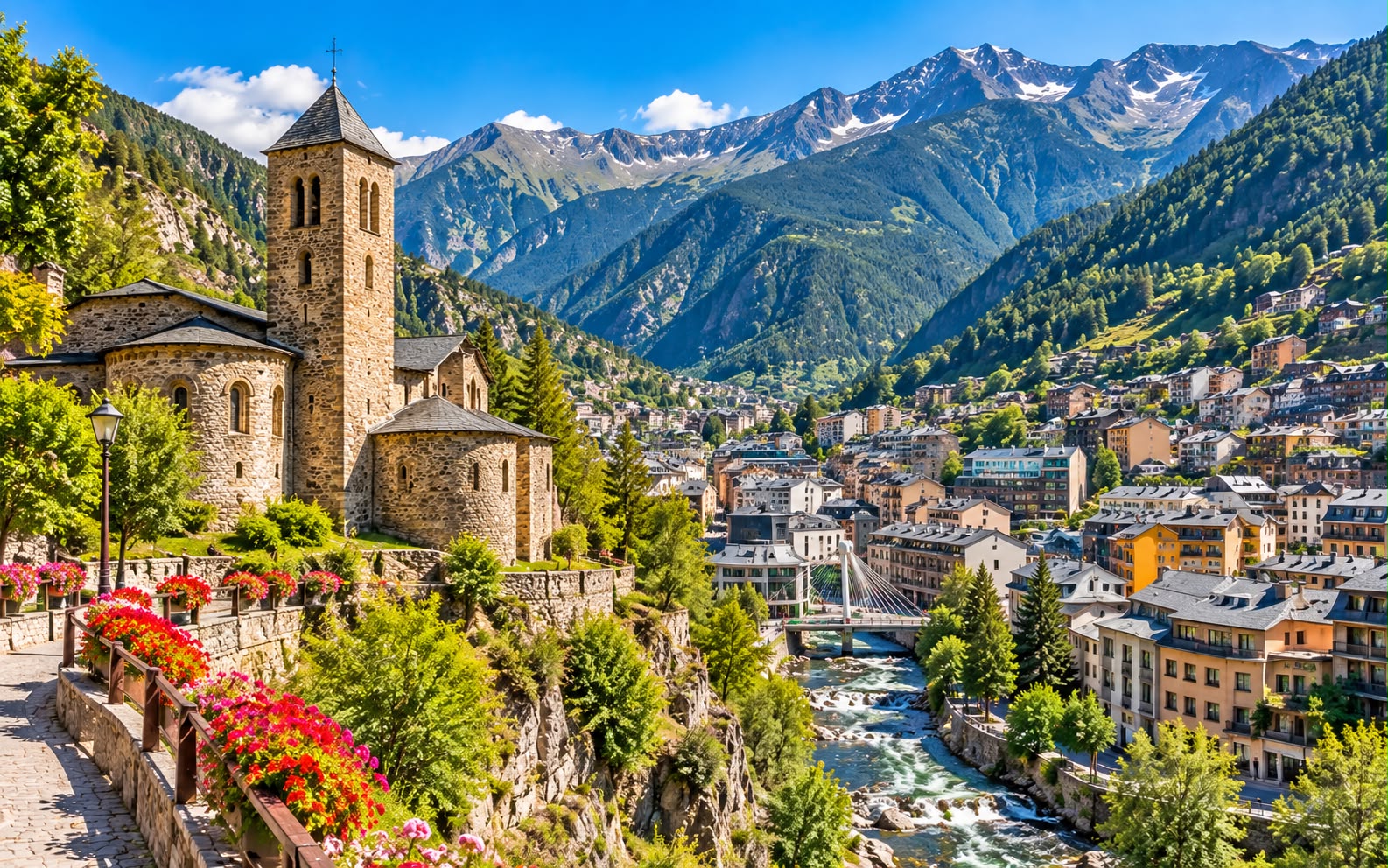
Andorra in 4 days: the Pyrenees, Romanesque churches and Europe's highest capital
A country of 468 square kilometres with no airport, no railway, two heads of state who have never both lived there, a UNESCO glacial valley covering a tenth of the land, and the visa rule that catches people out — because the one you need is not Andorra's.
- Southern Europe
- 4 days
- ≈ AED 1,750 / person
- Mountains without the Alpine price, and a country run by two princes
Before you go
Andorra is a co-principality in the Pyrenees, jointly headed by the President of France and a Spanish bishop, an arrangement settled in 1278 and never seriously revisited. It has no airport, no railway and no army. It is 468 square kilometres, most of it vertical.
Andorra la Vella sits at 1,023 metres, which makes it the highest capital in Europe, and the mountains start at the end of its main street. That is the appeal: alpine scenery, a short drive from Barcelona, at noticeably less than Alpine prices.
The Madriu-Perafita-Claror valley is the serious reason to come — a glacial valley on the UNESCO list that covers around a tenth of the country, has no road into it at all, and is reached on foot from the edge of the capital. The Romanesque churches are the quiet one: Santa Coloma’s circular bell tower, Sant Joan de Caselles above Canillo, painted interiors in villages of two hundred people.
Then there is the shopping, which is why most visitors come and is not why you should. Andorra is outside the EU customs union and charges 4.5% on most goods, so the capital’s main avenue is a kilometre of electronics and perfume. It is easily ignored.
Four days does it comfortably. Figure EUR 425 (≈ AED 1,740) per person excluding flights. Go June–September for the hiking or December–March for the skiing; late April and early November are the two dead spots, when the lifts have shut and the high trails have not opened.
Before you go: the 15-minute admin
The visa you need is not Andorra’s
- Andorra has no visa requirement of its own and no passport control on either border. That sounds simple and is the thing people get wrong.
- There is no way in except through France or Spain, both of which are in the Schengen area. So if your nationality needs a Schengen visa, you need one to reach Andorra at all.
- Worse: leaving Andorra means re-entering Schengen. A single-entry Schengen visa is spent on the way in and will not get you back out. Ask for multiple entry, and say Andorra is on the itinerary when you apply.
- Andorra is not in Schengen itself, so your nights there do not count against the 90-in-180 allowance — though with no exit stamp to prove when you left, do not plan a trip that depends on that.
- Check your own case on the French or Spanish consular site, not on Andorra’s.
Getting there, because there is no airport
- From Barcelona — about three hours by direct coach from the airport or the city, several a day, around €35 each way. This is what most people do and it is easy.
- From Toulouse — about three hours, fewer departures, better if you are already in France.
- Andorra–La Seu d’Urgell airport is 20 minutes away but sits in Spain and takes only a handful of seasonal commercial flights. Do not build a trip around it.
- By car, the Spanish approach is open year-round. The French one climbs to the Port d’Envalira at 2,408 metres, the highest paved pass in the Pyrenees, which closes in bad weather — the Envalira tunnel below it is the reliable option and tolled.
- Winter driving: snow tyres or chains are required when conditions call for it, and hire cars from Spain do not always carry them. Ask before you book.
Money, and the rule on the way out
- The euro, by agreement, although Andorra is not in the EU and not in the eurozone.
- Cards everywhere. ATMs are plentiful in the capital and thin in the villages.
- Customs checks happen as you leave, not as you arrive, and they are real. There are per-person limits on alcohol, tobacco, perfume and electronics, and exceeding them means paying duty at the border.
- Not a cheap country for food and hotels — roughly Spanish prices plus a bit — but well short of Switzerland or the French Alps for the same scenery.
SIM and data
- Andorra Telecom is the only operator, and the country is outside EU roaming rules — your EU or UK bundle does not cover you here, and roaming charges can be steep.
- Turn data roaming off at the border, use hotel wifi, or buy a local tourist SIM at the bus station or airport desks.
- Coverage along the valleys is excellent and disappears entirely in Madriu, which is part of the point.
Getting around
- The national bus network is cheap, frequent and genuinely good — the country is one main valley with branches, and buses run the length of it for a couple of euros.
- A car helps for the high trailheads and the Tristaina lakes. Hire from around €45/day, and park in the underground car parks in town; street parking is scarce.
- Nowhere on this itinerary is more than 45 minutes from anywhere else.
- Ski buses run free or nearly free from the main towns to the lift stations in season.
Travelling with kids?
- Short distances, no long drives, and a lot of outdoors.
- Naturlandia has the Tobotronc, an alpine coaster that runs for more than five kilometres down through the forest and is billed as the world’s longest. Minimum heights apply.
- Caldea has a family section separate from the adult thermal areas — check which ticket you are buying, as the upper levels are adults-only.
- The Tristaina lakes circuit is about two hours and manageable for anyone who walks happily.
Day by day
Day 1 — Andorra la Vella and Escaldes
- Afternoon — Arrive by coach, check in. The capital and Escaldes-Engordany run into each other with no visible join; staying in either works.
- 16:00 — Casa de la Vall, the 16th-century house that served as the country’s parliament until 2011. Small, odd and the best single explanation of how a country run by a French president and a Spanish bishop actually works.
- 17:00 — Santa Coloma, 15 minutes’ walk or a short bus ride. Pre-Romanesque, ninth-century in parts, with a circular bell tower — unusual enough in the Pyrenees to be the thing people photograph.
- 19:00 — Caldea in Escaldes, the thermal complex fed by the hot springs the town is named after. Three hours is the standard ticket and about right. Go in the evening, when the glass spire is lit and the day trippers have gone.
Where to stay in Andorra la Vella (three nights, unpacked once)
- Mid-range: Escaldes-Engordany, walkable to Caldea and on the bus spine.
- Value: the upper streets of the capital, five minutes further out and noticeably cheaper.
Day 2 — Ordino and the north
- 09:30 — Bus or drive to Ordino, 20 minutes up the valley and the prettiest of the seven parishes.
- 10:00 — Casa d’Areny-Plandolit, the house of the family that ran Andorran iron for generations, kept as it was lived in. Then Sant Martí de la Cortinada nearby, a Romanesque church with twelfth-century frescoes and a wooden gallery.
- 12:30 — Lunch in Ordino.
- 14:00 — Up to Ordino-Arcalís at the head of the valley, and the Tristaina lakes — three glacial lakes on a circuit of about two hours, above 2,300 metres, with the French border on the ridge above. In summer a chairlift cuts the climb; out of season it is all on foot.
- 18:00 — Back down. Dinner in Ordino is better than dinner in the capital.
Day 3 — Canillo, Meritxell and the Madriu valley
- 09:00 — Sant Joan de Caselles at Canillo, the best-preserved Romanesque church in the country — a three-storey bell tower, a wooden Christ figure, and traces of the painted apse still in place.
- 10:30 — Meritxell, the national sanctuary. The medieval chapel burned down in 1972 and Ricardo Bofill built its replacement beside the ruin; the two standing together are more interesting than either alone.
- 13:00 — Lunch back in Escaldes.
- 14:30 — The Madriu-Perafita-Claror valley. The trailhead is a twenty-minute walk from the middle of Escaldes, and within half an hour the road noise is gone and there is nothing ahead but a glacial valley with stone shepherds’ huts in it. There is no road in, at all — which is why it is on the UNESCO list.
- A full traverse is a serious multi-day walk. Up to the Entremesaigües hut and back is three or four hours and gives you the valley without the commitment. Take water; there is nothing to buy up there.
Day 4 — Leave
- Morning — Last coffee, and the duty-free run if you are doing one. Remember the limits — the check is on the way out.
- Midday — Coach to Barcelona or Toulouse, about three hours. Build in margin: one road in each direction, and weather closes the high one.
Costs and practicalities
Best time to visit
June–September for walking and December–March for skiing, and those are genuinely the only two seasons — the shoulder weeks in between are when lifts and high refuges are shut and the valley has little to offer.
- December–March — Grandvalira and Vallnord running, best snow usually February.
- April–May — the quiet gap. Lifts closed, high trails still under snow.
- June–September — the Madriu valley and the GR routes at their best, wildflowers in June, warm and clear through September.
- October–November — the second gap, with autumn colour in the lower valleys and most mountain refuges closed.
Travel tips
- There is no airport. Everyone arrives by road from Barcelona (about three hours) or Toulouse; the direct bus is far simpler than driving.
- Andorra is not in the EU or Schengen, so there is a customs check on the way out. Duty-free allowances are real and enforced — this is why the bus queue is long on Sunday evenings.
- It uses the euro without being in the eurozone. Cards work everywhere.
- Winter tyres or chains are a legal requirement on mountain roads from November, and hire cars do not always come with them.
- Petrol, alcohol, tobacco and electronics are the reason half the traffic exists — duty is low, which is also why the border queue is.
- Catalan is the official language; Spanish is universal, French common, English widely spoken in tourism.
- The Madriu-Perafita-Claror valley is UNESCO-listed and has no road. Walking in is the only way, and it is the best thing here.
What this trip actually costs
Two people, 3 nights, mid-range comfort, flights excluded:
| Item | Cost |
|---|---|
| Hotels, 3 nights | EUR 270 (≈ AED 1,106) |
| Coach from Barcelona, return, two | EUR 120 (≈ AED 491) |
| Buses and taxis in-country | EUR 60 (≈ AED 246) |
| Car hire, 1 day + fuel | EUR 70 (≈ AED 287) |
| Food and drink, 4 days | EUR 220 (≈ AED 901) |
| Caldea, two adults | EUR 80 (≈ AED 328) |
| Museums, churches, sanctuary | EUR 30 (≈ AED 123) |
| Total for two | EUR 850 (≈ AED 3,480) |
- Roughly EUR 425 (≈ AED 1,740) per person. The mountains are the free part; the hotels are what you pay for.
- Skiing changes this completely. A lift pass at Grandvalira plus hire runs €60–80 per person per day, and February rooms cost roughly double July’s.
- Drop the car if you are not doing Tristaina — the buses reach everything else on this list.
- Hotel picks here are chosen on location, not on commission — always check prices and recent reviews before booking.
What to pack
- Proper walking shoes. Madriu and Tristaina are mountain paths, not promenades.
- A warm layer even in August. You will be above 2,000 metres on two of these days and it is a different country up there.
- Sun protection. Thin air, high sun, and snow glare in winter.
- Something for the churches — shoulders covered, and they are often locked outside service times, so check opening hours rather than turning up.
FAQ
Is Andorra in the EU? No. It is in a customs union with the EU for manufactured goods, uses the euro by agreement, and sits outside both the EU and Schengen. That combination is why the shopping is cheap, the customs check is on the way out, and your phone roaming does not work.
Do I need a car? Not for this itinerary. The buses are cheap and frequent along the main valley. One day of hire is useful for the high trailheads and nothing else.
Is it worth going if I do not ski? Yes — arguably more so. Summer gives you the UNESCO valley, the lake circuits and the Romanesque churches with nobody else in them, at half the winter room rate.
What language do they speak? Catalan is the only official language, and Andorra is the only country where that is true. Spanish, French and Portuguese are all widely spoken, and English is fine in hotels and less so in the villages.
How long do I actually need? Four days is comfortable. Three works if you skip either Ordino or Madriu. A day trip from Barcelona is six hours of coach for three hours of shopping, and is not worth it.
Prices and entry rules change, and what you need depends on your passport; last checked 8 October 2026, so confirm with the embassy or your airline before booking.


