 The Itinerary
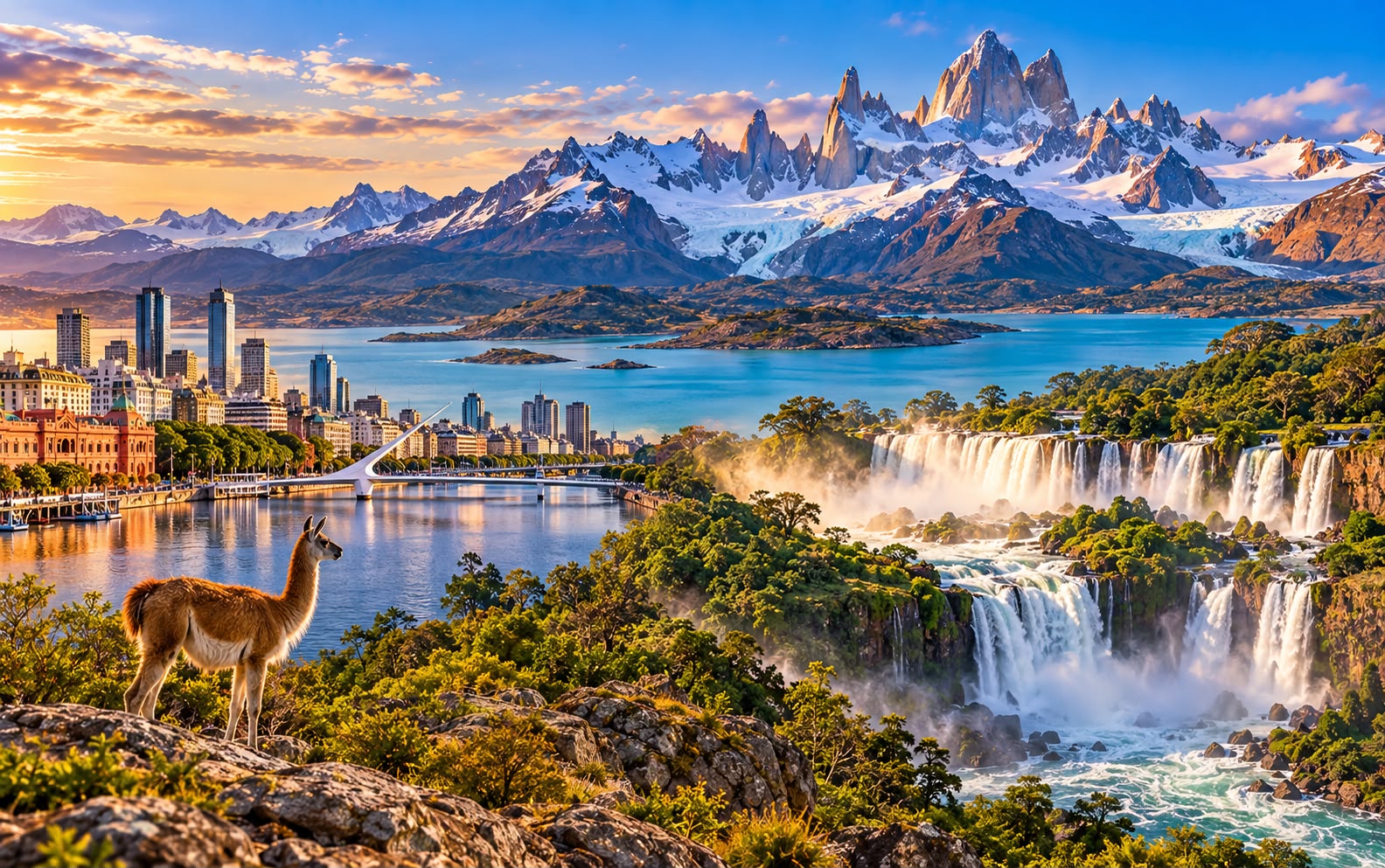
Argentina in 12 days: Buenos Aires, Iguazú and Patagonia
A country so long it holds subtropical waterfalls and Patagonian ice in the same trip: Buenos Aires' European boulevards and steak, the thunder of Iguazú from both sides, a glacier you watch calve into a lake, and the granite spires of Fitz Roy — with the internal-flight planning and the currency reality that make or break the budget.
- Southern Cone
- 12 days
- ≈ AED 9,550 / person
- Cities + glaciers
Before you go
Argentina is 3,700 km from top to bottom, and that is the planning problem in one sentence. You cannot drive this trip. What you can do is fly three times and see three completely different countries: a European capital that eats late and dances later, subtropical rainforest with the largest waterfall system on earth, and Patagonia, where the ice comes down to the water.
Buenos Aires first, for the steak, the bookshops and a tango scene that survives the tourist version. Iguazú next, seen from the Argentine side where you walk out over the falls. Then south to El Calafate for the Perito Moreno glacier, and El Chaltén, which exists purely because people wanted to walk to Fitz Roy.
Twelve days is the minimum that does not feel like a series of airports.
Before you go: flights, money and the seasons
Entry, and the season that flips
- Most nationalities enter visa-free for 90 days — the EU, UK, US, Canada, Australia and most of Latin America. Check your own case; Argentina has changed its reciprocity arrangements before.
- The seasons are inverted. Patagonia’s usable window is November to March, its summer. Outside that, El Chaltén’s trails and much of the infrastructure shut, daylight collapses and the wind becomes genuinely dangerous.
- December to February is peak: best weather, busiest trails, highest prices, and accommodation in El Chaltén booked months out.
- Iguazú is subtropical and works year-round, hot and humid in summer, pleasant in the shoulder months.
- The practical answer for most people is March or November — Patagonia still open, crowds thinner, prices lower.
The money situation, honestly
- Argentina’s currency is unstable, and that is not a criticism, it is a planning fact. Inflation has run high for years and the peso moves fast enough that a figure printed today may be wrong in a month. This guide budgets in US dollars for that reason.
- Bring US dollars in cash, in clean large notes. They remain the most useful thing in your bag, and many tourist businesses quote in them directly.
- Card payments have historically settled at a tourist-favourable rate, but the rules here have changed repeatedly. Check the current position close to travel rather than trusting any guide, including this one.
- Never change money on the street. Use your hotel, a formal exchange house, or your card.
- Prices in pesos will look enormous. Fix a conversion on arrival and re-check it mid-trip.
Internal flights are the itinerary
- Three flights make this trip: Buenos Aires → Iguazú → Buenos Aires → El Calafate, then home from El Calafate or back via Buenos Aires.
- Buenos Aires has two airports. Most domestic flights use the city one, Aeroparque (AEP); most international ones use Ezeiza (EZE), 45 km away. Connections between them need at least three hours, and ideally a night.
- Book domestic flights early. Prices rise steeply and Patagonian routes fill in the summer.
- El Calafate → El Chaltén is a three-hour bus, comfortable and frequent. No flight needed.
Meals, and the clock
- Argentina eats late. Restaurants fill at 22:00 and some do not open until 20:30. Arriving at 19:00 means eating alone.
- The steak is the real thing, and a parrilla is the place for it. Order it jugoso (rare) or expect well done.
- Lunch menus (menú del día) are the cheap way to eat well.
- Tipping is around 10% and often cash only.
Day by day
Day 1 — Land in Buenos Aires
- 10:00 — Land at Ezeiza (EZE), 35 km out — an hour into town, more at rush hour. Use the official remise desk or a pre-booked car; the touts outside arrivals are not worth it.
- 11:30 — Sleep in Palermo for the restaurants and parks, or Recoleta for the grand streets. Both are safe to walk at night, which is the deciding factor.
- 13:00 — Change money. The exchange situation here changes constantly, so ask your hotel what today’s arrangement is rather than trusting anything written more than a month ago. Bring clean USD notes.
- 15:00 — Walk. Plaza Serrano and the Palermo Soho blocks, or the Bosques de Palermo if you need grass and air.
- 19:00 — A first drink. Nobody eats before nine.
- 21:30 — Dinner, late, and let the jet lag sort itself out against a city that does everything two hours after you would.
Day 2 — The city’s two halves
- 10:00 — Recoleta Cemetery: 4,700 mausoleums laid out in streets, marble and cracked glass and cats, with Evita in the Duarte family vault. The free map at the gate matters; people lose an hour looking for her.
- 12:00 — The Floralis Genérica sculpture and the Museo Nacional de Bellas Artes, free and strong on Argentine painters.
- 13:30 — Lunch in Recoleta.
- 15:30 — San Telmo: cobbles, antique shops and the Mercado de San Telmo for a sandwich at the counter. On Sundays the whole of Defensa becomes a street market and the neighbourhood is at its best.
- 17:30 — Plaza de Mayo: the Casa Rosada, the Cabildo, and the white headscarves painted on the paving for the Madres de Plaza de Mayo, who have circled here every Thursday since 1977.
- 21:30 — A parrilla, properly. Order bife de chorizo or ojo de bife, ask for jugoso if you want it pink, and let the Malbec happen.
Day 3 — Tango, books and football
- 10:00 — El Ateneo Grand Splendid, a 1919 opera house turned bookshop — the stalls are shelves, the boxes are reading nooks, and the stage is a café. Fifteen minutes, and it earns the fuss.
- 11:30 — La Boca: the painted corrugated houses of Caminito are a film set with prices to match. Go, look, take the photograph, and leave within the hour — and stay on the tourist streets, because the surrounding barrio is not one to wander.
- 13:30 — Lunch back in the centre.
- 15:00 — La Bombonera stadium tour, or El Monumental for River. If there is a match and you can get a seat through a reputable agency, that is the better use of the afternoon by some margin.
- 18:00 — Rest.
- 22:00 — Tango. The dinner shows are competent and for visitors. A milonga — La Catedral, Salón Canning — is where people actually dance, starts late, and will happily let you sit at the edge and watch all night.
Day 4 — Fly north to Iguazú
- 08:00 — Fly from Aeroparque (AEP), the city airport, not Ezeiza — two hours to Puerto Iguazú.
- 10:30 — Land into heat and humidity that Buenos Aires did not prepare you for. This is subtropical rainforest.
- 12:00 — Check in, and swim if there is a pool.
- 15:00 — Hito Tres Fronteras, the obelisk where Argentina, Brazil and Paraguay meet across two rivers — ten minutes, and it orients you for the next two days.
- 17:00 — Buy tomorrow’s park ticket online tonight if you can; the queue at the gate can take 45 minutes.
- 19:30 — Dinner in town. Early night — the falls need the whole of tomorrow and the heat peaks at two.
Day 5 — Iguazú, the Argentine side
- 08:00 — At the gate for opening. The Argentine side holds about 80% of the falls and puts you among them rather than opposite them.
- 08:30 — The Lower Circuit first, while it is cool — 1.4 km of walkway down to the level of the water, with Salto Bossetti overhead.
- 10:30 — The Upper Circuit, along the tops of the falls.
- 12:30 — Lunch inside the park.
- 14:00 — The Ecological Train to the Garganta del Diablo — a kilometre of catwalk over flat water that ends at the edge of an 80 m horseshoe with half the river going into it. It is loud enough to feel through the boards. Expect to be soaked, and to stop caring.
- 16:30 — Isla San Martín if the river is low enough for the boat to run.
- 18:00 — Out. Coatis on the paths are not tame; they will open your bag.
Day 6 — The Brazilian side, or the jungle
- Option A — Brazil, 09:00. The Brazilian side is a single 1.2 km walkway giving the panorama: Argentina puts you in the falls, Brazil shows you their scale, and doing both is why people allow two days. Check your visa before planning this — many nationalities need one for Brazil and it is not issued at the bridge.
- Option B — the water, 09:00. The Gran Aventura boat takes you under Salto San Martín. You will be drenched to the skin; dry bags are provided and are not optional.
- Option C — the forest. The Macuco trail, 7 km return through jungle to a waterfall you can swim beneath, with toucans and capuchins and almost nobody on it.
- 17:00 — Fly back to Buenos Aires, or overnight and fly early.
Day 7 — South to Patagonia
- 09:00 — Fly Aeroparque to El Calafate, about three and a half hours. Watch out of the window: green pampa becomes brown steppe becomes ice fields, and the change is complete.
- 13:00 — Land. The town is small, treeless, extremely windy and built entirely around the glacier.
- 14:30 — Check in, then Avenida del Libertador for supplies — Patagonia is expensive and the supermarket is where you assemble tomorrow’s lunch.
- 16:30 — Laguna Nimez, a reserve on the lake edge ten minutes’ walk from town, with flamingos, black-necked swans and the Andes behind.
- 19:30 — Dinner — Patagonian lamb, cooked on a cross over embers, which is the regional dish and worth the ceremony.
- 21:00 — Book tomorrow: the park bus, and the boat if you want it.
Day 8 — Perito Moreno
- 08:00 — The bus to Parque Nacional Los Glaciares, 80 km, 90 minutes.
- 09:30 — The balconies. Perito Moreno is a 5 km wall of ice, 70 m high above the water and 170 m below it, and one of very few glaciers on earth not retreating. Seven kilometres of steel walkway take you along the face at every level.
- 10:30 — Stand still and wait. It calves without warning — a crack like artillery, then a tower of ice the size of a building goes into the lake. You will hear it before you see it, and you will miss the first three.
- 13:00 — The boat to the south face for scale, or the mini-trekking with crampons on the ice itself — five hours, booked weeks ahead in season, and the better option if you are fit.
- 17:30 — Back to El Calafate.
- 19:30 — The Glaciarium ice museum on the way in if you have the energy; better than it sounds on how the ice field works.
Day 9 — Bus to El Chaltén
- 08:00 — Three hours north by bus. Fitz Roy appears on the horizon about an hour out and does not look real.
- 11:00 — Arrive El Chaltén, founded in 1985 in a border dispute and now Argentina’s trekking capital — three streets, no ATM you should rely on, and every trail starts from the village itself. No park fee, no permits, no guide required.
- 12:00 — The ranger station briefing, which is genuinely useful on conditions.
- 14:00 — An easy first walk: Chorrillo del Salto, flat and an hour each way, or the Mirador de los Cóndores, 45 minutes up for the view over the valley.
- 18:00 — Eat early. Buy tomorrow’s food tonight — the shops are small and shut early.
- 20:00 — Check the wind forecast, which matters more than rain here and decides whether tomorrow happens.
Day 10 — Laguna de los Tres
- 06:30 — Start in the dark. The Laguna de los Tres trail is 20–22 km return, eight to ten hours, and it is the reason people come.
- 08:30 — Laguna Capri at 4 km, where Fitz Roy first fills the view. Many people stop here, and it is a complete day on its own if the weather has turned.
- 11:00 — The flat middle section through lenga forest to Poincenot camp.
- 12:00 — The last kilometre: 400 m straight up on loose scree, an hour of it, and comfortably the hardest thing on this itinerary.
- 13:00 — The lake, the granite tower directly above it, and the glacier feeding in. Eat, and get cold quickly.
- 14:00 — Down, which is harder on the knees than the climb was on the lungs.
- 17:30 — Back in the village. Beer at one of the two breweries, entirely earned.
Day 11 — El Chaltén, gentler
- 08:30 — Laguna Torre, 18 km return but almost flat — three hours out through forest to a glacial lake with Cerro Torre at the end, a spire so difficult it went unclimbed until 1974 and the first ascent is still argued about.
- 13:30 — Back, and lunch.
- 15:00 — Bus to El Calafate, three hours.
- 18:30 — Arrive. Last chance for anything you meant to buy.
- 20:30 — Last Patagonian lamb, and an early night if the flight is early.
Day 12 — Fly home
- Morning — Fly El Calafate → Aeroparque, three and a half hours.
- The connection is the risk. Domestic flights land at Aeroparque and most international flights leave from Ezeiza — two airports, 45 minutes apart in good traffic and much worse in bad. Leave four hours, or sleep in Buenos Aires and fly out the next day.
- At Ezeiza, claim the VAT refund on anything you bought with a tax free receipt before you check in, not after.
Costs and practicalities
Best time to visit
November–March, but Argentina is 3,700km long and the right month depends entirely on which part you are going to.
- Patagonia and Ushuaia — November–March only. The wind is relentless in all of them; December and January are the warmest and the busiest.
- Buenos Aires — best in spring (October–November) and autumn (March–April). January is hot, humid and half the city is away.
- Iguazú — year-round. Summer is hot and wet with the biggest flow; winter is comfortable and the falls are still enormous.
- Mendoza and the wine country — March is the harvest, with the Vendimia festival at the start of the month.
- The northwest (Salta, Jujuy) — April–October, the dry months. The summer rains wash out the Quebrada roads.
A single trip covering Patagonia and the northwest properly has no perfect month; November and March come closest.
Travel tips
- The exchange situation has normalised. Since controls were lifted in April 2025 the parallel-rate gymnastics are largely over and foreign cards get a fair rate — but check current practice before you travel, because this has changed repeatedly.
- Carry some US dollars anyway. They remain welcome and useful in smaller towns.
- Dinner starts at 9pm and often later. A restaurant at 7.30pm will be empty or shut.
- Long-distance buses are excellent. Cama and semi-cama seats recline almost flat and are a genuine alternative to flying, which is expensive domestically.
- Tipping is about 10% in restaurants and often cash, even when you pay the bill by card.
- Spanish here sounds different. ll and y are pronounced “sh”, and vos replaces tú.
- Patagonian wind is a planning factor, not weather. Secure hats, pitch tents properly, and expect ferry and flight disruption.
What this trip actually costs
Two people, 11 nights, mid-range, excluding international flights:
| Item | Cost |
|---|---|
| Hotels, 11 nights across four towns | USD 1,800 (≈ AED 6,611) |
| Domestic flights ×3 legs, two people | USD 1,300 (≈ AED 4,774) |
| Iguazú park entries, Perito Moreno, boats, buses | USD 700 (≈ AED 2,571) |
| Food and drink, 12 days | USD 1,200 (≈ AED 4,407) |
| Transfers, eSIM, extras | USD 200 (≈ AED 735) |
| Total for two | USD 5,200 (≈ AED 19,097) |
- Roughly USD 2,600 (≈ AED 9,549) per person. Internal flights are the line that decides the budget — booked late they can double.
- Patagonia is materially more expensive than the rest of the country, especially El Chaltén, where everything is trucked in.
- Eating the set lunch and one parrilla dinner rather than two keeps the food line where it is above.
What to pack
- Wind protection above all for Patagonia. It is relentless, and a windproof shell matters more than a warm coat.
- Proper hiking boots if you are doing Laguna de los Tres.
- Layers for four seasons in a day — Patagonian weather changes hourly.
- A dry bag or poncho for Iguazú. You will be soaked.
- US dollars in cash, clean and undamaged.
- Type I plugs (the Australian-style angled pins), 220V.
FAQ
Can I do this in a week? Not honestly. Cutting Iguazú makes a tidy 8-day Buenos Aires and Patagonia trip; cutting Patagonia defeats the point. Twelve days is the shape that works.
Which side of Iguazú is better? Both, for different reasons — Argentina puts you in the falls, Brazil shows their scale. If you only do one, do Argentina, which is where this itinerary is based.
Is the currency situation a problem for visitors? It is a planning complication, not a barrier. Bring dollars cash, check the current card position before you fly, and never change money on the street.
When should I go? November to March for Patagonia, and March or November if you want that window without the peak-season crowds and prices.
Prices and entry rules change, and what you need depends on your passport; last checked 8 October 2026, so confirm with the embassy or your airline before booking.


