 The Itinerary
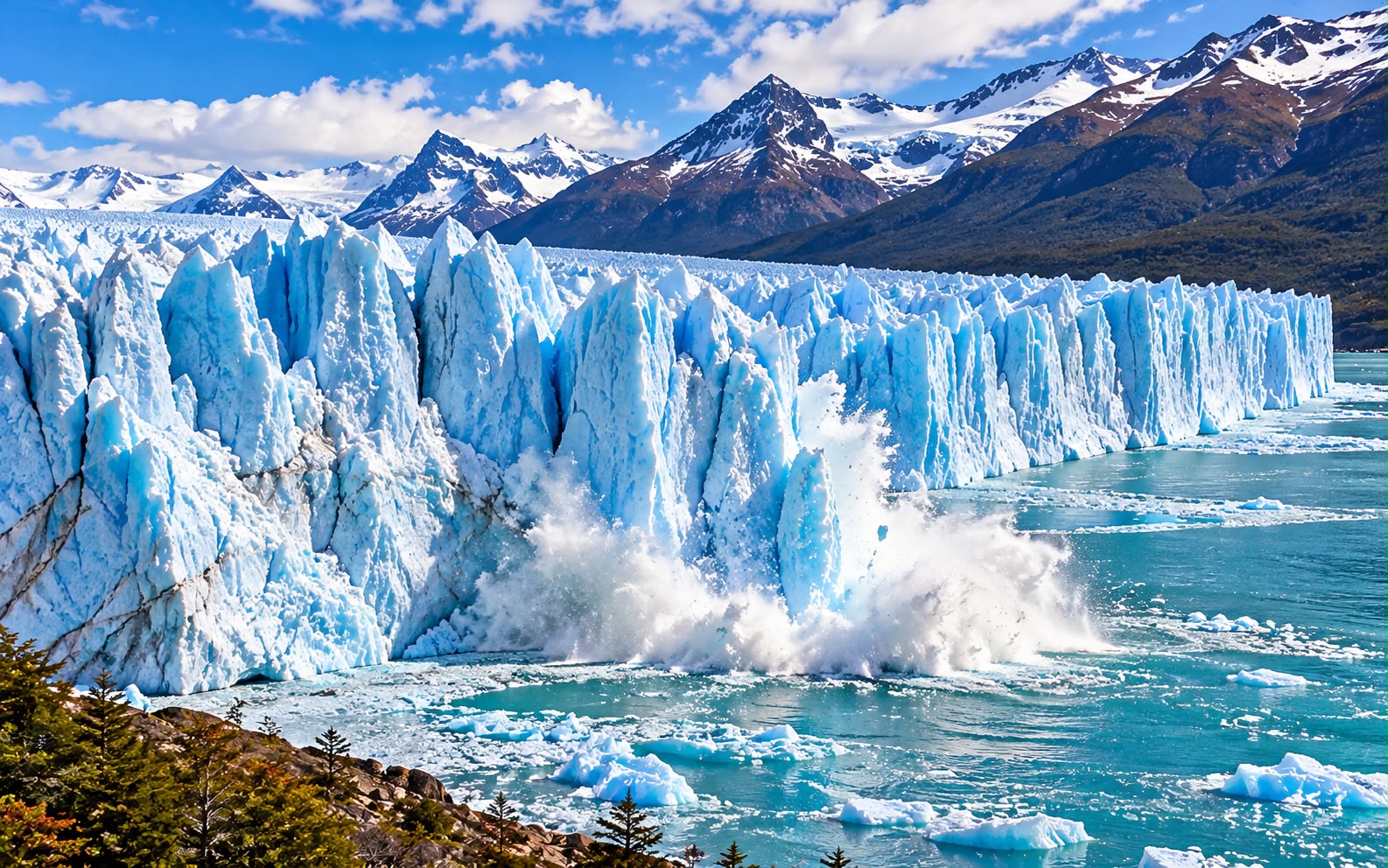
Patagonia in 13 days: Perito Moreno, Fitz Roy and Torres del Paine
A sixty-metre ice wall that breaks up with a noise like artillery, a granite spire that turns red for four minutes at dawn, and three towers above a glacial lake — split across two countries because the mountains were there first and the border came later.
- Southern Cone
- 13 days
- ≈ AED 9,900 / person
- A glacier that calves while you watch it, and the two best trekking massifs in the Americas
Before you go
Before you go: the admin
Two countries, one mountain range
- Most nationalities enter both Argentina and Chile visa-free — 90 days each.
- You will cross the border twice on this route, at Cerro Castillo / Cancha Carrera between El Calafate and Torres del Paine. It is a 20-minute formality in a hut.
- Chile’s agricultural inspection is strict and enforced. No fruit, no vegetables, no seeds, no honey, no meat, no dairy across the border. The fine is substantial and the dogs are good. Eat the apple before the queue.
- Both need six months’ passport validity.
Flights, and the shape of the route
- Fly into El Calafate and out of Punta Arenas, which is the efficient direction and saves a long backtrack. Both connect through Buenos Aires or Santiago.
- Buenos Aires has two airports and the Patagonia flights usually go from Aeroparque (AEP) while the international arrivals land at Ezeiza (EZE). Allow four hours and a taxi between them — this is the single most common missed connection on the route.
- The road legs are long and scenic: El Calafate to El Chaltén is three hours, El Calafate to Puerto Natales five including the border, Puerto Natales to the park two.
- Buses are the normal way to do this and are comfortable, frequent and far cheaper than hiring.
Money
- Argentine pesos and Chilean pesos, neither usable in the other and both with a lot of zeros.
- Argentina’s exchange situation has normalised since controls were lifted in April 2025 — foreign cards now get a fair rate. Check current practice before you travel, as this has changed repeatedly.
- Chile is card-friendly almost everywhere, including small towns.
- Carry cash for park fees, refugios and the border bus.
One gentle brief
- The wind is a planning factor, not weather. Gusts above 100km/h are normal in summer and are stronger than most people have experienced. It affects walking, ferries, flights and tents.
- Book Torres del Paine refugios and campsites months ahead — and the park will not let you start the W or the O circuit without proof of reservation.
- Layers, always. Four seasons in a day is the local cliché and it is accurate.
Day by day
Day 1 — Land in El Calafate
- Arrive, and do nothing. The town is a base rather than a destination.
- Laguna Nimez at the edge of town for flamingos and the lake, which is a gentle first afternoon.
- The Glaciarium if the weather is poor — a genuinely good ice museum ten minutes out.
Day 2 — Perito Moreno
- An hour and a half east into Los Glaciares. The glacier is 5km wide and 60m high at the face, and it is one of the few in the world that is not retreating.
- The boardwalks face it directly — several kilometres of them on three levels, and you can spend four hours just listening. The calving is the point: a crack like artillery, then a tower of ice going into the water.
- A boat gets you close to the face, and the ice trek — minitrekking — puts crampons on you and walks you onto it, which is the better half of the day and books out.
- Go in the afternoon if you can; the light is better and the morning coaches have gone.
Day 3 — To El Chaltén
- Three hours north along Lago Argentino and up the Ruta 40, with Fitz Roy appearing an hour out if the cloud allows.
- El Chaltén was founded in 1985 to hold the border against Chile and is now Argentina’s trekking capital — a one-street town where every trailhead starts from the edge of it.
- The Mirador de los Cóndores in the afternoon, an hour up, to get your legs in.
Day 4 — Laguna de los Tres
- The classic day walk — 20km return, 800m of ascent, eight to ten hours, and the last kilometre is a brutal scree climb.
- At the top, Fitz Roy stands straight out of the lagoon. Go at dawn if you can face a 3am start, because the spire goes red for about four minutes at sunrise and that is the photograph.
- No permit and no fee — Los Glaciares’ northern sector is free and unticketed, which is unusual and welcome.
- Check the forecast and be flexible. Fitz Roy is in cloud most days; a clear one is a gift and should be used.
Day 5 — Laguna Torre, or a rest
- Laguna Torre — 18km return, much flatter, and Cerro Torre at the end of it, which is the harder mountain and the more dramatic skyline.
- Or the Huemul circuit’s first day, or simply a rest day in town, which the legs will want.
- El Chaltén has very good food for a town of 3,000 and the brewery is a local institution.
Day 6 — Back to El Calafate, on to Puerto Natales
- A long transfer day — three hours south, then five hours west including the border.
- The Cerro Castillo crossing is straightforward. Eat all fresh food before it.
- Puerto Natales on the Última Esperanza sound is the base for the park and is a pleasant small town in its own right.
Day 7 — Into Torres del Paine
- Two hours to the park. The entry fee is paid online in advance and is checked.
- The Salto Grande and Lago Nordenskjöld lookouts on the way in, and the guanaco and the condors.
- Decide your version now: the W trek is four to five days with refugios, the O circuit eight to nine, and the day-trip version covers the Base Torres and Grey glacier from a hotel. All three are legitimate.
Day 8 — Base Torres
- The signature walk — 19km return, 900m up, eight to ten hours, and the last section is a boulder field.
- The three towers stand above a milky glacial lake at the top, and they also go red at sunrise, which is why people camp at Chileno and start at 4am.
- The wind in the Ascencio valley is funnelled and ferocious. This is the day that most tests kit.
Day 9 — Grey Glacier
- The catamaran from Pudeto across Lago Pehoé and the walk to the Grey viewpoints, or the boat onto the lake among the icebergs.
- Grey is the Southern Patagonian Ice Field’s outlet — the third-largest body of ice on earth after Antarctica and Greenland.
- Kayaking among the bergs is the memorable version and runs in settled weather only.
Day 10 — The French Valley, or Lago Sarmiento
- The French Valley is the middle leg of the W — a hanging glacier above an amphitheatre of granite, with ice falling off it audibly through the day.
- Or the quieter east — Laguna Azul and Lago Sarmiento, with the thrombolites on the shore and the best Paine massif view from outside the crowds.
- Puma tracking has become a real thing on the eastern estancias and the success rate is now high — it is expensive and it is the best wildlife experience in Patagonia.
Day 11 — To Punta Arenas
- Five hours south across the pampa, with rheas and guanaco.
- Punta Arenas on the Strait of Magellan, which was the great clipper route until the Panama Canal opened and killed the town’s reason for existing.
- The Municipal Cemetery is genuinely one of the most remarkable in South America — cypress avenues and the mausoleums of the Croatian and Scottish settlers.
Day 12 — Magdalena Island, or Tierra del Fuego
- Isla Magdalena — a 3-hour return boat to a colony of around 60,000 Magellanic penguins, which runs December to March only.
- Or Seno Otway, closer and smaller, or a day into Chilean Tierra del Fuego.
- The Nao Victoria museum with its full-size replicas of Magellan’s ship and Shackleton’s James Caird.
Day 13 — Fly out of Punta Arenas
- Buy something woollen. The Patagonian wool is the real local product.
- Leave margin. Punta Arenas flights are cancelled for wind more than for anything else.
Costs and practicalities
Best time to visit
November and March are the two best months, and the reason is the wind rather than the temperature.
- November–early December — spring. Wildflowers, long days, the refugios opening, and noticeably less wind than midsummer. The best of the season.
- December–February — warmest, busiest and windiest. Gusts above 100km/h are routine. Refugios and campsites are fully booked months ahead and El Chaltén is at capacity.
- March–early April — the other sweet spot: autumn colour in the lenga forests, the wind dropping, and the crowds gone. Cold nights.
- May–September — winter. Most refugios close, the W is a specialist undertaking, and the Magdalena penguin boats do not run. Torres del Paine under snow is extraordinary and almost empty.
The daylight swing is large — about seventeen hours in December and eight in June, which is the practical argument for summer regardless of wind.
Travel tips
- Book Torres del Paine refugios and campsites months ahead — November for the following season is not too early. The park requires proof of reservation to let you start the W or the O, and there is no walk-up option.
- Allow four hours between Ezeiza and Aeroparque in Buenos Aires. Different airports, an hour apart in traffic, and the most common missed connection on this route.
- Eat all fresh food before the Chilean border. No fruit, vegetables, seeds, honey, meat or dairy — the inspection is strict and the fine is real.
- Treat the wind as kit, not weather. A proper hard shell, a hat that stays on, trekking poles, and the discipline to turn back. Hold car doors with both hands.
- Fitz Roy and the Torres are in cloud most days. Build flexibility and use the clear day when it comes rather than sticking to the plan.
- El Chaltén’s trails are free and unticketed; Torres del Paine’s entry fee is bought online in advance.
- Carry cash for refugios and park buses, which often do not take cards.
What this trip actually costs
Two people, 12 nights, mid-range comfort, international flights excluded:
| Item | Cost |
|---|---|
| Hotels, hosterías and refugios, 12 nights | USD 2,160 (≈ AED 7,933) |
| Flights in and out of Patagonia, two people | USD 900 (≈ AED 3,305) |
| Food and drink, 13 days | USD 800 (≈ AED 2,938) |
| Perito Moreno boat, Grey catamaran, guided days | USD 640 (≈ AED 2,350) |
| Transfers, buses and the border crossing | USD 500 (≈ AED 1,836) |
| Park entry: Los Glaciares and Torres del Paine | USD 400 (≈ AED 1,469) |
| Total for two | USD 5,400 (≈ AED 19,832) |
- Roughly USD 2,700 (≈ AED 9,916) per person. Patagonia is expensive for what it is — the remoteness means everything is trucked or flown in, and the season is short.
- Refugios on the W are not cheap, and full board in them adds substantially. Camping with your own kit roughly halves the accommodation line.
- Minitrekking on Perito Moreno and puma tracking are each about $200 per person and neither is in this figure.
- Hotel picks here are chosen on location, not on commission — always check prices and recent reviews before booking.
What to pack
- A genuine hard shell, jacket and trousers. Not a showerproof — the wind drives rain sideways.
- Layers, and a warm hat and gloves in any month.
- Broken-in boots. Base Torres and Laguna de los Tres are both long days on rock.
- Trekking poles, which halve the descent damage and help in the wind.
- Sunglasses and SPF 50 — the ozone hole is real here and the glacier reflects.
- A dry bag and a pack cover.
- Cash in both pesos, and a card that works in Chile.
FAQ
Which side is better, Argentine or Chilean? They are different. El Chaltén has the best free day-walking in South America; Torres del Paine has the better multi-day circuit and the stronger wildlife. Doing both is the point of the route.
Do I have to trek the W? No. The day-trip version from a hotel covers Base Torres and Grey, which are the two highlights. The W is better if you have the days and the booking.
How bad is the wind? Worse than you are imagining, in December and January. It is the single biggest factor in enjoying or not enjoying this trip, and it is why November and March are the better months.
Will I see Fitz Roy and the Torres? On a clear day, which is maybe one in three. Build flexibility and be ready to change the plan when the forecast is good.
Is the border crossing difficult? No, about twenty minutes. The only real issue is the agricultural inspection — eat or bin all fresh food beforehand.
Prices and entry rules change, and what you need depends on your passport; last checked 19 October 2026, so confirm with the embassy or your airline before booking.


