 The Itinerary
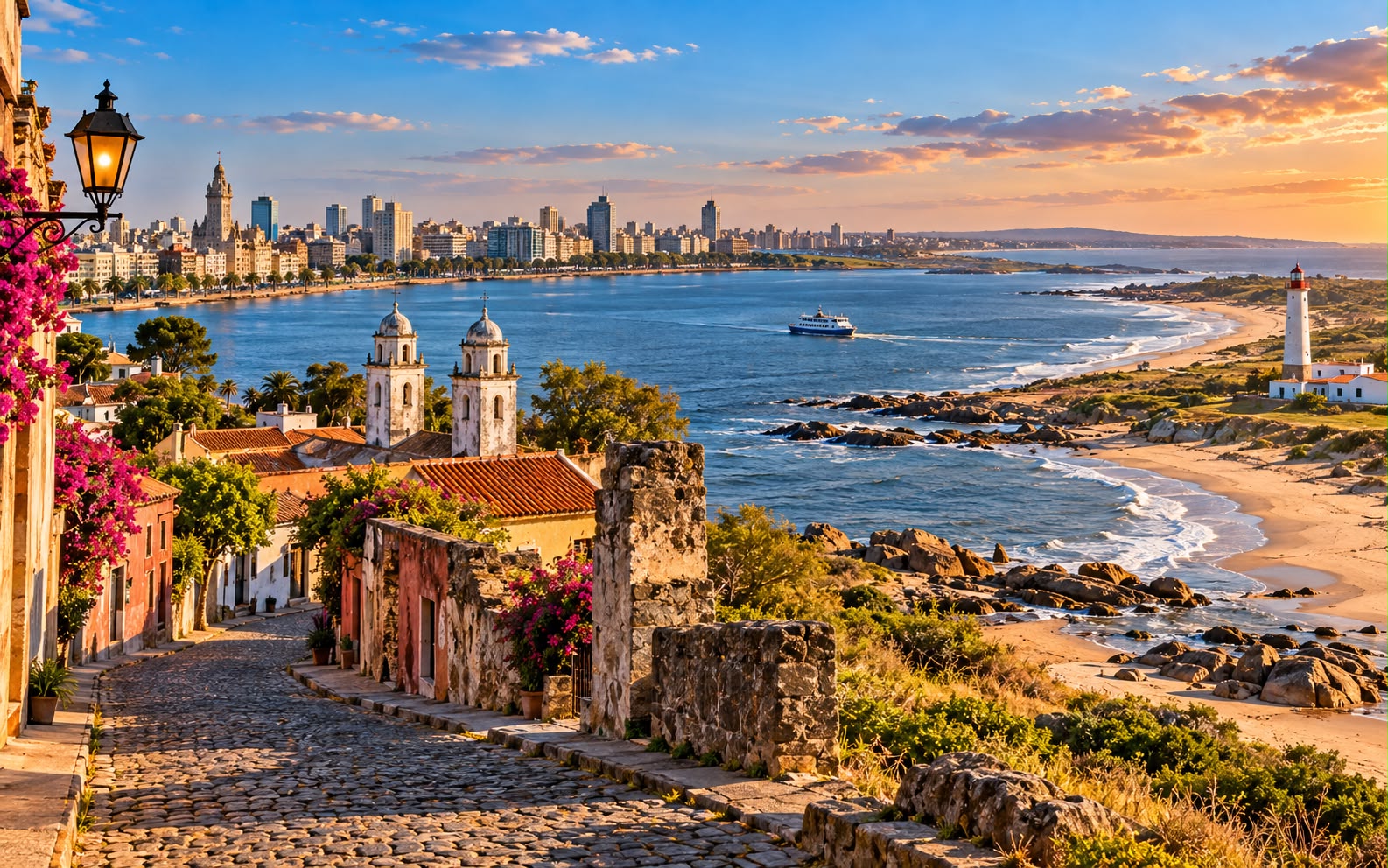
Uruguay in 8 days: Montevideo, Colonia and the wild east coast
South America's quietest country: a capital with a 22 km seafront promenade, a Portuguese smuggling town of cobbles and sycamores an hour from Buenos Aires, and a village at the far end of the coast with no road to it, no mains electricity and a sea lion colony under the lighthouse.
- Southern Cone
- 8 days
- ≈ AED 4,450 / person
- Slow coast + Tannat
Before you go
Uruguay is the country people pass over on the way between Buenos Aires and Rio, and it is the calmest place on the continent. Three and a half million people, half of them in one city, and a coastline that goes from a 22-kilometre urban promenade to a village you can only reach by four-wheel-drive over dunes.
Colonia del Sacramento was founded by the Portuguese in 1680 to smuggle goods past the Spanish, changed hands nine times, and its cobbled quarter is a UNESCO site one hour by ferry from Buenos Aires — which is why this trip attaches so naturally to Argentina.
At the other end, Cabo Polonio has no road, no mains electricity and no street lighting, a sea lion colony under the lighthouse, and one of the darkest skies you can drive to.
It is also, quietly, expensive — and there is one refund that makes a real difference.
Before you go: the car, the refund and the season
Getting in, and getting around
- Carrasco (MVD) is 20 km east of Montevideo and small.
- Many people arrive from Buenos Aires instead: the Buquebus ferry reaches Colonia in about an hour and Montevideo in two and a quarter, which makes this an easy add-on to an Argentina trip. See our Argentina guide.
- Hire a car. The east coast beyond Punta del Este is not usefully served by bus, and the whole point of the second half of this trip is the ability to stop. Roads are good, traffic is light, and distances are short.
- Buses are comfortable and frequent between the main towns if you would rather not drive — Montevideo to Punta del Este is two and a half hours.
The refund nobody tells you about
- Foreign visitors get the 22% VAT refunded automatically on restaurant meals, and on hotel stays, when you pay with a non-Uruguayan card. It is deducted at the point of sale — no forms, no airport desk.
- This is not a small thing in a country this expensive. Pay with a foreign card rather than cash, which gets no discount.
- Hotels additionally charge no VAT at all to non-residents paying by foreign card, provided you show your passport at check-in.
The season swings hard
- December to February is summer and the whole country goes to the coast. Punta del Este is genuinely packed, prices double or triple, and booking is essential.
- March is the best month: the water is still warm, the crowds have gone back to work, and prices fall off a cliff after Carnival.
- April and November are quiet and pleasant with cooler sea.
- June to August is winter — cold, grey, wet, and much of the coast simply shuts. Cabo Polonio and Punta del Diablo are close to empty.
Money and practicalities
- Uruguayan peso (UYU). Cards are widely accepted and preferred — see the refund above. ATMs dispense pesos and sometimes US dollars.
- Mate is everywhere. People walk with a thermos under one arm and a gourd in the other hand, all day, including at work. You will be offered it; accept, drink it all, hand it back.
- Tap water is safe across the country.
- Uruguay is the safest country in South America by most measures, with the ordinary caution of any city applying in Montevideo after dark.
Day by day
Day 1 — Land in Montevideo
- 13:00 — Land at Carrasco (MVD), which is 20 minutes from the city and architecturally rather good for an airport.
- 14:30 — Stay in Ciudad Vieja for the old quarter or Pocitos for the beach and the restaurants. Pocitos is where Montevideans actually live.
- 16:00 — The Rambla: 22 kilometres of continuous seafront promenade, said to be the longest in the world, and the spine of the city’s daily life. Walk any stretch of it in late afternoon and you will pass several hundred people with thermos flasks, drinking mate and watching the river.
- 18:00 — This is the Río de la Plata, not the Atlantic — the widest river in the world, brown with silt, and 100 km across at Montevideo.
- 19:30 — Dinner. A chivito, the national sandwich: steak, ham, cheese, bacon, olives, egg and salad in a bun, and it arrives larger than you expect.
Day 2 — Montevideo properly
- 09:30 — Ciudad Vieja, the old town on its peninsula. Plaza Independencia with the Palacio Salvo — a 1928 tower that was briefly the tallest building in South America and looks like it was designed by someone having a vivid dream — and the Artigas mausoleum beneath the square.
- 11:00 — Teatro Solís, 1856, the country’s opera house, by guided tour.
- 12:30 — The Mercado del Puerto: a wrought-iron market hall from 1868, now wall-to-wall parrillas — open grills loaded with beef, sweetbreads, chorizo and provolone. Sit at a counter, order parrillada, and have a medio y medio, the local half-sparkling-half-white.
- 15:00 — Walk back along the port. Montevideo is a working container port and makes no attempt to hide it.
- 16:30 — The Museo Torres García for the Uruguayan constructivist, or the Museo del Carnaval — Montevideo’s carnival is the longest in the world at forty days, and candombe drumming on the street is its heart.
- 19:00 — Candombe drumming in Barrio Sur or Palermo on a Sunday evening: three drums, descended from enslaved Africans brought here, played walking down the middle of the road. It is a neighbourhood event, not a performance.
- 21:00 — Dinner late.
Day 3 — Colonia del Sacramento
- 09:00 — Drive west, about two and a half hours on Route 1.
- 11:30 — Colonia, and the Barrio Histórico is small enough to walk in an hour and good enough to spend a day in. Founded by Portugal in 1680 purely to smuggle goods across the river past Spanish Buenos Aires, it changed hands nine times before Uruguay existed — and the street surfaces tell you which power laid them, Portuguese cobbles draining down the middle, Spanish ones to the sides.
- 12:30 — Lunch on Calle de los Suspiros, the most photographed street in the country.
- 14:30 — The lighthouse, built into the ruins of a 17th- century convent, for the view over the red roofs and the brown river.
- 16:00 — Rent a golf cart or a bicycle, which is what everyone does, and run the riverfront out past the old bullring at Real de San Carlos.
- 18:00 — Sunset over the water from the rocks by the old gate, with Buenos Aires 50 km away across the estuary and visible as a smudge on a clear evening.
- 20:00 — Dinner, and stay the night. Colonia empties when the last ferry leaves and is at its best after that.
Day 4 — East to Punta del Este
- 09:00 — The long leg: Colonia to Punta del Este, about four hours, skirting Montevideo.
- 11:00 — Stop at a bodega. Uruguay’s grape is Tannat — brought by Basque immigrants in the 1870s, almost extinct in its native south-west France, and it produces a dark, tannic, structured red that is now the national wine. Bodega Bouza outside Montevideo is the convenient one and does lunch.
- 14:30 — Arrive Punta del Este, a peninsula with the Río de la Plata on one side and the Atlantic on the other — locals call them mansa (tame) and brava (wild), and the water genuinely changes colour and temperature between them.
- 16:00 — La Mano, the fingers of a hand emerging from the sand on Playa Brava — Mario Irarrázabal, 1982, and it is about drowning, which nobody photographing it seems to know.
- 18:00 — The port at feeding time, where sea lions gather for the fishing boats and are entirely unbothered by anybody.
- 20:30 — Dinner. In January this town is Monaco; in March it is a pleasant beach resort at a third of the price.
Day 5 — The coast, east of the money
- 09:30 — Casapueblo at Punta Ballena, 20 minutes west — the home and studio of the painter Carlos Páez Vilaró, built by hand over 36 years with no plans and no straight lines, in white stucco poured down a cliff. It is part Gaudí, part Santorini, part nothing else at all, and the sunset ceremony with his recorded poem is unashamedly sentimental and works anyway.
- 12:00 — Isla de Lobos by boat from the port if the sea allows: one of the largest South American sea lion colonies in the world, around 200,000 animals, on an island two hours round trip.
- 15:00 — East to José Ignacio, 40 minutes — a fishing village of sand streets and a lighthouse that became the place the Punta crowd escaped to. Still low-rise, still mostly sand, and the restaurants are excellent.
- 17:00 — La Barra on the way, with the undulating bridge that everybody drives over slightly too fast.
- 19:30 — Dinner at José Ignacio, watching the light go over the Atlantic.
Day 6 — Cabo Polonio
- 09:00 — Drive east on Ruta 10, about two hours, past Laguna Garzón and its circular bridge.
- 11:00 — At the Cabo Polonio park entrance you leave the car and get into a four-wheel-drive truck with bench seats that crosses 7 km of dune and beach. There is no road, and this is the only way in apart from walking.
- 12:00 — Arrive. No mains electricity, no running water in most houses, no street lighting, no cars. Perhaps eighty permanent residents, solar panels, wind turbines, candles and a single lighthouse.
- 13:00 — Lunch at one of the handful of places.
- 15:00 — The sea lion colony on the rocks beneath the lighthouse — hundreds of them, loud and close, and you walk right up to the edge of it.
- 17:00 — Climb the lighthouse, then walk the dunes between the two beaches.
- 19:30 — Dinner by candle and generator.
- 21:30 — The sky. No street lighting for many kilometres and nothing on the horizon but sea. This is the reason to stay the night rather than take the truck back, and almost everyone who day-trips it says afterwards that they should have stayed.
Day 7 — Punta del Diablo, and west
- 08:30 — The truck back across the dunes.
- 10:00 — Punta del Diablo, 45 minutes further east — a fishing village turned surf and backpacker town, sand streets, wooden houses, and genuinely the end of the country: the Brazilian border is 40 km on.
- 11:30 — Santa Teresa National Park next door: a Portuguese-then-Spanish hilltop fortress from the 1760s, pine forest planted over dunes, and long empty Atlantic beaches.
- 13:30 — Lunch, and then turn around.
- 15:00 — The drive west, about four and a half hours to Montevideo, or three to Punta del Este if you would rather break it.
- 19:30 — Last dinner. Asado if you can find somewhere doing it properly — Uruguay eats more beef per head than any country on earth and does not consider this a competition with Argentina, because it has already won.
Day 8 — Fly home
- Morning — Carrasco is 20 minutes from the city.
- Return the car with time for the inspection and check the fuel policy.
- Last stop — Tannat to carry home, and dulce de leche, which Uruguay and Argentina both claim and which you can settle for yourself.
Costs and practicalities
Best time to visit
December–February is the summer and the only season the coast really works, though it is also when Uruguayans and Argentines fill it.
- December–February — hot, 28–30°C, and Punta del Este and José Ignacio are at full capacity in January, with Buenos Aires money and prices to match.
- March–April — the best of the year: still warm, the sea swimmable, and the coast quiet again. The grape harvest in Canelones is in February and March.
- May–August — winter, 10–16°C, wet and windy on the coast. Montevideo works, the beach resorts largely close.
- September–November — spring, warming, and good value before the season starts.
Carnival in Montevideo is the longest in the world — around forty days from late January, with the llamadas candombe drum parades in early February.
Travel tips
- Uruguay is more expensive than its neighbours, particularly in January on the coast. Montevideo and the interior are far better value.
- Mate is carried everywhere — thermos under the arm, gourd in hand. It is not shared with strangers the way it is in Argentina; do not expect to be offered it, and do not ask.
- Cards work widely and the IVA tax refund for tourists on restaurant bills paid by foreign card is automatic and substantial.
- Cannabis is legal but only for registered residents. Tourists cannot legally buy it.
- Colonia del Sacramento is an hour by fast ferry from Buenos Aires and is UNESCO-listed — it works as a day trip in either direction.
- Buses are excellent and cover the country from Montevideo’s Tres Cruces terminal.
- Beef is the national subject. The parrilla at Mercado del Puerto is the obvious introduction; the asado is a long lunch, not a quick meal.
What this trip actually costs
Two people, 7 nights, mid-range, outside peak season, excluding international flights:
| Item | Cost |
|---|---|
| Montevideo, 3 nights | UYU 15,000 (≈ AED 1,366) |
| Colonia, 1 night | UYU 5,500 (≈ AED 501) |
| Punta del Este / José Ignacio, 2 nights | UYU 12,000 (≈ AED 1,093) |
| Cabo Polonio, 1 night | UYU 4,000 (≈ AED 364) |
| Car hire, 6 days, and fuel | UYU 24,000 (≈ AED 2,186) |
| Isla de Lobos, Polonio truck, bodega, museums | UYU 9,000 (≈ AED 820) |
| Food and drink, 8 days | UYU 24,000 (≈ AED 2,186) |
| Extras | UYU 4,500 (≈ AED 410) |
| Total for two | UYU 98,000 (≈ AED 8,925) |
- Roughly UYU 49,000 (≈ AED 4,463) per person. Uruguay is expensive by South American standards — comparable to southern Europe — and people arriving from Bolivia or Peru get a shock.
- Pay restaurants and hotels with a foreign card and the 22% VAT comes off automatically. Over a week this is a meaningful sum and costs nothing to claim.
- January and February cost roughly double on the coast. March is the same trip at off-peak prices.
- Buses instead of a car would save about UYU 20,000 (≈ AED 1,822) and cost you Cabo Polonio.
What to pack
- Layers. The coast is windy year-round and evenings cool sharply even in summer.
- A torch for Cabo Polonio, which has no street lighting at all — this is not optional.
- Cash for Cabo Polonio, where card machines mostly do not work.
- Sun protection. The ozone layer over the southern cone is thin and the UV index is high even on cool days.
- Swimming things and a windbreak — Atlantic beaches here are beautiful and rarely still.
- Type C/F/L plugs, 230V.
- Your passport at hotel check-in to get the tax exemption.
FAQ
Can I do this from Buenos Aires? Yes, and many people should. The ferry to Colonia is an hour and to Montevideo about two and a quarter. Three days gets you Colonia and Montevideo comfortably; this full week adds the east coast, which is the half most visitors never see.
Is Punta del Este worth it? In January it is a crowded, expensive scene. Outside peak it is a genuinely good beach town with excellent restaurants and Casapueblo nearby. If you are there for the coast rather than the scene, José Ignacio is the better base.
Should I stay the night in Cabo Polonio? Yes. The day trip gives you sea lions and dunes; the night gives you the stars with no electric light anywhere, which is the actual experience. Accommodation is basic — a bed, a candle, a shared bathroom — and that is the point.
When should I go? March, if you can. Warm sea, empty beaches, and prices that have collapsed since Carnival. December to February if you want the coast at full volume; avoid June to August entirely unless Montevideo alone is the plan.
Is it really the safest country in South America? By most measures yes, and the difference from the region is noticeable. Montevideo has normal urban crime and the usual caution applies after dark in Ciudad Vieja; the coast and the interior are very quiet indeed.
Prices and entry rules change, and what you need depends on your passport; last checked 8 October 2026, so confirm with the embassy or your airline before booking.


