 The Itinerary
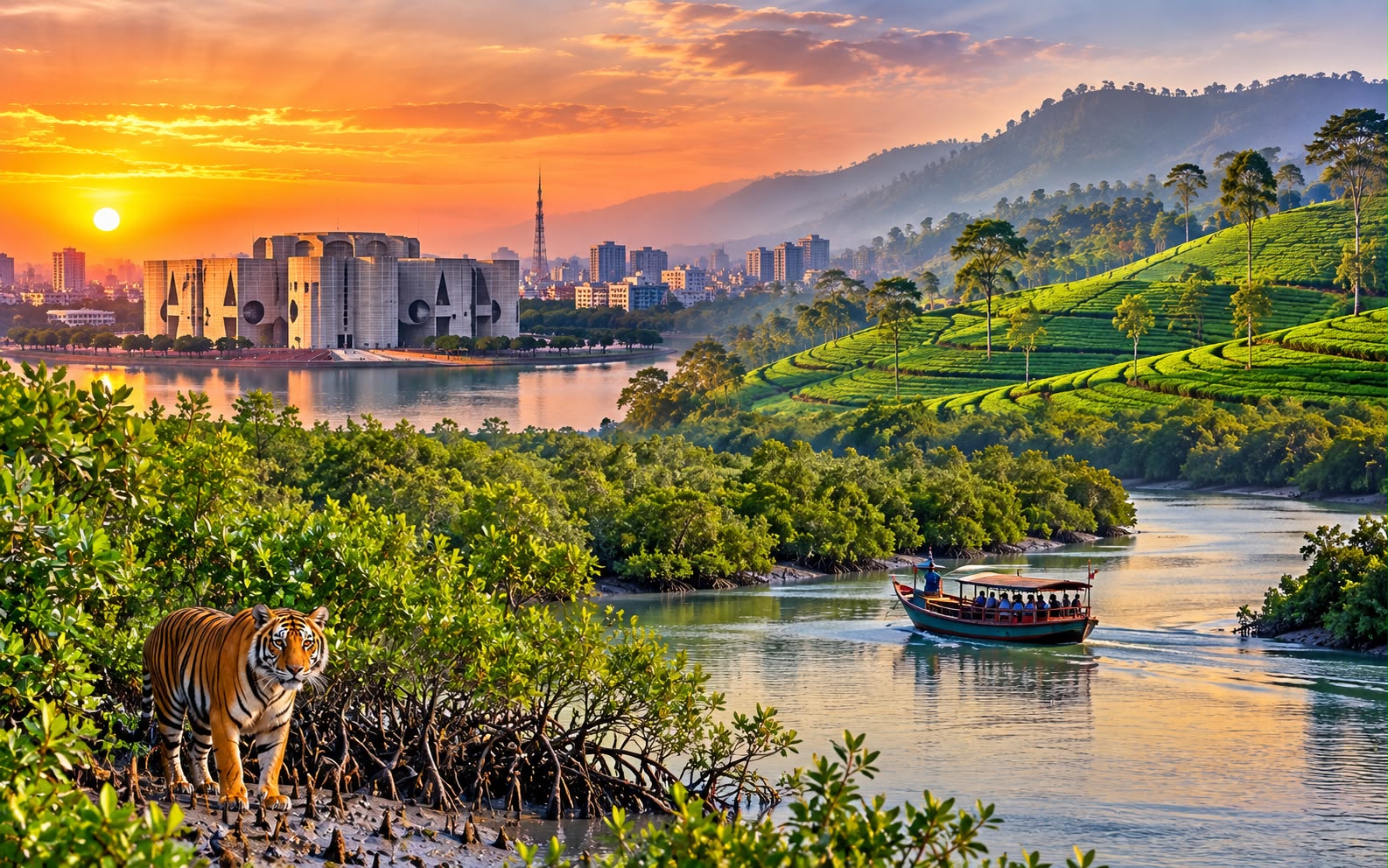
Bangladesh in 7 days: Dhaka, the Sundarbans and tea country
The largest mangrove forest on earth with tigers still in it, a medieval mosque city of seventy-seven domes, a capital with a million cycle rickshaws and a parliament building by Louis Kahn, and hills of tea where the drink is served in seven separate layers.
- South Asia
- 7 days
- ≈ AED 2,800 / person
- The world's largest mangrove forest
Before you go
Bangladesh gets a fraction of the visitors its neighbours do, which is strange for a country holding the largest mangrove forest in the world. The Sundarbans spread across 10,000 square kilometres of tidal delta where the Ganges, Brahmaputra and Meghna meet the sea — a UNESCO site, a labyrinth of channels, and the last substantial habitat of the Royal Bengal tiger. You will almost certainly not see one. You will see the pugmarks, and spotted deer, crocodiles, and more kingfishers than you can count.
Dhaka is the other extreme: among the most densely populated cities on earth, with somewhere near a million cycle rickshaws, each hand-painted. It also has the Jatiya Sangsad Bhaban — the parliament building Louis Kahn designed in raw concrete and water, which architects travel here specifically to see.
And Srimangal in the north-east is tea: rolling green hills, pickers in the rows, and a glass of tea served in seven visible layers that a local inventor worked out how to make and has not fully explained.
The shape: Dhaka (2 nights) → Khulna/Sundarbans (3) → Srimangal (1). Figure BDT 95,000 (≈ AED 2,807) per person excluding flights. Go November–February — cool, dry, and before the heat and the monsoon.
Before you go: the 15-minute admin
Visas
- Most nationalities need a visa in advance; some are eligible for visa on arrival at Dhaka. The rules change and are applied strictly — confirm your own case with the Bangladesh mission before you fly.
- A Sundarbans permit is required and is arranged by the tour operator as part of the boat trip, not separately.
Money
- Bangladeshi taka. Cash for almost everything outside Dhaka hotels. ATMs are reliable in Dhaka and Khulna.
- Very inexpensive. The Sundarbans boat is the one significant cost on this itinerary.
SIM and data
- Tourist SIMs from Grameenphone or Robi need passport and a photo. Coverage is good except deep in the delta, where there is none.
Getting around
- Dhaka traffic is the planning constraint, not distance. Cross-city journeys can take two hours. Build mornings around it.
- Dhaka–Khulna is a short flight to Jessore then a drive, or an overnight train. The flight saves most of a day.
- Dhaka–Srimangal is a four-hour train, and the train is genuinely pleasant — book a first-class seat.
- Rickshaws for short hops in cities; agree the fare before getting in.
Travelling with kids?
- The Sundarbans boat is two or three nights aboard with limited room to run around — judge that for your own children.
- Dhaka’s rickshaw art and the river at Sadarghat are endlessly interesting at any age.
- The tea gardens are easy walking and the seven-layer tea is a reliable novelty.
- Heat and crowds are the real fatigue. Plan short days.
Day by day
Day 1 — Old Dhaka
- Afternoon — Land, check in. Expect the drive from the airport to take longer than you planned.
- 16:00 — Ahsan Manzil, the pink palace of the Nawabs on the riverfront, and the lanes of Old Dhaka around it — spice markets, metalworkers, and the hand-painted rickshaws that are a folk art in their own right.
- 18:00 — Sadarghat, the river port: hundreds of launches loading at once, and one of the great unmanaged spectacles anywhere.
- 20:00 — Dinner. Bengali food is fish, mustard, rice and more chilli heat than Indian Bengali cooking.
Where to stay in Dhaka (three nights across the trip)
- Luxury: Gulshan and Banani, the diplomatic districts, where the international hotels are.
- Mid-range: also Gulshan — it is where most visitors stay and where the traffic is least painful.
- Value: guesthouses in Dhanmondi, central and cheaper.
Day 2 — Kahn’s parliament, and the war
- 09:00 — Jatiya Sangsad Bhaban, Louis Kahn’s parliament: geometric voids cut through raw concrete, surrounded by water. Tours of the interior need arranging in advance through the parliament secretariat; the exterior is free and is most of the point.
- 11:30 — Lalbagh Fort, an unfinished Mughal complex of 1678 — abandoned when the governor’s daughter died and the site was thought unlucky.
- 14:00 — The Liberation War Museum, on 1971 and the war of independence. It is unflinching and it is the context for the whole country.
- 17:00 — Dhakeshwari Temple, the national Hindu temple, or the Star Mosque with its blue-tiled mosaic.
Day 3 — South to Bagerhat and the delta
- 07:00 — Fly to Jessore, then drive to Bagerhat, about two hours.
- 11:00 — The Mosque City of Bagerhat, UNESCO-listed: a fifteenth-century city of mosques built by a Sufi general, of which the Sixty Dome Mosque is the greatest — and has seventy-seven domes, despite its name.
- 14:00 — Drive to Mongla or Khulna and board the Sundarbans boat. Most trips depart in the afternoon and sail overnight into the forest.
- Evening — On the water. The engine stops, and the delta is very quiet.
Day 4 — Inside the Sundarbans
- Dawn — Out in the small boat along narrow channels, which is when the forest is awake: kingfishers, macaques, spotted deer on the banks, and estuarine crocodiles sliding off the mud.
- Mid-morning — A walk at Katka or Kotka on the boardwalks, with a guard — the forest department requires one, because the tigers are genuinely there.
- Afternoon — Jamtola beach or the watchtowers. Tiger pugmarks on the sand are common. Tigers are not; perhaps a hundred live on the Bangladeshi side across an area the size of a small country.
- Evening — Back aboard. Fireflies in the mangroves on a still night.
Day 5 — Out of the delta, back to Dhaka
- Morning — A last channel run, then sail back toward Mongla.
- Afternoon — Drive to Jessore and fly to Dhaka, arriving evening.
- Evening — Dhaka. Rest; tomorrow is an early train.
Day 6 — Srimangal and the tea hills
- 06:30 — Train from Dhaka to Srimangal, about four hours through green country. Sit on the left.
- 11:00 — The tea gardens: Bangladesh has grown tea here since the 1850s and the estates run over the hills in every direction. Walk the rows; the pickers will usually say hello first.
- 13:00 — Seven-layer tea in Srimangal town — seven visibly separate bands of tea in one glass, made by a man who worked out the densities and has kept the method largely to himself.
- 15:00 — Lawachara National Park, a patch of remaining rainforest holding hoolock gibbons — the only ape in the subcontinent — which you hear long before you see.
- Evening — Stay in Srimangal, in a tea bungalow if you can get one.
Day 7 — Back to Dhaka, fly home
- Morning — Train back to Dhaka, four hours.
- Afternoon — Last of Dhaka: Aarong for handicrafts and textiles, or the rickshaw-painting workshops in the old city, then the airport. Leave more time than seems sane for the traffic.
Costs and practicalities
Best time to visit
November–February, the cool dry season, and the gap between it and the rest of the year is wider here than almost anywhere.
- November–February — 15–25°C, dry, clear, and the only comfortable months. This is also when the Sundarbans boats run reliably.
- March–May — the pre-monsoon hot season, humid and over 35°C, with Nor’wester squalls.
- June–October — the monsoon. Bangladesh is a delta and a quarter of it floods in a normal year; roads close, launches are disrupted, and the Sundarbans becomes difficult.
- September–October — the water recedes and the country is extraordinarily green, but travel is still unpredictable.
Durga Puja in late September or October and Eid both move the whole country at once — transport sells out days ahead.
Travel tips
- Allow far more time for Dhaka traffic than seems reasonable. Ten kilometres can take two hours. Plan one thing per half-day and use the metro where it goes.
- Negotiate the CNG autorickshaw fare before getting in, every time.
- bKash is the national payment system. Cash otherwise; cards work in Dhaka hotels and restaurants and almost nowhere else.
- The Friday–Saturday weekend is the local one. Sunday is a working day.
- Sundarbans entry needs a permit and a registered operator. Arrange it before arriving rather than in Khulna.
- Hartals — general strikes — stop transport at no notice. They are usually announced a day or two ahead; ask locally rather than assuming your plan holds.
- Drink only bottled or boiled water and be careful with ice. Dress modestly; this is a conservative Muslim country and shorts are unusual on adults.
What this trip actually costs
Two people, 6 nights, mid-range comfort, flights excluded:
| Item | Cost |
|---|---|
| Sundarbans boat, 3 days 2 nights, two people | BDT 70,000 (≈ AED 2,068) |
| Hotels, 4 nights | BDT 36,000 (≈ AED 1,064) |
| Domestic flights and trains | BDT 30,000 (≈ AED 886) |
| Food and drink, 7 days | BDT 28,000 (≈ AED 827) |
| Guides, permits, entries and transfers | BDT 26,000 (≈ AED 768) |
| Total for two | BDT 190,000 (≈ AED 5,613) |
- Roughly BDT 95,000 (≈ AED 2,807) per person, and the Sundarbans boat is more than a third of it. Everything else in Bangladesh is very cheap.
- Boat quality varies enormously. Check what is included, how many cabins, and whether the small boat for the narrow channels is on board — that last one is what makes the trip.
- Book the Sundarbans first and build the rest around the sailing date.
- Hotel picks here are chosen on location, not on commission — always check prices and recent reviews before booking.
What to pack
- Long sleeves and trousers in neutral colours for the forest, and insect repellent that you trust.
- Binoculars. The difference between a good and a dull day in the delta is almost entirely optics.
- Modest dress. Bangladesh is conservative; covered shoulders and knees everywhere.
- A torch for the boat, and motion sickness tablets if you are prone — the delta is calm but the estuary is not always.
FAQ
Will I see a tiger? Almost certainly not. Around a hundred live across an area the size of a small country, in forest you cannot walk freely. People go for the delta itself, the birds and the silence; the tiger is a presence, not a sighting.
Is three days enough for the Sundarbans? It is the standard trip and it works. Two is mostly sailing. Longer trips go deeper toward the Indian border and see fewer other boats.
Is Dhaka manageable? Yes, with low expectations about moving around. Treat traffic as the fixed constraint, do one thing per half day, and use rickshaws for anything under two kilometres.
Is it better to visit the Sundarbans from India? They are the same forest, split by the border. The Bangladeshi side is far larger, much less visited, and done by liveaboard boat rather than day trips.
Prices and entry rules change, and what you need depends on your passport; last checked 8 October 2026, so confirm with the embassy or your airline before booking.


