 The Itinerary
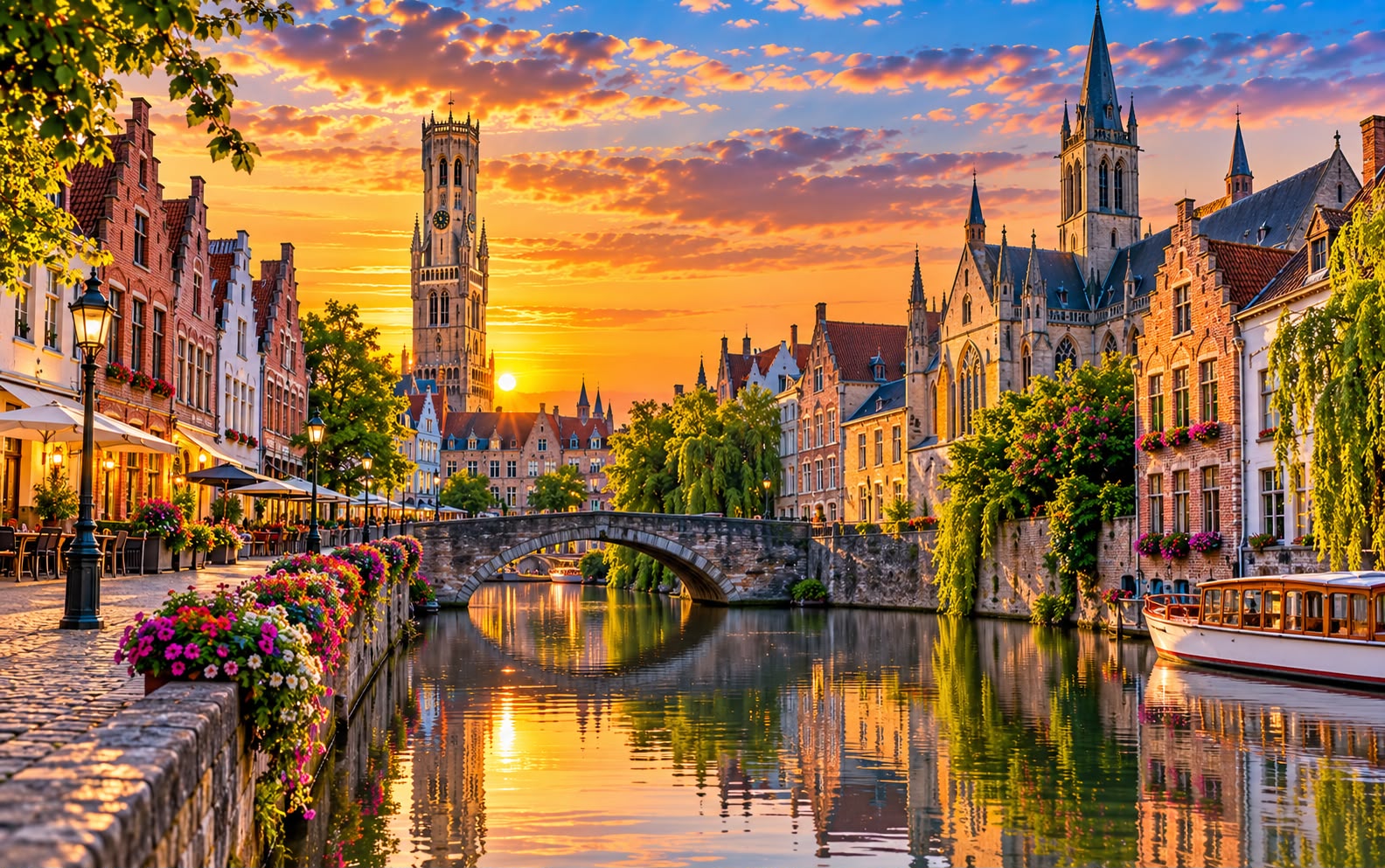
Belgium in 6 days: Bruges, Ghent and Brussels
Four medieval cities inside an hour of each other by train: Bruges' canals at dawn before the coaches arrive, Ghent's castle and student energy, Brussels' grand square and comic-strip walls, and Antwerp's cathedral Rubens — with the day-trip trap, the beer that is genuinely worth the fuss, and why the trains make a car pointless.
- Western Europe
- 6 days
- ≈ AED 5,100 / person
- Old towns + short hops
Before you go
Belgium’s advantage is compression. Four cities worth a day or more each, all within an hour of one another by train, on a network so dense that a car would be an active nuisance. You can base yourself in one place and see the lot, or move twice and never pack in a hurry.
Bruges is the famous one, and deserves it — a medieval merchant town of canals and step-gabled houses, wrapped in coach tours between ten and five. Ghent is what Bruges would be if people actually lived there, with a river-front of guild houses and a castle in the middle. Brussels has the finest market square in Europe and a reputation for dullness it no longer merits. Antwerp has Rubens, diamonds and the best-dressed people in the country.
Six days is enough for all four without rushing, and the trains mean you barely notice the moving.
Before you go: trains, timing and beer
Entry
- Belgium is in Schengen, so one visa covers it. The process, the lead times and the documents that cause refusals are in our Schengen visa guide.
- Visa-free nationalities need only a passport, with the EES biometric border now fully operational — allow extra time on first arrival.
- The euro, and cards work everywhere including on trains.
The trains make the trip
- Brussels to Bruges is about an hour, Ghent about 30 minutes, Antwerp about 45. Trains run several times an hour and need no reservation.
- Do not hire a car. Parking in these old centres is restricted, expensive and slower than walking, and the trains are quicker door to door.
- Brussels has multiple stations — Midi/Zuid for international services, Central for the old town. Check which one your ticket names.
- Buy tickets at the machine or in the app; both are simple and English-language.
The day-trip trap
- Bruges between 10am and 5pm belongs to coach tours. The difference between a magical Bruges and a disappointing one is entirely about being there outside those hours.
- Sleep in Bruges for at least one night. Early morning and after six, the town empties and becomes the place people describe.
- The same logic applies at smaller scale in Ghent, which is busiest at midday and lovely at night when the buildings are lit.
Beer, and how to take it seriously
- Belgian beer is a genuine food culture, not a marketing line — hundreds of distinct styles, many brewed by or for abbeys, each with its own glass.
- Order by style, not brand. A tripel, a dubbel, a witbier, a geuze if you want the sour one that surprises people.
- Strengths are high. Many are 8–10%, served in 330ml glasses for good reason.
- Chips are a national dish, served from a frituur with mayonnaise and eaten standing up. The waffles come in two kinds — Brussels (light, rectangular, dusted) and Liège (dense, sweet, caramelised) — and the Liège one is better.
When to go
- April to June and September to October are the best: mild, bright and less crowded than midsummer.
- December is Christmas-market season and genuinely lovely in Bruges and Ghent.
- July and August are warmest and busiest. It rains in every month; bring a jacket regardless.
Day by day
Day 1 — Land in Brussels
- 14:00 — Land at Brussels Airport (BRU). The train to Bruxelles-Central takes 20 minutes and runs four times an hour. If you flew into Charleroi, that is a different airport an hour away by coach — check which one your ticket says.
- 15:30 — Drop bags. Stay near Sainte-Catherine or the Dansaert quarter rather than immediately on Grand-Place.
- 16:30 — Grand-Place. Guild houses in gilded baroque on all four sides, rebuilt after Louis XIV’s bombardment in 1695, and the most concentrated piece of architecture in Belgium. Stand still in the middle of it for ten minutes.
- 17:30 — Galeries Royales Saint-Hubert, Europe’s first covered shopping arcade (1847), and the chocolatiers in it — Neuhaus invented the filled praline here in 1912.
- 19:30 — Dinner around Sainte-Catherine, not on the Rue des Bouchers strip off Grand-Place, which is all barkers, laminated menus and disappointment.
- 21:00 — A first beer. Ask what is on and let them choose.
Day 2 — Brussels properly
- 10:00 — Royal Museums of Fine Arts: the Bruegel collection — the Census at Bethlehem, the Fall of the Rebel Angels — and the Magritte Museum in the same complex, which is the largest holding of his work anywhere and is best done second.
- 13:00 — Lunch, then the Mont des Arts gardens for the view back down over the lower town.
- 14:30 — The comic-strip route: around 60 painted gable walls across the centre — Tintin, Lucky Luke, the Smurfs — with the Comics Art Museum in a Horta building if you want the indoor version. Belgium takes this seriously and so should you.
- 16:00 — Manneken Pis, which is 61 cm tall, usually dressed in one of his 1,000 costumes, and photographed by everyone including you.
- 17:00 — Musical Instruments Museum in the Old England art-nouveau department store, with the rooftop café.
- 19:30 — A proper beer bar — Delirium, Moeder Lambic, or À la Mort Subite for the lambic in its own 1920s room. Trappist, gueuze, kriek; every beer has its own glass and they are not being precious.
Day 3 — Train to Bruges
- 09:30 — Train to Bruges, one hour, twice an hour, no booking needed.
- 11:00 — Drop bags. Stay the night — this is the single most important decision on a Belgium trip and the reason the itinerary is shaped this way.
- 12:00 — The Markt and lunch on a side street off it.
- 14:00 — The Belfry: 366 steps, a narrowing spiral, and a carillon of 47 bells at the top. Tickets are timed and capped.
- 15:30 — The Burg square next door, the Basilica of the Holy Blood, and the Begijnhof — a walled courtyard of white houses under poplars, founded 1245, still silent.
- 18:00 — Bruges after six. The day coaches leave, the streets empty, and the canals go still and reflect the lamps. The town that was unbearable at two in the afternoon becomes the best thing in the country at eight.
- 20:00 — Dinner. Waterzooi, or mussels if they are in season — which is September to April, despite what the tourist menus claim in July.
Day 4 — Bruges at dawn, then Ghent
- 07:30 — Walk the canals before eight. Rozenhoedkaai, Groenerei, the Bonifacius bridge — you will have them to yourself, and the light is low and flat on the water. This hour is why you stayed.
- 09:30 — Breakfast, then the Groeningemuseum for the Flemish Primitives — Van Eyck’s Madonna with Canon van der Paele and Memling’s portraits, in a small museum you can do properly in 90 minutes.
- 12:00 — A canal boat, 30 minutes, which shows you the back of every building you have walked past.
- 13:30 — Lunch, collect bags.
- 15:00 — Train to Ghent, 30 minutes.
- 16:00 — Ghent is the correction to Bruges: the same canals and guild houses, but a working university city of 70,000 students rather than a preserved one.
- 19:00 — The Graslei and Korenlei waterfronts, lit, and dinner alongside.
Day 5 — Ghent and Antwerp
- 09:30 — Saint Bavo’s Cathedral for the Ghent Altarpiece — Van Eyck’s 1432 polyptych, the most stolen artwork in history, now shown with an augmented-reality guide in a climate-controlled room. Book the timed ticket; it is the single best thing in Belgium.
- 11:00 — Gravensteen, the moated castle of the Counts of Flanders, whose audio guide is unexpectedly funny and covers the torture instruments with enthusiasm.
- 12:30 — Lunch — a cuberdon, the cone-shaped raspberry sweet sold from carts here.
- 14:00 — Train to Antwerp, 45 minutes.
- 14:45 — Antwerpen-Centraal itself, which is one of the finest railway stations in Europe — stone, iron and glass over four levels, and worth walking back out of to look at.
- 15:30 — The Cathedral of Our Lady for four Rubens altarpieces in the room they were painted for, then the fashion district around Nationalestraat and MoMu.
- 18:00 — Back to Ghent, or on to Brussels if you fly from there. Check which before you buy the ticket.
Day 6 — Fly home
- Morning — Brussels Airport is 20 minutes by train from Central, four times an hour. Charleroi is an hour by coach and the coach leaves from a different place — confirm the night before.
- Last stop — Chocolate at the station is fine; chocolate from Pierre Marcolini, Wittamer or a local chocolatier is the thing you will wish you had bought. Buy it the day before, not at the gate.
Costs and practicalities
Best time to visit
April–June and September–October. Belgium’s weather is unreliable in every month, so the choice is really about crowds and daylight rather than sunshine.
- April–May — tulips and blossom, long enough days, and Bruges before the coaches arrive in force.
- June–August — warmest and busiest. Ghent’s Gentse Feesten in July takes over the city for ten days, and the Carpet of Flowers fills Brussels’ Grand-Place for four days every even-numbered August.
- September–October — the best compromise: mild, quiet, and the beer festivals begin.
- November–March — grey and wet, but the Christmas markets in Brussels, Bruges and Ghent run from late November, and the museums are empty.
Bruges in midsummer is a day-tripper’s city. Stay the night and you get it back after five o’clock.
Travel tips
- Trains link everything and the country is small. Brussels to Bruges is an hour; nothing needs a car. Weekend return tickets are heavily discounted.
- Order beer by name, not by type. Each has its own glass and the bar will be particular about it. Strengths of 8–10% are normal — pace accordingly.
- Chips are a meal, from a friture, with mayonnaise. Twice-fried, served in a cone, and nothing to do with what accompanies a steak.
- Brussels is officially bilingual; Flanders is Dutch-speaking and Wallonia French. Starting in the wrong one is a small social error. English is safe everywhere.
- Many museums close on Monday, including the big Brussels ones.
- Card payment is near-universal, but some fritures and market stalls are cash-only.
- Service is included. Rounding up is normal; a percentage tip is not expected.
What this trip actually costs
Two people, 5 nights, mid-range, excluding international flights:
| Item | Cost |
|---|---|
| Hotels, 5 nights across Brussels, Bruges and Ghent | EUR 1,050 (≈ AED 4,299) |
| Trains, all legs, two people | EUR 120 (≈ AED 491) |
| Museums, belfry, altarpiece, canal boat, castle | EUR 220 (≈ AED 901) |
| Food, beer and chips, 6 days | EUR 950 (≈ AED 3,890) |
| eSIM, extras | EUR 160 (≈ AED 655) |
| Total for two | EUR 2,500 (≈ AED 10,236) |
- Roughly EUR 1,250 (≈ AED 5,118) per person. Belgium is cheaper than the Netherlands next door and noticeably cheaper than Paris.
- Bruges hotels carry a premium for being inside the ring. Paying it is the right call for one or two nights, precisely because of the early-morning point above.
- Lunch from a frituur or a bakery and one proper dinner a day keeps the food line where it is.
What to pack
- A rain jacket. It rains in every month, briefly and often.
- Shoes for cobbles — all four old centres are paved in them.
- European Type C/E plugs.
- Layers, even in summer; the North Sea is close and the evenings cool quickly.
FAQ
Is Bruges worth it, or is it a tourist trap? Both, depending entirely on when you are there. Between ten and five it is a coach park. Before eight and after six it is one of the best-preserved medieval towns in Europe. Sleep there and you get the second one.
Should I base in one city or move? Move once. Two nights Brussels, two Bruges, one Ghent works well, and Antwerp is an easy day trip from any of them.
Do I need a car? No, and it would slow you down. The trains are frequent, cheap and faster once you count parking.
Which city should I cut if I only have four days? Antwerp, reluctantly. Brussels, Bruges and Ghent are the core, and Ghent is the one most people under-rate.
Prices and entry rules change, and what you need depends on your passport; last checked 8 October 2026, so confirm with the embassy or your airline before booking.


