 The Itinerary
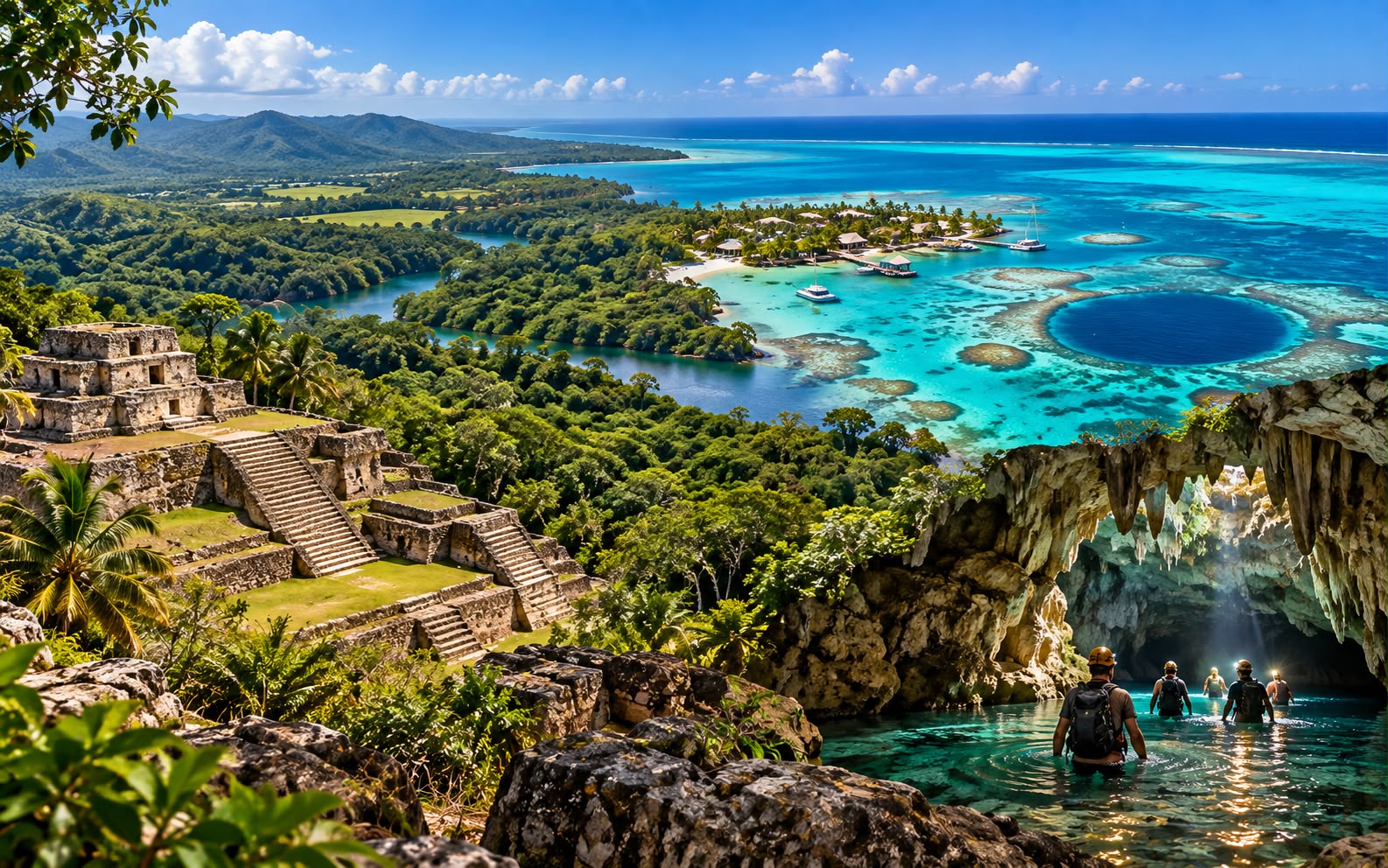
Belize in 8 days: the barrier reef, the ATM cave and the Cayo
The only English-speaking country in Central America, with the second largest barrier reef on earth off one coast and a Maya sacrificial cave inland that you swim into and walk through barefoot, past skeletons left where they fell twelve centuries ago.
- Mexico and Central America
- 8 days
- ≈ AED 4,500 / person
- Reef + Maya caves
Before you go
Belize is the size of Wales with 400,000 people in it, and it does two things better than anywhere nearby.
Off the coast lies the Belize Barrier Reef — the second largest in the world after Australia’s, a UNESCO site, and close enough to swim to from some beaches. Inland, under the limestone of the Cayo, is Actun Tunichil Muknal: a cave the Maya used for sacrifice during the drought that ended the Classic period, where the skeletons and pots lie exactly where they were left around 900 AD and you walk past them in socks.
It is also the one country in Central America where English is the official language, and the one where the currency is fixed at two to the US dollar, which removes most of the friction from a short trip.
Before you go: the cave, the reef and the seasons
Entry, money and language
- Most nationalities enter visa-free for 30 days. There is a departure tax, usually bundled into your air ticket — check.
- The Belize dollar is pegged at BZD 2 = USD 1, fixed since 1978. US dollars are accepted everywhere, often at exactly that rate, so there is very little to think about. Carry small notes; change is given in a mix of both.
- English is official. Kriol is what you will hear spoken, and Spanish, Garifuna, Maya and Mennonite German are all current.
- Cards work in hotels and tour offices; the cayes, buses and roadside food are cash.
Book the ATM cave before anything else
- Actun Tunichil Muknal admits a limited number of visitors a day in groups of eight with licensed guides only. It is a full day from San Ignacio.
- Cameras and phones are banned inside, entirely. A visitor dropped a camera on a 1,100-year-old skull in 2012 and the ban has been absolute since. Do not plan photographs; this is the one place the memory has to do.
- You wade and swim a short section at the entrance, scramble over rock in the river for 45 minutes, then climb into the dry upper chamber and go barefoot in socks across the formations.
- Not possible if you are claustrophobic, cannot swim, or cannot manage uneven rock for several hours. There is no shortened version.
When to go
- Late November to April is the dry season: reliable sun, flat water, best visibility on the reef. February to April is the sweet spot.
- June to November is hurricane season, with September and October the peak. It also rains hardest then, the ATM cave closes when the river is high, and prices drop accordingly.
- May is hot and humid and quiet, and still mostly dry.
- Sargassum — floating seaweed — can affect east-facing beaches from roughly April to August. It does not reach the snorkelling sites.
Getting around
- Water taxis run Belize City to Caye Caulker in about 45 minutes and on to Ambergris.
- Shuttles are how everyone crosses the country — Belize City or the water-taxi terminal to San Ignacio is about two and a half hours, and shared shuttles cost a fraction of a private transfer.
- Buses are old US school buses, cheap, slow and entirely usable.
- Spend as little time in Belize City as you can. It is a transit point with a real crime problem, and nothing on this itinerary requires staying there.
Day by day
Day 1 — Land, and out to the caye
- 11:00 — Land at Philip Goldson (BZE), 15 km from Belize City.
- 12:00 — Transfer straight to the water taxi terminal and take the next boat. Do not linger in the city.
- 13:30 — Caye Caulker, 45 minutes out, and the island’s motto is painted on a sign at the dock: GO SLOW. There are no cars — golf carts, bicycles and bare feet — and three sand streets named Front, Middle and Back.
- 14:30 — Drop bags. Lunch at a dock bar.
- 16:00 — Walk north to the Split, the channel that Hurricane Hattie cut through the island in 1961, where everyone swims and the bar plays music into the evening.
- 18:00 — Sunset from the west side.
- 19:30 — Dinner. Lobster in season (June 15 to February 15 — it is illegal outside it, and a restaurant offering it in April is lying), or grilled snapper with rice and beans cooked in coconut milk.
Day 2 — The reef
- 08:30 — The Hol Chan Marine Reserve day trip, which is the single best thing in the water here. Hol Chan is a natural cut through the reef, 9 m deep, and the current funnels fish through it in quantity.
- 09:30 — Snorkelling the cut: nurse sharks, green moray eels, enormous groupers, turtles, and spotted eagle rays. The reserve has been protected since 1987 and the difference from unprotected water is obvious within a minute.
- 11:30 — Shark Ray Alley, where fishermen once cleaned their catch and nurse sharks learned to gather. You get into water four metres deep with a dozen nurse sharks and southern stingrays around you. They are harmless, they are also very much there, and the first thirty seconds take some resolve.
- 13:30 — A manatee stop or a mangrove channel on the way back, depending on the operator.
- 15:30 — Back to Caulker. Swim off the Split.
- 19:30 — Dinner, and a rum punch that will be stronger than it tastes.
Day 3 — Caulker slow, or the Blue Hole
- Option A — go slow, 09:00. Which is the island’s actual instruction. Kayak or paddleboard the lee shore, snorkel the coral gardens straight off a boat for half a day, or do nothing at all with a book and a hammock.
- Option B — the Great Blue Hole, 06:00. A 300 m circular sinkhole in the reef, 124 m deep, formed as a limestone cave that flooded when the sea rose. It is a full day, ten hours, and expensive.
- Be clear about which you are: the Blue Hole is a diver’s site — three dives, the second along a wall past stalactites at 40 m — and it is genuinely extraordinary underwater. As a snorkeller you see a dark blue circle from the surface and very little else, and the two reef stops on the same trip are the better part of your day. Half of the people who do it as snorkellers come back disappointed, and the money would be better spent on another Hol Chan trip.
- 16:00 — Back, whichever you chose.
- 19:30 — Last island dinner.
Day 4 — Inland to San Ignacio
- 08:00 — Water taxi back to the mainland, 45 minutes.
- 09:30 — Shared shuttle west to San Ignacio, about two and a half hours on the Western Highway, past the Belize Zoo and the Mennonite farming country around Spanish Lookout.
- 12:30 — Arrive. San Ignacio is a hill town on the Macal River, the base for everything in the Cayo, and the first place on this trip that feels like a working Belizean town rather than a tourist one.
- 13:30 — Lunch at the market if it is a market day — Saturday is the big one.
- 15:00 — Cahal Pech, a small Maya site on the ridge directly above the town, ten minutes’ walk up. Early Preclassic, occupied from around 1200 BC, and almost always empty.
- 17:00 — The riverside, and confirm tomorrow’s ATM pickup.
- 19:00 — Dinner on Burns Avenue.
Day 5 — Actun Tunichil Muknal
- 07:30 — Pickup, then 45 minutes to the reserve and a 45-minute jungle walk with three river crossings — thigh to waist deep — to the cave mouth.
- 09:30 — You swim into the entrance, a few strokes in cold clear water under an overhang, and then it is an hour of wading and scrambling up the stream passage in the dark with headlamps, sideways through gaps, over boulders.
- 11:00 — You climb into the dry upper chamber, take off your shoes, and continue in socks so that nothing is scraped.
- 11:30 — And then: pottery left where it was placed, many pieces deliberately broken to release what they held. Fourteen sets of human remains, including infants. The Maya came here during the prolonged drought of the 9th century, went deeper and deeper, and the offerings escalated.
- 12:00 — At the back, on a ledge, the Crystal Maiden — a complete skeleton of a young adult, calcified into the cave floor over twelve centuries so that the bones sparkle.
- 14:00 — Out, back down the river, and lunch.
- 17:00 — Back in San Ignacio, quiet.
Day 6 — Xunantunich and the Cayo
- 08:30 — West to the Mopan River and the hand-cranked cable ferry — a platform pulled across by a man with a crank handle, free, carrying your vehicle and about four others.
- 09:00 — Xunantunich: El Castillo rises 40 m, the second tallest structure in Belize, and you climb it for a view over the forest canopy into Guatemala, which is three kilometres away. The eastern frieze — astronomical figures in moulded stucco — is one of the finest in the Maya world.
- 11:30 — Howler monkeys in the trees around the plaza, which you will hear long before you see.
- 13:00 — Lunch in San José Succotz or back in town.
- 14:30 — Choose one: the Barton Creek Cave by canoe, paddled a kilometre into the dark past burial ledges; the Rio Frio Cave and Rio On Pools in the Mountain Pine Ridge; or Caracol, the largest Maya site in Belize and a rough two-hour drive each way — bigger than Xunantunich and far emptier, but it eats the day.
- 18:30 — Back.
- 19:30 — Dinner, and arrange the morning shuttle south.
Day 7 — South to Hopkins, and the Garifuna coast
- 08:00 — Shuttle south to Hopkins, about two and a half hours via the Hummingbird Highway, which is the prettiest road in the country.
- 11:00 — Hopkins is a Garifuna village strung along a single sand road beside the sea. The Garifuna are descended from shipwrecked West Africans and Caribs, were deported to Central America by the British in 1797, and their language, dance and music are on UNESCO’s intangible heritage list.
- 12:30 — Lunch — hudut, fish in coconut broth with mashed plantain, which is the dish to order here.
- 14:30 — A drumming lesson at one of the village centres. The Garifuna drum is played with the heel of the hand and it is harder than it looks; the sessions are run by the drummers themselves and the money stays in the village.
- 16:30 — The beach, which is empty, or a bike along the sand road.
- 18:30 — Sunset, and the last swim.
- Alternative — Placencia an hour further south has more restaurants, a better beach and far more visitors. Cockscomb Basin, half an hour inland, is the world’s first jaguar preserve and a good half-day of waterfall trails, though you will not see a jaguar.
Day 8 — Fly home
- 08:00 — Hopkins to BZE is about two and a half hours by road. A domestic hop from Dangriga or Placencia to the international airport takes 30 minutes and costs a fraction of what you would expect, which is worth it if your flight is early.
- 12:00 — At the airport. It is small and straightforward.
- Note — Spend the Belize dollars; they are worth nothing outside the country. Keep the USD.
Costs and practicalities
Best time to visit
February–April is the driest, clearest window and the best for both the reef and the inland caves.
- December–April — the dry season. February to April is the sweet spot; December and January are busy with North American winter traffic.
- May — hot and still mostly dry, with the best value before the rains.
- June–November — the wet season, with afternoon downpours and higher humidity. Hurricane risk peaks August to October, and ATM cave tours close when the river is high.
- Whale shark season at Gladden Spit runs roughly March to June, around the full moons, and is the one thing worth timing a trip to.
The cayes and the mainland have different weather on the same day — the reef is often clear when the Cayo district is under cloud.
Travel tips
- English is the official language, which makes Belize unusually easy for a Central American trip. Kriol and Spanish are both widely spoken.
- The Belize dollar is fixed at 2:1 to the US dollar and US dollars are accepted everywhere. Always confirm which currency a price is in.
- The ATM cave requires a licensed guide and cameras have been banned inside since 2012. That is not negotiable and the rule exists because a visitor damaged a skull.
- Water taxis, not roads, serve the cayes. They are frequent to Caye Caulker and San Pedro and stop around dusk.
- Sandflies on the cayes are worse than mosquitoes. Repellent, and the beach is better in the breeze.
- There is a departure tax if you leave overland, payable in cash.
- Do not touch the reef, and wear reef-safe sunscreen. The Belize Barrier Reef is UNESCO-listed and was on the danger list until 2018.
What this trip actually costs
Two people, 7 nights, mid-range, excluding international flights:
| Item | Cost |
|---|---|
| Caye Caulker, 3 nights | BZD 900 (≈ AED 1,653) |
| San Ignacio, 3 nights | BZD 780 (≈ AED 1,432) |
| Hopkins, 1 night | BZD 320 (≈ AED 588) |
| Water taxis, shuttles and transfers | BZD 540 (≈ AED 992) |
| ATM cave, two people, guided | BZD 560 (≈ AED 1,028) |
| Hol Chan and Shark Ray Alley, two people | BZD 360 (≈ AED 661) |
| Xunantunich, Cahal Pech, drumming | BZD 200 (≈ AED 367) |
| Food and drink, 8 days | BZD 1,240 (≈ AED 2,277) |
| Total for two | BZD 4,900 (≈ AED 8,998) |
- Roughly BZD 2,450 (≈ AED 4,499) per person — about USD 1,225 at the fixed peg.
- Belize is noticeably more expensive than Guatemala or Mexico next door. Imported goods, a small population and a dollar-pegged economy are why.
- The Great Blue Hole would add around BZD 1,200 (≈ AED 2,204) for two and is not in this total — see day three before you commit to it.
- Backpacker rooms on Caulker and buses instead of shuttles bring this down by a third.
What to pack
- Reef-safe sunscreen. Several marine reserves require it and the reef needs it.
- Your own mask and snorkel if you have them — you will use them most days.
- Shoes you can swim and scramble in for the ATM cave — old trainers, not sandals — and a spare pair of socks, which is what you walk the dry chamber in.
- A dry bag, for the cave river and every boat.
- Long sleeves and repellent for the Cayo — sandflies on the coast are worse than mosquitoes.
- US-style Type A/B plugs, 110V, same as North America.
- Small USD notes, which spend exactly like local currency.
FAQ
Is the ATM cave as intense as it sounds? It involves a swim, two hours of wading and scrambling in a river in the dark, and a climb into a chamber with human remains in it. Fit people in their seventies do it; people who are claustrophobic or cannot swim should not. There is no photography and no shorter route, and almost everyone who goes calls it the best thing they did in Central America.
Caye Caulker or Ambergris Caye? Caulker is smaller, cheaper, has no cars and a backpacker rhythm. Ambergris (San Pedro) is larger, busier, has restaurants and nightlife and golf-cart traffic. Both reach the same Hol Chan reserve. This itinerary uses Caulker; swap if you want more at night.
Is the Great Blue Hole worth it? If you dive, yes. If you snorkel, probably not — you see a dark circle from the surface, and the two reef stops on the same trip are what you actually enjoy. It is a long, expensive day either way.
Do I need a car? No. Shuttles and water taxis cover this entire route, and in the Cayo every tour includes transport.
Is Belize safe? The country is fine for this itinerary with ordinary care. Belize City has a genuine violent crime problem and is the one place to transit rather than explore — which is why this guide moves you through it in under an hour in each direction.
Prices and entry rules change, and what you need depends on your passport; last checked 8 October 2026, so confirm with the embassy or your airline before booking.


