 The Itinerary
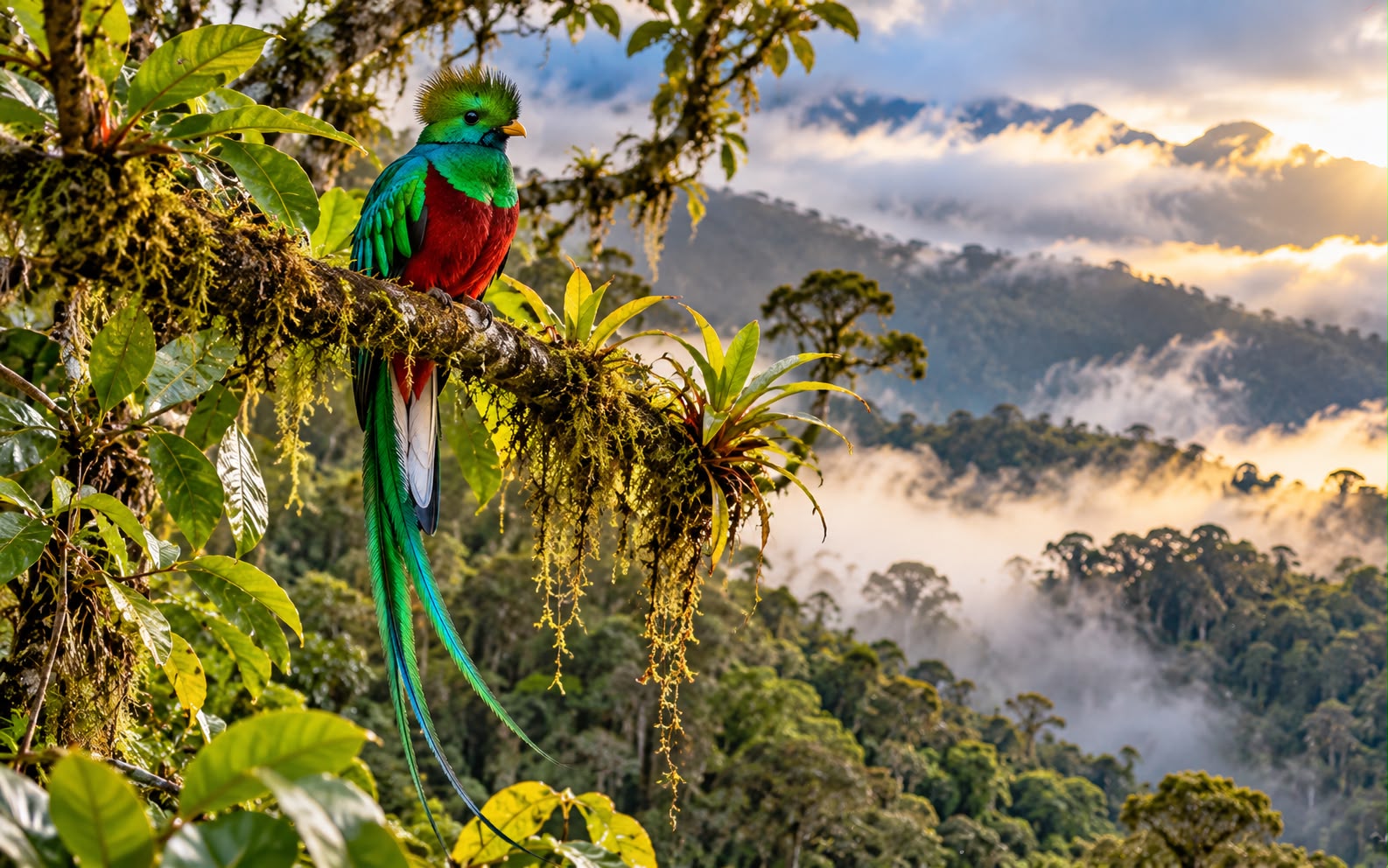
Costa Rica and Panama in 12 days: Arenal, Monteverde, Boquete and the Canal
Two countries on the same isthmus that went opposite ways — one sold its forests to the world as national parks, the other cut itself in half for shipping. Quetzals and hanging bridges, then ships climbing a staircase of locks.
- Mexico and Central America
- 12 days
- ≈ AED 8,100 / person
- Cloud forest and volcanoes, then the canal and an autonomous archipelago
Before you go
Before you go: the admin
Two entries, one easy border
- Most nationalities enter both visa-free — 90 days in Costa Rica, 90 to 180 in Panama.
- Both ask for proof of onward travel and Costa Rica enforces it at check-in more than at immigration. Have a booked flight out.
- The Paso Canoas land border is the main crossing and takes an hour or two. Most visitors fly David or Panama City instead, which this route does.
- Panama charges a small tourist card at some land crossings, in cash.
Flights and driving
- Fly into San José and out of Panama City, open-jaw.
- Costa Rica is a driving country and Panama is not, which is the shape of this route: hire a 4x4 for the Costa Rican week and fly to Panama.
- David to Panama City is an hour by air or seven by road.
- San Blas is reached by 4x4 and boat from Panama City, about three hours each way, or by light aircraft.
The hire car, and the insurance
- Costa Rican hire insurance is mandatory, expensive and not covered by your credit card whatever the card says. The advertised daily rate is roughly half what you will pay. Budget for it rather than being surprised at the desk.
- A 4x4 is genuinely needed for Monteverde and much of the Nicoya and Osa, where the roads are gravel and the river crossings are real.
- Distances take far longer than the map suggests — mountain roads, single-lane bridges and fog mean 100km can be three hours.
Money
- Costa Rican colones and the US dollar in Panama — the dollar is Panama’s official currency, and the balboa exists only as coins pegged to it. There is nothing to change for the Panamanian half.
- Dollars are widely accepted in Costa Rica too, but you will get change in colones at a mediocre rate. Pay in colones where you can.
- A 10% service charge is already on Costa Rican restaurant bills by law, plus tax.
Day by day
Day 1 — Land in San José
- Do not linger. San José is a transit point and most itineraries leave the next morning.
- 14:00 — The Jade Museum or the Pre-Columbian Gold Museum if you have an afternoon — both are good and both are indoors, which matters in the wet season.
- 16:30 — Pick up the car and drive out, or stay near the airport in Alajuela. Do not drive the mountain roads after dark on your first day — they are unlit, steep and poorly signed.
- 19:00 — Dinner in Alajuela, which is a pleasant town and ten minutes from the terminal.
Day 2 — Arenal
- 08:00 — Three hours north-west. The volcano is a textbook cone and has been in a resting phase since 2010, so the lava shows are over — the hot springs, the forest and the lake are the draw now.
- 12:00 — La Fortuna, and drop bags.
- 14:00 — The La Fortuna waterfall, 500 steps down and back, with a pool you can swim in at the bottom.
- 17:00 — The hot springs — Tabacón is the famous one, the free river pools below the bridge are the local one. The free ones are genuinely good and genuinely free.
- 19:30 — Night walks for frogs, snakes and sleeping birds, which is when the forest is busiest. Book one for tonight; they go out around seven.
Day 3 — The canopy, and the lake
- 07:30 — The hanging bridges at Mistico, which put you at canopy level. Early is when the birds and the howler monkeys are active.
- 11:00 — The Arenal Observatory Lodge trails, on the volcano’s flank, with the old lava fields.
- 14:00 — Lake Arenal — a boat, a kayak, or the windsurf end at the far side.
- 17:00 — Sunset with the cone out, which happens on perhaps one afternoon in three. Patience is the whole trick.
- Arrange the lake crossing for tomorrow tonight.
Day 4 — To Monteverde
- 08:00 — Three hours by the lake-crossing route, which is a jeep, a boat across Lake Arenal and a jeep — far better than driving round, which takes five.
- 12:00 — Into Santa Elena. The road up is unpaved and the cloud forest is cloudy. Both are the point.
- 14:30 — The canopy: Selvatura or Sky Adventures for the ziplines and hanging bridges, which Costa Rica invented as a tourist product.
- 18:00 — A night walk in Santa Elena, different again from Arenal’s — this is cloud forest and the species change.
Day 5 — The cloud forest
- 06:30 — Monteverde Cloud Forest Reserve at opening, with a guide who can find things. The reserve caps numbers, so the first entry is both the best and the only quiet one.
- Resplendent quetzals breed February to July and that is when to see them; outside it they are luck.
- 11:00 — Santa Elena reserve is the quieter neighbour and is often better for birds.
- 14:00 — The hummingbird gallery and the bat jungle, both small and both better than they sound.
- 16:30 — A coffee and chocolate tour, which here is about the cloud-forest microclimate rather than decoration.
Day 6 — Manuel Antonio
- 07:00 — Three to four hours south on the coastal road.
- The smallest national park in Costa Rica and the busiest — it sells timed entry and sells out, so book online ahead and go at opening.
- 12:00 — Sloths, capuchins, squirrel monkeys and agoutis on a rainforest trail that ends at a white beach. A guide with a scope finds four times what you will.
- Do not feed anything, and keep food sealed. The capuchins are practised thieves and the feeding has made them sick and aggressive.
- 16:00 — The beach inside the park until it closes, and Playa Biesanz outside it after.
- 18:00 — Sunset from the Quepos road, which is lined with bars facing the right way.
Day 7 — To Boquete
- 07:00 — South to the border, or drop the car at David and fly. The land crossing at Paso Canoas takes two to three hours and is the slow part of the day.
- 14:00 — Boquete sits at 1,200m in the Chiriquí highlands and is cool, green and full of coffee — a relief after the coast.
- 16:00 — A coffee finca tour — this is some of the best arabica in the world and Panamanian Geisha regularly sets the record price at auction. The tours are serious rather than decorative.
- 19:00 — Dinner in town, and book tomorrow’s hike tonight.
Day 8 — Boquete
- 06:00 — The Quetzal Trail between Boquete and Cerro Punta — six hours, and the bird it is named for is genuinely there in season. Arrange the transport at the far end before you set off.
- Volcán Barú is Panama’s highest point at 3,474m and from the summit on a clear day you can see both the Pacific and the Caribbean, which is a thing only a handful of places on earth offer. It is a brutal overnight hike or a pre-dawn 4x4 — pick it instead of the Quetzal Trail, not as well as.
- 15:00 — The hot springs at Caldera and the Caldera petroglyphs, half an hour down the valley.
- 18:30 — Back in Boquete, and an early night.
Day 9 — Fly to Panama City
- 09:00 — An hour from David.
- 13:00 — Casco Viejo — the colonial quarter, UNESCO-listed, half restored and half still ruined, which is what makes it interesting rather than a theme park.
- 16:00 — The Iglesia San José and its golden altar, which legend says was whitewashed to hide it from Henry Morgan.
- 18:00 — Rooftop bars looking back at the modern skyline across the bay.
- 20:00 — The Cinta Costera at dusk, and a ceviche at the fish market — the Mercado de Mariscos does it by the cup for a couple of dollars.
Day 10 — The Canal
- 08:00 — Miraflores Locks with the visitor centre and the museum. Check the transit schedule — ships pass in the morning and mid-afternoon, and without one you are looking at empty concrete.
- A partial transit by boat is the better version if you have the day — you go through the Miraflores and Pedro Miguel locks yourself. These run on fixed days; check before you fix this day.
- 13:00 — The Agua Clara locks on the Atlantic side are the new Panamax ones and take the enormous ships — an hour and a half away, so it is this or Miraflores, not both.
- 16:30 — The Biomuseo by Frank Gehry on the causeway, which explains how the isthmus forming three million years ago changed the planet’s climate and biology.
- 18:30 — The Amador Causeway at sunset, built from the canal spoil.
Day 11 — San Blas
- 05:30 — Three hours by 4x4 and boat, or a short flight. The road is steep, winding and 4x4-only, and the transfers leave very early.
- Guna Yala is autonomous. The Guna run it, charge their own entry fees, and photography of people requires permission and usually a small payment. Tours are Guna-operated.
- 10:00 — Around 365 islands, most of them a sandbar with a few palm trees, and the snorkelling is excellent.
- Accommodation is basic by design — cabins on sand, bucket showers, generator power. That is the experience, not a shortfall.
- A day trip is possible and an overnight is much better.
- 18:00 — Sunset from a sandbar, which is the whole reason to stay.
Day 12 — Fly out of Panama City
- 08:00 — Back to the city, three hours by road from San Blas.
- Tocumen is the best-connected hub in Central America.
- Leave three hours — and more than that if you are coming straight off the San Blas road, which has no alternative if it closes.
Costs and practicalities
Best time to visit
December–April is the dry season on the Pacific side of both countries, which is where this route runs.
- December–April — dry, sunny, busiest and dearest. Christmas and Easter are at a premium in Costa Rica.
- February–July — resplendent quetzals are breeding at Monteverde and on the Quetzal Trail, which is the one wildlife date worth planning around.
- May–November (green season) — mornings are usually clear and the rain comes in the afternoon. The forest is at its best, rates drop sharply, and the wildlife is more active. September and October are the wettest on the Pacific.
- The Caribbean side runs on an opposite calendar — September and October are its driest months, which is why Bocas del Toro and Tortuguero sit outside this routing.
- San Blas is best December to April, when the sea is calmest; the boat crossing is rough in the wet season.
Turtle nesting at Ostional and Tortuguero runs through the wet season, which is the other argument for going then.
Travel tips
- Budget for Costa Rican hire insurance properly. It is mandatory, expensive, and not covered by your credit card whatever the card’s terms say. The advertised rate is roughly half the real one.
- Book Manuel Antonio online ahead — it sells timed entry and sells out, and it is the busiest park in the country.
- Take the jeep-boat-jeep to Monteverde, not the road around. It is faster, cheaper than it looks and far more pleasant.
- Check the canal transit schedule before going to Miraflores. Without a ship it is a lot of concrete.
- Guna Yala is autonomous — separate fees, Guna-run tours, and ask before photographing anyone.
- Do not feed or approach monkeys, and keep food sealed. Human food is making the Manuel Antonio capuchins sick.
- Tap water is safe in most of Costa Rica and in Panama City, but not in Bocas del Toro or on the San Blas islands.
What this trip actually costs
Two people, 11 nights, mid-range comfort, international flights excluded:
| Item | Cost |
|---|---|
| Hotels and cabins, 11 nights | USD 1,540 (≈ AED 5,656) |
| 4x4 hire in Costa Rica, 7 days, with mandatory insurance | USD 840 (≈ AED 3,085) |
| Food and drink, 12 days | USD 700 (≈ AED 2,571) |
| David–Panama City flight and San Blas transfer | USD 700 (≈ AED 2,571) |
| Park entries, guides, canopy and the canal | USD 620 (≈ AED 2,277) |
| Total for two | USD 4,400 (≈ AED 16,159) |
- Roughly USD 2,200 (≈ AED 8,080) per person. Costa Rica is the dearer half — it has priced itself as a premium eco destination and the hire insurance is part of why.
- The mandatory insurance is the line that surprises people and is roughly equal to the car rate itself.
- San Blas as a day trip rather than an overnight saves about $250 for two and is much the lesser version.
- Hotel picks here are chosen on location, not on commission — always check prices and recent reviews before booking.
What to pack
- A proper waterproof and quick-dry clothes. Cloud forest is wet in every season.
- A warm layer for Monteverde and Boquete, both of which are at altitude and genuinely cool at night.
- Binoculars. This is a birding route whether you planned it that way or not.
- Reef shoes and reef-safe sunscreen for San Blas.
- Insect repellent with DEET and your malaria advice checked for San Blas and the lowlands.
- A dry bag for the boat crossings and the afternoon rain.
- Cash in colones and dollars, kept separate.
FAQ
Is Costa Rica worth the price? It is the most expensive country in Central America and it has the best-protected forest, the best guiding and the easiest infrastructure. Whether that is worth double Panama is a personal call; doing both is a way of answering it.
Do I need a 4x4? For Monteverde, yes. For Arenal and Manuel Antonio a high-clearance 2WD is enough. Most people take the 4x4 and are glad of it on the gravel.
Can I drive from Costa Rica to Panama? Yes, via Paso Canoas, and most hire companies prohibit taking the car across. Dropping at David and flying is the normal approach.
Is San Blas worth the effort? If you want an autonomous Indigenous territory and an archipelago with almost no development, yes. If you want a comfortable beach, Bocas del Toro or the Costa Rican Pacific is easier.
When will I see a quetzal? February to July, breeding season, at Monteverde or on the Quetzal Trail, with a guide. Outside that window it is luck.
Prices and entry rules change, and what you need depends on your passport; last checked 29 October 2026, so confirm with the embassy or your airline before booking.


