 The Itinerary
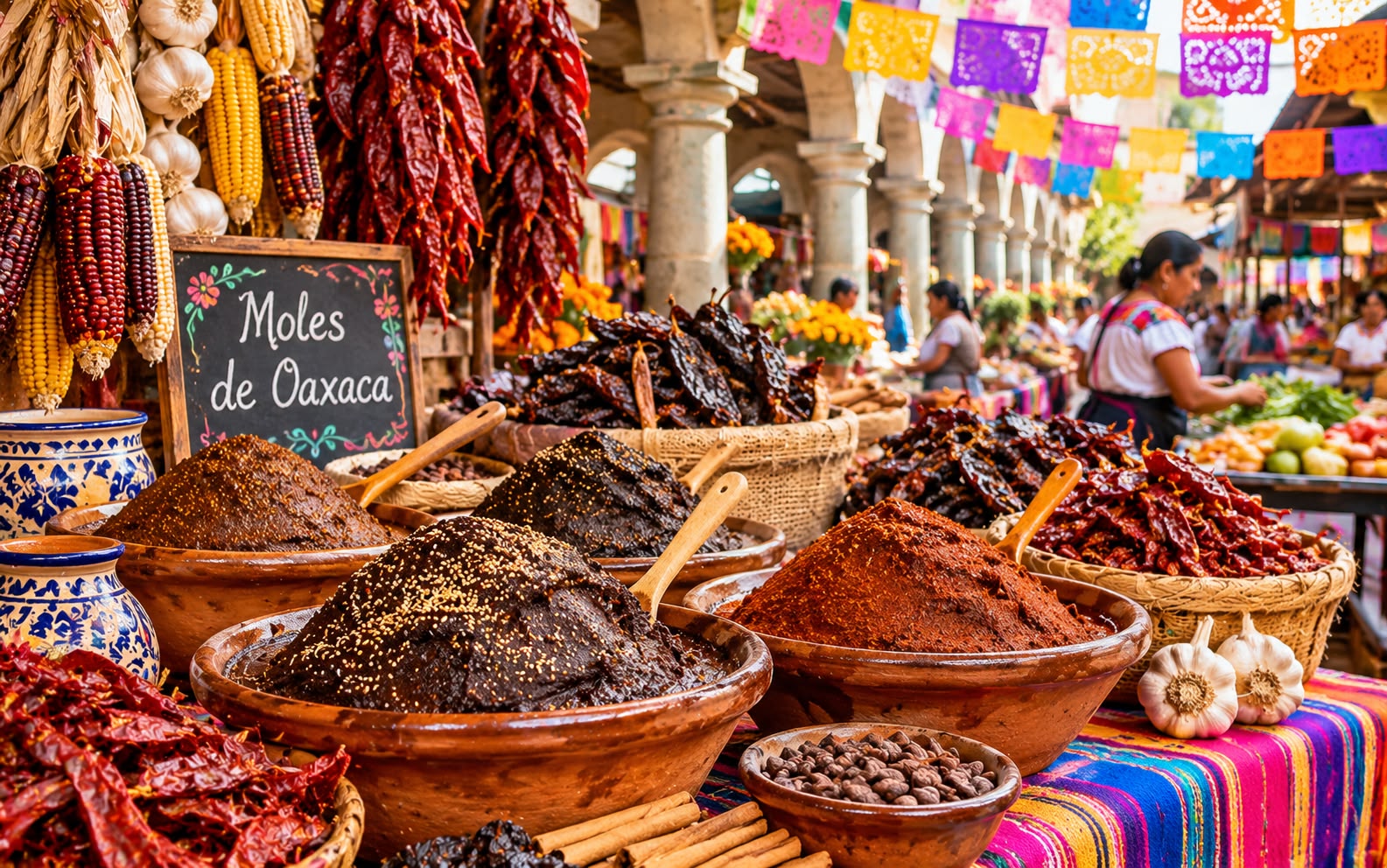
Oaxaca and the Pacific coast in 9 days: markets, mezcal and Mazunte
Four days in Oaxaca for the markets, the mole and the mezcal villages, then over the sierra to a Pacific coast that still has no big resorts. The mountain road that decides how you get there, when the turtles come ashore, and why Día de Muertos doubles every price.
- Mexico and Central America
- 9 days
- ≈ AED 5,150 / person
- The best food in Mexico, then a Pacific beach to sleep it off
Before you go
Mexico’s one guide on this site is Mexico City and the Yucatán — the capital, Chichén Itzá and the Caribbean. Oaxaca is the other Mexico, and for a great many people it is the better one.
This is a food trip that happens to have ruins and a beach. Oaxaca is widely held to be the country’s culinary capital — seven moles, tlayudas, and the mezcal villages an hour out — and the state is also the most indigenous in Mexico, with sixteen recognised peoples and languages.
Then over the sierra to the coast, which is the stretch of Mexican Pacific that resisted being turned into Cancún. Puerto Escondido surfs, Mazunte sleeps, Zipolite is clothing-optional, and none of them has a high-rise.
Fly into Oaxaca, out of Huatulco. Backtracking over that mountain road is the one thing to avoid.
Figure MXN 26,000 (≈ AED 5,125) per person. October to April, and book far ahead for Día de Muertos.
Before you go: the admin
Entry and money
- Many nationalities enter visa-free for up to 180 days; the length is at the officer’s discretion and written on your form. Check yours before booking.
- Cards work in Oaxaca City hotels and restaurants. Markets, colectivos, mezcal palenques and most of the coast are cash. Carry pesos in small notes.
- ATMs: use bank-branded machines inside branches, not the free-standing ones in shops, which charge heavily and have a poorer security record.
- Last checked: 3 November 2026.
Getting over the sierra — the decision that shapes the trip
- Oaxaca City to the coast crosses the Sierra Madre del Sur, and there are three ways:
- Fly. About 35 minutes to Puerto Escondido or Huatulco on a light aircraft. Expensive by Mexican standards, and the baggage allowance is small, but it removes a day.
- The new highway. A toll road has cut the drive to roughly three to four hours, where it used to be six or more. Check its current status — sections have opened in stages.
- The old road, by van or colectivo. Six to seven hours of continuous switchbacks. It is cheap and beautiful and a significant number of people are sick on it — take something for motion sickness and sit at the front.
- This itinerary assumes the highway or a flight.
Día de Muertos
- 1 and 2 November, with the build-up from late October. Oaxaca is one of the two best places in Mexico to see it and the city knows it.
- Rooms double or triple and sell out months ahead. So do the cemetery tours.
- It is a family remembrance, not a carnival. Ask before photographing anyone at a graveside, and in the village cemeteries expect to be asked for a donation rather than a fee.
- If you are not coming for it, avoid the week entirely — you will pay festival prices for an ordinary visit.
Altitude and climate
- Oaxaca City sits at about 1,550 m. Mild, dry and sunny in winter, cool at night. Not high enough to cause real trouble, but you will notice the first day.
- The coast is hot and humid year round, around 30°C, with the rains from June to October.
- Hurricane season runs June to November on this coast. Take insurance that covers it.
Day by day
Day 1 — Oaxaca City
- Stay in the Centro Histórico, which is flat, walkable and where everything on Days 1 to 4 is.
- Afternoon — The Zócalo and Santo Domingo, a baroque church with a gilded interior that is genuinely startling.
- 17:00 — The Mercado 20 de Noviembre and, beside it, the Pasillo de Humo — the smoke corridor, where you buy raw meat by weight and they grill it in front of you. This is the single best cheap meal in the city.
- 20:00 — A mezcal bar. Mezcal is sipped, not shot, and the orange with worm salt is a garnish rather than a dare.
Where to stay in Oaxaca City (four nights)
- Grand: Quinta Real, a converted sixteenth-century convent with the original frescoes.
- Mid-range: a colonial-house hotel in the Centro with a courtyard.
- Simple: a guesthouse in Jalatlaco or Xochimilco — two neighbourhoods just out of the centre, quieter and cheaper.
Day 2 — Monte Albán and the markets
- 08:30 — Monte Albán, twenty minutes up the hill. A Zapotec city built on a levelled mountaintop from about 500 BC, with ball courts, carved stelae and a view over three valleys. Go early; there is almost no shade.
- 12:00 — Back down for lunch.
- 14:00 — The Centro on foot: the Museo de las Culturas in the Santo Domingo complex, which holds the Mixtec gold from Tomb 7, and the Textile Museum, free and excellent.
- 17:00 — The Mercado de Artesanías, and the rug shops. A genuine Teotitlán rug is wool, dyed with cochineal and indigo, and costs what it costs. The cheap ones are acrylic.
- Evening — Tlayudas, which are the Oaxacan street food everyone else calls a pizza and nobody here does.
Day 3 — The valley: mezcal, trees and Hierve el Agua
- A full day east, by hire car, taxi or tour.
- 09:00 — El Tule, a cypress with the stoutest trunk of any tree in the world. Ten minutes, and worth them.
- 10:00 — Teotitlán del Valle, the weaving village. A demonstration of carding, spinning and natural dyeing is the point, not the shop at the end.
- 12:00 — A mezcal palenque at Santiago Matatlán. Agave roasted in a stone pit, crushed by a horse-drawn stone wheel, and distilled in clay or copper. Taste espadín first, then a wild variety, and understand why the wild ones cost what they do.
- 14:30 — Hierve el Agua — petrified mineral waterfalls and spring-fed infinity pools over a valley. Access has been interrupted more than once by disputes between communities, and the site has closed for extended periods — check it is open before you commit the afternoon.
- 18:00 — Back, or Mitla on the way for its geometric Zapotec stonework.
Day 4 — A cooking class, and the last of the city
- A cooking class is the best half-day in Oaxaca. Market first to buy the chillies, then mole negro from scratch, which takes hours and about thirty ingredients.
- The alternative: San Bartolo Coyotepec for black pottery and San Martín Tilcajete for alebrijes — the carved painted animals — both short drives south.
- Evening — Last dinner, and pack light for the coast.
Day 5 — Over the sierra to Puerto Escondido
- Morning — Fly (35 minutes) or drive the new highway (three to four hours). If you are taking the old road, leave at dawn and write the day off.
- Afternoon — Puerto Escondido. Stay at La Punta for the surf-town end or Zicatela for the big-wave beach.
- Zicatela is a serious wave and not a swimming beach. The Mexican Pipeline drowns strong swimmers. Playa Carrizalillo, down a long staircase, is the sheltered one.
- Sunset — Carrizalillo or La Punta, with everyone else.
Where to stay in Puerto Escondido (two nights)
- Grand: a boutique hotel on the cliff above Carrizalillo.
- Mid-range: a hotel with a pool at La Punta or Rinconada.
- Simple: surf hostels and cabañas at La Punta, which is where the town’s evening is.
Day 6 — Dolphins, lagoons, or a surf lesson
- 06:00 — A boat from Puerto Angelito. Dolphins are common, turtles near certain, and humpbacks pass from December to March.
- The alternative: Laguna de Manialtepec, half an hour west, for birdlife at dawn — and bioluminescence on moonless nights, which is a different trip entirely and worth timing for.
- Afternoon — A surf lesson at La Punta, which is the beginner break. Not at Zicatela.
- Evening — The fish market, or the long row of beach restaurants.
Day 7 — East to Mazunte
- Morning — Drive or colectivo east, about an hour and a half.
- Midday — Mazunte. A village that used to live by killing turtles and now lives by not doing so — the national turtle centre here is the result.
- Afternoon — Punta Cometa, the headland, which is the southernmost point of Oaxaca and the sunset walk.
- The neighbours: San Agustinillo is a five-minute drive and calmer; Zipolite is the next bay and is Mexico’s only legally clothing-optional beach — go or do not, but know before you arrive.
- Zipolite’s surf is dangerous and the name means “beach of the dead”. Swim where the flags are.
Where to stay in Mazunte (two nights)
- Grand: a cliffside eco-hotel with open-air rooms above the bay.
- Mid-range: a posada in the village, a minute from the sand.
- Simple: cabañas and hammock places, of which there are many.
Day 8 — Turtles
- The turtle release is the thing to time. Olive ridleys nest on this coast most of the year, with arribadas — mass nestings — concentrated between roughly August and November at La Escobilla. Hatchling releases run on a schedule that depends on the nests, so ask locally the day you arrive rather than booking months ahead.
- Morning — The Centro Mexicano de la Tortuga in Mazunte, which is a research centre with tanks rather than a show.
- Afternoon — Nothing. This is the day the trip is for.
- Sunset — Punta Cometa again, because it is better the second time.
Day 9 — Huatulco, and out
- Morning — Drive east to Huatulco, about an hour and a half, through the last of the coast.
- If the flight is late: the Bahías de Huatulco — nine bays, several reachable only by boat, and the most developed stretch of this coast, which here means a few low-rise hotels.
- Huatulco airport is 20 minutes from La Crucecita.
Costs and practicalities
Best time to visit
October to April, which is the dry season and the cooler one.
- November to March — the best window. Oaxaca is dry and mild, the coast is hot without being brutal, and whales pass from December. Avoid the Día de Muertos week unless that is why you are coming.
- Late October to 2 November — Día de Muertos. Extraordinary, and the most expensive and crowded week of the Oaxacan year.
- April and May — hot and dry inland, very hot on the coast. Semana Santa fills everything.
- June to October — the rains. Oaxaca gets afternoon storms and is at its greenest; the coast is humid and this is hurricane season. It is also the cheapest time and the arribada months.
- Guelaguetza, in late July, is Oaxaca’s other great festival — two Mondays of regional dance — and books out similarly.
Travel tips
- Fly into Oaxaca, out of Huatulco. Do not cross the sierra twice.
- Take motion-sickness tablets if you are on the old mountain road.
- Check Hierve el Agua is open before building a day around it.
- Carry cash. Markets, colectivos and most of the coast are cash-only.
- Do not swim at Zicatela or Zipolite outside the flags.
- Mezcal is sipped. Three tastings is a session, not a warm-up.
- Ask before photographing people, especially in villages and at Día de Muertos gravesides.
- A genuine Teotitlán rug is wool and naturally dyed. Ask them to show you the cochineal.
- Book Día de Muertos and Guelaguetza months ahead or avoid those weeks.
What this trip actually costs
Two people, 8 nights, mid-range throughout, international flights excluded:
| Item | Cost |
|---|---|
| Hotels and posadas, 8 nights | MXN 17,000 (≈ AED 3,351) |
| Food and drink, 9 days | MXN 13,000 (≈ AED 2,563) |
| Transport: the sierra crossing, colectivos, taxis | MXN 8,000 (≈ AED 1,577) |
| A cooking class, a mezcal palenque, Monte Albán, Mitla | MXN 7,000 (≈ AED 1,380) |
| A boat morning, the turtle centre, beach days | MXN 4,000 (≈ AED 788) |
| Extras | MXN 3,000 (≈ AED 591) |
| Total for two | MXN 52,000 (≈ AED 10,250) |
- Roughly MXN 26,000 (≈ AED 5,125) per person for nine days.
- This is noticeably cheaper than the Yucatán for the same standard — Oaxaca has no all-inclusive economy inflating prices, and the coast has almost no chains.
- The sierra crossing is the one variable worth paying for. Flying costs several times the van and removes most of a day.
- Market eating is both the cheapest and the best food here. The Pasillo de Humo costs a fraction of a restaurant and is better.
- Hotel picks here are chosen on location, not on commission — always check prices and recent reviews before booking.
What to pack
- A light jacket for Oaxaca evenings — 1,550 m gets cool after dark even in April.
- Beach clothes and a rash vest for the coast’s sun.
- Walking shoes for Monte Albán, which is uneven stone with no shade.
- Reef-safe sunscreen and a hat.
- Insect repellent for the coast and the lagoons.
- Cash in small notes, more than you think.
- Motion-sickness tablets if the old road is your route.
- A Type A or B adapter, 127V.
Part of a bigger trip?
- Mexico in 10 days is Mexico City, Chichén Itzá and the Caribbean — the two together make an excellent three weeks.
- Add Chiapas east of Oaxaca — San Cristóbal, Palenque and the Sumidero canyon — for five or six more days.
- Mexico City is an hour’s flight from Oaxaca and is the obvious bolt-on at either end.
FAQ
Is Oaxaca safe? Oaxaca City and this stretch of coast are among the more relaxed parts of Mexico, and ordinary city sense is the whole of it: bank ATMs rather than shop ones, a taxi or a ride app late at night, nothing flashy on display. Check your government’s current travel advice by state before you book, since Mexican advisories are issued state by state and change.
How do I get from Oaxaca to the coast? Three ways. A 35-minute light-aircraft flight, which costs the most and saves the most. The new toll highway, roughly three to four hours by car or van — check its current status, as it has opened in stages. Or the old road, six to seven hours of switchbacks, cheap and genuinely nauseating for many people.
Is Día de Muertos worth planning around? If you want it, yes, and it needs booking months ahead at double or triple the normal rate. If you do not, actively avoid the week — you will pay festival prices for a city that is full. It is a family remembrance rather than a spectacle, so photograph gravesides only after asking.
When can I see turtles? Olive ridleys nest on this coast for most of the year, with the mass arribadas concentrated roughly between August and November. Hatchling releases depend on which nests are ready, so they cannot be booked far ahead — ask in Mazunte the day you arrive. The turtle centre itself is open year-round.
Can I swim at the beaches? At Carrizalillo, Puerto Angelito, San Agustinillo and Mazunte’s main bay, yes, with care. Not at Zicatela, which is a world-class surf break that drowns strong swimmers, and not outside the flags at Zipolite, whose name translates roughly as “beach of the dead”.
Prices and entry rules change, and what you need depends on your passport; last checked 3 November 2026, so confirm with the embassy or your airline before booking.


