 The Itinerary
Mundo Maya in 14 days: Tikal, Copán and the Belize barrier reef
Temples above the rainforest canopy, the finest carved hieroglyphs in the Americas, a cave the Maya used for sacrifice that still holds the bones — and then the second-largest barrier reef on earth, because the same people traded along it.
- Mexico and Central America
- 14 days
- ≈ AED 8,450 / person
- One civilisation, three modern borders, and a reef at the end of it
Before you go
Before you go: the admin
Three countries, one border agreement
- Most nationalities enter all three visa-free — 90 days each.
- The CA-4 agreement covers Guatemala, Honduras, El Salvador and Nicaragua as a single zone: your 90 days is shared across all four, and crossing between them does not reset it. Belize is not in the CA-4 and gives its own 30 days.
- Belize charges a departure tax when you leave overland, payable in cash — more than people expect, and the border post does not take cards.
- Guatemala and Honduras both charge a small land-border fee. Carry small US dollars.
Flights and the shape of the route
- Fly into Guatemala City and out of Belize City, which avoids a long backtrack. An open-jaw costs much the same as a return.
- One internal flight does the heavy lifting: Guatemala City to Flores for Tikal, about an hour. The overland alternative is eight to ten hours on a night bus and costs you a day at both ends.
- The Flores to San Ignacio crossing at Melchor de Mencos is a shuttle and takes three to four hours including the border.
- Water taxis, not flights, to the cayes — 45 minutes from Belize City to Caye Caulker.
Money
- Three currencies: the quetzal, the lempira and the Belize dollar. None is usable in the others.
- The Belize dollar is fixed at two to the US dollar and US dollars circulate freely there. Always confirm which currency a price is in — “thirty dollars” means two very different things.
- Cards work in Antigua, San Ignacio and the cayes and poorly elsewhere. ATMs on Caye Caulker run out; draw in Belize City or San Ignacio.
- Carry small US dollars for border fees and the departure tax.
One gentle brief
- Belize is the odd one out and that is the point. It is English-speaking, Caribbean, and was British Honduras until 1981 — arriving there from Guatemala is a bigger change than the forty-minute drive suggests.
- Altitude, then heat. Antigua is 1,500m and Atitlán 1,560m, both cool at night; the Petén and the cayes are humid lowland.
- Shuttles between tourist towns, not chicken buses. The chicken buses are an experience and are also where most robberies of travellers happen.
Day by day
Day 1 — Land in Guatemala City, go to Antigua
- Do not stay in Guatemala City. Antigua is an hour away and is where everyone bases.
- A cobbled colonial grid under three volcanoes, UNESCO- listed, ruined repeatedly by earthquakes and left half-rebuilt, which is what gives it its look.
- The Santa Catalina arch at the end of 5a Avenida with Volcán de Agua framed behind it.
Day 2 — Antigua
- The ruined churches — Las Capuchinas, La Recolección, San Francisco — which were left as they fell in 1773.
- Cerro de la Cruz at dawn for the volcanoes over the roofs.
- A coffee finca on the slopes of Agua, where the beans are picked, washed and dried in front of you.
- Semana Santa, the week before Easter, turns the streets into sawdust carpets and processions and is the biggest event in Central America. The town books out a year ahead.
Day 3 — Acatenango, or straight to Atitlán
- The Acatenango overnight is the hard option — 1,500m of ascent to 3,900m, camping on the ridge, and Volcán de Fuego erupting across the saddle all night. It is genuinely difficult and genuinely unforgettable.
- Or Pacaya as a half-day, which is a gentler active volcano with lava-warmed ground at the top.
- Or go straight to Lake Atitlán, three hours west.
Day 4 — Lake Atitlán
- A caldera lake under three volcanoes, with a dozen Maya villages round the shore and no road to most of them.
- Boats are the transport. San Pedro for the budget crowd, San Marcos for the yoga, San Juan la Laguna for the weaving and dyeing cooperatives, which are the best thing on the lake and are women-run.
- The afternoon wind — the Xocomil — gets up around midday and makes the crossings rough. Do the long boat legs in the morning.
- Santiago Atitlán for Maximón, a folk saint who smokes and drinks and is housed in a different family’s home each year.
Day 5 — Chichicastenango, or a second lake day
- Chichicastenango’s market on Thursday and Sunday is the largest in Central America — and the Santo Tomás church steps, where Maya ceremonies are conducted on Catholic ground, are the real sight.
- Do not photograph people or ceremonies without asking. This matters a great deal in the highlands and has caused serious trouble.
Day 6 — To Copán, in Honduras
- A long day east — five to six hours including the Agua Caliente border.
- Copán Ruinas is a small, pleasant town and the site is a mile out.
Day 7 — Copán
- Copán is the art of the Maya world. It is not the biggest site and it holds the finest sculpture — the Hieroglyphic Stairway, 63 steps carrying some 2,200 glyphs, which is the longest Maya text that survives.
- The stelae of the Great Plaza, carved almost in the round, which is unique to this city.
- The Rosalila temple replica in the sculpture museum, buried intact under a later pyramid and painted as it was.
- The macaws in the entrance forest are a reintroduction programme and are startling.
- A guide is worth it here more than anywhere on this route — the carving is a text and without someone to read it you are looking at pattern.
Day 8 — Back to Guatemala, fly to Flores
- Return across the border and on to Guatemala City, then fly north to Flores — an hour.
- Flores is an island town on Lake Petén Itzá, joined to the mainland by a causeway, and is a pleasant base rather than a sight.
- Sunset from the western shore and a swim off the dock.
Day 9 — Tikal
- Leave at four. The sunrise tour gets you into the park before the gates open to day visitors, and the howler monkeys start before the light does.
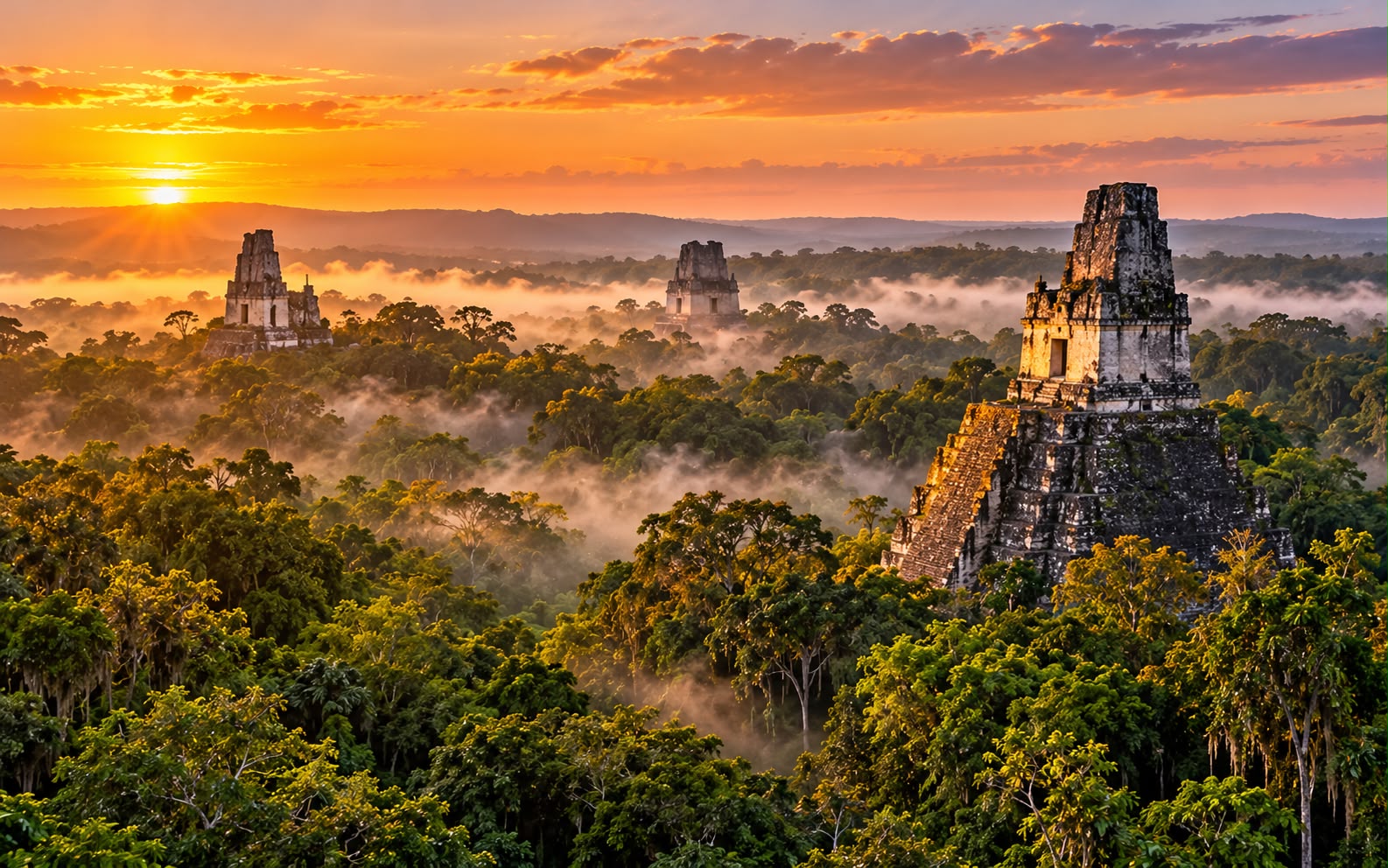
- Temple IV is the tall one — 70m, above the canopy, with the combs of Temples I, II and III breaking through the green. It is the view from the end of the first Star Wars film.
- The Great Plaza with Temple I, the Jaguar temple, and the North Acropolis behind it.
- Tikal was a city of perhaps 60,000 people and what is cleared is a fraction of it; the forest between the temples is still full of unexcavated mounds.
- Go slowly and listen. The toucans, spider monkeys and coatis are half the visit.
Day 10 — Yaxhá, and the crossing to Belize
- Yaxhá on the way east — a lakeside site with almost nobody at it, and the sunset from Temple 216 is better than Tikal’s.
- Cross at Melchor de Mencos into Belize. The Belize departure tax applies when you leave again — have cash.
- San Ignacio in the Cayo district, which is the base for the caves and the inland sites.
Day 11 — The ATM cave
- Actun Tunichil Muknal is the best thing in Belize and one of the most extraordinary archaeological visits anywhere.
- You swim into the entrance, then wade and scramble a kilometre underground to a chamber of Maya sacrificial remains — pots, and fourteen sets of human bones calcified into the floor, including the “Crystal Maiden”.
- A licensed guide is mandatory and numbers are capped.
- Cameras have been banned inside since 2012, after a visitor dropped one on a skull. The rule is absolute and enforced — do not ask.
- It is physical: swimming, wading in current, squeezing through gaps, and socks-only in the chamber.
Day 12 — Caracol or Xunantunich, then to the coast
- Xunantunich is twenty minutes away, reached by a hand-cranked cable ferry across the Mopan, with El Castillo’s carved frieze at the top.
- Caracol is the bigger prize — Belize’s largest site, once more powerful than Tikal, which it defeated in 562 AD — but it is three hours each way on a rough road and sometimes requires a convoy.
- Then east to Belize City and the water taxi out.
Day 13 — Caye Caulker
- “Go slow” is the island’s actual motto and is painted on the signs. There are no cars, the streets are sand, and the golf carts move at walking pace.
- The Belize Barrier Reef is the second largest on earth after Australia’s, UNESCO-listed, and was on the danger list until 2018.
- Hol Chan Marine Reserve and Shark Ray Alley — a cut through the reef with nurse sharks and southern stingrays, and the snorkelling is as good as any in the Caribbean.
- The Split at the north end for swimming and a rum punch.
Day 14 — Fly out of Belize City
- The early water taxi back, which takes 45 minutes.
- The Blue Hole is a scenic flight or a full-day dive from here if you have a spare day — it is a sinkhole 300m across and is more impressive from the air than underwater.
- Leave three hours. The international terminal is small and slow.
Costs and practicalities
Best time to visit
December–April is the dry season across all three, and it is unusually well aligned for a three-country route.
- December–April — dry, clear, and the best for the archaeology and the reef. Peak is Christmas to mid-January and Easter. Whale sharks at Gladden Spit run roughly March to June around the full moons.
- February–April — the sweet spot: driest, clearest, and the ATM cave is reliably open.
- May–June — the rains begin as afternoon downpours. Mornings are usually clear, the Petén is luminous, and rates fall.
- June–November — the wet season and the Atlantic hurricane season, peaking August to October. The ATM cave closes when the river is high, which is the one thing to check before building a trip around it.
- The highlands are cool year-round — Antigua and Atitlán are 1,500m and need a layer at night in any month.
Semana Santa, the week before Easter, is extraordinary in Antigua and books out a year ahead.
Travel tips
- No cameras in the ATM cave. The ban has been absolute since 2012, when a visitor dropped one on a skull. Do not ask your guide to make an exception.
- Check the ATM cave is open before planning around it — it closes when the Roaring Creek is high, which happens in the wet season.
- The CA-4 agreement means your 90 days is shared across Guatemala, Honduras, El Salvador and Nicaragua. Crossing between them does not reset the clock. Belize is separate.
- Carry small US dollars for border fees and the Belize departure tax, which is cash-only and larger than people expect.
- Always confirm which dollar. Belize dollars and US dollars are both called dollars and differ by a factor of two.
- Use shuttles between tourist towns, not chicken buses.
- Do not photograph people or ceremonies in the Guatemalan highlands without asking. This is taken seriously and has caused real trouble.
- Do the long Atitlán boat crossings in the morning, before the Xocomil wind gets up around midday.
What this trip actually costs
Two people, 13 nights, mid-range comfort, international flights excluded:
| Item | Cost |
|---|---|
| Hotels and guesthouses, 13 nights | USD 1,300 (≈ AED 4,774) |
| Shuttles, drivers and border transfers | USD 900 (≈ AED 3,305) |
| Guides and entries: Tikal, Copán, ATM, Xunantunich | USD 800 (≈ AED 2,938) |
| Food and drink, 14 days | USD 700 (≈ AED 2,571) |
| Hol Chan snorkelling, water taxis, Atitlán boats | USD 500 (≈ AED 1,836) |
| Guatemala City–Flores flight, two people | USD 400 (≈ AED 1,469) |
| Total for two | USD 4,600 (≈ AED 16,894) |
- Roughly USD 2,300 (≈ AED 8,447) per person, which makes this one of the best-value multi-country routes on the site.
- Belize is two to three times the price of Guatemala for the same standard, and the cayes are the most expensive nights of the trip.
- The Flores flight is worth every dollar. The overland alternative is a night bus and two lost days.
- The ATM cave is the single best-value excursion here and is not something to book on price.
- Hotel picks here are chosen on location, not on commission — always check prices and recent reviews before booking.
What to pack
- A warm layer for the highlands. Antigua and Atitlán are cold at night and nobody packs for it in a tropical country.
- Shoes and socks you can soak for the ATM cave — you swim in, and the chamber is socks-only.
- A dry bag for the cave, the boats and the afternoon rain.
- Reef-safe sunscreen and a rash vest for Hol Chan.
- Insect repellent with DEET for the Petén, where the mosquitoes at Tikal at dawn are serious.
- Small US dollars for the border fees and the departure tax.
- A torch — power on Caye Caulker is not continuous.
FAQ
Can I really photograph nothing in the ATM cave? Nothing. Cameras and phones have been banned inside since 2012 after a visitor dropped one on a 1,000-year-old skull. Guides lose their licence over it.
Is Copán worth the detour into Honduras? Yes. It is the finest Maya sculpture anywhere and the Hieroglyphic Stairway is the longest surviving Maya text. It is a day’s travel each way and it is the reason this route has three countries in it rather than two.
Tikal or Caracol? Tikal, on a first visit — bigger, better excavated, and the Temple IV canopy view is unmatched. Caracol is the connoisseur’s choice and is three hours of rough road each way.
Is Belize expensive? Compared with Guatemala and Honduras, yes — two to three times for the same standard. Caye Caulker is cheaper than Ambergris and has more character.
What language will I need? Spanish in Guatemala and Honduras, and some of it is essential outside the tourist towns. Belize is English-speaking, which is one of the pleasant surprises of the route.
Prices and entry rules change, and what you need depends on your passport; last checked 20 October 2026, so confirm with the embassy or your airline before booking.


