 The Itinerary
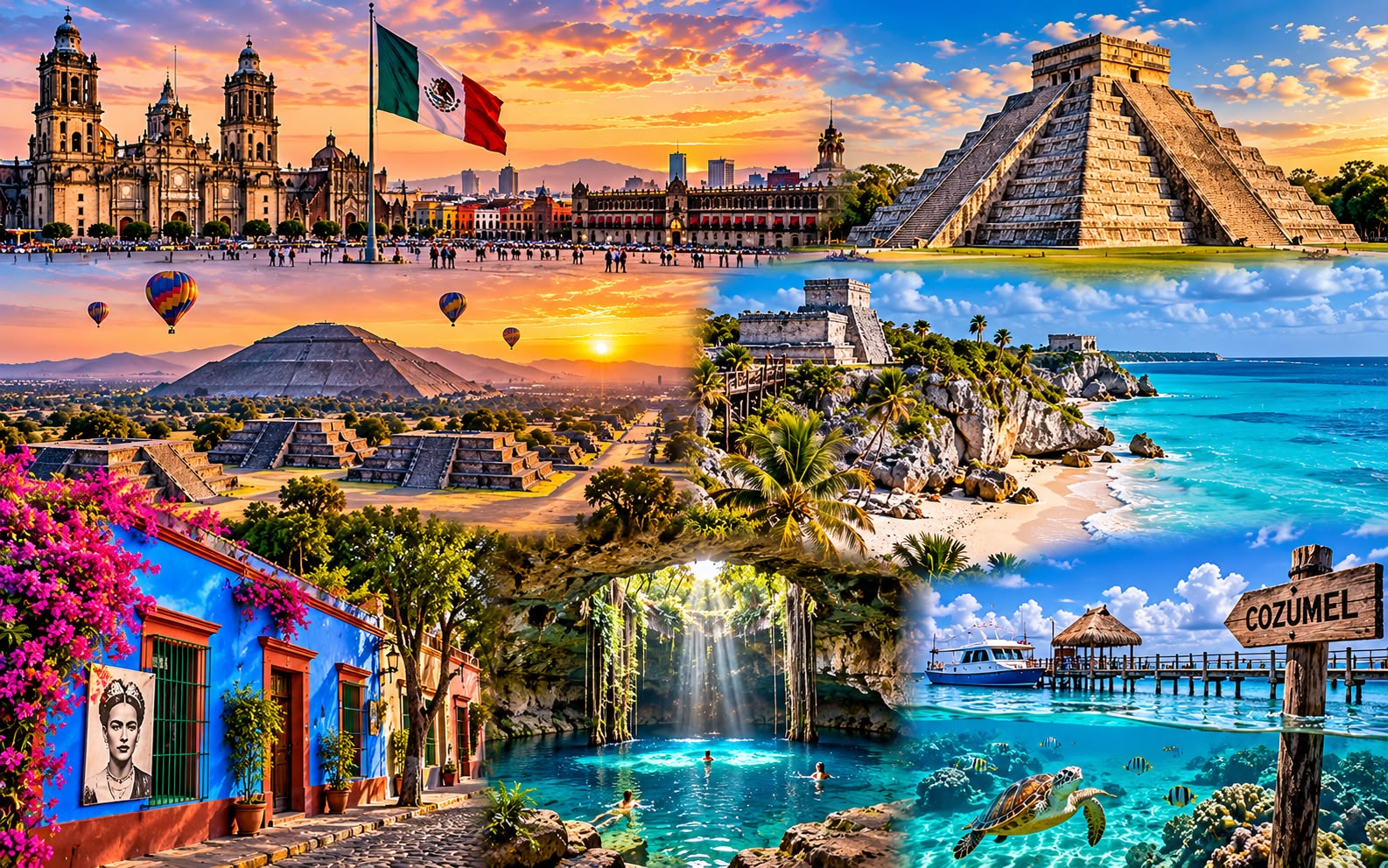
Mexico in 10 days: Mexico City and the Yucatán
The two Mexicos in one trip: the 22-million-person capital of Aztec ruins, Frida's blue house and the world's best street tacos, then the Maya coast — Chichén Itzá at opening time, jungle cenotes, Tulum's clifftop ruins over turquoise water. Plus the visa rule worth knowing: a valid US, UK or Schengen visa gets you in without a Mexican one.
- Mexico and Central America
- 10 days
- ≈ AED 6,100 / person
- Culture + beach
Before you go
Mexico is two brilliant countries wearing one name. The capital is the Spanish-speaking world’s greatest city — Aztec temple foundations under a colonial square, Diego Rivera’s murals, neighbourhoods that out-eat Paris at a tenth of the price. A two-hour flight east, the Yucatán is something else entirely: flat jungle pierced by turquoise sinkholes, thousand-year-old Maya pyramids, and the Caribbean doing its best screensaver impression.
Ten days covers both properly — four in the capital, five on the coast — and the logistics are gentler than Mexico’s headlines suggest: one internal flight, comfortable ADO coaches, Uber in the city, and tour pickups for the ruins.
Go November–April — dry, warm, mosquito-light (December– January is peak price). May–October is hot, humid and hurricane-season on the coast (September–October is the real risk window), with sargassum seaweed a variable beach guest April–August. Mexico City is spring-like all year — and 2,240 m high, so expect one breathless first day. All costs are in Mexican pesos (MXN).
Before you go: the visa rule, money and safety
The visa rule worth checking first
- Hold a valid US, UK, Canadian, Japanese or Schengen visa? You’re in free. Whatever passport you carry, Mexico waives its own visa for holders of a valid, multiple-entry visa from any of those countries — or permanent residence in them. Show it at check-in and at immigration, fill the entry form, done. Two catches: electronic authorisations like ESTA or the UK ETA do not count, it has to be a visa in the passport; and an ordinary residence permit is not permanent residence, so a Gulf residence visa won’t do it on its own. If you have been through our USA guide, that $435 B1/B2 keeps paying dividends.
- Check whether you need anything at all. Mexico admits a long list of nationalities visa-free for tourism — the EU and UK, the US and Canada, Japan, Australia, New Zealand and most of South America among them. Look your own passport up before assuming you need paperwork.
- Neither of those? You need a consular Mexican visa: ~US$56, biometrics in person, typically 1–2 weeks’ processing, and often issued up to 10 years multiple-entry — apply 4–6 weeks ahead at the Mexican embassy serving where you live, and confirm which one that is before you book. Mexico’s SAE online authorisation covers only Russian, Turkish and Ukrainian passports.
Routing warning
- Routing warning: many cheap fares into Cancún connect through the USA, which needs a US transit visa even if you never leave the airport. Without one, route via Europe, Istanbul or Panama instead.
Money, water and tipping
- Cash still matters: cards work in cities and resorts, but ruins ticket booths, cenotes, colectivos and taco stands are pesos-only — carry 1,500–2,000 MXN in small notes; ATMs at real banks beat airport exchange desks.
- Water: bottled or filtered only — including teeth- brushing for sensitive stomachs. Street food is glorious and safest at busy stalls with high turnover (the queue is the hygiene certificate). Ease in; carry rehydration salts.
- Tipping: 10–15% at restaurants (often not included), 20–50 MXN for porters and tour guides’ hats.
- eSIM ~US$10–15; Telcel coverage is excellent on this route.
The safety honesty
- The safety honesty: Mexico’s violent headlines are real and overwhelmingly elsewhere — the CDMX tourist core, the Riviera Maya corridor and the ruins circuit see millions of visitors with ordinary big-city precautions. The rules that matter: Uber/DiDi, never street taxis, in Mexico City; authorised prepaid taxis only at airports; nothing flashy on the metro; beach-town common sense after midnight.
Travelling with kids?
- Kids: Mexicans adore them — under-11s pay 100 MXN at the big ruins, under-13s enter Teotihuacán free, cenotes are nature’s swimming pools (life jackets provided), and the whole Yucatán runs on family logistics.
Day by day
Day 1 — Land in Mexico City, the Zócalo at night
Stay in the Centro Histórico (walk to the big sights — our verified picks below) or leafy Roma Norte/Condesa (the café-and-taquería quarter, 15 min by Uber).
- Afternoon — Land at MEX. Uber or authorised airport taxi in (~250–350 MXN, 30–60 min by traffic).
- 18:00 — Walk into the Zócalo: one of the world’s largest squares, the Metropolitan Cathedral sinking gently into the old lake bed, the flag the size of a tennis court.
- 19:30 — First tacos: al pastor carved off the trompo, five for ~80 MXN, salsa courage optional. Follow with churros dipped at El Moro (open till late).
Where to stay in Mexico City (four nights)
- Luxury: Gran Hotel Ciudad de México — 4.9/5 on TripAdvisor (~8,300 reviews), the Art Nouveau lobby with the Tiffany stained-glass ceiling, rooftop breakfast over the Zócalo. ~3,500–5,000 MXN.
- Mid-range: Hotel Histórico Central — 4.8/5 (~3,100 reviews), free breakfast and all-day snacks a block from the cathedral. ~2,000–2,800 MXN.
- Budget: Hotel Catedral — 4.6/5 (~2,800 reviews), the centro’s long-standing value pick. ~1,200–1,700 MXN.
Day 2 — Aztec centro and the murals
- 09:00 — Templo Mayor (~100 MXN): the Aztec great temple excavated beside the cathedral — Tenochtitlan surfacing through the Spanish city built on top of it.
- 11:00 — Palacio Nacional (free, passport ID): Diego Rivera’s staircase mural — the entire history of Mexico in one wall. Then the gold-domed Palacio de Bellas Artes (~90 MXN) for Rivera’s Man at the Crossroads — the one Rockefeller destroyed, repainted here in defiance.
- 13:30 — Lunch at a centro fonda: comida corrida (soup, guisado, agua fresca) for ~90–130 MXN.
- 15:30 — Coffee at the Sears café terrace for the Bellas Artes dome photo, then ride the Torre Latinoamericana (~200 MXN) for smog-and-volcano sunset views over the endless city.
- 20:00 — Dinner in Roma Norte — this is one of the world’s great food neighbourhoods; queue where the locals queue (~150–300 MXN a head).
Day 3 — Teotihuacán, then the Anthropology Museum
- 07:00 — Beat the sun to Teotihuacán (entry 210 MXN, under-13s free): the 80 MXN public bus from Terminal del Norte takes ~1 h, tours run 900–1,500 MXN with guide and pickup, and the sunrise hot-air balloon over the Pyramid of the Sun (~3,300–5,000 MXN) is the splurge people frame. Walk the Avenue of the Dead between the two great pyramids (climbing is no longer allowed — the views from the plazas still stun). Three hours before the heat.
- 14:00 — Back in the city: late lunch, then the Museo Nacional de Antropología (~100 MXN, closed Mondays) in Chapultepec Park — the Aztec Sun Stone, Pakal’s jade mask, and the finest museum in the Americas. Two hours minimum; it earns them.
- 19:30 — Stroll Reforma at dusk to the Angel of Independence; dinner in Polanco (upscale) or back in Condesa (better tacos, half the bill).
Day 4 — Frida, floating gardens, flying wrestlers
- 09:00 — Coyoacán: cobbled plazas, the mercado’s tostadas, and the Frida Kahlo Museum (Casa Azul) — 320 MXN foreigners, timed entry, and it sells out weeks ahead on the official boletos.museofridakahlo.org.mx — this is the trip’s second-hardest ticket after nothing. Book it the day your flights fix.
- 13:30 — Xochimilco: hire a painted trajinera boat on the Aztec canals (~600–800 MXN per boat per hour — the whole boat, not per person; take two hours, buy elotes and micheladas from passing canoes, pay the floating mariachis for one song).
- 19:00 — If it’s Tuesday or Friday: Lucha Libre at Arena México (~300–700 MXN) — masked wrestlers, flying grandmothers’ insults, pure joy. Otherwise: farewell-to- CDMX dinner and an early pack.
Day 5 — Fly to the Caribbean
- 09:30 — MEX → Cancún (~2h15; Aeroméxico, Viva, Volaris from ~1,200–2,200 MXN — budget carriers charge for every bag, price the total).
- 13:30 — Land CUN, skip the taxi hustle: the ADO coach to Playa del Carmen (~275 MXN, 1h15, hourly) is comfortable, cold and scam-proof.
- 16:00 — Check in, then Quinta Avenida (5th Avenue) — the walking street’s 20 blocks of everything — and toes in the Caribbean before dinner.
- 20:00 — Dinner off the Quinta (two blocks inland, prices drop 40%): tacos de camarón, aguachile (~150–250 MXN a head).
Where to stay on the Riviera Maya (five nights, Playa del Carmen base — central for every day trip below)
- Luxury all-inclusive: Grand Velas Riviera Maya — 4.8/5 (~7,000 reviews), the coast’s benchmark resort. ~12,000+ MXN all-in.
- Beachfront charm: Mahekal Beach Resort — 4.6/5, palapa-roof bungalows on the sand at the quiet north end, no wristbands. ~4,500–6,500 MXN.
- Family all-inclusive value: Paradisus Playa del Carmen — 4.5/5 (~18,500 reviews), kids’ club and swim-up everything. ~6,000–8,500 MXN all-in.
- Town-centre budget beds (Calle 38 area) run 1,100–1,800 MXN — plentiful; check current reviews before booking.
Day 6 — Chichén Itzá, done right
- 06:30 — Leave early — this is the day that punishes lie-ins. Options: a tour with Valladolid + cenote + lunch (~1,400–1,800 MXN pp, pickup included) or DIY by ADO coach. Entry is 697 MXN (100 MXN under-12s) — cash pesos; the state and federal desks are separate, keep both tickets.
- 10:00 — El Castillo: the calendar-pyramid whose staircases count the year, where the serpent-shadow crawls down at equinox. The ball court’s acoustics, the Temple of Warriors, the cenote of sacrifices. Two to three hours; the vendor gauntlet inside is part of the experience — a polite “no, gracias” on repeat works.
- 13:00 — Valladolid: pastel colonial streets, lunch of cochinita pibil, and a swim at Cenote Zací or Suytun (the Instagram light-beam one, ~150–250 MXN).
- 19:00 — Back in Playa by dark; easy dinner.
Day 7 — Tulum: ruins on a cliff, cenotes in the jungle
- 07:30 — Colectivo van down the highway (~50 MXN, every 10 min) to Tulum’s ruins at 08:00 opening (265 MXN including the national-park and Jaguar Park fees; +20 MXN shuttle): the only Maya city built on a cliff — iguanas, palm shade, and that view of green-blue water that sells a million posters. Ninety minutes before the heat and cruise crowds.
- 10:30 — Swim below the ruins at Playa Paraíso, or head straight for cenote hours: Gran Cenote (~500 MXN — snorkel with turtles under stalactites) and Cenote Calavera or Azul (~150–250 MXN) — two is the right number; bring biodegradable-only sunscreen, it’s checked.
- 15:00 — Lunch in Tulum pueblo (~150–250 MXN), a look at the beach-road boutiques if you must, colectivo home.
- 20:00 — Playa dinner and, if energy allows, the Quinta’s people-parade with marquesitas (Yucatán’s crêpe- cousin, ~50 MXN) for dessert.
Day 8 — Island day: Cozumel
- 09:00 — The ferry from Playa’s pier (Ultramar/ Winjet, ~270 MXN each way, 45 min) to Cozumel — Mexico’s best reef water.
- 10:30 — Snorkel trip to the Palancar and Colombia reefs (~800–1,100 MXN, 2.5–3 h, gear included) — visibility runs 30 m+; expect rays, turtles, walls of fish. Non- swimmers: rent a jeep/scooter and loop the wild east coast beaches instead.
- 15:00 — Lunch and a wander in San Miguel, late ferry home, sunset from the Playa pier.
- The alternative day: families with a parks budget swap Cozumel for Xcaret (~2,600–3,300 MXN pp — underground rivers, wildlife, the night show; expensive and, honestly, excellent) — or simply take the beach day a day early.
Day 9 — The slow one
- Morning — Beach proper: Playa’s Fundadores and Mamitas stretches, or a lazy Mahekal-style beach-bed day. You’ve earned a day of nothing; the Caribbean is best consumed horizontally.
- 16:00 — Last-souvenir sweep (vanilla, habanero salsas, a lucha mask for the desk at work), fish-tacos-and- marquesitas farewell crawl.
- 19:30 — Book-the-window-table dinner: whole grilled fish, coconut shrimp, one last agua de horchata (~250–400 MXN a head).
Day 10 — Home from Cancún
- Morning — ADO back to CUN (1h15 — leave 4+ hours before the flight; the highway has moods), fly home via Europe or Istanbul (or the US, for those whose visa made this trip free in the first place).
Costs and practicalities
Best time to visit
November–April is the dry season across most of the country, and within it the regions differ sharply.
- November–April — dry and the main season. The Yucatán and the Caribbean coast are at their best, and the central highlands are clear and cool.
- Day of the Dead, 31 October–2 November — the single best time to be in Oaxaca or Michoacán, and the one date worth planning a whole trip around. Book a year ahead for Pátzcuaro.
- May–October — the rainy season, usually a heavy afternoon hour. Green, cheap, and the archaeology is quieter. Hurricane season runs June to November on both coasts, peaking September and October.
- Monarch butterflies in Michoacán: November to March. Whale sharks off Isla Mujeres: June to September. Grey whales in Baja: January to March.
- Sargassum weed affects the Caribbean beaches, worst roughly April to August.
Travel tips
- Check the state-by-state advice, not the country one. Mexico’s security situation varies enormously between states; Yucatán and Oaxaca are not Guerrero or Tamaulipas.
- Use Uber or Didi in the cities and authorised sitio taxis at airports and bus stations. Never flag a street taxi in Mexico City.
- ADO and the first-class bus network is excellent — comfortable, safe and far better than it sounds. It is how to move around the south.
- Carry pesos. Cards work in cities and resorts; markets, comedores and small towns are cash. Decline dynamic currency conversion.
- Tap water is not drinkable. Bottled or purified, and good restaurants use purified water and ice.
- Tipping is 10–15% in restaurants, and small amounts for petrol attendants and baggers.
- Cenotes are freshwater and fragile — shower off sunscreen before entering, which most require anyway.
What this trip actually costs
Two people, 9 nights (4 + 5), mid-range comfort, international flights excluded:
| Item | Cost |
|---|---|
| Hotels, 9 nights (centro CDMX + Riviera beachfront) | MXN 28,000 (≈ AED 5,519) |
| Flight MEX→CUN, two seats with bags | MXN 3,600 (≈ AED 710) |
| Ground transport: ADO coaches, colectivos, Ubers, metro | MXN 3,000 (≈ AED 591) |
| Entries & day tours: Teotihuacán, Frida, Anthropology, Chichén tour, Tulum, two cenotes, Xochimilco boat, Cozumel snorkel | MXN 9,000 (≈ AED 1,774) |
| Food and drink, 10 days (taco-forward) | MXN 14,000 (≈ AED 2,760) |
| eSIM, tips, sunscreen (reef-safe), extras | MXN 1,000 (≈ AED 197) |
| Buffer: a balloon, lucha tickets, Xcaret upgrade, souvenirs | MXN 3,400 (≈ AED 670) |
| Total for two | MXN 62,000 (≈ AED 12,221) |
- Roughly MXN 31,000 (≈ AED 6,111) per person (~US$1,700) — Mexico delivers Europe-grade wonder at two-thirds the bill, and the capital is the bargain half: CDMX runs half the Riviera’s prices. Hostal beds, DIY buses to the ruins and taco-stand devotion pull it toward MXN 24,000 (≈ AED 4,731); Grand Velas all-inclusive nights and the Teotihuacán balloon push past MXN 45,000 (≈ AED 8,870).
- Book in this order: confirm your visa route (US/UK/ Schengen visa in hand = free; else the consular visa 4–6 weeks out) → international flights (in via MEX, out via CUN — no backtrack) → Frida Kahlo timed slot the day flights fix (sells out weeks ahead) → hotels free-cancel → the MEX–CUN flight → Chichén tour and Cozumel snorkel 2–3 days out → everything else (ruins, cenotes, Xochimilco) walks up with cash pesos.
- Hotel and restaurant picks here are unsponsored — no affiliate links in this article. Chosen on location and current ratings; always check prices and recent reviews before booking.
What to pack
- Reef-safe (biodegradable) sunscreen — cenotes and parks check bottles; regular sunscreen gets confiscated.
- Water shoes for cenote ladders and rocky entries; a dry bag for boat days; your own snorkel mask if you’re particular.
- A light layer for Mexico City evenings (2,240 m = 12–15°C nights) and arctic ADO air-conditioning.
- Mosquito repellent (jungle cenotes at dusk), rehydration salts, and the stomach kit you hope not to open.
- Small-note pesos habit: 20s, 50s and 100s make colectivos, tips and taco stands frictionless.
- Modest cover for churches; a lucha mask goes home in the suitcase whether you plan it or not.
FAQ
Is Mexico safe for tourists right now? On this route, with city sense — yes. The cartel violence behind the headlines is concentrated in regions this trip never touches; CDMX’s tourist core and the Riviera corridor are heavily policed and heavily visited. The rules that carry the day: Uber not street taxis in the capital, authorised airport transport, valuables boring, nights on main streets. Millions do exactly this trip uneventfully every year.
We only have a US visa — is entry really that simple? Yes: a valid multi-entry US (or UK/Canada/Japan/Schengen) visa in the passport waives Mexico’s visa at check-in and immigration. It must be a visa sticker/foil, not an ESTA or ETA, and ideally valid beyond your stay. Without one, the Mexican consular visa (~US$56, up to 10-year multi) is a straightforward 1–2 week process — just start 4–6 weeks out.
Chichén Itzá or Tulum — if we must choose? Chichén for the wonder (it’s the one your grandmother has heard of, and El Castillo lands hard in person); Tulum for the setting and the swim after. This itinerary refuses the choice — but if a day dies, protect Chichén and do Tulum’s ruins as a 90-minute add-on to a cenote morning.
Cancún vs Playa del Carmen vs Tulum as the base? Playa wins for this trip: mid-point of the coast (Chichén, Tulum and Cozumel all within reach), walkable centre, real town prices two blocks off the Quinta. Cancún’s hotel zone is a resort corridor (great all-inclusives, zero Mexico); Tulum is beautiful, boutique and 30–40% pricier with worse transport. Self-drivers touring ruins should add a Valladolid night — the colonial charmer of the peninsula.
Halal and vegetarian food? Vegetarians do better than Mexico’s meaty reputation suggests — quesadillas de flor de calabaza, chilaquiles, bean tacos, guacamole by the litre — but ask “¿tiene manteca?” (lard hides in beans and tamales). Halal-certified kitchens are rare outside a handful of CDMX spots, so the working strategy is seafood (superb and everywhere on the coast) plus vegetarian street food; strict travellers should plan around fish and pack patience.
Do we need Spanish? Tourist-route English is fine (hotels, tours, Playa), thinner at taco stands and colectivos — where twenty words of Spanish, numbers and a smile upgrade every interaction. Download Google Translate offline; menus photograph well.
What about Oaxaca / the south? The food-and-mezcal deep cut — with Monte Albán, the pueblos’ craft villages and Day of the Dead’s true home. It deserves its own trip and is first in line for our second Mexico guide.
Prices and entry rules change, and what you need depends on your passport; last checked 8 October 2026, so confirm with the embassy or your airline before booking.


