 The Itinerary
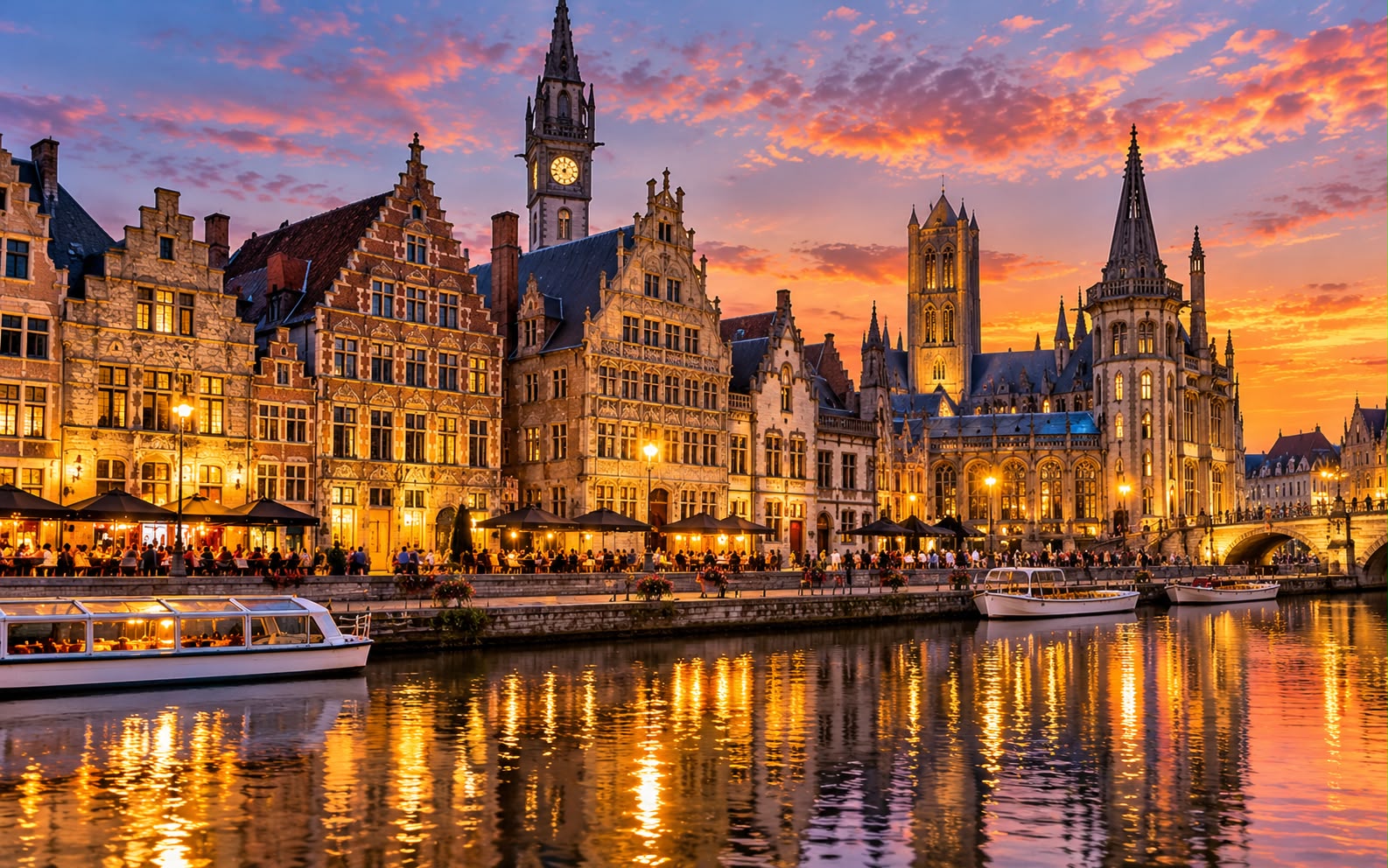
Benelux in 9 days: Amsterdam, Bruges, Ghent, Brussels and Luxembourg
The densest run of old cities in Europe: canals and Vermeer, a Flemish wool town the sea left behind, an altarpiece worth the trip on its own, and a fortress city built into a gorge — joined by trains that take an hour and cost very little.
- Western Europe
- 9 days
- ≈ AED 5,300 / person
- Three countries in nine days, and no journey longer than three hours
Before you go
Before you go: the admin
One visa, three countries, no borders
- All three are founding EU members, in Schengen and in the eurozone. One visa, one currency, and borders you cross without noticing.
- Benelux is a customs union that predates the EU — the 1944 agreement is the thing the EU was built on top of, which is a pleasing bit of context for a route that treats the three as one country.
- Passports need three months’ validity beyond departure.
Trains, which make this work
- Nothing on this route is more than three hours. Amsterdam to Bruges is three, Bruges to Ghent half an hour, Ghent to Brussels forty minutes, Brussels to Luxembourg three.
- Book nothing in advance except the international legs. Belgian and Dutch domestic trains are turn-up-and-go at a flat fare; the Amsterdam–Brussels leg is cheaper booked ahead.
- A Belgian Rail Pass — ten journeys, flat rate, shareable — is the cheapest way to move around Belgium if you are making more than a few hops.
- Fly into Amsterdam and out of Luxembourg, or do it as a loop back to Brussels, which is usually cheaper.
Money
- Euros throughout, and cards work almost everywhere.
- The Netherlands is PIN-only in a lot of places and does not take credit cards as widely as you would expect — a debit card with Maestro or V-Pay is the safe option.
- Belgium is more cash-friendly; carry some for fritures and market stalls.
One gentle brief
- Language changes as you move. Dutch in the Netherlands and Flanders, French in Wallonia and Luxembourg, German also official in Luxembourg and eastern Belgium — and Brussels is officially bilingual. English works everywhere, and starting in the wrong one of the two local languages is a small social error.
- The weather is unreliable in every month. This is a route where it rains and you go to a museum instead, which is why it works in winter.
- The cities are small and walkable and the day-trippers leave at five, which is the argument for staying the night in Bruges and Ghent rather than visiting them from Brussels.
Day by day
Day 1 — Land in Amsterdam
- Look both ways before stepping off a kerb. The bike lanes are traffic, cyclists have right of way and they use it; this is the most common way visitors get hurt here.
- 15:00 — Arrive and walk the Jordaan rather than the centre — the canals, the hofjes, and the Noordermarkt if it is a Saturday.
- 18:00 — A canal boat at dusk, which is touristy and is also the right way to understand the city’s shape.
- 20:00 — Dinner in the Jordaan or De Pijp.
- Book the Anne Frank House now if you have not — see tomorrow.
Day 2 — The Rijksmuseum and the Anne Frank House
- 09:00 — The Rijksmuseum at opening — the Night Watch, four Vermeers, and the Delftware. Two hours minimum.
- 12:00 — The Van Gogh Museum next door, booked ahead with a timed slot.
- 15:00 — The Anne Frank House sells online only and releases tickets six weeks ahead. They go within hours. If you have not booked, you will not get in — this is the single most common disappointment in the city.
- 17:00 — Westerkerk beside it, and the tower climb for the canal belt from above.
- 20:00 — Brown cafés in the evening — Hoppe, ‘t Smalle, Papeneiland.
Day 3 — Delft or Haarlem, then south
- 09:00 — Delft is an hour — Vermeer’s town, the Nieuwe Kerk with the royal vault, and the Royal Delft factory where they still paint by hand.
- Or Haarlem for the Frans Hals Museum and a quieter version of Amsterdam, which is twenty minutes rather than an hour.
- Keukenhof instead if it is mid-March to mid-May — eight weeks only, with the bulb fields around it peaking in late April. Go at opening; the coaches arrive at ten.
- 14:00 — Back for the bags.
- 17:00 — Evening train to Bruges, about three hours, changing at Antwerp or Rotterdam.
Day 4 — Bruges
- 08:00 — Bruges is a day-tripper’s city between ten and five and yours before and after. Walk the Begijnhof and the Minnewater early.
- 10:00 — The Markt and the Belfry — 366 steps, and the carillon plays on the way up, which at close range is considerable.
- 12:00 — The Church of Our Lady holds Michelangelo’s Madonna and Child, the only sculpture of his to leave Italy in his lifetime.
- 14:30 — The Groeningemuseum for the Flemish Primitives, which is the reason Bruges matters art-historically: van Eyck, Memling, Bosch.
- 17:30 — The canals once the coaches have gone, which is the hour the photographs are of.
- 19:30 — Dinner off the Markt, which costs half as much.
Day 5 — Ghent
- 09:00 — Half an hour by train, and the better city of the two.
- 10:00 — The Ghent Altarpiece in Sint-Baafs — van Eyck’s Adoration of the Mystic Lamb, 1432, restored over a decade and now shown in a climate-controlled chamber. It is the single greatest painting on this route, and the restoration revealed the famously disconcerting original lamb’s face.
- 13:00 — Gravensteen castle, whose audio guide is a comedy and is genuinely excellent — it is narrated as a deadpan tour and is the best thing of its kind anywhere.
- 16:00 — The Graslei and Korenlei at dusk, the two medieval quays facing each other.
- 19:00 — Ghent has the best street food and the best beer bars in Flanders — Dulle Griet, where they take your shoe as deposit for the glass.
Day 6 — Brussels
- 09:00 — Forty minutes by train.
- 10:30 — The Grand-Place, which Victor Hugo called the most beautiful square in Europe and which is hard to argue with. The Carpet of Flowers fills it for four days every even-numbered August.
- 12:00 — The Royal Museums of Fine Arts and the Magritte Museum next door, which share a building and a ticket.
- 15:30 — The Art Nouveau quarter — Horta’s own house, UNESCO-listed, in Saint-Gilles. It is closed Mondays and the queue is unmanaged.
- Or the Atomium and Mini-Europe if you have children.
- 19:30 — Mussels, fritures and a lambic in the evening. Chips are a meal from a friture with mayonnaise, not a side.
Day 7 — Brussels, or a day out
- 10:00 — The Comic Strip Centre in a Horta building, for Tintin and the Smurfs, which is a serious part of Belgian culture rather than a diversion.
- Or Antwerp, 40 minutes, for Rubens’ house, the cathedral and the diamond quarter — and the station, which is the finest in Europe.
- Or Waterloo, 30 minutes, for the battlefield and the Lion’s Mound, which is 226 steps.
- 16:00 — Back for the bags.
- 18:00 — Evening train to Luxembourg, about three hours.
Day 8 — Luxembourg City
- All public transport in the country is free, for everyone, since 2020 — buses, trams and trains. There is nothing to buy.
- 09:00 — The Chemin de la Corniche — “Europe’s most beautiful balcony” — along the old ramparts above the Alzette gorge.
- 11:00 — The Bock casemates, 17km of tunnels cut into the rock, UNESCO-listed and closed from roughly November to March.
- 13:00 — The Grand Ducal Palace and the Notre-Dame cathedral, and lunch in the Ville Haute.
- 15:00 — The Mudam for contemporary art in an I. M. Pei building on the Kirchberg plateau.
- 17:00 — The American Cemetery at Hamm, where Patton is buried among 5,000 others.
- 19:00 — Down in the Grund for the evening, which is the valley quarter below the cliffs.
Day 9 — The Müllerthal, or out
- 08:30 — The Müllerthal — “Little Switzerland” — is 40 minutes by the free train and bus, and is sandstone gorges, beech forest and the best walking in the country. The Route 1 loop from Echternach is the one to take.
- Or Vianden castle, a restored hilltop fortress an hour north, which is the most photographed building in Luxembourg.
- 14:00 — Back to the city.
- Findel airport is 20 minutes from the centre, or take the train back to Brussels for a cheaper flight — which is three hours, so decide before this morning rather than after.
Costs and practicalities
Best time to visit
April–June and September–October. The weather is unreliable in every month, so the choice is about crowds, daylight and what is actually open.
- April–May — Keukenhof is open for about eight weeks only, mid-March to mid-May, with the bulb fields peaking in late April. Blossom, long enough days, and Bruges before the coaches arrive in force.
- June–August — warmest and busiest. Ghent’s Gentse Feesten in July takes over the city for ten days, and Luxembourg’s National Day on 23 June has a torchlight procession the night before.
- September–October — the best compromise: mild, quiet, the beer festivals, and the Müllerthal beech forests turning.
- Late November–December — the Christmas markets in Brussels, Bruges, Ghent and Luxembourg, which are a genuine reason to come. The Bock casemates close for the winter from about November.
- January–March — grey and wet, the museums empty, and the cheapest accommodation of the year.
Travel tips
- Book the Anne Frank House the day tickets release — six weeks ahead, online only, and they go within hours. There is no walk-up.
- Stay the night in Bruges and Ghent rather than day-tripping from Brussels. Both empty completely after five and are better for it.
- Look before stepping into a bike lane in the Netherlands. Cyclists do not stop and are not expected to.
- Carry a debit card with Maestro or V-Pay for the Netherlands, where a lot of places are PIN-only and do not take credit cards.
- Order beer by name, not by type. Each has its own glass and the bar will be particular. Strengths of 8–10% are normal — pace accordingly.
- Coffeeshops sell cannabis; cafés sell coffee. Amsterdam has banned smoking it on the street in parts of the centre.
- All public transport in Luxembourg is free. Do not queue for a ticket machine; there is nothing to buy.
What this trip actually costs
Two people, 8 nights, mid-range comfort, international flights excluded:
| Item | Cost |
|---|---|
| Hotels, 8 nights | EUR 1,120 (≈ AED 4,586) |
| Food and drink, 9 days | EUR 720 (≈ AED 2,948) |
| Museums, belfries, castles and the altarpiece | EUR 320 (≈ AED 1,310) |
| Trains between the cities, two people | EUR 280 (≈ AED 1,146) |
| City transport and airport transfers | EUR 160 (≈ AED 655) |
| Total for two | EUR 2,600 (≈ AED 10,646) |
- Roughly EUR 1,300 (≈ AED 5,323) per person, which makes this the cheapest European route on the site after the Baltics.
- Amsterdam is the expensive night — Bruges, Ghent and Luxembourg are all noticeably cheaper for the same standard.
- The train line is small because the distances are small and Luxembourg’s transport is free.
- Hotel picks here are chosen on location, not on commission — always check prices and recent reviews before booking.
What to pack
- A waterproof, in every month. It will rain.
- Shoes for cobbles. Bruges and Ghent are both entirely cobbled and Luxembourg is steep as well.
- A debit card with Maestro, for the Netherlands.
- A layer for the evenings, which are cool even in July.
- Very little else. This is nine days of cities with good laundry and short train journeys; travel light.
FAQ
Is nine days enough for three countries? Easily. Nothing here is more than three hours apart and the cities are small. If anything the risk is going too fast — two nights each in Amsterdam, Bruges and Brussels is the right shape.
Bruges or Ghent? Ghent, on most reckonings — it is a working university city with the better altarpiece and the better bars, and a fraction of the coach traffic. Bruges is prettier and knows it.
Do I need to book trains ahead? Only the Amsterdam–Brussels leg. Belgian and Dutch domestic trains are flat-fare and turn-up-and-go.
Is Luxembourg worth two days? One full day covers the city comfortably. The second is for the Müllerthal or Vianden, both of which are good and neither of which is essential.
When is Keukenhof open? About eight weeks, mid-March to mid-May, with the surrounding bulb fields best in late April. Outside that window there is nothing to see there.
Prices and entry rules change, and what you need depends on your passport; last checked 29 October 2026, so confirm with the embassy or your airline before booking.


