 The Itinerary
Bhutan in 7 days: Paro, Thimphu and Punakha
The kingdom that measures happiness: a monastery glued to a cliff, dzongs the size of walled towns, 108 chortens on a Himalayan pass and a hot-stone bath in a farmhouse — with the two-tier fee system decoded (a ₹1,200-a-night regional SDF against US$100, and who qualifies for which) and the permit choreography that makes the whole trip run.
- South Asia
- 7 days
- ≈ AED 4,250 / person
- Culture + mountains
Before you go
Bhutan is the last of its kind: a Himalayan Buddhist kingdom that never rushed, never colonised its own culture for tourism, and famously measures Gross National Happiness. There are no traffic lights in the entire country (Thimphu’s white-gloved policeman dances instead), dzong-fortresses still run both church and state, and the air at Dochula Pass smells of pine and prayer-flag cotton.
What you pay to be here depends entirely on your passport. Most visitors pay the Sustainable Development Fee of US$100 per adult per night, plus a US$40 visa arranged through a licensed operator. Indian, Bangladeshi and Maldivian nationals travel on the regional rate instead — ₹1,200 a night, no visa, Voter ID accepted. Either way the catch is choreography, not cost — permits, route papers and one sacred cliff hike — and this guide runs the steps in order.
Go October–November (post-monsoon crystal: Himalaya views daily) or March–May (rhododendrons, jacaranda-lilac Punakha). December–February is cold, clear and quiet; June–August is monsoon-green with hidden mountains. All costs are in Bhutanese ngultrum (BTN — pegged 1:1 with INR, and Indian rupees are accepted almost everywhere).
Before you go: the SDF maths and the permit choreography
The two fee tiers, and which one you pay
- No visa. Entry permit instead — free — against an Indian passport (6+ months) or original Voter ID (Aadhaar/PAN/licences rejected; kids under 18 without either use birth certificate + parent’s ID).
- SDF: US$100 per adult per night (children 6–12 half, under-6 free), plus a one-off US$40 visa — so a couple’s 6-night trip pays US$1,280 before anything else. Both tiers are locked through August 2027.
- The regional rate, if you qualify: Indian, Bangladeshi and Maldivian nationals pay ₹1,200 per adult per night (children 6–12 ₹600, under-6 free) and no visa fee — ₹14,400 for the same six nights, the widest gap between the two tiers Bhutan has ever run.
- Apply two ways: online at immi.gov.bt 4–5 working days ahead (pay SDF there, land smooth), or on arrival at Paro airport (15–30 min). Land-crossers at Phuentsholing report 3–8-hour queues in season — fly, or arrive at opening.
The choreography (the part that trips people)
- The entry permit covers Thimphu and Paro only. For Punakha (and anywhere deeper) you need a Route Permit, issued at Thimphu’s immigration office on weekdays (1.5–2 hours) — which is why this itinerary goes Thimphu first and keeps Day 2 a weekday. Your guide/agent handles it with your originals.
- The guide question, honestly: in Thimphu and Paro, Indians can currently wander independently; beyond (the Punakha leg), a licensed guide is expected with the route permit and enforcement at checkposts is real. The standard, and frankly the best, solution: a car + driver + guide package (~Nu 5,000–7,500/day all-in) — on these mountain roads a local driver is a safety feature and a Bhutanese guide turns dzongs from pretty walls into stories.
- Money: INR notes up to ₹500 are accepted (₹2,000 notes are not; small notes smoothest), ATMs are sparse and moody — carry cash for the week. Cards work at better hotels only.
- Small print worth loving: Tuesdays are national dry days (no alcohol sold), tobacco is restricted (declare and pay duty; smoke only in designated areas), drones are effectively banned, and dzongs require covered shoulders/knees, no hats, and no photos inside temples.
Day by day
Day 1 — The landing, then to the capital
- Morning — Fly into Paro (Druk Air/Bhutan Airlines only, via Delhi/Kolkata/Guwahati/Bagdogra — book early, sit LEFT from Delhi: on clear days Everest and Kanchenjunga file past the window). The final approach — banking between pine ridges onto one of the world’s most exacting runways — is flown by only a few dozen certified pilots; applause is customary and earned.
- 12:00 — Permits stamped (pre-applied or on-arrival), meet the driver, and roll up the valley to Thimphu (1 h) — pausing at Tamchhog Lhakhang’s 600-year-old iron-chain bridge.
- 15:00 — Capital orientation: Clock Tower Square, the handicraft lanes, the world’s most charming traffic cop mid-ballet at the main junction.
- 19:00 — First Bhutanese table: ema datshi (chilli-cheese, the national dish — order it mild the first night, trust us), red rice, momos (~Nu 300–600 pp).
Where to stay in Thimphu (two nights)
- Luxury: Pemako Thimphu — 4.6/5 on TripAdvisor (~1,200 reviews), Bhutanese craft at five-star polish. ~Nu 18,000+.
- Boutique: The Postcard Dewa / The Pema by Realm tier — view rooms and rooftop calm. ~Nu 8,000–12,000.
- Value: Druk Hotel / Thimphu Towers — Clock Tower Square classics. ~Nu 3,500–5,500.
Day 2 — Thimphu: the Buddha, the dzong, the paperwork
- 09:00 — Route-permit run at immigration (your guide queues; you sign — 1.5–2 h, weekdays only; this is why today is a weekday).
- 10:30 — Buddha Dordenma (Nu 300): the 52-metre golden Buddha on the ridge, 125,000 smaller Buddhas inside, the whole valley below.
- 12:30 — Lunch downtown (~Nu 300–500), then the National Memorial Chorten (Nu 500) — join the slow tide of elders circumambulating with prayer wheels; Bhutan’s daily devotion at its most moving.
- 15:00 — Culture hour by taste: the Royal Textile Academy, the giant-paper factory, or the archery ground (the national sport — 145-metre targets, taunting songs, free to watch; weekend matches are best).
- 17:00 — Tashichho Dzong (Nu 500; visitor entry after offices close ~17:00 weekdays): the seat of King and Je Khenpo — whitewashed walls, golden roofs, monks crossing courtyards at dusk.
- 19:30 — Dinner; weekend travellers add the Centenary Farmers’ Market. Early night — passes tomorrow.
Day 3 — Over Dochula to the warm valley
- 08:00 — Climb to Dochula Pass (3,100 m): the 108 Druk Wangyal chortens stacked on the saddle and — on clear mornings, near-daily Oct–Feb — a 200-km wall of eastern Himalaya. Coffee at the pass café with the view doing the talking.
- 10:30 — Descend 1,800 vertical metres through cloud-forest into Punakha’s subtropical valley — bananas and cactus by lunchtime (motion tablets for the wind-y bits; the road is good and the driver better).
- 13:00 — Riverside lunch (~Nu 400–600).
- 15:00 — The Chimi Lhakhang walk: 25 minutes through rice paddies to the 15th-century fertility temple of the “Divine Madman” — whose, let’s say, emblem decorates village houses en route with total unselfconsciousness. Pilgrims seeking children receive blessings here; everyone receives a story (Nu 500).
- 18:30 — Farm-stay or riverside dinner; the valley hums with crickets a season warmer than breakfast.
Where to stay in Punakha (two nights): Dhensa Boutique (forest-terrace serenity, ~Nu 15,000+), RKPO Green Resort (~Nu 6,000–9,000), or Meri Puensum’s valley-view balconies (~Nu 4,000–6,000) — book by current reviews; the valley’s inventory is small.
Day 4 — The most beautiful building in the Himalaya
- 09:00 — Punakha Dzong (Nu 500): moored like a white ship at the meeting of the Mother and Father rivers — Bhutan’s masterpiece, where kings are crowned. In April–May the jacarandas turn the walls lilac and photographers weep quietly. Allow two hours; the murals repay the guide’s stories.
- 11:30 — Walk the Punakha Suspension Bridge (160 m of prayer-flagged sway over the Po Chhu — free, giggly, gorgeous).
- 13:00 — Lunch, then choose the afternoon:
- Khamsum Yulley Namgyal Chorten — 45 minutes up through paddies to the queen’s four-storey chorten and the valley’s best panorama; or
- White-water rafting on the Mo Chhu (~Nu 2,500–3,500 pp, gentle grades — the scenic float past the dzong is the point).
- 19:00 — Last warm-valley evening; try suja (butter tea) with zow shungo — acquired tastes, acquired here.
Day 5 — Back west to Paro
- 08:30 — The road back over Dochula (second chance at the big view — mornings are kindest) and down the Paro valley (~4 h with stops).
- 14:00 — Rinpung Dzong (“fortress on a heap of jewels”) and the covered Nyamai Zam bridge below — the classic Paro composition — then the National Museum in the round watchtower above (Nu 500).
- 16:30 — Kyichu Lhakhang (Nu 500): one of Bhutan’s two oldest temples (7th century), orange trees fruiting improbably in the courtyard, prayer wheels worn mirror-smooth.
- 18:00 — Paro town’s two charming streets; early dinner, early night, water bottles filled — the cliff is tomorrow.
Where to stay in Paro (two nights): Zhiwa Ling Heritage (the grand Bhutanese-owned flagship — carved timber, its own temple; ~Nu 20,000+), Naksel Boutique (forest-edge, ~Nu 8,000–12,000), or the valley’s farmstays (~Nu 3,000–5,000 — dinner with the family included in spirit and often in fact).
Day 6 — Tiger’s Nest, then the hot stones
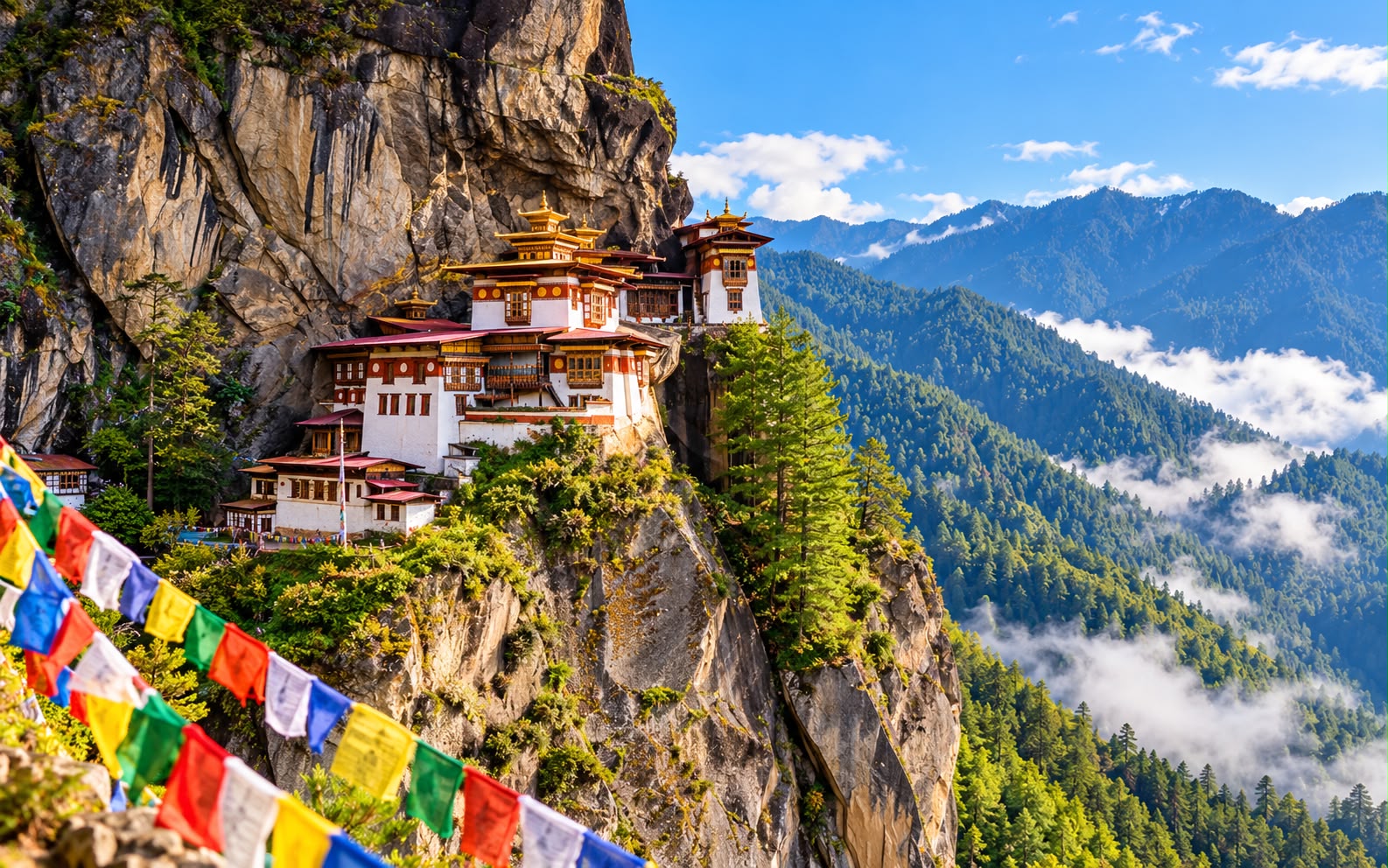
- 07:00 — Taktsang — the Tiger’s Nest (Nu 1,000): the monastery glued to a cliff-face 900 m above the valley, where Guru Rinpoche arrived on a flying tigress. The honest brief: 2–3 hours up on a good trail (ponies to the midpoint, ~Nu 700–1,000, uphill only), tea-house viewpoint at halfway, then the famous 700 steps down-and-up past the waterfall to the gate. Bags, cameras and phones stay in lockers — the golden rooms and the meditation cave are for eyes and memory. Altitude tops out ~3,120 m: slow is the whole technique.
- 13:00 — Trail-foot lunch, legs vibrating agreeably.
- 15:30 — The correct reward: a farmhouse hot-stone bath (dotsho) — river stones fired for hours, dropped hissing into a wooden tub of artemisia-strewn water (~Nu 1,200–2,000 pp; book morning-of). Follow with a farm dinner and a taste of ara (the local spirit) if it’s not Tuesday.
- 19:30 — Last supper: ema datshi ordered properly spicy now. You’ve earned rank.
Day 7 — Fly out
- Morning — The Paro runway show in reverse (LEFT side again for the giants, Delhi-bound). Permits surrendered, prayer flags in the luggage, blood pressure measurably improved. Extra-day owners: the Haa Valley over the Chele La pass (Bhutan’s highest road) is the classic add.
Costs and practicalities
Best time to visit
October–November is the clearest window of the year, when the monsoon haze has gone and the Himalaya are actually visible from the Paro valley.
- March–May — spring, rhododendrons in flower, and the Paro Tshechu in late March or April, the biggest festival in the west of the country.
- June–September — the monsoon. Warm, green, cheap, and the mountains are behind cloud for weeks at a time. Trekking is poor.
- October–November — the best month. Clear skies, the Thimphu Tshechu in late September or October, and the Jomolhari views.
- December–February — cold, very clear, and quiet. Passes above 3,000m can close, and the Gangtey valley gets the black-necked cranes from late October to February.
Festivals move with the lunar calendar, so confirm dates before booking anything around one.
Travel tips
- The Sustainable Development Fee is the structure of the trip. It is charged per adult per night on top of all costs, with reductions for children; everything else follows from it.
- You must book through a licensed Bhutanese operator, who arranges the visa. Independent travel is not a thing.
- A guide accompanies you throughout. This is the rule, not an upsell.
- Smoking is heavily restricted and tobacco sales were banned for years. Bringing a personal quantity requires declaring it and paying duty.
- Dress respectfully at dzongs — long sleeves and long trousers, no hats, and shoes off inside temples. Your guide will wear the formal gho or kira.
- Tiger’s Nest is a three-hour climb to 3,100m with 900m of ascent. Acclimatise first; it is the hardest easy walk on most itineraries.
- Cards barely work. Bring cash; the ngultrum is pegged to the Indian rupee, which also circulates.
What this trip actually costs
Two people, 6 nights (2+2+2), mid-range, at the international rate, flights to Paro excluded (Delhi–Paro returns run ~₹18,000–28,000; Bangkok, Singapore, Kathmandu and Dhaka are the other gateways — book the moment dates fix; two airlines, small planes):
| Item | Cost |
|---|---|
| SDF: US$100 × 2 adults × 6 nights | BTN 115,000 (≈ AED 4,490) |
| Visa: US$40 × 2, one-off | BTN 7,700 (≈ AED 301) |
| Hotels, 6 nights | BTN 29,000 (≈ AED 1,132) |
| Car + driver, 6 days + licensed guide (the Punakha-leg requirement solved) | BTN 37,500 (≈ AED 1,464) |
| Monument fees: Tiger’s Nest, dzongs, museum, temples | BTN 7,600 (≈ AED 297) |
| Food, 7 days (ema-datshi economy) | BTN 12,500 (≈ AED 488) |
| Farmhouse hot-stone baths for two | BTN 3,000 (≈ AED 117) |
| Local SIM, extras | BTN 800 (≈ AED 31.24) |
| Buffer: rafting, textiles, the archery bet you’ll lose | BTN 5,200 (≈ AED 203) |
| Total for two | BTN 218,300 (≈ AED 8,524) |
- Roughly BTN 109,150 (≈ AED 4,262) per person (≈US$1,140) — and over half of that is the SDF and visa, not the trip. Bhutan prices access deliberately; the hotels, food and driver are ordinary Himalayan money.
- Indian, Bangladeshi and Maldivian passports pay a fraction of it. The regional SDF of ₹1,200 per adult per night replaces the US$100, and the permit is free, which brings the same six nights to about BTN 55,000 (≈ AED 2,148) per person — the cheapest trip on this site, in the country once billed as the world’s most exclusive.
- Book in this order: Paro flights (the true bottleneck — two airlines, weather-sensitive schedules) → immi.gov.bt permit + SDF 4–5 working days out (or plan the on-arrival counter) → car + driver + guide package → hotels (Punakha and farmstays have few rooms) → make Day 2 a weekday for the route permit → Tiger’s Nest needs only legs and the Nu 1,000; the hot-stone bath books morning-of.
- Hotel and restaurant picks here are unsponsored — no affiliate links in this article. Chosen on location and current ratings; always check prices and recent reviews before booking.
What to pack
- Layers for three climates in one day: Thimphu mornings 5–12°C in season, Punakha afternoons 25°C+, Dochula wind always.
- Broken-in walking shoes with grip (Taktsang’s trail
- 700 stone steps), a walking pole if knees ask.
- Dzong-and-temple dress: long sleeves/trousers, no hats inside, socks you’re proud of (shoes come off).
- Cash: INR in ₹100/200/500 notes for the week (₹2,000 notes refused; ATMs are rumours outside cities).
- Motion tablets for the passes, sunscreen + lip balm (altitude sun), a headlamp for farmstays.
- A soft heart for dogs: Bhutan’s strays are numerous, calm and adored — the nightly barking chorus is included in every room rate.
FAQ
Is the guide mandatory or not — final answer? Current practice: Thimphu and Paro, no — beyond (Punakha included), yes in effect: route permits and checkposts expect a licensed guide on the paperwork, and enforcement is real. Since a driver is near-essential on these roads anyway, the car-driver-guide bundle is less a tax than the trip’s best upgrade — Bhutan’s guides are storytellers, fixers and hot-stone-bath negotiators in one.
How hard is Tiger’s Nest, really? A determined beginner’s hike: 900 m of altitude gain, 2–3 hours up at chat pace, ponies covering the first two-thirds for the unsure (uphill only — the descent is everyone’s own knees). The 700 final steps are the honest sting. Grandparents summit daily; so do five-year-olds, insufferably. Start at 7, carry water, go slow — the cliff does the rest.
When is the SDF window — and will it last? The ₹1,200 regional rate (and the internationals’ US$100 halved rate) is officially extended through 31 August 2027. Beyond that, policy history says rates revisit. Translation: this is the cheapest legal Bhutan in decades on either tier — a reason to go sooner, not later.
Festivals — should we time for a tshechu? If you can: Paro Tshechu (March–April) and Thimphu Tshechu (September–October) fill dzong courtyards with masked cham dances and the whole valley in its finest gho and kira. Book flights and rooms months ahead and expect the SDF-era’s biggest crowds — a dedicated festival guide is on our list.
Halal and vegetarian food? Vegetarians have accidentally found their national cuisine: ema datshi, kewa datshi (potato-cheese), shamu datshi (mushroom), veg momos and red rice make half of Bhutanese food meat-free by default. Formal halal certification is essentially absent (meat is imported and mixed-sourced) — Muslim travellers overwhelmingly eat vegetarian here, which in Bhutan is no sacrifice at all.
What’s Bhutan guide #2? Phobjikha Valley (the glacial bowl where black-necked cranes winter, Nov–Feb) extends this exact route by two days — or the festival special above. The cranes are currently winning.
Prices and entry rules change, and what you need depends on your passport; last checked 8 October 2026, so confirm with the embassy or your airline before booking.


