 The Itinerary
Britain and Ireland in 14 days: London, the Highlands, the Causeway and the Wild Atlantic Way
South to north and then west: a capital of museums, Georgian Bath, a castle on a rock, single-track roads through the Highlands, 40,000 basalt columns on a County Antrim shore, and cliffs with the Atlantic at the bottom of them.
- Northern Europe
- 14 days
- ≈ AED 13,250 / person
- Two islands, three countries, one trip, and a ferry in the middle
Before you go
Before you go: the admin
Three jurisdictions, two of them one country
- The United Kingdom covers England, Scotland and Northern Ireland; the Republic of Ireland is a separate country. This route crosses between them once, by land.
- Most nationalities need a UK ETA — an electronic travel authorisation introduced for visa-exempt visitors, applied for by app, usually approved in minutes to days. Check whether yours is covered; the rollout has been staged.
- Ireland is outside Schengen and has its own rules, and a UK visa does not automatically cover it.
- The Belfast to Dublin land border is open and unmarked — you will not be stopped — but it is a real immigration border and you must be entitled to enter the other side.
Getting between them
- The Cairnryan to Belfast ferry is about two and a quarter hours and takes cars. Holyhead to Dublin is the other main crossing.
- Or fly Edinburgh or Glasgow to Belfast in an hour, which loses the drive up the Ayrshire coast.
- Tell the hire company you are crossing. Many UK companies allow it with notice and a fee; a few do not, and you need cover valid in both.
- Fly into London and out of Dublin or Shannon, open-jaw.
Trains and cars
- Trains for the cities, a car for the rest. London to Edinburgh is four and a half hours by train and is far better than driving.
- Book UK train tickets as far ahead as possible. Advance fares are a fraction of walk-up, which are among the highest in Europe. A Railcard pays for itself in two journeys.
- The Highlands, Skye and the Wild Atlantic Way all need a car, and the roads are single-track with passing places.
Money
- Pounds sterling in the UK, euros in Ireland. Northern Ireland uses sterling.
- Scottish and Northern Irish banks issue their own notes, which are legal currency and are sometimes refused in England. Spend them before you cross.
- Contactless is universal in both, including on London buses and the Tube. Many places no longer take cash at all.
Day by day
Day 1 — London, the river
- Get an Oyster or just tap a contactless card. Do not buy paper tickets — the daily cap makes tapping cheaper than any travelcard.
- 14:00 — Westminster, and the Abbey if you have booked timed entry. The Tower of London and Westminster Abbey are the two worth paying for.
- 16:30 — A walk from Southwark to Tower Bridge along the south bank, past the Globe and Borough Market.
- 19:00 — Dinner in Borough or Bermondsey.
- Jet lag runs the first evening. Do not book theatre tonight.
Day 2 — The free museums
- 10:00 — The British Museum, the National Gallery, the V&A and Tate Modern are all free. That is the single best thing about London and most visitors underuse it.
- Two in a day is the limit — pick the British Museum this morning and the National Gallery after lunch, or the V&A and Tate Modern if that is more your register.
- 13:00 — Lunch in Bloomsbury or Covent Garden.
- 15:00 — The second museum.
- 18:00 — Soho and a theatre, with same-day tickets from the TKTS booth in Leicester Square if you did not book.
Day 3 — The Tower, and Greenwich
- 09:00 — The Tower of London, booked, at opening — the Crown Jewels queue is the whole difference between arriving at nine and at eleven.
- 12:30 — Greenwich by river bus — ordinary transport, better than any cruise, and the Cutty Sark and the Observatory at the end.
- 15:00 — The Observatory and the meridian, up the hill through the park, with the view back over Canary Wharf.
- 18:00 — Back by river, which is the better direction for the light.
- Or Columbia Road on a Sunday for the flower market, if your days fall that way.
Day 4 — Bath, and the stones
- 08:30 — An hour and a half by train from Paddington.
- 10:30 — The Roman Baths, which are genuinely Roman and genuinely still flowing at 46°C. The audio guide is included and unusually good.
- 13:00 — The Royal Crescent and the Circus, and the Jane Austen Centre if that is your thing.
- 15:30 — Stonehenge is 40 minutes away and needs a booked slot; the stone circle at Avebury is free, larger, and you can walk among the stones, which you cannot at Stonehenge.
- With a car, do Avebury. Without one, Stonehenge is the practical choice from Bath.
- 19:00 — Back to Bath or straight on north.
Day 5 — To Edinburgh
- 09:00 — Four and a half hours by train from London, up the east coast with the sea out of the window from Berwick. Sit on the right going north.
- 14:30 — Drop bags, and the Royal Mile down to Holyrood.
- 17:00 — Arthur’s Seat — an extinct volcano in the middle of the city, 45 minutes up, and the best view in any British city. Go for the evening light.
- 20:00 — Dinner in the Old Town or Leith.
- August is the Festival and the Fringe — the city doubles in population and accommodation triples in price. Plan around it in one direction or the other.
Day 6 — The Castle, and the museum
- 09:30 — The Castle on its volcanic plug, booked ahead. The one o’clock gun is fired every day but Sunday.
- 13:00 — The National Museum of Scotland, free, and Dolly the sheep is in it. The roof terrace is the best free view in the city.
- 15:30 — The New Town — Charlotte Square, the Georgian House, and Stockbridge below it.
- 18:00 — Pick up a car for tomorrow, or arrange it for the morning.
- 19:30 — A whisky bar rather than a distillery tour, which you can do properly in the Highlands.
Day 7 — Into the Highlands
- 08:00 — Pick up a car in Edinburgh.
- 11:00 — Stirling or Doune on the way north if you want a castle without a queue.
- 14:00 — Glencoe — the most dramatic valley in Scotland and the site of the 1692 massacre, which the visitor centre handles properly.
- 16:30 — Glenfinnan for the viaduct, and the Jacobite steam train crosses it late morning in season — so if the train is the point, reverse this day and come here first.
- 18:30 — On to Fort William or Mallaig for the night.
Day 8 — Skye
- 09:00 — Skye over the bridge. The island is small and the roads are not; allow far longer than the distances suggest.
- Single-track roads have passing places and they are for passing and for letting faster traffic by. Using them is the whole etiquette of driving here, and not using them is how visitors earn a reputation.
- 10:30 — The Old Man of Storr, an hour up and an hour down, on the best-maintained path on the island.
- 14:00 — The Quiraing, a landslip of pinnacles with a road over the top of it.
- 17:30 — Neist Point for sunset, which is the far western tip and worth the drive.
- Midges from June to August in the west Highlands are genuinely bad at dawn and dusk. Repellent, and a head net is not an overreaction.
Day 9 — Skye, and south
- 08:30 — The Fairy Pools early, before the car park fills — it is a small one and it fills by ten.
- 12:00 — Portree for lunch, the harbour with the painted houses.
- 14:00 — South toward Ayrshire, which is a long drive — five hours or so — so break it rather than pushing through.
- 19:00 — Overnight near Cairnryan so the morning ferry is not a dawn start from far away.
Day 10 — Cairnryan to Belfast
- 07:30 — Down the A77 along the Ayrshire coast, with Ailsa Craig offshore, then the ferry. The crossing is about two hours.
- 13:00 — The Titanic Quarter museum, which is on the slipway where she was built.
- 16:00 — The black-taxi tours of the murals and the peace walls. Take one with a driver from the community; it is the serious hour in the city.
- 19:00 — The Crown Liquor Saloon, a Victorian gin palace owned by the National Trust — snugs with their own doors and bell pushes.
Day 11 — The Causeway Coast
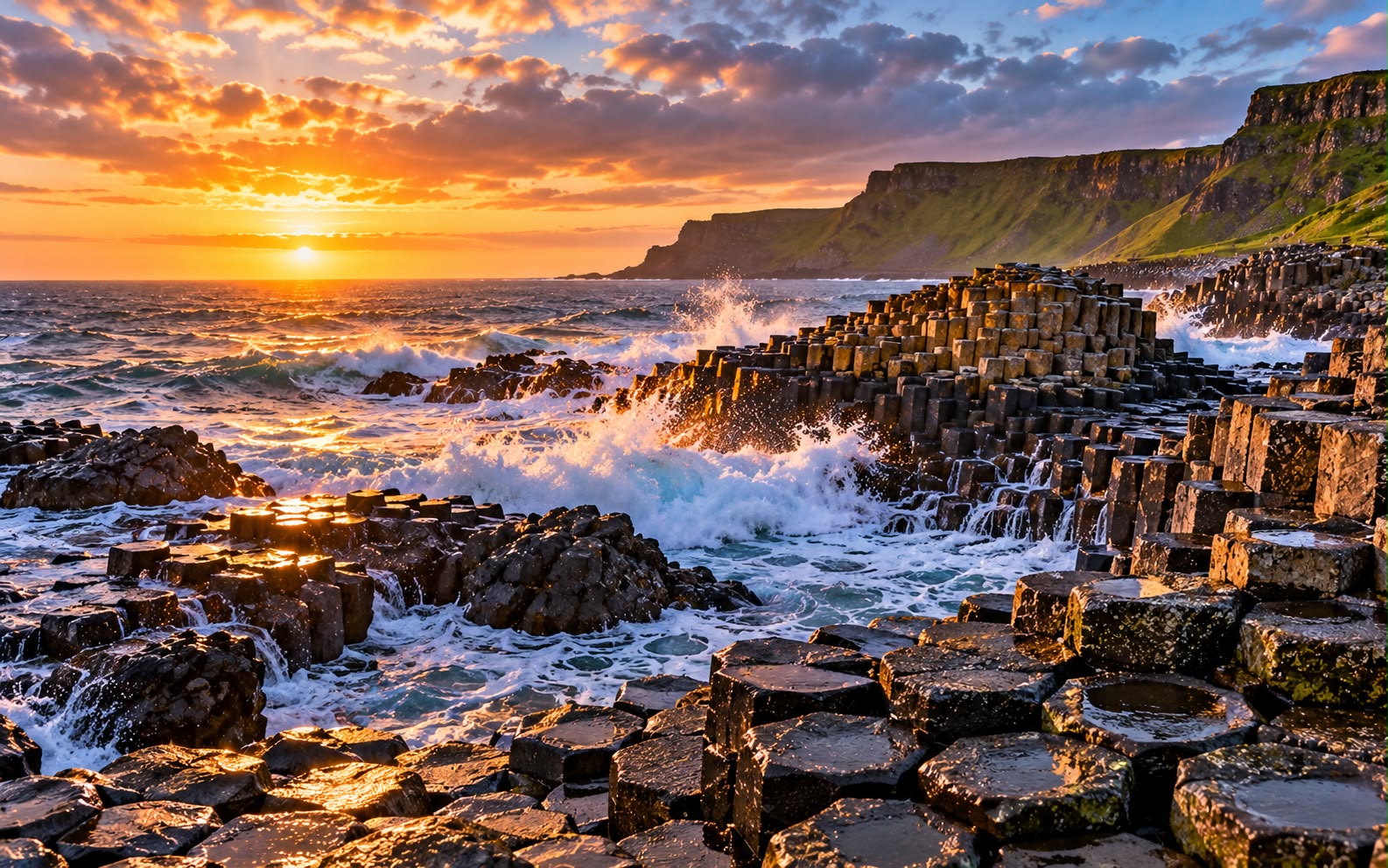
- 08:00 — The Giant’s Causeway — around 40,000 basalt columns from a Palaeogene eruption, UNESCO-listed. Go early or late; the visitor centre car park is the only one and it fills.
- 11:00 — Carrick-a-Rede rope bridge, booked, and Dunluce Castle on its stack, both within twenty minutes.
- 13:30 — The Dark Hedges, which is a beech avenue that Game of Thrones made famous and which is now rather trampled. Ten minutes is enough.
- 15:00 — Then south to Dublin, about three hours, crossing a border you will not notice — the only sign is that the road signs change to kilometres.
Day 12 — Dublin
- 09:00 — Trinity College and the Book of Kells, booked, and the Long Room library above it.
- 11:30 — Kilmainham Gaol — where the 1916 leaders were executed, and the best single explanation of modern Irish history. Book well ahead; it sells out.
- 14:30 — The National Museum of Ireland, free, for the bog bodies and the Tara Brooch.
- 17:00 — The Guinness Storehouse is the most visited attraction in the country and is a brand experience; the Jameson distillery or a session in a pub in Stoneybatter is better value.
- 20:00 — A session. The music starts around nine and the good ones are not in Temple Bar.
Day 13 — West to Galway, and the cliffs
- 08:30 — Two and a half hours across the country.
- 12:00 — The Burren, a limestone pavement with Mediterranean and Arctic flowers growing side by side in the grykes — and Poulnabrone, a portal tomb standing on it.
- 17:00 — The Cliffs of Moher — 214m at the highest point, with the Atlantic at the bottom. Go at opening or in the evening; the coaches arrive at eleven. Evening is also when the light is behind you.
- 20:00 — Galway for the evening — the Latin Quarter, the pub sessions, and the Claddagh.
Day 14 — Connemara, or out
- 09:00 — Connemara for the last day if you have it — Kylemore Abbey, the Sky Road at Clifden, and bog and mountain the whole way.
- Or the Aran Islands by ferry, 40 minutes from Rossaveal, for Dún Aonghasa on its cliff edge.
- Fly out of Shannon or Dublin — Shannon is 90 minutes from Galway and Dublin is two and a half hours, so pick the airport before you plan this morning, not after.
Costs and practicalities
Best time to visit
May–June and September, though the weather is unreliable in every month and the real variables are daylight and what is open.
- May–June — the best of the year. Long days, the hedgerows and gorse in flower, the west coast before the summer traffic, and the midges have not got going until late June.
- July–August — warmest, busiest, and school holidays. Edinburgh’s Festival and Fringe take all of August and the city’s accommodation with it. Skye and the Ring of Kerry are at capacity and the Highland midges are at their worst.
- September — the best single month: mild, the heather on the Scottish hills, the crowds gone, and the light on the west coast at its finest.
- October–April — short days, dark by four in December, and many west-coast attractions and ferries run reduced or not at all. London and Dublin work year-round; the Highlands in winter are beautiful and the roads are a different proposition.
It will rain. The west of Ireland and Scotland both exceed 200 wet days a year — plan around it rather than for it.
Travel tips
- Check whether you need a UK ETA, and remember Ireland has separate requirements. The land border is open and is still a real immigration border.
- Tell the hire company you are taking the car to Ireland. Many allow it with notice and a fee; a few do not.
- Book UK train tickets months ahead. Walk-up fares are among the highest in Europe and advance ones are a fraction.
- Driving is on the left in both countries, and the rural roads are single-track with passing places, stone walls and no verge. Take the extra insurance — the excess on Irish hire cars in particular is notoriously high and many companies require proof of your own cover to waive it.
- Spend Scottish and Northern Irish notes before you leave. They are legal currency and English shops sometimes refuse them.
- Midge repellent for the west Highlands from June to August. Smidge works better than DEET for these specifically.
- Pub sessions are not performances. Sit, listen, do not talk over the music, and buy a round.
What this trip actually costs
Two people, 13 nights, mid-range comfort, international flights excluded:
| Item | Cost |
|---|---|
| Hotels and B&Bs, 13 nights | GBP 2,340 (≈ AED 11,483) |
| Food and drink, 14 days | GBP 1,200 (≈ AED 5,889) |
| Car hire, 8 days, with cross-border cover | GBP 700 (≈ AED 3,435) |
| Castles, museums and guided tours | GBP 500 (≈ AED 2,454) |
| Trains, two people | GBP 400 (≈ AED 1,963) |
| Ferry, fuel and city transport | GBP 260 (≈ AED 1,276) |
| Total for two | GBP 5,400 (≈ AED 26,500) |
- Roughly GBP 2,700 (≈ AED 13,250) per person. London and Edinburgh are the expensive nights; the Highlands and the Irish west are B&B country and much better value.
- London’s great museums are free, which offsets a lot.
- Booking trains late can add £300 on its own, and Edinburgh in August can double the accommodation line.
- Hotel picks here are chosen on location, not on commission — always check prices and recent reviews before booking.
What to pack
- A proper waterproof, jacket and trousers. Not a showerproof; the west coast rain comes sideways.
- Layers in every month. Scotland in July can be 9°C on a ridge.
- Boots with grip for Arthur’s Seat, the Quiraing and the Burren’s limestone, which is lethal when wet.
- Midge repellent and a head net for the west Highlands in summer.
- A contactless card, which covers nearly everything in both countries.
- A paper map or offline maps — signal drops across the Highlands and Connemara.
FAQ
Is fourteen days enough for both islands? For this routing, yes — but it is one line from London to Galway and it does not include Wales, the Lake District, Cork or Kerry. Do not try to add them.
Do I need a car? For the Highlands, Skye, the Causeway Coast and the west of Ireland, yes. For London, Edinburgh, Belfast and Dublin, a car is a liability — take trains between the cities and hire for the rural legs.
Ferry or fly to Belfast? The ferry takes the car across and gives you the Ayrshire coast drive. Flying is an hour and means hiring again in Ireland. Either works; the ferry keeps it one trip.
Is the border a problem? No — it is open and unmarked, and you will not be stopped. You must still be entitled to enter, since they are different countries with different rules.
How bad are the midges? In the west Highlands from June to August, bad enough to end an evening. They are a dawn and dusk problem, they dislike wind, and repellent works. They are not present in Ireland in the same way.
Prices and entry rules change, and what you need depends on your passport; last checked 29 October 2026, so confirm with the embassy or your airline before booking.


