 The Itinerary
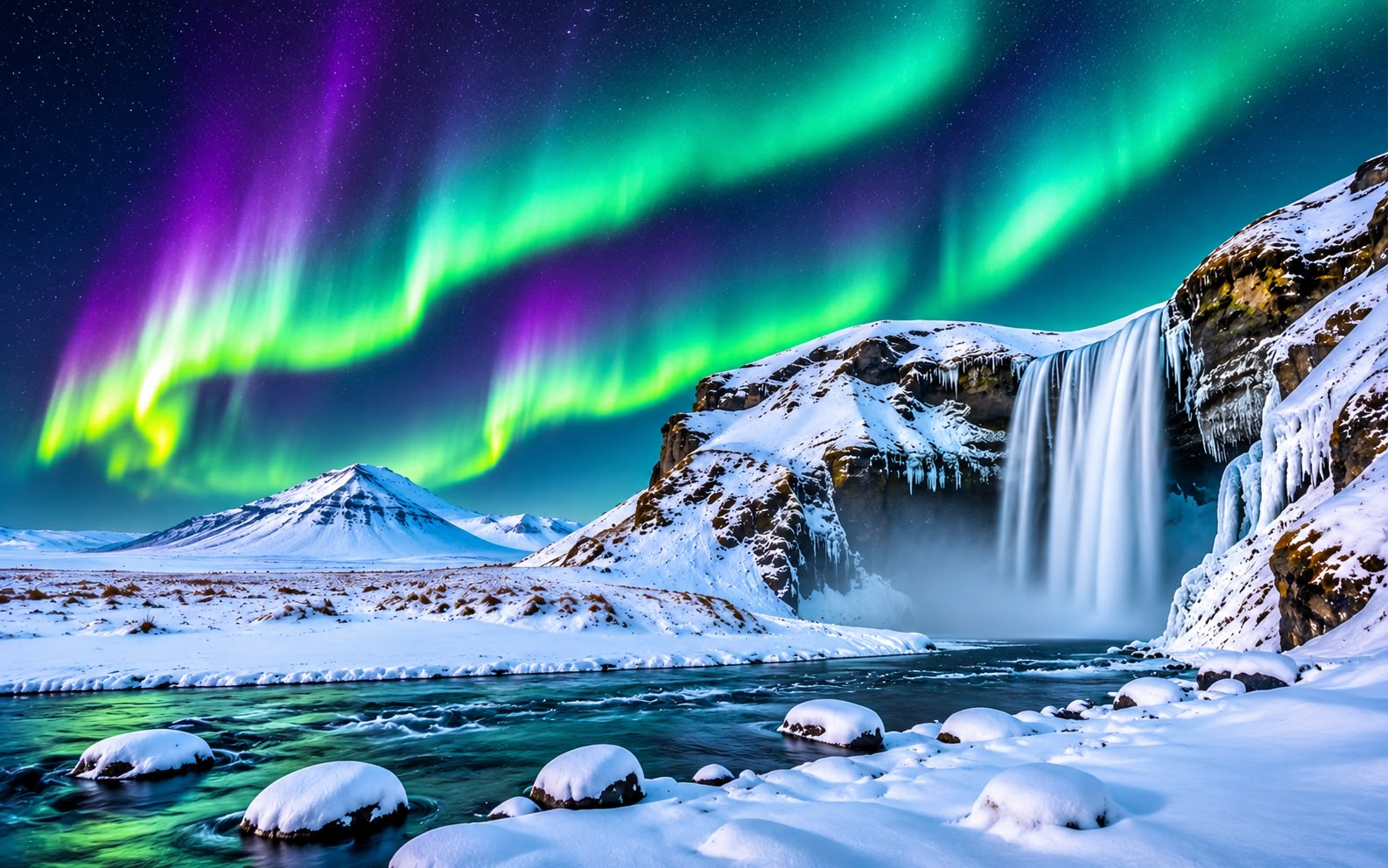
Iceland in winter in 6 days: northern lights and ice caves
The south coast between November and March, when the ice caves open and the aurora is visible. Four hours of daylight, the wind that rips car doors off, road.is before every drive, and why the itinerary has to be written in pencil.
- Northern Europe
- 6 days
- ≈ AED 6,450 / person
- The aurora, and the caves that only exist in winter
Before you go
Iceland in winter is a different country from Iceland in summer, and the site’s Iceland in 8 days covers the summer one. Between November and March you get four to six hours of daylight, roads that close without warning, and two things you cannot have in July: the aurora, and the ice caves.
The caves are seasonal because they are real. They form in glaciers each winter and melt out each spring, so the guided season runs roughly November to March and the exact caves change year to year.
Six days, all on the south coast. Do not attempt the Ring Road in winter on a short trip — the north and east close regularly, and a plan that depends on them is a plan that breaks.
This itinerary is written in pencil. Weather decides the order. Build in the flexibility or accept losing a day.
Figure ISK 215,000 (≈ AED 6,445) per person. Late September to late March for the aurora; November to March for the caves.
Before you go: the admin
The two websites you check every morning
- road.is — road conditions and closures, updated constantly. Check it before every single drive, not the night before.
- vedur.is — the Icelandic Met Office: weather warnings, and the aurora forecast with cloud cover, which is the part that actually matters. A strong aurora under solid cloud is nothing.
- safetravel.is for alerts and for leaving a travel plan.
- Orange and red wind warnings mean do not drive. This is not advisory.
The wind, which is the real danger
- Iceland’s wind, not its cold, is what hurts people and cars.
- Hold the car door with both hands when you open it. Gusts rip doors clean off their hinges every winter, and door damage is specifically excluded from most hire insurance. It is a four-figure repair.
- Park facing into the wind where you can.
- Sand and ash storms on the south coast strip paint. Take the sand-and-ash waiver if it is offered; this is the one add-on that genuinely pays.
The car
- A 4x4, not a compact. Not because you will go off-road — that is illegal everywhere in Iceland — but for clearance, weight and traction on packed snow.
- Studded tyres are standard in winter and should be on the car when you collect it. Check.
- Take the full insurance including sand, ash and gravel.
- Fuel at every opportunity. Stations are far apart on the south coast and some are unattended card-only pumps — make sure your card has a PIN.
- Never stop on the road for a photograph. Use the marked pull-offs. Stopping in a carriageway in low light is how collisions happen here.
Daylight, and what it means for a plan
- Mid-December gives roughly four to five hours of usable light, from about 11:00 to 15:30, with long golden hours at both ends.
- That is not a disaster — it is a constraint. Two sights a day, not five, and the light while you have it is extraordinary.
- By late March you are back to twelve hours and the caves are closing. February is the balance point most people want.
Entry and money
- Iceland is in the Schengen area; see our Schengen visa guide. The EES biometric border is in operation.
- Iceland is effectively cashless. Cards work everywhere including rural petrol pumps and public toilets. You do not need Icelandic króna in cash.
- Tipping is not expected.
- Last checked: 2 November 2026.
Day by day
Day 1 — Land, and the first night sky
- Keflavík is about 45 minutes from Reykjavík. Collect the car at the airport and photograph every existing scratch before you leave the bay.
- Afternoon — Reykjavík on foot while the light lasts: Hallgrímskirkja and its tower, the Sun Voyager, and the harbour.
- Evening — The Sky Lagoon at the edge of the city, which is closer and quieter than the Blue Lagoon and faces the sea. Book the slot.
- Night — First aurora check. Look at vedur.is, and if the cloud is thin, drive twenty minutes out of the city lights. Þingvellir or the Grótta lighthouse both work.
Where to stay in Reykjavík (two nights)
- Grand: a design hotel on Laugavegur or by the harbour.
- Mid-range: a guesthouse in the 101 district, walkable to everything.
- Simple: apartments slightly out of the centre — cheaper, and parking becomes free rather than metered.
Day 2 — The Golden Circle
- The three stops are close together and all are open in winter.
- 10:30 — Þingvellir, where the Mid-Atlantic Ridge surfaces and the Icelandic parliament met from 930. You are walking in the rift between two continents.
- 12:30 — Geysir. The original one is dormant; Strokkur next to it erupts every five to ten minutes. Stand upwind.
- 14:00 — Gullfoss, a two-tier waterfall in a canyon, often half-frozen in January and more impressive for it. The upper path is sometimes closed for ice — take the viewing platform.
- 16:00 — Back to Reykjavík, or add the Secret Lagoon at Flúðir on the way.
- Night — Aurora check again. Two nights of looking beats one night of hoping.
Day 3 — The south coast waterfalls, and Vík
- 10:00 — Seljalandsfoss. You can walk behind it, and in winter the path behind is often closed for ice — check the barrier rather than the guidebook. Gljúfrabúi, hidden in a cleft a few hundred metres north, is the one most people miss.
- 12:00 — Skógafoss, sixty metres and a staircase beside it.
- 14:00 — Reynisfjara, the black sand beach, and the most dangerous place in this itinerary. Sneaker waves arrive without warning, run far further up the sand than the previous twenty, and the undertow is lethal. People die here. Stay well back from the water line and never turn your back on the sea. Obey the warning-light system.
- 16:00 — Vík, the village under the cliff. Stay here.
- Night — The south coast has darker skies than the capital, which is the other reason to be here.
Where to stay in Vík (one night)
- Grand: a hotel with glass-fronted rooms facing the sky, of which there are now several on this coast.
- Mid-range: a guesthouse in Vík itself, walking distance to the one supermarket.
- Simple: farm accommodation along the Route 1 corridor either side of the village.
Day 4 — The glacier lagoon and an ice cave
- 08:30 — Drive east to Jökulsárlón, about two and a half hours. This is the longest drive of the trip and the one most likely to be affected by weather. Check road.is before you leave.
- 11:00 — Jökulsárlón. Icebergs calve off the glacier tongue and drift across a lagoon to the sea.
- Across the road, Diamond Beach — where those icebergs wash back up onto black sand. Same warning as Reynisfjara applies.
- 13:00 — The ice cave tour. Guided only, booked weeks ahead, and the meeting point is usually a car park near Jökulsárlón where you transfer to a modified truck. Caves are assessed for safety each year and each week; the one you visit is decided by conditions, not by the photograph you booked from.
- Alternative if caves are shut: a glacier walk on Skaftafell’s Svínafellsjökull, with crampons, which runs in more conditions.
- Evening — Stay near Höfn or back towards Skaftafell.
Day 5 — West again, slowly
- Morning — Skaftafell in Vatnajökull National Park: Svartifoss, a waterfall over black basalt columns, is an hour round trip on a path that is usually walkable with spikes.
- Midday — The Fjaðrárgljúfur canyon, if open — it closes periodically to let the vegetation recover, and the closures are enforced.
- Afternoon — Drive back west, around four hours to Reykjavík with stops. Break it at Hvolsvöllur or Selfoss if the light goes.
- Night — Last aurora attempt.
Day 6 — The Blue Lagoon, and out
- Morning — The Blue Lagoon sits between Reykjavík and the airport, which makes it the obvious last stop. Book the slot weeks ahead; it does sell out.
- Note: the Reykjanes peninsula has seen repeated volcanic activity in recent years and the lagoon has closed at short notice more than once. Check its status before relying on it, and have the Sky Lagoon as the fallback.
- Allow three hours at Keflavík and return the car with the fuel receipt.
Costs and practicalities
Best time to visit
November to March for the caves; late September to late March for the aurora. The two overlap through the middle of winter.
- Late September to October — aurora season begins, roads are still largely clear, and there is real daylight. No ice caves yet.
- November and December — caves open. December has the least daylight of the year and the Christmas period is expensive.
- January and February — the best balance. Caves at their best, daylight climbing back, and the lowest prices of the season outside Christmas.
- March — long days returning, aurora still good, caves closing towards the end. A fine compromise.
- April to August — midnight sun, no aurora, no caves, and the summer itinerary instead.
Travel tips
- Check road.is before every drive, and vedur.is every morning.
- Hold the car door with both hands. Door damage is excluded from most policies.
- Take the sand-and-ash waiver.
- Never turn your back on the sea at Reynisfjara or Diamond Beach.
- Book the ice cave, the lagoons and any glacier walk weeks ahead.
- Two sights a day in December, not five.
- Microspikes for your boots — the single most useful thing you can pack.
- Do not drive off marked roads. It is illegal, the fines are heavy, and the damage lasts decades.
- Shower naked and thoroughly before entering any pool or lagoon. This is non-negotiable local etiquette and it is enforced.
What this trip actually costs
Two people, 5 nights, mid-range throughout, international flights excluded:
| Item | Cost |
|---|---|
| Hotels and guesthouses, 5 nights | ISK 150,000 (≈ AED 4,496) |
| Food and drink, 6 days | ISK 110,000 (≈ AED 3,297) |
| 4x4 hire, 6 days, with fuel and the sand-and-ash waiver | ISK 95,000 (≈ AED 2,848) |
| An ice cave tour, two people | ISK 48,000 (≈ AED 1,439) |
| Lagoon entries, two people | ISK 20,000 (≈ AED 600) |
| Parking and extras | ISK 7,000 (≈ AED 210) |
| Total for two | ISK 430,000 (≈ AED 12,890) |
- Roughly ISK 215,000 (≈ AED 6,445) per person for six days.
- Iceland is expensive and winter is its cheap season — outside Christmas and New Year, rooms cost noticeably less than in July.
- Food is the line people underestimate. A supermarket run at Bónus or Krónan for breakfasts and lunches makes a real difference; restaurant dinners do not come down.
- The ice cave is the one unavoidable guided cost and the reason to come in this season at all.
- Hotel picks here are chosen on location, not on commission — always check prices and recent reviews before booking.
What to pack
- Microspikes or crampons for your boots. Every path is ice.
- Waterproof outer layers, top and bottom, plus thermal base layers. Cotton is useless here.
- Waterproof boots with ankle support.
- Hat, buff and waterproof gloves, plus a spare pair — gloves get wet and then they are worse than nothing.
- Swimwear and a quick-dry towel, for the lagoons and the village pools.
- A head torch. Sunrise is late and car parks are unlit.
- A Type F adapter, 230V.
- Sunglasses, genuinely — low winter sun on snow is blinding.
Part of a bigger trip?
- Iceland in 8 days is the summer version of this coast, with the highlands open.
- Iceland and Norway in 10 days pairs it with the fjords and Tromsø, which is the other great aurora base.
- A stopover works both ways. Iceland sits between Europe and North America, and the national carrier allows multi-day stopovers at no extra airfare — worth checking when you book.
FAQ
Will I definitely see the northern lights? No, and nobody can promise it. You need darkness, a clear sky and solar activity at the same time, and cloud is the usual spoiler. What you can do is improve the odds: come between late September and March, stay at least four nights, get away from town lights, and check the cloud map on vedur.is rather than the aurora number alone. Three or four nights of trying is a good chance; one night is a lottery.
Are the ice caves safe? With a licensed guide, yes — they are assessed continuously and closed when they are not sound. Without one, absolutely not. You cannot visit them independently, the glacier surface is crevassed, and the cave you are taken to is chosen on the day by conditions rather than by the photograph that sold you the tour.
Can I drive the Ring Road in six winter days? No. The north and east close regularly for snow and wind, and a six-day schedule has no slack to absorb a closure. The south coast out and back is the winter route, and it still contains the waterfalls, the black beach, the glacier lagoon and the caves.
How bad is four hours of daylight? Less of a problem than it sounds, because the light you do get is low and golden for most of it. The real effect is on the plan: two sights a day rather than five, driving done between eleven and four, and evenings spent in a pool or looking at the sky. If that sounds restful rather than frustrating, December is for you.
Is the Blue Lagoon worth it? It is expensive, busy and genuinely pleasant, and its position between the city and the airport makes it an easy last morning. But the Reykjanes peninsula has had repeated eruptions and the lagoon has shut at short notice more than once, so check before you plan around it. The Sky Lagoon is closer to town, cheaper, and faces the open sea.
Prices and entry rules change, and what you need depends on your passport; last checked 3 November 2026, so confirm with the embassy or your airline before booking.


