 The Itinerary
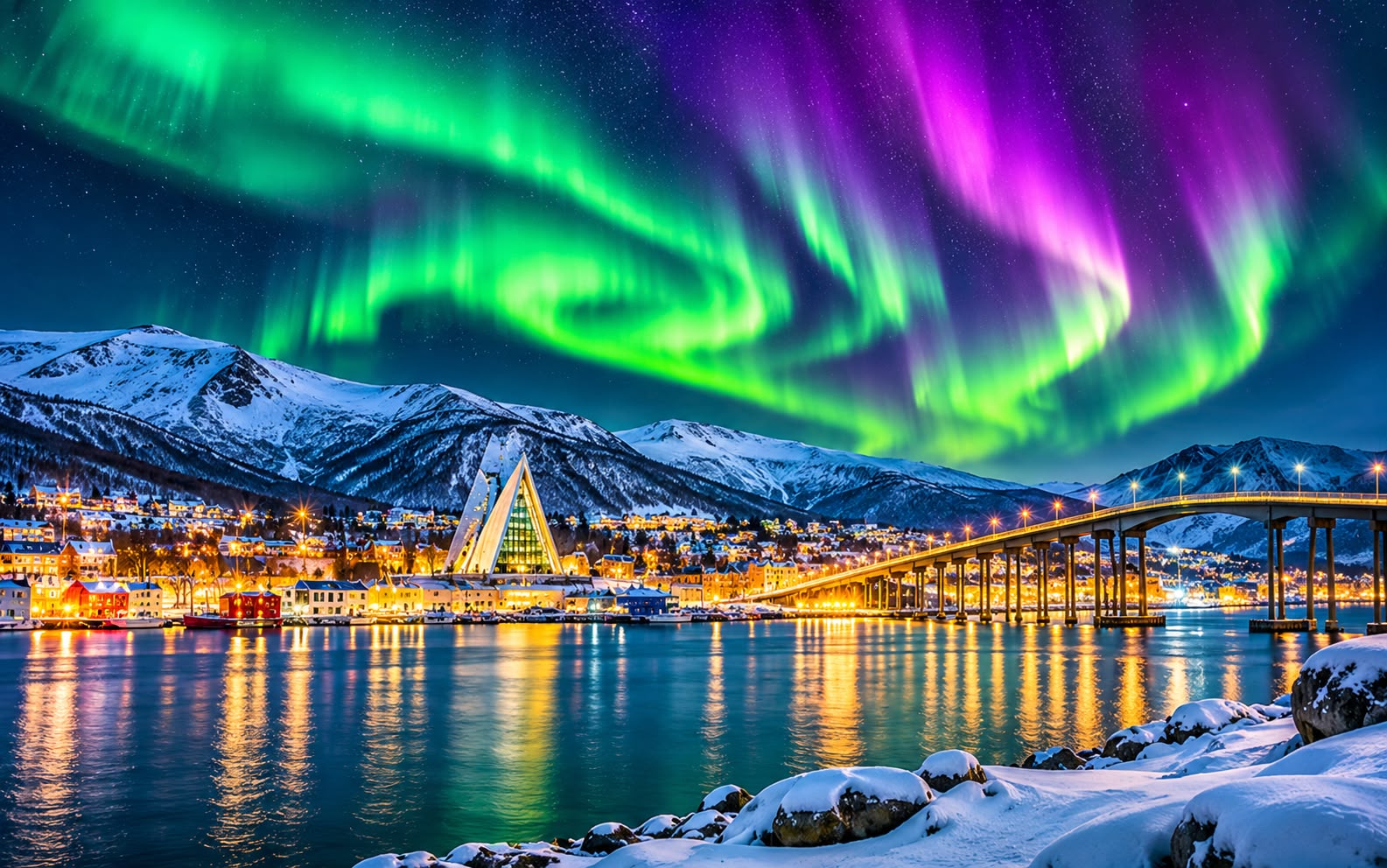
Iceland and Norway in 10 days: the south coast, and the lights from Tromsø
Five days driving Iceland's south coast, then four inside the Arctic Circle at Tromsø. Why two countries doubles your odds on the one thing nobody can book, what Icelandic car hire insurance actually needs to cover, and the months this works at all.
- Northern Europe
- 10 days
- ≈ AED 10,450 / person
- Two separate chances at the aurora, from two countries, in one trip
Before you go
The northern lights cannot be booked, which is the whole problem with planning a trip around them. The answer is more nights under more skies, and this itinerary gives you nine of them across two countries and 2,000 km of longitude.
Five days in Iceland and five in Norway. Iceland is driven — the Golden Circle and the south coast. Norway is flown to: Tromsø, 350 km inside the Arctic Circle, which is the most reliable aurora base in Europe and has whales in the fjords at the same season.
Iceland in 8 days and Norway in 7 days are each country on its own.
Figure USD 2,850 (≈ AED 10,467) per person. Late September to late March.
Before you go: the admin
One Schengen visa, two non-EU countries
- Iceland and Norway are both outside the European Union and both inside the Schengen area. One Schengen visa covers both, and there is no border check between them.
- Apply to the country where you will spend the most nights. They are even here, so use the country of first entry — Iceland.
- An ETIAS authorisation is being phased in for visa-exempt travellers. The start date has moved repeatedly — check before you fly.
- Last checked: 2 November 2026.
The aurora, honestly
- Nobody can promise it. It needs darkness, a clear sky and solar activity, and the first two are weather.
- What you can control is the number of attempts. Nine nights between 64°N and 69°N is a genuinely good run — far better than a three-night weekend.
- Tromsø’s advantage is latitude, which means the aurora oval sits overhead rather than on the horizon, and a chase bus can drive two hours inland to find a hole in the cloud.
- Take a guided chase at least once in Tromsø. They have the forecasts, the vehicles and the local roads.
- Download a forecast app and check the cloud cover map, not just the KP number. Cloud is what actually stops you.
Icelandic car hire, and the insurance that matters
- Take gravel protection and sand-and-ash protection. Neither is covered by a standard waiver and both are the damage that actually happens on Icelandic roads.
- Never open a car door into the wind. Wind damage to doors is one of the commonest and most expensive claims and is usually excluded.
- Winter tyres are legally required from roughly November to April and should be on any winter rental.
- Check road.is every morning. Roads close for weather with no notice, and the south coast is the stretch that closes.
- A 2WD is fine for this itinerary. You do not need a 4x4 unless you are going into the highlands, which are shut in winter anyway.
Money, and the cost
- Iceland uses the króna and Norway the krone, and they are different currencies despite the names.
- Both are effectively cashless. Cards work everywhere, including unstaffed fuel pumps — which need a PIN, so know yours.
- These are two of the most expensive countries on this site. Buy alcohol at the airport duty free on arrival in both; it is the single largest saving available.
- Supermarket lunches are how people afford this trip. Bónus in Iceland, Rema or Kiwi in Norway.
Day by day
Day 1 — Land in Reykjavík
- Arrive at Keflavík, 45 minutes from the city.
- Afternoon — Hallgrímskirkja, the concrete church on the hill, and the tower lift for the coloured roofs below.
- Evening — Harpa concert hall on the waterfront, which is free to walk into and is a building worth the detour.
- Check the aurora forecast tonight and every night. You are already far enough north.
Day 2 — The Golden Circle
- Þingvellir — the rift valley where the North American and Eurasian plates pull apart, and where the Icelandic parliament met from 930.
- Geysir — Strokkur erupts every five to ten minutes, eight to twenty metres. Geysir itself, which gave the word to every language, is mostly dormant.
- Gullfoss — a two-tier waterfall dropping into a canyon. The spray freezes on the path in winter; take the steps slowly.
- Evening — the Secret Lagoon at Flúðir, or back to Reykjavík. Keep the evening free for the sky.
Day 3 — The south coast
- Seljalandsfoss — you can walk behind it. You will get soaked and the path ices over; take waterproofs and grips.
- Skógafoss — 60 m, and a staircase to the top beside it.
- Reynisfjara, the black sand beach at Vík, with basalt columns and sea stacks.
- Stay away from the water at Reynisfjara. The sneaker waves here have killed people and they arrive without warning on a calm day. The warning lights are not decorative.
- Night — Vík. Dark, small, and a good aurora base.
Day 4 — The glacier lagoon
- Jökulsárlón, about two hours further east: icebergs calving off Breiðamerkurjökull and drifting out to sea.
- Diamond Beach opposite, where the bergs wash back up onto black sand, which is the photograph.
- An ice cave, if you have booked one — November to March only, with a guide, never alone. The caves re-form each year and last year’s is gone.
- It is a long drive back. Either stay a second night east or budget four hours.
Day 5 — Back, the Blue Lagoon, and fly
- Morning — the drive west, with Sólheimajökull or the Seljalandsfoss area if you skipped anything.
- Afternoon — the Blue Lagoon or Sky Lagoon, booked, and conveniently close to the airport. The Blue Lagoon is 20 minutes from Keflavík and is the right last stop.
- Evening — fly Keflavík to Oslo, about three hours.
- You gain an hour. Norway is ahead of Iceland.
Day 6 — Oslo, then north
- Morning — the Fram Museum, which holds the actual ship that went furthest north and furthest south, and the Kon-Tiki next door.
- Or the new Munch museum and the National Museum, which has The Scream.
- Midday — the Opera House, whose roof you walk up from the waterfront.
- Afternoon — fly Oslo to Tromsø, about two hours.
- Evening — arrive inside the Arctic Circle. In midwinter the sun does not rise here at all, which is less gloomy and more strange than it sounds.
Day 7 — Tromsø
- Morning — the Fjellheisen cable car up Storsteinen, for the island, the sound and the mountains.
- Midday — the Arctic Cathedral, which is eleven concrete triangles and a glass mosaic, and the Polaria aquarium if the weather is bad.
- Afternoon — the Polar Museum, on the trappers and the expeditions.
- Night — an aurora chase. Four to six hours, often two hours’ drive to find clear sky, sometimes into Finland. Dress for standing still at -15°C.
Day 8 — Whales, or dogs
- Whale watching, roughly November to January, when orca and humpback follow the herring into the fjords. A silent electric or hybrid boat is worth the premium.
- Or dog sledding, which runs the full winter — two hours on a sled, and you drive it rather than ride it.
- Or a Sami reindeer camp, with feeding, a sled ride and joik singing. Choose a Sami-owned operation; several are.
- Night — chase again if it is clear. This is why you came.
Day 9 — The fjord, and the last sky
- A fjord day — Ersfjord or Kvaløya, the island west of Tromsø, with beaches that look Caribbean and are at 69°N.
- Or snowshoeing, or a quiet day — nine days of this is more tiring than it looks.
- Afternoon — the Mack brewery, the world’s northernmost, or the Storgata shops for wool.
- Night — the last attempt. If you have seen nothing yet, this is the night to take a guided chase rather than hope from the hotel.
Day 10 — Out
- Tromsø airport is ten minutes from the centre — one of the easiest airports anywhere.
- Allow two hours, which is genuinely enough here.
- Morning — a last look at the sound. If the sun rises at all in your month, it does so very slowly and very pink.
Costs and practicalities
Best time to visit
Late September to late March. Outside that, there is no darkness to see the aurora in, and this trip loses its reason.
- Late September to mid-October — dark enough for the lights, still mild, and Iceland’s roads are all open. Autumn colour, and the best compromise.
- November to January — longest nights and the best aurora odds. Tromsø’s polar night runs from late November to mid-January — no sunrise at all, which is the strongest version of this trip. Whale watching is at its peak.
- February and March — the other sweet spot. Equinox periods around March often bring stronger activity, days are returning, and ice caves are still open.
- April to August — do not come for the lights. By late April there is no true darkness and in midsummer the sun does not set in Tromsø at all. It is a magnificent trip in summer for completely different reasons — midnight sun, fjords, hiking — but it is not this itinerary.
- Iceland’s weather closes roads at short notice all winter. Check road.is daily and build slack into the south coast days.
Travel tips
- Take gravel and sand-and-ash protection on the Icelandic hire car. Not covered by the standard waiver.
- Never open a car door into the wind. The commonest expensive claim in Iceland.
- Check road.is every morning, and the aurora cloud map every evening.
- Stay back from the water at Reynisfjara. The sneaker waves are lethal.
- Take at least one guided aurora chase in Tromsø.
- Book the Blue Lagoon and any ice cave in advance. Both sell out.
- Buy duty free alcohol on arrival in both countries. The largest single saving available.
- Eat lunch from supermarkets. Bónus, Rema, Kiwi.
- Know your card PIN — Icelandic fuel pumps are unstaffed and require it.
- Dress for standing still outdoors at -15°C, not for walking in it.
What this trip actually costs
Two people, 9 nights, mid-range throughout, international flights excluded:
| Item | Cost |
|---|---|
| Hotels and guesthouses, 9 nights | USD 2,150 (≈ AED 7,896) |
| Food and drink, 10 days | USD 1,250 (≈ AED 4,591) |
| Iceland car hire, 5 days, with winter tyres and full cover | USD 780 (≈ AED 2,865) |
| Flights: Keflavík–Oslo and Oslo–Tromsø, two people | USD 700 (≈ AED 2,571) |
| Aurora chases, whale watching and dog sledding | USD 480 (≈ AED 1,763) |
| The Blue Lagoon, an ice cave, museums and the cable car | USD 340 (≈ AED 1,249) |
| Total for two | USD 5,700 (≈ AED 20,933) |
- Roughly USD 2,850 (≈ AED 10,467) per person for ten days.
- These are two of the three most expensive countries on this site, and the food line is the one people underestimate. A restaurant dinner for two can be a sixth of a day’s budget in either.
- Supermarket breakfasts and lunches cut that line by close to half, which is what the figure above assumes.
- The car hire line includes the insurance that matters. The cheap quote you find online does not, and gravel damage on the south coast is routine.
- The aurora activities are the discretionary part. You can stand in a field for nothing, and some nights that works — but a guided chase can drive to clear sky and you cannot.
- Hotel picks here are chosen on location, not on commission — always check prices and recent reviews before booking.
What to pack
- Proper thermal base layers, top and bottom. This is the single most important item and cotton is useless.
- A windproof, waterproof outer shell. It is the wind, not the temperature, that makes Iceland cold.
- Microspikes or crampons for your boots. Icelandic paths at Gullfoss and Seljalandsfoss ice over completely and this is the commonest injury on the route.
- Waterproof boots with real grip.
- A hat that covers your ears, a neck gaiter and two pairs of gloves — a thin pair for the camera, a thick pair over them.
- Hand warmers, for standing still on an aurora chase.
- A swimsuit and a quick-dry towel for the lagoons.
- A tripod, if you want aurora photographs. Handheld does not work and spare batteries die fast in the cold — keep them inside your jacket.
- A Type C/F adapter for both, 230V.
Part of a bigger trip?
- Iceland in 8 days does the full ring road.
- Norway in 7 days is the fjords and Bergen rather than the Arctic.
- Lapland in 10 days is the Finnish and Swedish version of the same latitude.
- Scandinavia in 12 days is Copenhagen, Stockholm, Oslo and the Bergen railway.
FAQ
Will I definitely see the northern lights? No, and anyone who promises otherwise is selling something. The aurora needs darkness, clear sky and solar activity, and two of those are weather. What this itinerary buys you is nine nights across two countries at 64°N and 69°N, which is a genuinely good run — far better odds than a long weekend, and the reason for using two countries rather than one.
Why Tromsø rather than staying in Iceland? Latitude. Tromsø sits 350 km inside the Arctic Circle, which puts the aurora oval overhead rather than low on the horizon, and the chase operators there can drive two hours inland — sometimes into Finland — to find a gap in the cloud. Iceland’s weather is also famously changeable, so splitting the trip spreads the risk across two separate weather systems.
What insurance do I need on an Icelandic hire car? Gravel protection and sand-and-ash protection, neither of which comes with a standard collision waiver, and both of which cover what actually happens on Icelandic roads. Wind damage to doors is usually excluded entirely, so never open a door into the wind. A 2WD is fine for this route; the highlands that need a 4x4 are shut in winter anyway.
Is a 2WD really enough in an Icelandic winter? For the Golden Circle and the south coast, yes, with winter tyres — these are main roads that are ploughed and salted. The real risk is not traction but closure: roads shut for wind and snow at short notice, so check road.is every morning and keep slack in the schedule. The highland F-roads need a 4x4 and are closed in winter.
Could I do this in summer instead? You could travel both countries in summer and it would be wonderful, but it would not be this trip. By late April there is no true darkness at these latitudes and in midsummer the sun does not set in Tromsø at all, so the aurora is simply not visible. Summer is for the midnight sun, the fjords and hiking — a different itinerary with a different point.
Prices and entry rules change, and what you need depends on your passport; last checked 2 November 2026, so confirm with the embassy or your airline before booking.


