 The Itinerary
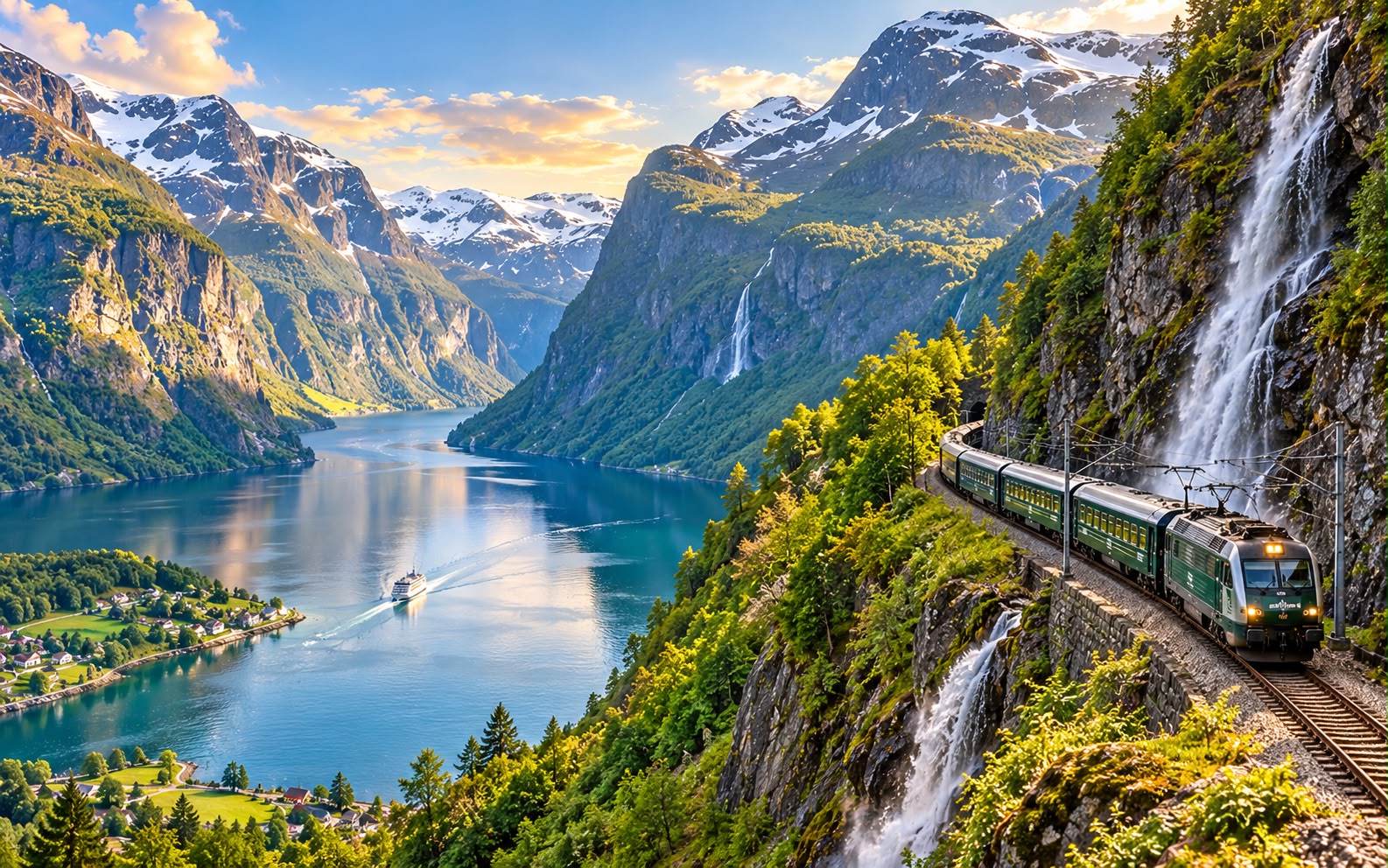
Scandinavia in 12 days: Copenhagen, Stockholm, Oslo and the Norway fjords by train
Design, archipelagos and a fjord: Copenhagen's harbour baths and smørrebrød, Stockholm spread over fourteen islands, Oslo's new waterfront, and then the Bergen railway over the roof of Norway and down to a village at the end of an arm of the sea.
- Northern Europe
- 12 days
- ≈ AED 8,600 / person
- Three capitals and the best railway journey in Europe, with no flights needed
Before you go
Before you go: the admin
One visa, three countries, no borders
- All three are in Schengen, so one visa covers the trip and the borders are invisible — the Copenhagen to Stockholm train does not stop for passports.
- Denmark, Sweden and Norway are not all in the EU. Norway is outside it, inside Schengen and inside the EEA, which matters for duty-free: you can buy duty-free arriving in Norway, and everybody does.
- None of the three uses the euro. Danish krone, Swedish krona, Norwegian krone — three currencies, all different, all abbreviated confusingly.
Trains, which are the point
- This route needs no flights. Copenhagen to Stockholm is five hours, Stockholm to Oslo six, Oslo to Bergen seven over the Hardangervidda.
- Book direct with the operators — DSB in Denmark, SJ in Sweden, Vy in Norway. Advance fares are released about 90 days out and are a fraction of walk-up prices.
- The Bergen railway is the trip’s centrepiece, and the Flåm branch line down to the fjord is the steepest standard- gauge railway in the world at 1 in 18. Book both ahead.
- “Norway in a Nutshell” is the packaged version of Oslo → Myrdal → Flåm → Nærøyfjord cruise → Voss → Bergen. You can book the same legs individually and usually cheaper.
Money
- It is all cashless. Cards work everywhere including buses, toilets and market stalls; Norway in particular has shops that do not accept notes at all.
- Three currencies means no cash is worth changing. Use the card and decline every dynamic currency conversion the terminal offers.
- This is an expensive trip. Supermarket lunches, hotel breakfasts and the duty-free on arrival in Norway are how people manage it.
One gentle brief
- Alcohol is state-monopoly in Sweden and Norway. Systembolaget and Vinmonopolet, limited hours, closed Sunday, and anything above 3.5% is not in a supermarket.
- The daylight swing is extreme. Eighteen hours in June, six in December, and it shapes the whole trip.
- Tipping is not expected in any of the three. Service is included and wages are high.
Day by day
Day 1 — Land in Copenhagen
- 14:00 — Arrive and get on a bike or a harbour bus. The 991 and 992 are ordinary public transport and the best city tour in Scandinavia.
- 16:00 — Nyhavn for the painted houses, then away from it — the canal is twenty minutes of your life, not an afternoon.
- 17:00 — The Round Tower, climbed by a spiral ramp rather than steps, which a tsar once rode a horse up.
- 19:00 — Reffen or Broens Gadekøkken for street food in the evening, which is where Copenhageners actually eat.
- A bike is the way to move here, and the lanes have their own traffic lights and their own etiquette — signal, and do not stop in them.
Day 2 — Copenhagen: design, a palace and a harbour swim
- 10:00 — Designmuseum Danmark for the chairs — Wegner, Jacobsen, Klint — which is the city’s real contribution.
- 13:00 — Rosenborg Castle for the crown jewels, or Christiansborg for the tower, which is free and the best view in the city.
- 15:00 — Christiania, which is a self-declared free town on an old barracks site. Photography is prohibited on Pusher Street and the rule is enforced by residents.
- 17:00 — A harbour bath at Islands Brygge if the weather allows. The harbour is clean enough to swim in, which took thirty years of work and is the thing Copenhagen is proudest of.
- 20:00 — Dinner in Vesterbro.
Day 3 — Train to Stockholm
- 08:00 — Five hours over the Øresund Bridge and up through the Swedish forest. Book a seat with a table.
- 14:00 — Arrive mid-afternoon and walk Gamla Stan — the old town on its own island, Stortorget’s painted facades, and Mårten Trotzigs Gränd, which is 90cm wide.
- 16:30 — Fika in the late afternoon. Coffee and a cinnamon bun, taken seriously, and often twice a day.
- 18:00 — The changing of the guard at the Royal Palace if the timing lands, and the Royal Apartments otherwise.
- 20:00 — Dinner in Gamla Stan or across to Södermalm.
Day 4 — Stockholm: the Vasa, and the islands
- 08:30 — The Vasa Museum first thing — a 69-metre warship that sank on her maiden voyage in 1628, was raised intact in 1961 and is 98% original timber. It is the best museum in Scandinavia and it is not close.
- 11:30 — Skansen next door, the world’s first open-air museum, with Nordic animals and relocated farmsteads.
- 15:00 — The Fotografiska or ABBA The Museum in the afternoon, depending on the company.
- 17:00 — The City Hall tower for the Blue Hall where the Nobel banquet is held, by guided tour only — the tower is seasonal, roughly May to September.
- 19:30 — Södermalm for the evening.
Day 5 — The archipelago
- 09:00 — A ferry out from Strömkajen into the 30,000 islands. Vaxholm is the easy one, an hour; Grinda or Fjäderholmarna are quieter.
- Waxholmsbolaget runs the network as public transport and an island-hopping pass is good value.
- 12:00 — Lunch on the island, and the smoked fish is the thing.
- 14:00 — Swim if it is July or August — the Baltic is 18–20°C at best and Swedes are unbothered by that.
- 18:00 — Back for the evening in Södermalm, which is where the city eats and drinks.
Day 6 — Train to Oslo
- 09:00 — Six hours through Värmland and across the border, which you will not notice.
- 15:30 — Arrive and walk the Opera House roof — you walk up it, it is free, and it is the best thing Oslo has built.
- 17:00 — Aker Brygge and Tjuvholmen in the evening for the waterfront, and the Astrup Fearnley museum on the point.
- 20:00 — Dinner at Mathallen, which is the food hall and avoids Oslo’s restaurant prices.
- Norway is markedly more expensive than Sweden or Denmark. Budget for it rather than being surprised by it.
Day 7 — Oslo: Munch, the polar ship and Vigeland
- 10:00 — The Munch Museum in its new tower — thirteen floors, and the versions of The Scream are rotated for conservation.
- 13:00 — The Viking Ship Museum has been closed for rebuilding since 2021 and reopens as the Museum of the Viking Age — check its status before planning around it. The Fram Museum nearby, with Nansen and Amundsen’s polar ship, is open and excellent — you walk the decks of the ship itself.
- 16:00 — Vigeland Sculpture Park — 200 bronze and granite figures by one man, free and open always.
- 18:30 — The Holmenkollen ski jump for the view and the ski museum, which is 20 minutes out on the metro.
Day 8 — The Bergen railway to Flåm
- 08:00 — Oslo to Myrdal is the great journey — four and a half hours climbing to 1,222m over the Hardangervidda, Europe’s largest high plateau, with snow beside the track well into June.
- 13:00 — Change at Myrdal for the Flåm line — 20km, 866m of descent, twenty tunnels, and a stop at the Kjosfossen waterfall.
- 15:00 — Flåm itself is a village of a few hundred people at the end of the Aurlandsfjord with a very large cruise berth. Stay the night; it empties in the evening.
- 17:00 — Stegastein viewpoint above it, 650m up on a cantilevered platform, reached by bus.
- 20:00 — Dinner at the Ægir brewery, which is built as a stave church and is better than that sounds.
Day 9 — The Nærøyfjord, and on to Bergen
- 09:00 — The Nærøyfjord cruise — UNESCO-listed, 250m wide at its narrowest with 1,700m walls, and the electric ferries run it silently, which changes the experience completely.
- 11:30 — Then Gudvangen to Voss by bus up the Stalheimskleiva hairpins if the road is open, which is thirteen bends at one in five.
- 14:00 — Voss to Bergen by train, about an hour and a quarter.
- 16:00 — Arrive in Bergen in the late afternoon.
- 19:00 — Dinner at Bryggen, and the light in June runs to nearly midnight.
Day 10 — Bergen: Bryggen and the mountain
- 09:00 — Bryggen, the Hanseatic wharf, UNESCO-listed — leaning wooden warehouses that have burned down and been rebuilt in the same form since the fourteenth century. The Hanseatic Museum explains who lived in them and how badly.
- 12:00 — The fish market is now mostly for visitors; Fisketorget’s indoor hall is better, and lunch there.
- 14:00 — The Fløibanen funicular up Fløyen, or walk it in 45 minutes, for the view over the seven mountains.
- It rains here. Bergen gets around 2,250mm a year and about 230 wet days. Locals do not use umbrellas — they wear proper coats and carry on.
- 19:30 — Lysverket or Bare for dinner.
Day 11 — A fjord day, or Edvard Grieg
- 10:00 — Troldhaugen, Grieg’s villa on the lake, with lunchtime recitals in the purpose-built hall — the composing hut at the bottom of the garden is the part worth the walk.
- Or the Hardangerfjord as a day trip — Steinsdalsfossen and the fruit orchards, which are the other fjord and are gentler than the Sognefjord. The blossom is in May.
- Or the Ulriken cable car and the ridge walk back down to Fløyen, which is four hours and the best walk in the city.
- 18:00 — A last evening on the wharf.
Day 12 — Fly out of Bergen
- 09:00 — Spend the last krone, because there is nowhere else to spend it — Norwegian, Swedish and Danish kroner are three different currencies and none works in the others.
- 11:00 — Bergen’s airport is 20 minutes by light rail from the centre.
- Buy duty-free on the way out as well as the way in — Norwegian alcohol prices make it worth the detour.
Costs and practicalities
Best time to visit
May–September for the fjords and the light, with the rest of the year a genuinely different trip.
- May–June — the best of the year. Waterfalls at full volume from the snowmelt, everything open, and near-24-hour daylight by late June in the north. Norway’s National Day on 17 May fills Oslo and Bergen with processions.
- July–August — warmest and busiest, with the Bergen railway and the fjord cruises at capacity and Flåm taking several cruise ships a day. Midsummer in late June empties the Swedish and Danish cities entirely.
- September–October — autumn colour on the Hardangervidda, prices down, and the crowds gone. The best value.
- November–March — cold, dark and expensive to heat. The Bergen railway runs year-round and the plateau in deep snow is arguably better than in summer. Daylight in Oslo in December is about six hours.
The Nobel ceremonies are on 10 December in Stockholm and Oslo, which fills both cities.
Travel tips
- Book trains about 90 days out. Advance fares on SJ and Vy are a fraction of the walk-up price, and the Flåm and Bergen services sell out in summer.
- Buy the Norway legs separately rather than as a package. “Norway in a Nutshell” is the same trains, buses and boat, resold.
- Buy duty-free alcohol on arrival in Norway. Vinmonopolet is the only other source, it closes early and all day Sunday, and the prices are the highest in Europe.
- Everything is cashless. Do not change money; many Norwegian businesses will not take notes at all.
- Allemansrätten and allemannsretten let you walk and wild camp on uncultivated land in all three, 150m from any dwelling. It comes with obligations, not just rights.
- Check the Norwegian mountain code before any hike. Weather above the treeline turns fast and the rescue services spend every summer on unprepared visitors.
- Tap water is excellent in all three. Bottled water is pure waste here.
What this trip actually costs
Two people, 11 nights, mid-range comfort, international flights excluded:
| Item | Cost |
|---|---|
| Hotels, 11 nights | EUR 1,760 (≈ AED 7,206) |
| Food and drink, 12 days | EUR 1,100 (≈ AED 4,504) |
| Trains: Copenhagen–Stockholm–Oslo–Bergen, two people | EUR 620 (≈ AED 2,539) |
| Fjord cruise, funiculars, museums and entries | EUR 420 (≈ AED 1,720) |
| City transport, transfers and the Flåm buses | EUR 300 (≈ AED 1,228) |
| Total for two | EUR 4,200 (≈ AED 17,197) |
- Roughly EUR 2,100 (≈ AED 8,599) per person, which makes this the most expensive route on the site — and the figure is honest rather than pessimistic.
- Food is the line people underestimate. A restaurant dinner for two in Oslo or Bergen runs to €100 before wine; the supermarket and the hotel breakfast are how to manage it.
- Booking the trains late can add €300 on its own.
- Hotel picks here are chosen on location, not on commission — always check prices and recent reviews before booking.
What to pack
- A proper waterproof, not an umbrella. Bergen has 230 wet days a year and the wind makes umbrellas useless.
- Layers. The Hardangervidda is cold in July and the fjord boat decks are colder.
- Shoes that handle wet rock for Fløyen and Stegastein.
- A reusable bottle. The tap water is the best in Europe.
- An eye mask in summer and nothing for the dark in winter — it is the light that stops people sleeping.
- A card, and a second card. There is no cash fallback here.
FAQ
Can I do this without flying? Yes — that is the point of the route. Trains link all four legs and the only boat is the fjord cruise.
Is “Norway in a Nutshell” worth booking? Not as a package. It is the Oslo–Myrdal train, the Flåm railway, the Nærøyfjord cruise and the Voss bus, all of which you can book individually, usually cheaper and with your own timings.
Which capital deserves the most days? Stockholm, on most people’s reckoning — the Vasa, the old town and the archipelago are three distinct days. Oslo can be done in two.
How expensive is it really? Roughly double southern Europe. Norway is the dearest of the three and Denmark the cheapest, and food is where the difference shows most.
Will I see the northern lights? Not on this route and not in summer. The lights need darkness and latitude — Tromsø and Lapland from September to March.
Prices and entry rules change, and what you need depends on your passport; last checked 29 October 2026, so confirm with the embassy or your airline before booking.


