 The Itinerary
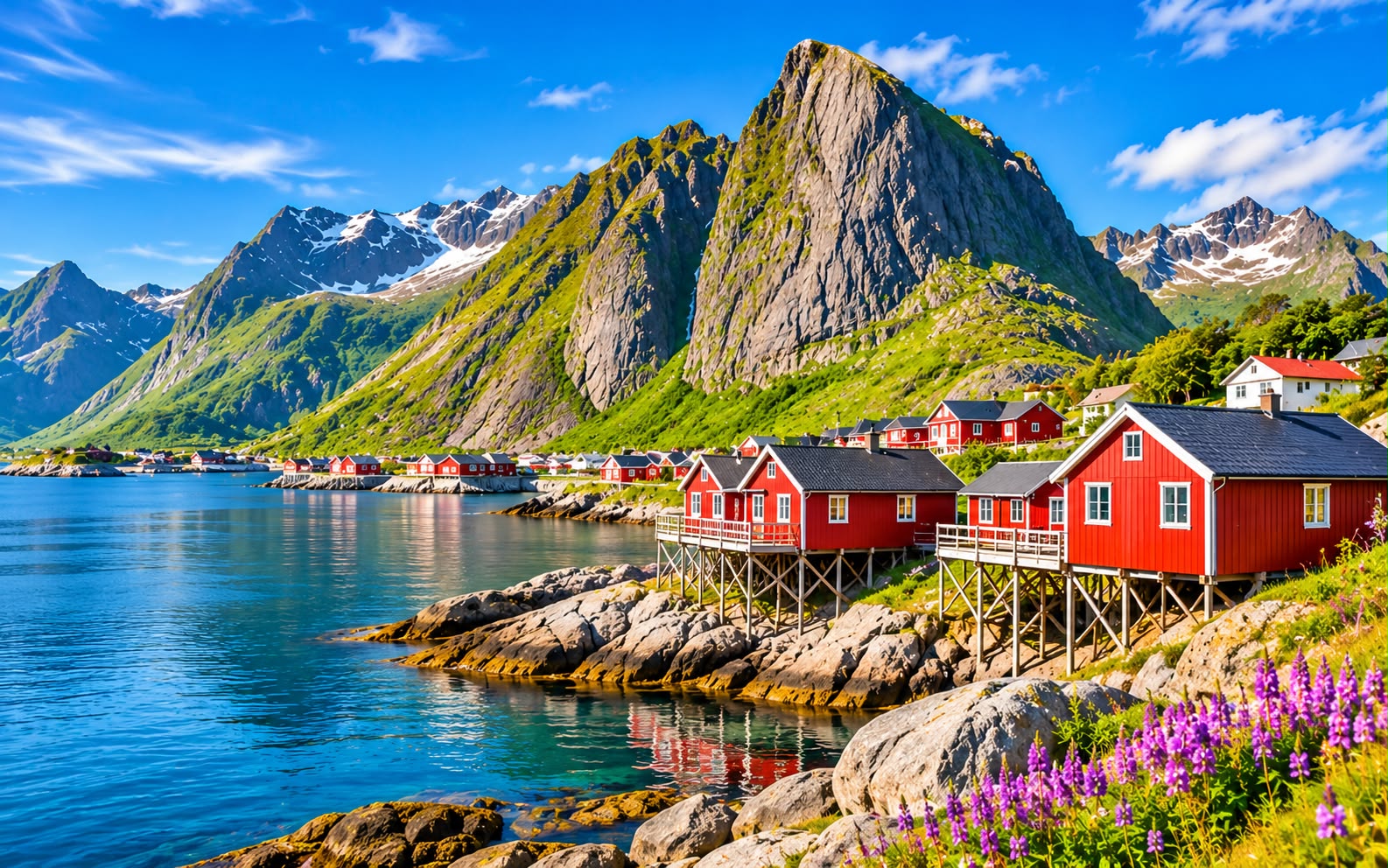
Lofoten in 8 days: Arctic beaches and the midnight sun
The archipelago where granite peaks drop straight into turquoise water, done in summer when the sun never sets. The car ferry that needs booking, the Reinebringen steps, why a rorbu is worth it, and what Norwegian prices actually do to a budget.
- Northern Europe
- 8 days
- ≈ AED 7,150 / person
- White-sand beaches above the Arctic Circle, in daylight at midnight
Before you go
The site’s Norway in 7 days is Oslo, Flåm and Bergen — the fjords everyone knows. Lofoten is 1,200 kilometres north of that, inside the Arctic Circle, and it does not look like anywhere else in Europe.
Mountains rise straight out of the sea to 1,000 metres, there are white-sand beaches with turquoise water that is four degrees, and the villages are red fishermen’s cabins on stilts.
This is written for summer and the midnight sun — roughly late May to mid-July, when the sun does not set at all. That is deliberate: the site already has two aurora guides, and Lofoten in July is a completely different proposition from Lofoten in January.
Fly into Bodø, ferry across, drive north, fly out of Evenes. One direction, no backtracking.
Figure NOK 18,400 (≈ AED 7,147) per person. June and July for the midnight sun; September for autumn and fewer people.
Before you go: the admin
The ferry, which is the one thing to book
- Bodø to Moskenes is three to four hours across open water and is the gateway. Book the car on it as far ahead as you can — summer sailings sell out, and the walk-on queue is no help if you have a vehicle.
- The alternative is to fly into Evenes (Harstad/Narvik) and drive in from the north-east, which avoids the ferry entirely. This itinerary does Bodø in, Evenes out, which gets you the crossing and no repeated road.
- The crossing can be rough. Take something for it.
Money, and the thing everyone warns you about
- Norway is among the most expensive countries in the world and Lofoten is not a discount corner of it.
- It is effectively cashless. Cards work everywhere, including car-park machines and unstaffed ferries. You do not need kroner in cash.
- Alcohol is sold through the state monopoly, Vinmonopolet, outside supermarkets, with limited hours and none on Sundays. Beer is in supermarkets but stops being sold at 20:00 on weekdays and 18:00 on Saturdays.
- The cost control that actually works: self-cater. Rorbuer and cabins have kitchens, supermarkets are normal-priced by Norwegian standards, and restaurant dinners are where budgets die.
Driving the E10
- One road runs the length of the archipelago — the E10 — and it is largely single carriageway, with tunnels, bridges and long stretches with nowhere to pass.
- Pull over to let locals past. They are going to work.
- Parking at the trailheads is paid, enforced, and fills by 09:00 in July. Do not park on verges — it blocks farm access and is ticketed.
- Campervans are everywhere in summer and slow. Build the time in.
- Wild camping is a legal right under allemannsretten, but not within 150 m of a dwelling, and not for campervans in laybys — the rules tightened after the archipelago was overwhelmed. Use the campsites.
Midnight sun, and weather
- From roughly 25 May to 17 July the sun does not set. It is disorienting and wonderful. Bring an eye mask; the cabins rarely have blackout curtains.
- Weather changes within the hour. Four seasons in a day is the norm, and a forecast two days out is a guess.
- It is cool even in July — 12 to 18°C is a normal summer day, and it is windy. Nobody swims for long.
- Midges are not the issue here that they are in Scotland, but bring repellent anyway for the still evenings.
Day by day
Day 1 — Bodø, and the crossing
- Fly into Bodø and, if the ferry timing allows, see the Saltstraumen — the strongest tidal current in the world, twenty minutes out, where the water boils through a narrow channel four times a day. Check the tide table; between tides there is nothing to see.
- The ferry to Moskenes, three to four hours.
- Arrive in Lofoten in the evening — which in June is indistinguishable from the afternoon.
- Drive to Reine or Hamnøy, about twenty minutes.
Where to stay around Reine (three nights)
- Grand: a restored rorbu at Hamnøy or Sakrisøy with the peaks out of the window — these are the postcard cabins and they book a year ahead.
- Mid-range: a rorbu or sjøhus in Reine or Å.
- Simple: the campsites at Moskenes and Ramberg, or a room in a village guesthouse.
Day 2 — Reine, Å and the end of the road
- Morning — Reine itself, which is the photograph that sold you the trip: red cabins on a spit under a granite wall.
- 11:00 — Å, the village at the literal end of the E10, with a stockfish museum and a working cod-liver-oil rendering that is exactly as pungent as it sounds, and genuinely interesting.
- 13:00 — Sakrisøy for the famous yellow cabins and a fish burger from the stall.
- 15:00 — Kvalvika beach, reached by a one-hour hike over a saddle from Torsfjord. A beach you have to walk to, and in summer there are tents on it.
- Evening — Ryten, above Kvalvika, if the legs hold — the view down onto the beach is the one people chase.
Day 3 — Reinebringen, or the fjord
- The hike: Reinebringen. About 1,500 stone steps built by Nepali Sherpa crews, climbing 450 metres to a ledge above Reine. One to two hours up.
- It is dangerous in wet weather — the steps are slick and the summit ridge is exposed with a long fall. People have died here. Do not go in rain or low cloud, and do not continue past the viewing area.
- The alternative, and it is a good one: a boat into the Reinefjord to Vindstad, then walk to Bunes beach, which is enormous, empty and backed by a 700-metre rock face.
- Evening — Cook in the cabin and watch the light not go.
Day 4 — North to Nusfjord and the beaches
- Morning — Nusfjord, a preserved fishing village in a narrow inlet — UNESCO-listed and charging an entry fee, which is unusual here and worth it for how complete it is.
- 12:00 — Flakstad and Ramberg beaches, which are Caribbean to look at and Arctic to stand in.
- 14:00 — Haukland and Uttakleiv, over the hill from Leknes, and the two best beaches in Lofoten. Uttakleiv is where the aurora photographs come from in winter; in summer it is turquoise and empty-ish.
- 16:00 — The Mannen hike above Haukland, forty-five minutes up, for the view over both beaches.
- Evening — On towards Henningsvær.
Where to stay in Henningsvær or Svolvær (four nights)
- Grand: a design hotel on the water at Svolvær, or a rorbu in Henningsvær harbour.
- Mid-range: guesthouses in Henningsvær, which is small enough to walk entirely.
- Simple: cabins and campsites around Kabelvåg, which is between the two and cheaper than both.
Day 5 — Henningsvær
- The village is on islets linked by bridges and is the most attractive settlement in Lofoten.
- Morning — The football pitch, which sits on a rock shelf surrounded by sea and is one of the most photographed sports grounds anywhere. It is a working pitch; do not walk on it during a match.
- 11:00 — The galleries and the climbing shop. Henningsvær is Norway’s climbing capital and Svolværgeita — the Goat — is the famous route above Svolvær.
- 14:00 — A sea-eagle safari by RIB into the Trollfjord, a two-kilometre-long slot barely 100 metres wide at the mouth. White-tailed eagles are near-certain.
- Evening — Dinner in the harbour, which is where to spend on a meal if you spend on one.
Day 6 — The Vikings, and the north
- 10:00 — The Lofotr Viking Museum at Borg — built over the excavated site of the largest Viking longhouse ever found, 83 metres, with a full reconstruction. Better than it sounds, and the best wet-weather day on the islands.
- 13:00 — Eggum, on the exposed north coast, for a coastal walk with the open Atlantic on one side.
- 15:00 — Unstad, which is where people surf in the Arctic — and you can, in a thick wetsuit, with lessons.
- Evening — Svolvær.
Day 7 — Vesterålen and towards Evenes
- Morning — North over the bridges into Vesterålen, which is Lofoten’s quieter neighbour and nearly as good.
- The whale option: Andenes, at the top of Vesterålen, runs sperm-whale trips through the summer — it is a long drive, three hours each way, and a full commitment. Worth it if whales are the point; skip it otherwise.
- The easier day: Nyksund, an abandoned fishing village partly brought back to life, and the Dronningruta coastal walk.
- Evening — Stay near Harstad or Evenes for the flight.
Day 8 — Out from Evenes
- Evenes airport serves Oslo and connects onward.
- Drop the car with the usual margin, and fill the tank before you get there — the airport station charges accordingly.
Costs and practicalities
Best time to visit
June and July for the midnight sun; September for autumn.
- Late May to mid-July — the midnight sun, roughly 25 May to 17 July. Everything is open, the hiking is at its best, and it is the busiest and most expensive stretch of the year.
- August — still light late, warmer water, fewer campervans after the Norwegian holidays end.
- September — the quiet gem. Autumn colour on the mountainsides, the first aurora of the season on dark nights, and prices down. Weather is less reliable.
- October to March — the polar night runs roughly 7 December to 5 January, with no sunrise at all. Aurora season, dramatic and genuinely hard: roads close, ferries cancel, and many businesses shut. A different trip — see Iceland and Norway in 10 days for the aurora version.
- April and May — snow still on the peaks, light returning fast, very few people.
Travel tips
- Book the Bodø–Moskenes car ferry early. It sells out.
- Book rorbuer months ahead for summer — the postcard ones go a year out.
- Self-cater. It is the single biggest saving available.
- Do not climb Reinebringen in rain or cloud.
- Trailhead parking is paid and fills by 09:00. Do not park on verges.
- Bring an eye mask for the midnight sun.
- Pack for 12–18°C and wind, in July.
- Alcohol: Vinmonopolet for wine and spirits, supermarkets for beer until 20:00 on weekdays.
- Pull over for local traffic on the E10.
- Wild camping is a right, not a free-for-all — 150 m from any dwelling, and campsites for vans.
What this trip actually costs
Two people, 7 nights, mid-range throughout, international flights excluded:
| Item | Cost |
|---|---|
| Rorbuer and guesthouses, 7 nights | NOK 14,000 (≈ AED 5,438) |
| Food and drink, 8 days, mostly self-catered | NOK 9,000 (≈ AED 3,496) |
| Hire car, 7 days, with fuel | NOK 7,000 (≈ AED 2,719) |
| The Bodø ferry and a sea-eagle RIB safari | NOK 3,800 (≈ AED 1,476) |
| The Lofotr Viking Museum, Nusfjord, entries | NOK 1,800 (≈ AED 699) |
| Tolls, parking and extras | NOK 1,200 (≈ AED 466) |
| Total for two | NOK 36,800 (≈ AED 14,293) |
- Roughly NOK 18,400 (≈ AED 7,147) per person for eight days.
- The food line assumes you cook most nights. Eating out every evening would add roughly half as much again — this is the biggest single lever in a Norwegian budget.
- Rorbuer are not cheap but they are the stay, and they come with kitchens, which is partly why the food line works.
- The hiking, the beaches and the villages all cost nothing. The paid items on this trip are the ferry, one boat and one museum.
- Hotel picks here are chosen on location, not on commission — always check prices and recent reviews before booking.
What to pack
- A proper waterproof jacket and trousers. Not showerproof.
- Walking boots with ankle support for Reinebringen’s steps and the beach hikes.
- Layers including a warm mid-layer, in July.
- A windproof hat and gloves, which you will use.
- An eye mask for the midnight sun.
- Swimwear, for the three minutes you will manage.
- A dry bag for the RIB, which is wet.
- Sunglasses and sunscreen — low Arctic sun for twenty-four hours a day burns.
- A Type F adapter, 230V.
Part of a bigger trip?
- Norway in 7 days is Oslo, Flåm and Bergen — the southern fjords.
- Iceland and Norway in 10 days is the winter and aurora pairing.
- Add Senja, north-east of Vesterålen, which many Norwegians consider the better island and which has a fraction of the visitors.
- The Hurtigruten coastal ferry calls at Svolvær and Stamsund and is the slow way in or out.
FAQ
When exactly is the midnight sun? Roughly 25 May to 17 July in Lofoten — the sun stays above the horizon for the whole 24 hours. Either side of that you get long twilight rather than true midnight sun, which is nearly as good. Bring an eye mask; cabins here rarely have blackout curtains and sleeping in full daylight takes some adjustment.
Do I need to book the ferry? If you are taking a car, yes, and as far ahead as you can — summer sailings on the Bodø–Moskenes route sell out. Foot passengers can usually walk on. The alternative is to fly into Evenes and drive in from the north-east, skipping the crossing altogether.
Is Reinebringen safe? The 1,500 stone steps are solid and well built, and in dry weather it is a steep but straightforward hour or two. In rain or low cloud it is genuinely dangerous — the stone is slick and the ridge above the viewing platform is exposed with a long fall. People have died. If the weather is poor, take the boat to Bunes beach instead.
How expensive is it, really? Norway is among the most expensive countries in the world, and this budget assumes you cook most nights in the cabin. Eating out every evening would add roughly half again. The compensation is that almost everything you came for — the beaches, the hikes, the villages, the light — costs nothing at all.
Can I see the northern lights? Not in summer; the sky never gets dark enough. Aurora season runs roughly September to early April, and the polar night from about 7 December to 5 January. That is a different trip with different risks — roads close and ferries cancel — and it is covered in the Iceland and Norway pairing rather than here.
Prices and entry rules change, and what you need depends on your passport; last checked 3 November 2026, so confirm with the embassy or your airline before booking.


