 The Itinerary
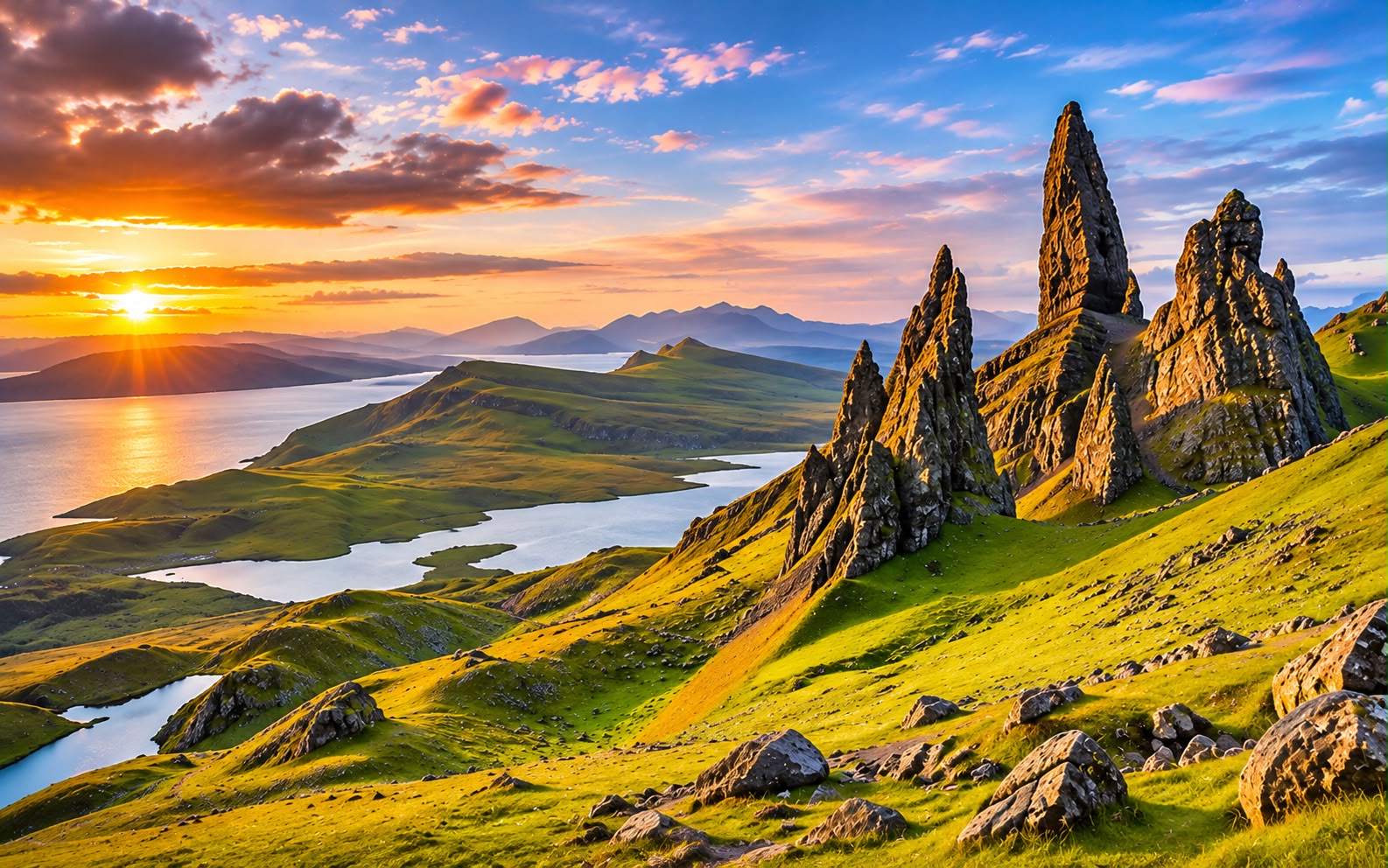
Scotland in 7 days: Edinburgh, Glencoe and the Isle of Skye
Edinburgh first, then a car north through Glencoe to Skye and back by Loch Ness. The single-track road etiquette, the midge season, why Skye beds book out six months ahead, and what the weather actually does to a plan.
- Northern Europe
- 7 days
- ≈ AED 6,150 / person
- Two days of city, four of Highlands, one loop
Before you go
Scotland is one of the few places where the drive is the holiday. Glencoe, the road to Skye and the run back down Loch Ness are not transfers between sights — they are the sights, and the plan has to be built around that.
Two days in Edinburgh, four with a car, one to come home. Edinburgh is compact and rewards exactly two days. The car gets picked up on the morning of Day 3, because nobody needs one in Edinburgh and the parking is punitive.
Skye is the bottleneck. It has a small number of beds and a very large number of visitors, and June to August books out months in advance. Fix those two nights before anything else.
The United Kingdom in 10 days is the London-and-Edinburgh version; this is Scotland on its own terms.
Figure GBP 1,250 (≈ AED 6,134) per person. May, June, or September.
Before you go: the admin
Book these two things first
- Two nights on Skye, as early as you possibly can. Portree, Dunvegan and Broadford are the practical bases and they fill six months out for summer.
- Edinburgh Castle, timed entry, booked online. The walk-up queue on a July morning is a waste of a day.
- If your dates touch August, read the Fringe paragraph below before booking anything at all.
Entry to the UK
- Many nationalities now need an ETA — an electronic travel authorisation — before boarding, and others need a standard visitor visa. Check which applies to your passport, and apply on the official government site rather than the agencies that advertise above it.
- Scotland is part of the UK, so there is no separate entry process, but Scottish banknotes are issued by Scottish banks and occasionally confuse tills in England. They are legal currency; keep the receipt if it matters.
- Last checked: 2 November 2026.
The car, and the roads
- Driving is on the left. If that is new to you, the first hour out of Edinburgh is not the moment to also be tired.
- Hire an automatic if you have any doubt — most Scottish hire cars are manual and the gear lever is on your other side.
- Single-track roads are standard on Skye and common in the Highlands. The etiquette is not optional: passing places are for pulling into or opposite, never for parking, you give way to whoever is closer to one, and you let faster traffic through rather than leading a queue. A raised hand is the thank-you.
- Sheep have right of way in practice. So do deer, and hitting one at dusk is a common and expensive way to end a trip.
- Fuel is sparse and expensive in the north-west. Fill up in Fort William and Portree.
Midges, and the weather
- The Highland midge runs roughly late May to September, is worst at dawn and dusk in still, damp conditions, and is genuinely capable of ruining an evening. Wind kills them — a breezy summit is fine, a sheltered loch shore at 20:00 is not. Bring repellent and, if you camp, a head net.
- “Four seasons in one day” is a description, not a joke. Pack waterproofs and wear layers every single day, including the ones that start blue.
- Ticks are present in bracken and long grass. Check afterwards.
Day by day
Day 1 — Edinburgh old and new
- Stay in the Old Town or Stockbridge. Both walk to everything; Stockbridge is quieter and cheaper.
- 10:00 — Edinburgh Castle at your booked slot: the Honours of Scotland, the Stone of Destiny, St Margaret’s Chapel, and the one o’clock gun if you time it.
- 13:00 — Down the Royal Mile on foot, taking the closes and wynds off it rather than the main drag — Mary King’s Close runs beneath the street and is the better history.
- 16:00 — Holyrood Palace at the bottom, or the Scottish Parliament opposite it, which is free and architecturally strange.
- 18:00 — Up Calton Hill for sunset. Twenty minutes, mostly steps, and the best view of the city for no money.
Where to stay in Edinburgh (two nights)
- Grand: The Balmoral — the clock tower at the end of Princes Street, deliberately kept three minutes fast.
- Mid-range: a Georgian townhouse hotel in the New Town, walkable and quieter than the Royal Mile.
- Simple: Stockbridge or Leith guesthouses, fifteen minutes out and noticeably cheaper.
Day 2 — Arthur’s Seat, and the other Edinburgh
- 08:30 — Arthur’s Seat. An extinct volcano in the middle of the city; an hour up, properly steep at the end, and the view is the whole Firth of Forth. The Salisbury Crags loop is the gentler alternative.
- 12:00 — The National Museum of Scotland — free, enormous, and the roof terrace is a secret.
- 15:00 — Dean Village and the Water of Leith walkway, which is five minutes from Princes Street and feels an hour away.
- 18:00 — Dinner in Leith, then the walk back along the shore if the evening holds.
- If it is August: the Fringe takes over the entire city. Beds triple, the Royal Mile is impassable, and it is also the greatest arts festival on earth. Decide deliberately rather than by accident.
Day 3 — North through Glencoe
- 09:00 — Collect the car. Out via the Forth bridges or west towards Stirling.
- 10:30 — Stirling Castle or the Wallace Monument, both on the way and both worth an hour.
- 12:30 — Loch Lomond at Luss, for lunch by the water.
- 15:00 — Rannoch Moor and Glencoe. The moor is a vast empty bowl and then the glen closes around you — the Three Sisters pull-off is the stop everyone makes and it deserves the traffic.
- 16:30 — The Glencoe visitor centre for the massacre’s history, which is worth knowing before you drive out the far end.
- Evening — Fort William or stay in Glencoe itself. Ben Nevis is here; climbing it is a full day and not in this plan.
Where to stay in Glencoe or Fort William (one night)
- Grand: a country-house hotel in the glen, of which there are two or three and all book early.
- Mid-range: a Fort William hotel with loch views; the town is functional rather than pretty but it has the beds.
- Simple: B&Bs in Ballachulish and Onich, between the two.
Day 4 — To Skye, the long way
- 09:00 — The Glenfinnan Viaduct, forty minutes west: a curved 21-arch railway bridge over a glen. The Jacobite steam train crosses in the late morning and again mid-afternoon in season — check the timetable, arrive an hour early for parking, and walk up to the viewpoint rather than standing in the car park.
- 12:30 — Back east and north to Eilean Donan Castle, which sits on an island at the meeting of three lochs and is the most photographed building in Scotland for good reason.
- 15:00 — Over the Skye Bridge. The ferry from Mallaig is the prettier alternative if you want it, and needs booking.
- 16:30 — Portree, the island’s small capital: the harbour front of coloured houses, and dinner booked, because Skye’s restaurants fill.
Where to stay on Skye (two nights)
- Grand: a country house near Dunvegan or Sleat — a handful exist and they book a year out.
- Mid-range: a Portree hotel or a guesthouse on the harbour, which puts dinner within walking distance.
- Simple: B&Bs in Broadford or Carbost, cheaper and better placed for an early start south.
Day 5 — Skye
- 07:30 — The Old Man of Storr before the coaches. An hour up on a rebuilt path, and the pinnacle is the one you have seen in photographs.
- 11:00 — The Quiraing. A landslip that produced a landscape nothing else resembles. The road in is single-track and steep; the circular walk is exposed in places and the car park fills by nine.
- 14:00 — Kilt Rock and Mealt Falls, a two-minute stop, then lunch in Staffin or Uig.
- 16:00 — Neist Point for the lighthouse and the westernmost sunset on the island, or the Fairy Pools at Glen Brittle — clear and freezing, and the car park is paid and fills early.
- Note: the Fairy Glen and the Fairy Pools are different places half the island apart. People lose an afternoon to that.
Day 6 — Loch Ness, and east
- 09:00 — South off the island, then east along Loch Duich and through Glen Shiel past the Five Sisters.
- 11:30 — Urquhart Castle on Loch Ness: a ruin on a promontory with the best outlook on the loch. Book the slot.
- 13:00 — A loch cruise from Drumnadrochit, if the day is clear, or straight on.
- 15:00 — Culloden, just east of Inverness. The 1746 battlefield is laid out as it was, with the clan graves still marked, and the visitor centre is unflinching. An hour and a half, and not a cheerful one.
- 16:30 — Clava Cairns five minutes away: Bronze Age burial chambers, free, usually empty.
- Evening — Inverness, or push on to Aviemore in the Cairngorms if you want a shorter final day.
Day 7 — Down the A9 and out
- Morning — The A9 south, two and a half to three hours to Edinburgh. The speed cameras on this road are average-speed and comprehensive — set the cruise control and relax.
- The one worthwhile stop: Blair Castle or a Speyside distillery if you did not manage one, booked in advance. Drams for the driver are offered as a take-home miniature; take it.
- Afternoon — Drop the car at the airport rather than in town; Edinburgh’s city-centre returns are awkward.
Costs and practicalities
Best time to visit
May, June or September. Scotland’s season is short and the shoulders are the sweet spot.
- May — the best month on balance: long days, the gorse out, the midges not yet started, and Skye not yet full.
- June — daylight until nearly midnight this far north, which is a genuine advantage. Midges begin.
- July and August — warmest, busiest, middiest. Edinburgh’s Fringe fills all of August and the city’s prices go with it.
- September — heather on the hills, the midges fading, and the crowds with them. The other best month.
- October to April — short days, real weather, and many Highland businesses closed. But Edinburgh at Hogmanay and the Cairngorms under snow are both their own reasons to come.
Travel tips
- Book Skye before you book anything else.
- Learn the passing-place rules before you need them. Pull in, give way downhill, let the locals past.
- Fill the tank in Fort William and Portree.
- Waterproofs every day, regardless of the forecast.
- Midge repellent from late May, and avoid still evenings by water.
- Start the Storr and the Quiraing before 09:00 or accept the car park.
- The Fairy Glen and the Fairy Pools are not the same place.
- Watch for deer at dawn and dusk on every Highland road.
- Edinburgh Castle, Urquhart and the Jacobite train all need booking.
What this trip actually costs
Two people, 6 nights, mid-range throughout, international flights excluded:
| Item | Cost |
|---|---|
| Hotels and guesthouses, 6 nights | GBP 900 (≈ AED 4,417) |
| Food and drink, 7 days | GBP 620 (≈ AED 3,043) |
| Hire car, 5 days, with fuel | GBP 480 (≈ AED 2,356) |
| Entries: the castle, Urquhart, Culloden, a distillery | GBP 190 (≈ AED 932) |
| A loch cruise, the Jacobite, parking charges | GBP 160 (≈ AED 785) |
| Edinburgh transport and extras | GBP 150 (≈ AED 736) |
| Total for two | GBP 2,500 (≈ AED 12,268) |
- Roughly GBP 1,250 (≈ AED 6,134) per person for seven days.
- Skye is the expensive bed and the inflexible one. Booking late there does not cost more; it means not going.
- August changes this budget materially, mostly through Edinburgh. The Fringe can double two nights on its own.
- B&Bs rather than hotels take a third off the accommodation line, and in the Highlands they are often the better stay.
- Hotel picks here are chosen on location, not on commission — always check prices and recent reviews before booking.
What to pack
- Proper waterproofs, jacket and trousers. Not a showerproof layer — actual rain gear.
- Walking boots with grip. The Storr and the Quiraing are mud and rock.
- Layers, including a warm one, in every month.
- Midge repellent from late May to September.
- A dry bag or waterproof phone case for the boat and the falls.
- Sunglasses and sunscreen, which sounds absurd and is not — the northern sun at a low angle is relentless when it appears.
- A UK plug adapter, Type G, 230V.
Part of a bigger trip?
- The United Kingdom in 10 days pairs Edinburgh with London.
- London in 3 days is the city on its own, and the obvious bolt-on at either end.
- Add the North Coast 500 and this becomes a twelve-day loop — the far north is emptier and wilder, and it needs its own days rather than being squeezed into these.
FAQ
Is seven days enough for Scotland? For Edinburgh, Glencoe and Skye, yes — this route is paced rather than rushed. It is not enough to add the North Coast 500, the Outer Hebrides or Orkney, each of which wants four or five days of its own. Trying to add one is the commonest way people ruin this trip.
Do I need to hire a car? For this route, yes. There are trains to Fort William and Inverness and buses to Skye, but Glencoe, the Quiraing and Neist Point are effectively unreachable without a car, and the schedule would eat two of your seven days.
How bad are the midges really? Bad enough to plan around between late May and September, and irrelevant outside it. They need still, damp, sheltered air — so they are a problem at a loch shore at dusk and a non-problem on a breezy ridge at noon. Repellent and a bit of wind solve most of it.
What happens if it rains all week? It might. The route is built so that most days have an indoor alternative — the museums in Edinburgh, the Glencoe centre, Culloden, Urquhart, a distillery — and the Highland landscape in low cloud is arguably better than in sun. What you lose is Neist Point and the ridge walks. Pack accordingly and do not reschedule around the forecast; it will change.
Is August worth avoiding? In Edinburgh it is a trade, not a verdict. The Fringe is genuinely one of the best things in the world and the city is unrecognisable with it — triple prices, no beds, and a show every hour. If you want the festival, come in August deliberately. If you want the Highlands, come in May or September.
Prices and entry rules change, and what you need depends on your passport; last checked 3 November 2026, so confirm with the embassy or your airline before booking.


