 The Itinerary
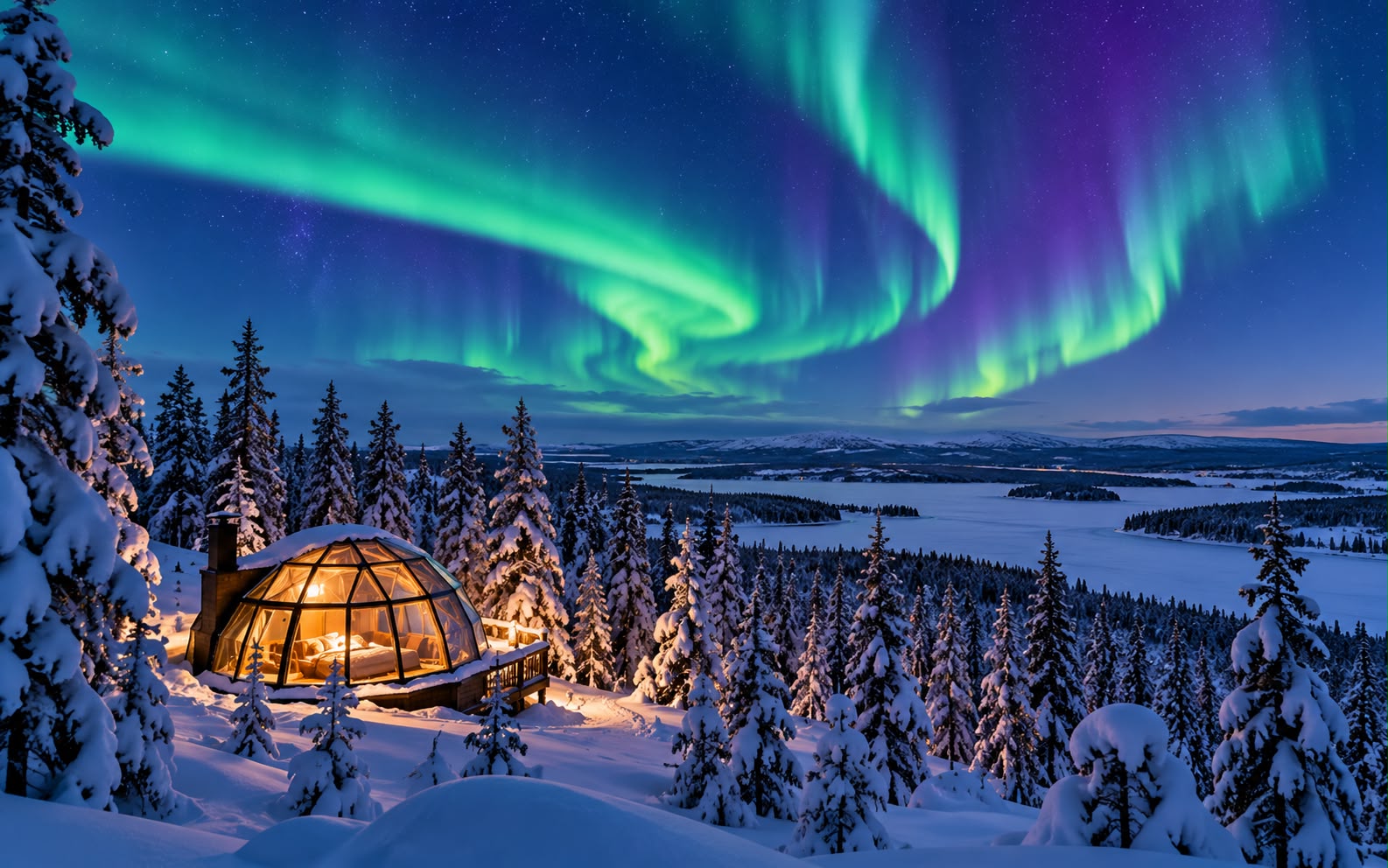
Lapland in 10 days: Rovaniemi, the aurora, Tromsø and the Icehotel
Finland for the glass igloos and the huskies, Norway for the fjord under the aurora oval, Sweden for a hotel rebuilt out of river ice every December — three countries that share one Arctic and sell it quite differently.
- Northern Europe
- 10 days
- ≈ AED 13,500 / person
- The three Lapplands in one winter, and four separate chances at the lights
Before you go
Before you go: the admin
One visa, three countries, invisible borders
- All three are in Schengen, so one visa and no checks between them — the Finland to Norway road crossing is a sign.
- None of the three uses the same currency. Finland is in the eurozone; Sweden uses the krona and Norway the krone.
- Norway is outside the EU customs union, so duty-free limits apply crossing from Finland or Sweden, and the alcohol allowance is the one people hit.
Getting round
- Fly into Rovaniemi and out of Kiruna, or reverse. Both have direct or one-stop connections from the major hubs.
- The legs are long and mostly by road. Rovaniemi to Saariselkä is three and a half hours; Saariselkä to Tromsø about six, crossing into Norway; Tromsø to Abisko four to five.
- The Narvik–Kiruna railway runs through Abisko and is the civilised way to do that leg — it is the Ofoten line, built for iron ore, and it crosses the treeline.
- Winter driving here needs studded tyres and experience. Hire cars come fitted; if you have not driven on packed snow and ice in the dark, take the buses and trains instead.
Money
- Three currencies and all three are near-cashless. Cards work everywhere including buses and huskies.
- Norway is the most expensive of the three by a clear margin, Finland the least.
- Buy duty-free alcohol on arrival in Norway — Vinmonopolet is the only other source, it shuts early and all day Sunday.
The aurora, honestly
- It needs darkness, a clear sky and solar activity, in that order of reliability.
- All three stops on this route sit under the auroral oval, which is the point of doing three rather than one: four or five nights across three countries beats three nights in one place, because the weather moves and the forecast does not.
- Abisko has the best odds in Europe. It sits in a rain shadow between mountains and has a documented “blue hole” of clear sky, which is why the Aurora Sky Station is there.
- Nobody can promise you the lights. Operators who do are selling something they cannot deliver.
Day by day
Day 1 — Rovaniemi
- Arrive, and dress for it before anything else. Thermal base layers, a proper outer shell and real boots — the tour operators lend snowsuits, and that is not the same as being warm walking round a town at minus 25°C.
- 14:00 — Rovaniemi sits on the Arctic Circle and leans into it — the Santa Claus Village is on the line, open year-round, and is either charming or a lot depending on your company.
- 17:00 — Arktikum is the serious counterweight: a genuinely good museum of the Arctic and of Sámi history, built half underground with a glass tunnel.
- 20:00 — The aurora, if the forecast is up. Get out of the town lights; the hotels run shuttles.
Day 2 — Huskies and reindeer
- 09:00 — A husky farm — a few hours driving a team yourself rather than riding as a passenger. Ask about the dogs’ rest and retirement before booking; the good kennels talk about it unprompted.
- 13:00 — Reindeer sledging with a Sámi herder, which is slower and quieter and comes with the better conversation — and the herder will tell you what the winter has actually been like.
- 16:00 — The light goes early. In December there are about four usable hours and the “day” is a long blue twilight.
- 19:00 — A smoke sauna, which is the Finnish answer to all of this.
Day 3 — Snow, ice, and the lake
- 09:30 — A snowmobile safari, which needs a driving licence and a briefing that is worth listening to.
- 13:00 — An ice-fishing afternoon on a frozen lake, which is an hour of drilling and three of sitting, and that is the point.
- 16:00 — Back to Rovaniemi, and the Korundi art museum if the weather closes in.
- The aurora forecast runs on a KP index — the hotels post it, and anything above KP3 this far north is worth going out for.
Day 4 — North to Saariselkä and Inari
- 09:00 — Three and a half hours north, past the treeline thinning.
- 13:00 — Inari and Siida, the Sámi museum and nature centre, which is the best account of Sámi life anywhere and should be the first thing you do in Lapland rather than the last.
- The Sámi are three countries’ indigenous people and this route crosses all three of their homelands. Siida explains the reindeer herding, the languages and the history of assimilation properly.
- 17:00 — A glass igloo or an aurora cabin at Saariselkä or Kakslauttanen — a glass roof over the bed so you can watch from under a duvet. It is the most photographed accommodation in Europe and it books out six months ahead.
- 22:00 — Watch from the bed, which is the whole proposition.
Day 5 — Across to Tromsø
- 08:00 — Six hours north-west, crossing into Norway and dropping to the coast.
- Norway is not in the EU and the currency changes, though cards work everywhere.
- 15:00 — Tromsø is at 69°N, inside the Arctic Circle, and is a proper small city — a university, bars, and the Arctic Cathedral across the bridge.
- 17:00 — The Fjellheisen cable car for the city under the mountains, and the aurora from the top on a clear night.
- 20:00 — Dinner in the centre, which after four days of lodge food is a relief.
Day 6 — Whales, and the polar night
- 07:00 — A whale safari from November to January, when humpbacks and orca follow the herring into the fjords north of the city. It is a long cold day on the water; the boats lend suits.
- The sun does not rise in Tromsø from late November to mid-January, which is an experience rather than a problem — the light at midday is blue and extraordinary.
- 14:00 — The Polar Museum for Amundsen and Nansen, and the hunting history that is harder to read.
- 16:30 — Polaria and the bearded seals, or the Perspektivet museum.
- 21:00 — An aurora chase by minibus, which goes wherever the cloud is not — sometimes as far as Finland.
Day 7 — Abisko
- 09:00 — Four to five hours by road, or the Narvik train, which is the better option and runs through the mountains.
- 14:00 — Abisko is the best aurora site in Europe — a mountain rain shadow produces a persistent clear patch, and the Aurora Sky Station is a chairlift ride up into it.
- 16:00 — The Lapporten, a U-shaped glacial valley that frames the horizon and is the symbol of Swedish Lapland.
- 21:00 — Up to the Sky Station, which is a cold twenty-minute chairlift and there is a warming hut at the top.
Day 8 — Abisko, and the odds
- 10:00 — Abisko National Park is the start of the Kungsleden, the King’s Trail, and in winter it is ski-touring and snowshoe country.
- 13:00 — A snowshoe walk to the canyon, which is short and the best way into the park without skis.
- Two nights here is deliberate. This is where the odds are best and one night is a coin toss.
- 21:00 — The second night at the Sky Station if the first was clouded, which is exactly what the second night is for.
Day 9 — Kiruna and Jukkasjärvi
- 10:00 — An hour and a half east.
- 12:00 — Kiruna is being physically moved, building by building, because the iron mine beneath it is undermining the town. The church was relocated whole. It is the strangest civic project in Europe and worth an hour.
- 15:00 — The Icehotel at Jukkasjärvi is rebuilt every winter from ice harvested out of the Torne river, with artist-designed suites that melt in spring. There is also a year-round section kept frozen by solar power in summer, which is a good joke at the Arctic’s expense.
- 22:00 — You sleep at minus 5°C in a thermal bag on a reindeer hide, with a warm building for everything else. One night is plenty and most people book one ice night and one warm.
Day 10 — Fly out of Kiruna
- 09:00 — The mine tour if there is time, 540m underground — it runs from the tourist office and must be booked, not walked up to.
- 13:00 — Kiruna’s airport is ten minutes out.
- Leave margin. Arctic flights are delayed for weather and the connections south are limited — there are only a handful a day and missing one can cost you the night.
Costs and practicalities
Best time to visit
December to March, and the sub-seasons matter more than most places.
- Late September–October — aurora season opens and the nights are dark enough, but there is no snow yet and the husky and snowmobile programmes have not started.
- December — deep polar night, Christmas in Rovaniemi at its most frantic, and the Icehotel opens in mid-December. Very little daylight: Tromsø’s sun does not rise from late November to mid-January.
- January — the coldest, often minus 25°C and colder inland. Reliable snow, the clearest air, and the fewest visitors between New Year and the February school holidays.
- February–mid-March — the best of the season. Full snow cover, the days lengthening fast so you get daylight activities and dark nights, and the aurora still strong. The Jokkmokk winter market in early February is the great Sámi gathering, running since 1605.
- April onwards — the Icehotel’s winter sections melt, the lights season ends, and the snow goes. This itinerary does not exist in summer; Lapland then is midnight sun, hiking and mosquitoes, which is a different trip.
Travel tips
- Book the glass igloos and the Icehotel six months ahead. Both sell out, and the Icehotel’s art suites go first.
- Give yourself four or five aurora nights across the three stops. The weather moves and the forecast does not; spreading the nights is the single best thing you can do for your odds.
- Dress for minus 25°C properly — thermal base layer, fleece, down, windproof shell, mittens not gloves, a hat covering the ears, and boots rated for cold. Most operators lend thermal suits and boots and it is worth taking them up on it.
- Camera batteries die fast in the cold. Carry spares inside your jacket, and let the lens warm up slowly in a bag indoors or it will fog and then freeze.
- Buy duty-free on arrival in Norway. It is the most expensive of the three and Vinmonopolet’s hours are short.
- Ask husky operators about rest and retirement. The good ones answer without being pushed.
- Visit Siida early. Understanding Sámi reindeer herding before you ride on a sled changes the rest of the trip.
What this trip actually costs
Two people, 9 nights, mid-range comfort including one glass igloo and one ice night, international flights excluded:
| Item | Cost |
|---|---|
| Accommodation, 9 nights | EUR 3,200 (≈ AED 13,103) |
| Huskies, reindeer, snowmobile and aurora chases | EUR 1,400 (≈ AED 5,732) |
| Food and drink, 10 days | EUR 900 (≈ AED 3,685) |
| Transfers, trains and the Tromsø leg | EUR 900 (≈ AED 3,685) |
| Thermal clothing hire | EUR 200 (≈ AED 819) |
| Total for two | EUR 6,600 (≈ AED 27,024) |
- Roughly EUR 3,300 (≈ AED 13,512) per person. The specialist accommodation is most of it — a glass igloo and an Icehotel night together can be a third of the total.
- Dropping both and staying in ordinary cabins saves close to €1,000 for two and costs you the two things people book this trip for.
- Norway is the expensive leg for food and drink by a wide margin.
- Hotel picks here are chosen on location, not on commission — always check prices and recent reviews before booking.
What to pack
- Thermal base layers, several. Merino, not cotton.
- Mittens, not gloves, and liner gloves underneath for camera work.
- A hat that covers the ears and a neck gaiter.
- Boots rated for minus 25°C if you have them; the operators lend them if you do not.
- Spare camera batteries, kept warm, and a bag to warm the lens in slowly indoors.
- Sunglasses. Snow glare in February and March is severe even at low sun angles.
- A head torch and lip balm. The dry cold cracks everything.
FAQ
Will I see the northern lights? Probably, over four or five nights across three countries — which is why this route has three stops rather than one. Nobody can promise them, and an operator who does is selling something they cannot deliver.
Which country has the best odds? Abisko in Sweden, by a clear margin — it sits in a mountain rain shadow with a documented persistent clear patch, which is why the Aurora Sky Station is there.
Is the Icehotel worth a night? One night, yes. You sleep at minus 5°C in a thermal bag on a reindeer hide and it is an experience rather than a rest. Book one ice night and one warm; almost everyone does.
How cold is it really? Minus 15°C to minus 25°C inland in January, colder on a still night. Tromsø on the coast is milder and wetter. With the right clothing it is entirely manageable; without it, it is not.
Can I do this in summer? Not this trip. Summer Lapland is midnight sun, hiking and mosquitoes — good, and nothing to do with huskies, ice hotels or the aurora.
Prices and entry rules change, and what you need depends on your passport; last checked 29 October 2026, so confirm with the embassy or your airline before booking.


