 The Itinerary
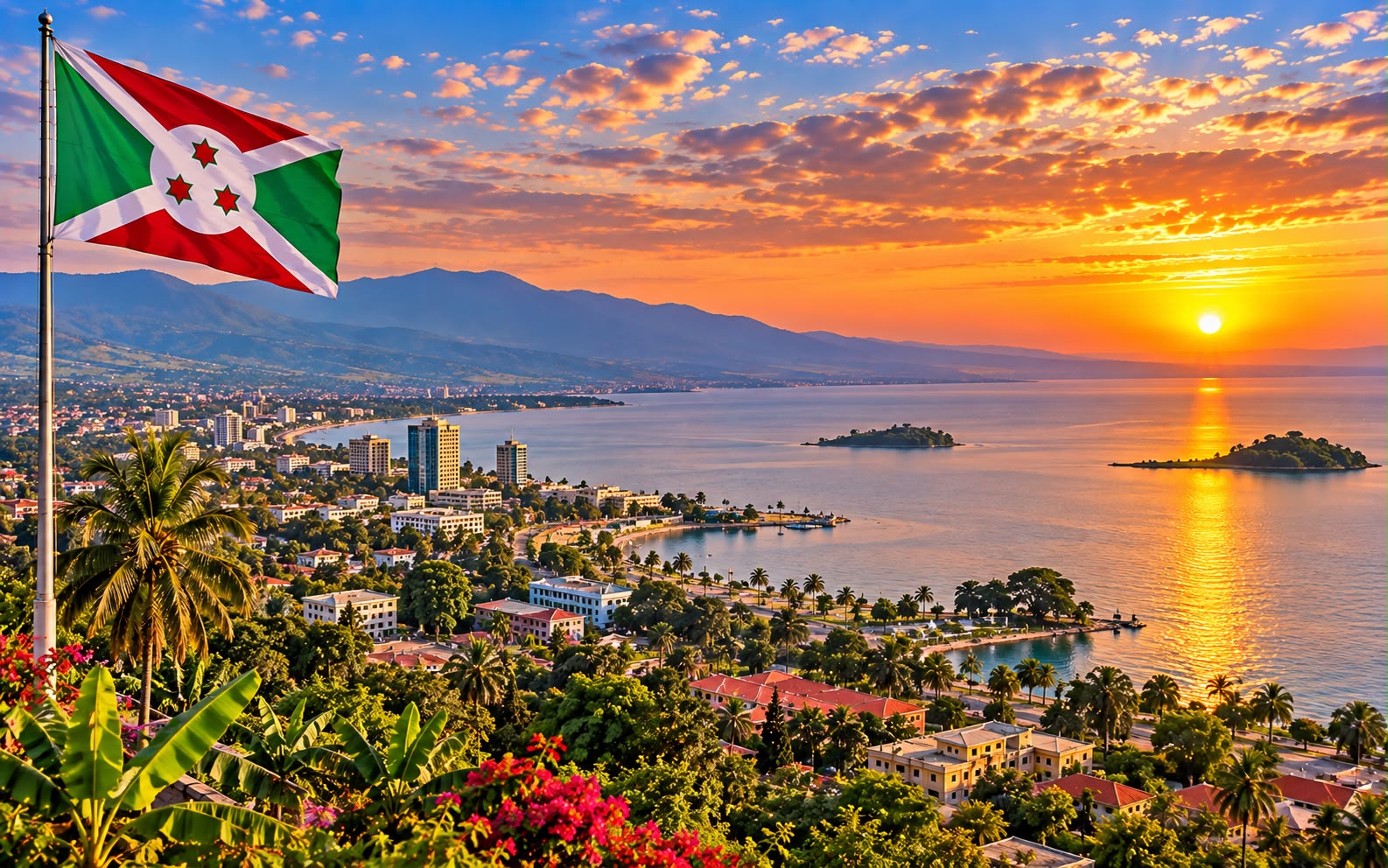
Burundi in 5 days: Lake Tanganyika, the royal drummers and the Kibira forest
A sand beach on a lake two kilometres deep, a sanctuary where the royal drummers perform a ritual that UNESCO protects, montane rainforest holding chimpanzees, and a disputed claim to the Nile's southernmost source — in one of the least visited countries in Africa.
- East Africa
- 5 days
- ≈ AED 2,000 / person
- Drummers on UNESCO's list, and a beach on the world's second-deepest lake
Before you go
Burundi is small, green, mountainous and very rarely visited. It is also one of the poorest countries in the world, and the practical and political realities of that shape a trip here more than the sights do — so those come first below.
What is here is genuinely worth the effort.
The royal drummers of Burundi are the thing the country is known for among people who know it at all. The ritual dance of the royal drum is on UNESCO’s intangible heritage list: drums carved from a single trunk, carried on the head in procession, played standing in a semicircle around a central drum, with the drummers rotating through the middle. At Gishora, on a hill outside Gitega, the sanctuary has kept the tradition and performs it where it was always performed.
Lake Tanganyika is the second-deepest lake on earth and holds an enormous share of the world’s unfrozen fresh water. Bujumbura sits at its head, and the beaches south of the city are proper white sand with mountains across the water in the Congo.
Kibira National Park is montane rainforest along the ridge of the Congo-Nile divide, continuous with Rwanda’s Nyungwe, holding chimpanzees and a great many birds.
Five days is right for a first visit. Figure USD 550 (≈ AED 2,020) per person excluding flights. Go June–September, the long dry season.
Before you go: the 15-minute admin
Current advice, read it first
- Several governments advise against all but essential travel to Burundi, and some against all travel to the provinces bordering the Democratic Republic of the Congo. This has been the position, on and off, for years.
- Read your own government’s current advice before you book, and again before you fly. This is not boilerplate here; it is the deciding factor for most people.
- Check your insurance. Cover is commonly void where your government advises against travel — sometimes for the whole trip, not just that area.
- The western border areas are the ones normally named. Bujumbura, Gitega and the route between them are not usually in that category, but the position moves.
- Avoid political gatherings and demonstrations entirely, and do not discuss domestic politics with people who could be put at risk by the conversation.
Visas
- An e-visa is applied for online in advance, and a visa on arrival has also been available at Bujumbura airport. Requirements change; use the official immigration portal and do not rely on a forum post.
- Yellow fever vaccination is required and the certificate is checked.
- Carry printed copies of your visa approval and hotel bookings. Officials ask for paper.
Money
- The Burundian franc (BIF). Bring US dollars in cash — clean, recent notes, as worn ones are refused.
- This is a cash economy. Foreign cards are accepted at a handful of Bujumbura hotels and nowhere else, and ATMs are unreliable for foreign cards.
- There is an official rate and a parallel rate, and the difference is substantial. Arrange changing through your hotel or guide rather than on the street.
- Costs are low once you are in the country; the flights are the expensive part of reaching it.
SIM and data
- Lumitel and Econet sell SIMs; bring your passport. Data is cheap.
- Coverage is reasonable in Bujumbura and Gitega and patchy in the hills.
Getting around
- Hire a 4WD with a driver and guide. Around $110–130 a day. Roads between the main towns are sealed and reasonable; everything else is not, and a local who knows the current state of things is worth more than the map.
- Bujumbura to Gitega is about two hours on a good road, climbing the whole way.
- Do not drive at night outside the towns.
- Expect checkpoints. Carry your passport and your vaccination certificate.
Photography and officials
- Do not photograph government buildings, the airport, bridges, police or military. This is taken seriously and is the most common way a visitor gets into trouble.
- Ask before photographing people, always.
Travelling with kids?
- Short distances and a lake beach make the logistics easy.
- Medical facilities are very limited. Insurance with evacuation cover is essential, and malaria prophylaxis is not optional.
- Lake Tanganyika has hippos and crocodiles. Swim only at the managed beaches where it is said to be safe, and not at dawn or dusk.
Day by day
Day 1 — Bujumbura and the lake
- Afternoon — Arrive at Bujumbura, 15 minutes from the city.
- 15:00 — The Musée Vivant, a small open-air museum with a reconstructed royal compound, and the Burundi Geological Museum if it is open.
- 17:00 — Out to Saga Beach on the lake shore south of town — white sand, bars, and the mountains of the DRC across the water. Swim where the locals swim and nowhere else.
- 19:00 — Dinner by the lake. The fish, mukeke, is the local speciality and is excellent.
Where to stay in Bujumbura (three nights across the trip)
- Mid-range: the lakeside strip, or the Rohero district in town.
- Value: guesthouses in Kiriri, up the hill, cooler at night.
Day 2 — Rusizi, and the southernmost source of the Nile
- 08:00 — Rusizi National Park, twenty minutes north where the Rusizi river enters the lake. A delta sector for hippos and birds, and a palm sector of borassus palms. The park’s most famous resident was a very large crocodile of local legend; the hippos are the reliable sighting.
- 12:00 — Back for lunch.
- 14:00 — South-east to the Kasumo / Rutovu monument, about two and a half hours: a small stone pyramid built in 1938 over a spring claimed as the southernmost source of the Nile. The claim is contested — Rwanda makes a rival one — and that is part of the appeal. The drive through the hills is the other part.
- Evening — Back to Bujumbura, or push on to Gitega.
Day 3 — Gitega and the drummers at Gishora
- 08:00 — Up to Gitega, the political capital since 2019, about two hours.
- 10:00 — The National Museum of Gitega, which holds the royal regalia, the drums and the ethnographic collection.
- 12:00 — Gishora Drum Sanctuary, on a hill a few kilometres out. Two sacred drums are kept in a hut here, and the drummers perform in the compound beside it. This is the ritual dance of the royal drum that UNESCO lists: drums carried in on the head, a semicircle around the central Ruciteme and Murimirwa, and dancers rotating into the middle to play and leap. Arrange it in advance through your guide — it is not continuous, and turning up unannounced may get you a hut and no drumming.
- 15:00 — Lunch in Gitega, then the basket weavers of the surrounding hills if there is time.
- Night in Gitega.
Day 4 — Karera Falls, or the Kibira forest
Either — the south-east:
- 08:00 — Karera Falls near Rutana, a set of four falls in a patch of forest, and the Nyakazu Fault (the “German Rift”) nearby, a cleft in the escarpment with a long view east over the Rusizi plain.
Or — the north-west, the better option if wildlife matters more than waterfalls:
- 07:00 — Kibira National Park, montane rainforest running along the Congo-Nile divide and continuous with Nyungwe across the Rwandan border. Chimpanzees live here along with black-and-white colobus and a long bird list. Tracking is far less developed than in Rwanda or Uganda — sightings are not reliable and the trails are rough. Go for the forest and treat the chimpanzees as a bonus.
- 16:00 — Down through the tea estates of Teza.
Day 5 — Bujumbura, and out
- Morning — The central market area and the craft cooperatives for basketry, which is the thing to take home — tightly coiled agaseke baskets with their conical lids.
- Midday — A last hour on the lake, then the airport.
Costs and practicalities
Best time to visit
June–September, the long dry season, which is also the most reliable window for the roads into the Kibira forest and up to the Nile source.
- June–September — dry, warm days and cool nights at Bujumbura’s altitude. The best months for chimp tracking in Kibira.
- October–December — the short rains. Green, with afternoon storms.
- January–February — a short dry spell, usually reliable.
- March–May — the long rains and the hardest time to travel; secondary roads become difficult and the Rusizi floodplain is wet.
Lake Tanganyika stays warm all year and the beaches south of Bujumbura are swimmable in any month, hippos and crocodiles notwithstanding — swim only where locals do.
Travel tips
- Check current advice before committing. Burundi has been politically volatile and the eastern DRC border carries additional warnings.
- Bring US dollars in cash, clean and recent. The official and street rates for the Burundian franc have diverged sharply at times; change through your hotel or a bank.
- Cards are essentially unusable outside one or two Bujumbura hotels.
- French and Kirundi are the working languages. Very little English outside the capital.
- Photography of government buildings, the airport, the port and anyone in uniform is prohibited and enforced.
- A yellow fever certificate is required. Malaria is year-round and the risk is high.
- Lake Tanganyika has hippos and crocodiles. The hotel beaches south of Bujumbura are netted or patrolled; elsewhere, ask.
What this trip actually costs
Two people, 4 nights, mid-range comfort, flights excluded:
| Item | Cost |
|---|---|
| Hotels, 4 nights | USD 320 (≈ AED 1,175) |
| 4WD with driver and guide, 4 days | USD 480 (≈ AED 1,763) |
| Food and drink, 5 days | USD 150 (≈ AED 551) |
| Park fees, drummers, museums | USD 150 (≈ AED 551) |
| Total for two | USD 1,100 (≈ AED 4,040) |
- Roughly USD 550 (≈ AED 2,020) per person on the ground. The flights are what make Burundi expensive — there are few of them and they are not cheap.
- The drum performance is arranged and paid for in advance through your guide. Agree the figure before you go.
- Bring all of it in cash. There is no reliable way to draw money here on a foreign card.
- Combining with Rwanda cuts the flight cost substantially — Kigali is a few hours by road and far better connected.
- Hotel picks here are chosen on location, not on commission — always check prices and recent reviews before booking.
What to pack
- US dollars in cash, clean and recent, enough for the whole trip.
- Yellow fever certificate and malaria prophylaxis.
- A warm layer — Gitega is at 1,500 metres and Kibira higher, and the nights are cold even though Bujumbura is hot.
- Waterproof and boots if you are going into Kibira.
- A basic first-aid kit and any medication you need; pharmacies are limited.
FAQ
Is Burundi safe to visit? Several governments advise against all but essential travel, and that is the honest starting point. Visitors who do go generally report calm, friendly and uneventful trips in Bujumbura and Gitega. Read your own government’s current advice, check your insurance, and make the decision deliberately.
Can I see the royal drummers without a special trip? Gishora is the place, and performances are arranged rather than scheduled. Your guide books it. Groups also perform at national events and occasionally in Bujumbura.
Is chimpanzee tracking here like Rwanda or Uganda? No. Kibira has chimpanzees but very little tourism infrastructure, no habituated groups to speak of, and no guarantee of a sighting. Go for the forest itself.
How do I get there? Flights into Bujumbura via Nairobi, Addis Ababa, Kigali or Doha. Overland from Rwanda is common and the border is straightforward.
What language do they speak? Kirundi and French, with English increasingly used. French is what you will need.
Prices and entry rules change, and what you need depends on your passport; last checked 8 October 2026, so confirm with the embassy or your airline before booking.


